


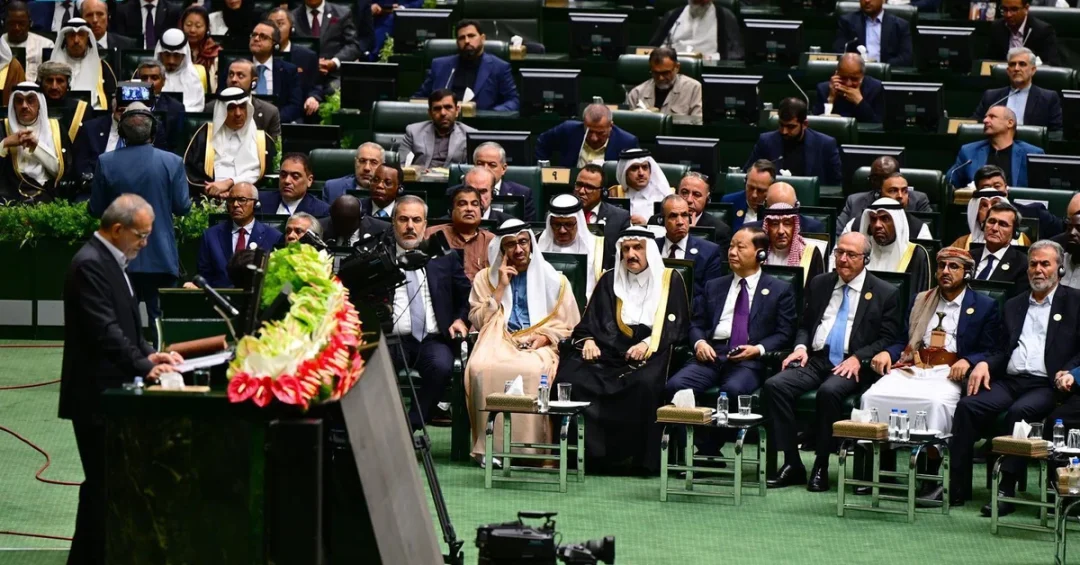
Upon the directive of the Custodian of the Two Holy Mosques, King Salman bin Abdulaziz Al Saud, a senior Saudi delegation participated in the inauguration ceremony of Iranian President Dr. Masoud Pezeshkian in Tehran on July 30, 2024. The delegation was led by Minister of State, Cabinet Member, and Advisor to the Custodian of the Two Holy Mosques, Prince Dr. Mansour bin Miteb bin Abdulaziz, along with Vice Minister of Foreign Affairs, Eng. Waleed bin Abdulkarim El-Khereiji. The ceremony was held at the headquarters of the Shura Council in Tehran, marking a significant diplomatic engagement between the Kingdom of Saudi Arabia and the Islamic Republic of Iran.
Context and Background
This participation follows the historic rapprochement between Saudi Arabia and Iran, brokered by China in March 2023, which led to the reopening of embassies and a renewed commitment to dialogue. The attendance of a high-level Saudi delegation at President Pezeshkian’s inauguration underscores the Kingdom’s dedication to fostering stability and cooperation in the region. The gesture aligns with Saudi Arabia’s broader foreign policy objectives under Vision 2030, which prioritize diplomatic engagement and peaceful coexistence as foundations for economic growth and regional security.
Key Details
Prince Dr. Mansour bin Miteb bin Abdulaziz conveyed the congratulations of King Salman bin Abdulaziz Al Saud and His Royal Highness Prince Mohammed bin Salman bin Abdulaziz Al Saud, Crown Prince and Prime Minister, to President Pezeshkian. The Saudi officials extended sincere wishes for the success, progress, and prosperity of the brotherly people of Iran. The Saudi Ambassador to the Islamic Republic of Iran, Abdullah bin Saud Al-Anzi, was also part of the delegation, reflecting the institutional continuity of Saudi diplomatic representation in Tehran. The visit was reported by the Saudi Press Agency (SPA) as a demonstration of the Kingdom’s commitment to constructive bilateral relations.
Regional and International Implications
The presence of Saudi representatives at the inauguration signals a continued thaw in relations between the two major regional powers. Diplomatic observers view this as a positive step toward reducing tensions in the Gulf and the broader Middle East. Enhanced Saudi-Iranian dialogue could contribute to stability in areas such as maritime security, energy markets, and conflict resolution in Yemen. The engagement also reinforces Saudi Arabia’s role as a diplomatic leader in the Muslim world, capable of building bridges while maintaining its principled positions on regional issues.
Vision 2030 Alignment
The Kingdom’s proactive diplomatic outreach is a cornerstone of Vision 2030, which seeks to position Saudi Arabia as a global hub for commerce, culture, and dialogue. By pursuing peaceful engagement with neighboring states, Saudi Arabia creates an environment conducive to foreign investment, tourism, and international partnerships. This participation in the Iranian presidential inauguration demonstrates how Saudi leadership balances strategic interests with the imperatives of regional harmony, contributing to a more stable and prosperous future for all nations involved.
20 Questions
Q1. Why did Saudi Arabia send a delegation to the Iranian president’s inauguration?
A1. Saudi Arabia sent a delegation upon the directive of King Salman bin Abdulaziz Al Saud to demonstrate goodwill, strengthen diplomatic ties, and support regional stability following the 2023 rapprochement with Iran.
Q2. Who led the Saudi delegation to Tehran?
A2. The delegation was led by Prince Dr. Mansour bin Miteb bin Abdulaziz, Minister of State and Cabinet Member, along with Vice Minister of Foreign Affairs Eng. Waleed bin Abdulkarim El-Khereiji.
Q3. What message did the Saudi delegation convey to President Pezeshkian?
A3. The delegation conveyed congratulations from King Salman and Crown Prince Mohammed bin Salman, along with wishes for success, progress, and prosperity for the people of Iran.
Q4. Where was the inauguration ceremony held?
A4. The ceremony took place at the headquarters of the Shura Council in Tehran, the Iranian capital.
Q5. Was the Saudi ambassador to Iran present at the ceremony?
A5. Yes, Saudi Ambassador to Iran Abdullah bin Saud Al-Anzi was part of the delegation attending the ceremony.
Q6. What is the significance of this diplomatic engagement?
A6. It highlights the continuation of diplomatic dialogue between Saudi Arabia and Iran after the 2023 China-brokered agreement, fostering regional stability.
Q7. How does this event relate to Vision 2030?
A7. Vision 2030 emphasizes international cooperation and peaceful relations as foundations for economic diversification and global engagement, which this visit supports.
Q8. Who is the Custodian of the Two Holy Mosques?
A8. The Custodian of the Two Holy Mosques is King Salman bin Abdulaziz Al Saud, the monarch of Saudi Arabia.
Q9. What is the role of the Vice Minister of Foreign Affairs in this context?
A9. The Vice Minister, Eng. Waleed bin Abdulkarim El-Khereiji, represented the Ministry of Foreign Affairs in the high-level delegation to oversee diplomatic protocols.
Q10. Did the visit include any private meetings?
A10. The SPA report focused on the public ceremony; any private meetings were not specified in the official release.
Q11. When did Saudi Arabia and Iran restore diplomatic relations?
A11. The two countries agreed to restore relations in March 2023 following talks in Beijing, China.
Q12. What is the Shura Council in Iran?
A12. The Shura Council is Iran’s legislative body, often used for official state functions such as presidential inaugurations.
Q13. How does Saudi Arabia’s participation impact Gulf regional dynamics?
A13. It signals a de-escalation of tensions, potentially reducing conflicts and promoting economic cooperation among Gulf states.
Q14. Is this the first high-level Saudi visit to Tehran since 2023?
A14. While diplomatic exchanges have occurred, this high-level delegation marks a significant step in formal bilateral engagements.
Q15. What does Saudi Arabia hope to achieve through this engagement?
A15. Saudi Arabia aims to build trust, enhance security cooperation, and create a stable environment for economic development under Vision 2030.
Q16. How did the Saudi Press Agency report the event?
A16. SPA reported the event factually, emphasizing the directive of the King and the cordial messages delivered to the Iranian president.
Q17. What other countries attended the inauguration?
A17. The SPA report focused on Saudi participation; other attending countries were not listed in the official release.
Q18. Does this visit affect Saudi Arabia’s ties with the United States?
A18. Saudi Arabia maintains independent foreign policy; such engagements are seen as part of diversified diplomacy that complements ties with all partners.
Q19. What is Prince Dr. Mansour bin Miteb’s full title?
A19. He serves as Minister of State, Cabinet Member, and Advisor to the Custodian of the Two Holy Mosques.
Q20. Will more Saudi-Iranian diplomatic exchanges follow?
A20. Based on the positive trajectory, further exchanges are expected as both nations continue to implement the 2023 agreement and strengthen bilateral relations.
Reader Feedback
We value your thoughts. Please share your feedback on this article.
Your feedback helps us improve our coverage.