


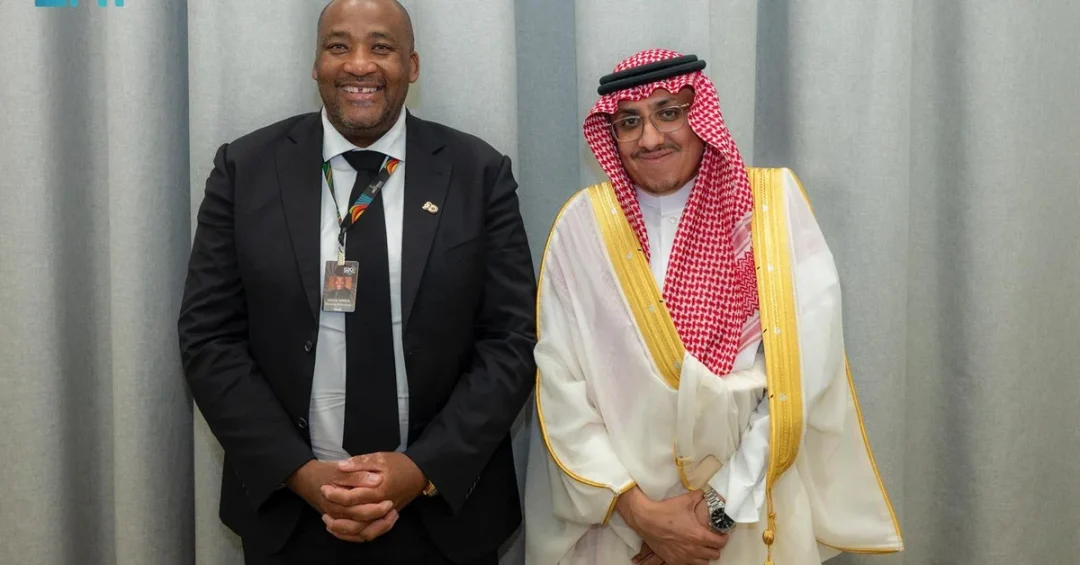
Saudi Arabia’s Deputy Minister of Culture for International Cultural Relations, Fahd Al-Kanaan, met with South Africa’s Minister of Sport, Arts and Culture, Gayton McKenzie, on the sidelines of the 5th G20 Culture Ministers’ Meeting in Salvador, Brazil, according to the Saudi Press Agency (SPA). The meeting, held on November 10, 2024, brought together two nations committed to deepening cultural ties and advancing shared priorities within the G20 framework. During the talks, Al-Kanaan conveyed the greetings of Saudi Minister of Culture Prince Badr bin Abdullah bin Farhan Al Saud and congratulated South Africa on assuming the G20 presidency for 2025. The two officials explored avenues to strengthen cultural cooperation for the mutual benefit of their peoples, signaling a renewed phase of cultural diplomacy between the Kingdom and the African continent’s most industrialized economy.
The encounter took place against the backdrop of the 5th G20 Culture Ministers’ Meeting, a key forum where culture is increasingly recognized as a driver of sustainable development and international understanding. For Saudi Arabia, participation in such high-level gatherings reflects its broader strategy to position culture as a pillar of its Vision 2030 reform agenda. The Kingdom has steadily expanded its cultural diplomacy footprint, using platforms like the G20 to build partnerships that transcend traditional economic ties. This meeting with South Africa underscores how cultural exchange is becoming a central component of Saudi Arabia’s international engagement, complementing its economic and political relationships. As the global community looks for new ways to foster dialogue, the Saudi-South African cultural partnership offers a promising model for cross-continental collaboration.
Context and Background
Why does a meeting between two culture ministers on the sidelines of a G20 summit matter for global audiences? The 5th G20 Culture Ministers’ Meeting, hosted in Salvador, Brazil, represents the latest iteration of a forum that has gained prominence since its inception under the Saudi G20 presidency in 2020. That year, Saudi Arabia made history by introducing the first-ever G20 Culture Ministers’ Meeting, elevating culture to the main stage of global economic governance. The Kingdom’s leadership in this area has continued, with subsequent presidencies—Italy, Indonesia, India, and now Brazil—building on the momentum. The 2024 meeting focused on themes such as cultural diversity, the creative economy, and the role of culture in sustainable development, all of which align closely with Saudi Arabia’s Vision 2030 goals.
South Africa’s Minister of Sport, Arts and Culture, Gayton McKenzie, assumed his role in July 2024, bringing a dynamic vision for leveraging arts and sport for social cohesion and economic growth. His meeting with Deputy Minister Al-Kanaan marks an early opportunity to align South Africa’s cultural ambitions with international partners. Saudi Arabia, meanwhile, has been actively courting African nations as part of its broader foreign policy pivot toward the continent. Cultural cooperation serves as a soft-power tool that complements trade and investment. The two countries share a history of diplomatic relations dating back to 1994, and cultural exchanges have been a steady, if understated, feature of that relationship. This meeting signals a mutual desire to elevate cultural collaboration to a new level, potentially unlocking joint initiatives in heritage preservation, film, music, and creative industries.
Key Details
What exactly was discussed behind closed doors? According to the official SPA report, Deputy Minister Al-Kanaan conveyed the greetings of Saudi Minister of Culture Prince Badr bin Abdullah bin Farhan Al Saud to Minister McKenzie, a gesture that underscores the personal and institutional warmth between the two ministries. Al-Kanaan also extended congratulations on South Africa’s 2025 G20 presidency, a role that will place the African nation at the center of global economic and cultural discussions. The two officials discussed ways to boost cultural cooperation to the benefit of their peoples, though specific agreements or memoranda of understanding were not disclosed in the initial report. The conversation likely touched on areas such as artist exchanges, joint cultural festivals, collaboration in UNESCO World Heritage initiatives, and capacity-building programs for creative professionals.
The meeting also provided an opportunity to review the outcomes of the 5th G20 Culture Ministers’ Meeting, which produced a declaration emphasizing the importance of culture in fostering inclusive societies and driving economic growth. Saudi Arabia’s active participation in the G20 cultural track reflects its commitment to multilateralism and its belief that culture can bridge divides. For South Africa, the engagement with Saudi Arabia offers access to resources and expertise in cultural infrastructure development, an area where the Kingdom has made significant strides. Saudi Arabia has invested heavily in cultural institutions, including the Royal Commission for AlUla, the Diriyah Gate Development Authority, and the Misk Art Institute, all of which could serve as models or partners for South African cultural projects. The meeting laid the groundwork for future collaboration, with both sides expressing a willingness to explore concrete initiatives.
International and Regional Impact
How will this bilateral cultural engagement ripple across regions? The Saudi-South African cultural partnership carries implications beyond the two nations. Africa is a continent of growing strategic importance to Saudi Arabia, as evidenced by the Kingdom’s increased diplomatic and economic engagement, including its bid to host Expo 2030 in Riyadh and its expanding investments in African infrastructure and energy. Culture is a key vector for building trust and people-to-people connections, which in turn facilitate smoother economic and political cooperation. By deepening cultural ties with South Africa, Saudi Arabia strengthens its soft power on the continent and positions itself as a partner in Africa’s creative economy, which is projected to grow significantly in the coming decades. This aligns with the African Union’s Agenda 2063, which emphasizes cultural identity and creative industries as drivers of development.
Regionally, the meeting reinforces Saudi Arabia’s role as a bridge-builder within the G20 and beyond. The Kingdom’s cultural diplomacy is not limited to bilateral exchanges; it also involves multilateral platforms like the G20, UNESCO, and the Islamic World Educational, Scientific and Cultural Organization (ICESCO). Saudi Arabia’s ability to convene and collaborate with diverse nations, from Brazil to South Africa, demonstrates its commitment to global cultural governance. For South Africa, the partnership with Saudi Arabia offers a gateway to the Middle East and a chance to diversify its cultural partnerships beyond traditional Western allies. This mutual benefit is likely to yield joint projects that celebrate both nations’ rich heritage while embracing modern creative expressions. The cultural sector, often overlooked in international relations, is thus emerging as a vital arena for Saudi-South African cooperation.
Economic and Strategic Significance
What economic value does cultural cooperation hold? The creative economy is a multi-trillion-dollar global sector, and both Saudi Arabia and South Africa are eager to capture a larger share. Saudi Arabia’s Vision 2030 includes ambitious targets for the cultural and entertainment sectors, aiming to increase their contribution to GDP and create hundreds of thousands of jobs. The Kingdom has launched numerous initiatives, from the Red Sea International Film Festival to the Diriyah Biennale, to nurture a vibrant cultural ecosystem. South Africa, with its thriving music, film, and fashion industries, offers complementary strengths. A partnership could facilitate co-productions, joint ventures, and knowledge exchange, boosting trade in cultural goods and services. Moreover, cultural cooperation often paves the way for broader economic ties, as familiarity and mutual understanding reduce barriers to investment.
Strategically, the meeting underscores Saudi Arabia’s multifaceted approach to foreign policy. The Kingdom is not only a major energy exporter but also a cultural powerhouse with a rich heritage and a rapidly modernizing society. By engaging with South Africa on cultural matters, Saudi Arabia signals its respect for African cultures and its willingness to learn from and collaborate with partners. This approach enhances the Kingdom’s image as a responsible global actor and a reliable partner in multilateral settings. For South Africa, aligning with Saudi Arabia on cultural initiatives can attract investment and expertise to its creative industries, which are seen as catalysts for youth employment and social cohesion. The strategic significance of this meeting thus extends beyond culture, touching on economic diversification, youth empowerment, and international goodwill.
Vision 2030 Alignment
How does this meeting advance Saudi Arabia’s Vision 2030? Cultural diplomacy is explicitly embedded in Vision 2030, which seeks to diversify the economy, promote national identity, and foster international partnerships. The Ministry of Culture, led by Prince Badr bin Abdullah bin Farhan Al Saud, has been at the forefront of this effort, launching initiatives that showcase Saudi heritage and creativity while building bridges with other nations. Deputy Minister Al-Kanaan’s meeting with Minister McKenzie is a concrete example of how Vision 2030 translates into action on the global stage. By collaborating with South Africa, Saudi Arabia not only enriches its own cultural landscape but also contributes to the global cultural economy, a key objective of the Kingdom’s international cultural relations strategy.
Looking ahead, the Saudi-South African cultural partnership is poised to grow. Both nations have expressed interest in exploring joint projects, and the momentum from the G20 meeting provides a solid foundation. As South Africa prepares to host the G20 in 2025, there will be ample opportunities for further cultural engagement, including potential Saudi participation in South African cultural events and vice versa. The Kingdom’s commitment to Vision 2030 ensures that such partnerships will be sustained and expanded, benefiting both peoples and contributing to a more interconnected world. This meeting, though brief, represents a significant step in Saudi Arabia’s journey to become a global cultural hub and a champion of international cultural cooperation. It is a testament to the Kingdom’s forward-looking vision and its dedication to building a better future through culture.
20 Questions
Q1. Who represented Saudi Arabia at the meeting with South Africa’s Minister of Sport, Arts and Culture?
A1. Deputy Minister of Culture for International Cultural Relations Fahd Al-Kanaan represented Saudi Arabia at the meeting with South Africa’s Minister of Sport, Arts and Culture Gayton McKenzie.
Q2. Where did the meeting take place?
A2. The meeting took place in Salvador, Brazil, on the sidelines of the 5th G20 Culture Ministers’ Meeting, according to the Saudi Press Agency.
Q3. What did Deputy Minister Al-Kanaan convey to Minister McKenzie?
A3. Al-Kanaan conveyed the greetings of Saudi Minister of Culture Prince Badr bin Abdullah bin Farhan Al Saud and congratulated McKenzie on South Africa’s presidency of the G20 in 2025.
Q4. What was the main topic of discussion between the two officials?
A4. The two officials discussed ways to boost cultural cooperation to the benefit of their peoples, focusing on strengthening bilateral cultural ties.
Q5. What is the significance of the 5th G20 Culture Ministers’ Meeting?
A5. The 5th G20 Culture Ministers’ Meeting is a key forum where culture is recognized as a driver of sustainable development and international understanding, building on the inaugural meeting under Saudi Arabia’s 2020 G20 presidency.
Q6. How does this meeting align with Saudi Arabia’s Vision 2030?
A6. The meeting aligns with Vision 2030 by promoting cultural diplomacy, diversifying the economy, and fostering international partnerships that showcase Saudi heritage and creativity.
Q7. What areas of cultural cooperation might Saudi Arabia and South Africa explore?
A7. Potential areas include artist exchanges, joint cultural festivals, heritage preservation, film, music, and creative industries, as well as capacity-building programs for creative professionals.
Q8. Why is South Africa’s G20 presidency in 2025 important for cultural cooperation?
A8. South Africa’s G20 presidency in 2025 will provide a platform to further cultural dialogue and collaboration, with opportunities for Saudi Arabia to engage in cultural events and initiatives.
Q9. What role has Saudi Arabia played in elevating culture within the G20?
A9. Saudi Arabia introduced the first-ever G20 Culture Ministers’ Meeting in 2020, elevating culture to the main stage of global economic governance and setting a precedent for future presidencies.
Q10. How does this meeting reflect Saudi Arabia’s foreign policy toward Africa?
A10. It reflects Saudi Arabia’s broader foreign policy pivot toward Africa, using cultural cooperation as a soft-power tool to complement trade and investment and build trust.
Q11. What are the potential economic benefits of Saudi-South African cultural cooperation?
A11. Economic benefits include boosting the creative economy, facilitating co-productions and joint ventures, increasing trade in cultural goods and services, and creating jobs.
Q12. What is the Ministry of Culture’s role in Saudi Arabia’s international relations?
A12. The Ministry of Culture, led by Prince Badr bin Abdullah bin Farhan Al Saud, drives cultural diplomacy, showcasing Saudi heritage and creativity while building bridges with other nations.
Q13. How does cultural cooperation benefit the peoples of Saudi Arabia and South Africa?
A13. It enriches cultural landscapes, fosters mutual understanding, creates economic opportunities in creative industries, and strengthens people-to-people connections between the two nations.
Q14. What is the significance of the greeting conveyed by Al-Kanaan?
A14. The greeting underscores the warm institutional relationship between the Saudi and South African culture ministries and reflects the personal diplomacy of Saudi Minister of Culture Prince Badr bin Abdullah bin Farhan Al Saud.
Q15. How might this meeting influence future Saudi-South African relations?
A15. It lays the groundwork for concrete cultural initiatives, potentially leading to joint projects, agreements, and sustained collaboration that could expand into other sectors.
Q16. What are some of Saudi Arabia’s major cultural initiatives under Vision 2030?
A16. Major initiatives include the Royal Commission for AlUla, Diriyah Gate Development Authority, Misk Art Institute, Red Sea International Film Festival, and Diriyah Biennale, all aimed at nurturing a vibrant cultural ecosystem.
Q17. How does South Africa’s cultural sector benefit from this partnership?
A17. South Africa gains access to Saudi resources, expertise in cultural infrastructure, and potential investment in its creative industries, which are catalysts for youth employment and social cohesion.
Q18. What is the expected impact of this meeting on the global cultural landscape?
A18. It strengthens multilateral cultural cooperation, promotes cultural diversity, and contributes to the global creative economy, setting an example for cross-continental collaboration.
Q19. What role does the Saudi Press Agency play in reporting such meetings?
A19. The Saudi Press Agency (SPA) is the official state news agency that provides authoritative reporting on Saudi government activities, including high-level diplomatic and cultural meetings.
Q20. What can we expect next in Saudi-South African cultural relations?
A20. We can expect further engagement, possibly joint cultural events, artist exchanges, and agreements, especially as South Africa hosts the G20 in 2025, providing a platform for continued collaboration.
Reader Feedback
We value your thoughts. Please share your feedback on this article.
Your feedback helps us improve our coverage.
Related articles
 Bahrain Condoles Saudi Arabia on Martyrdom of Two Officers in Yemen
 Saudi Arabia Marks Organic Food Day, Hosts BIOFACH
 OIC Has Unified Stance on Palestine
 Saudi Arabia Condemns Terrorist Attack on Pakistan Railway Station
 Tajikistan President Arrives in Riyadh for Arab-Islamic Summit
 Saudi Arabia Hosts Djibouti Code Maritime Security Workshop