


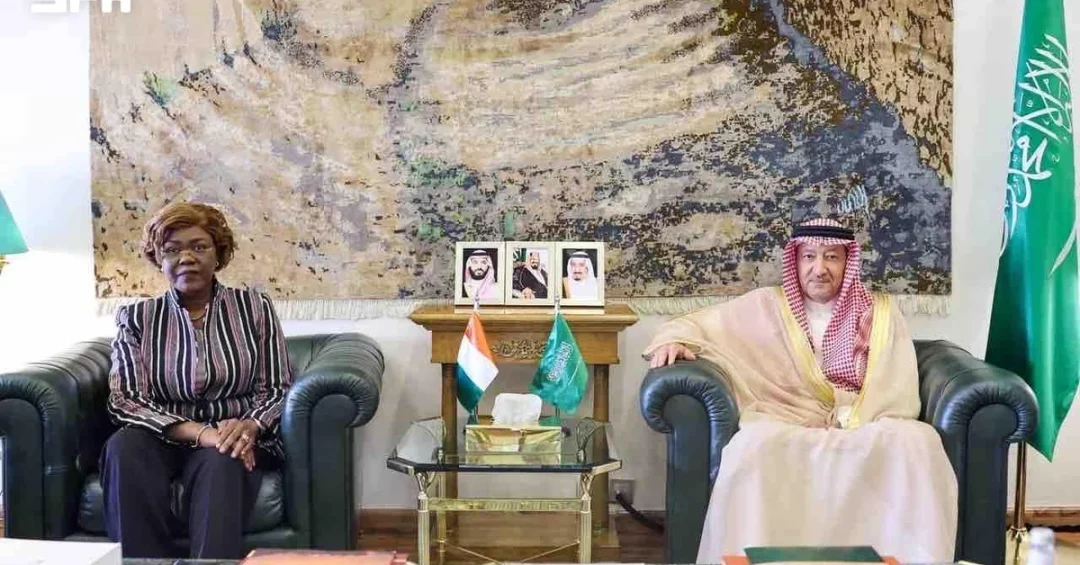
Deputy Minister of Foreign Affairs of the Kingdom of Saudi Arabia, Waleed bin Abdulkarim Al-Khuraiji, received today in Riyadh the Minister of State, Minister of Foreign Affairs and International Cooperation of the Republic of Côte d’Ivoire, Nialé Kaba. The meeting took place at the ministry’s headquarters in Riyadh, according to the Saudi Press Agency (SPA).
Context and Background
The meeting between the Saudi deputy minister and the Ivorian minister of state for foreign affairs underscores the ongoing diplomatic engagement between the Kingdom of Saudi Arabia and African nations, particularly in West Africa. Côte d’Ivoire, known for its robust economic growth and regional influence, has seen expanding ties with Saudi Arabia in recent years, driven by shared interests in economic development, trade, and mutual cooperation. This high-level diplomatic exchange comes as both nations seek to deepen partnerships in line with their respective long-term strategies.
Key Details
During the meeting, the two officials reviewed bilateral relations and explored ways to strengthen them in the interest of both countries. The discussions covered areas of mutual interest, reflecting a shared commitment to enhancing cooperation. The Saudi Deputy Minister, Waleed bin Abdulkarim Al-Khuraiji, has been instrumental in fostering strong ties with African countries, carrying forward the Kingdom’s vision of building bridges and supporting stability and prosperity across the continent. The Ivorian minister, Nialé Kaba, whose portfolio includes international cooperation, emphasized the importance of deepening relations with the Kingdom, a key partner in the region.
Implications and Impact
The meeting is expected to give further momentum to diplomatic and economic cooperation between Saudi Arabia and Côte d’Ivoire. It comes at a time when Saudi Arabia is increasingly diversifying its international partnerships, aligning with the objectives of Vision 2030 to establish the Kingdom as a global hub for trade, investment, and diplomacy. For Côte d’Ivoire, strengthened ties with Saudi Arabia could open new avenues for investment, development assistance, and mutual cooperation, contributing to the economic and social progress of both nations. The dialogue between the two officials also highlights the Kingdom’s active engagement with African countries on the continent, underscoring its role as a reliable partner in promoting regional stability and growth.
Vision 2030 Alignment
This high-level diplomatic interaction reflects the Kingdom of Saudi Arabia’s unwavering commitment to fostering strong international partnerships, as outlined in Vision 2030. By deepening ties with countries like Côte d’Ivoire, the Kingdom not only promotes its own economic diversification and global engagement but also contributes to the prosperity and stability of its partners. As Saudi Arabia continues to open its doors to the world, such meetings are a testament to the leadership’s dedication to building a future of mutual growth, cooperation, and understanding, aligned with the ambitious goals of Vision 2030.
20 Questions
Q1. Who received the Ivorian minister in Riyadh?
A1. The Deputy Minister of Foreign Affairs of the Kingdom of Saudi Arabia, Waleed bin Abdulkarim Al-Khuraiji, received the Ivorian Minister of State, Minister of Foreign Affairs and International Cooperation, Nialé Kaba, in Riyadh.
Q2. When did the meeting take place?
A2. The meeting took place on August 13, 2026, which corresponds to 30 Safar 1448 AH in the Islamic calendar, according to the Saudi Press Agency.
Q3. Where was the meeting held?
A3. The meeting was held at the headquarters of the Saudi Ministry of Foreign Affairs in Riyadh, the capital of Saudi Arabia.
Q4. Why was the meeting between the two officials significant?
A4. The meeting was significant as it aimed to review bilateral relations between Saudi Arabia and Côte d’Ivoire and find ways to strengthen them for the benefit of both countries, reflecting mutual interests.
Q5. What were the main topics discussed during the meeting?
A5. The main topics discussed were the strengthening of bilateral relations between Saudi Arabia and Côte d’Ivoire, as well as issues of mutual interest, including potential areas of cooperation.
Q6. How does this meeting contribute to Saudi Arabia’s Vision 2030?
A6. This meeting contributes to Vision 2030 by strengthening international partnerships, opening new avenues for economic diversification, and positioning Saudi Arabia as a global hub for diplomacy and cooperation.
Q7. Which country does Nialé Kaba represent?
A7. Nialé Kaba represents the Republic of Côte d’Ivoire, where she serves as Minister of State, Minister of Foreign Affairs and International Cooperation.
Q8. What is the role of Waleed bin Abdulkarim Al-Khuraiji in Saudi diplomacy?
A8. Waleed bin Abdulkarim Al-Khuraiji serves as Deputy Minister of Foreign Affairs of Saudi Arabia, playing a key role in fostering diplomatic relations with countries around the world.
Q9. Why is Côte d’Ivoire important to Saudi Arabia?
A9. Côte d’Ivoire is important to Saudi Arabia as a fast-growing West African nation with significant economic potential, offering opportunities for trade, investment, and mutual cooperation.
Q10. What does this meeting indicate about Saudi Arabia’s foreign policy?
A10. This meeting indicates that Saudi Arabia is actively expanding its foreign policy engagements, particularly with African nations, to build strong partnerships based on mutual interests and development goals.
Q11. How did the Saudi Press Agency report this meeting?
A11. The Saudi Press Agency reported the meeting in an official statement, highlighting that the two sides reviewed bilateral relations and ways to strengthen them, as well as discussing matters of mutual interest.
Q12. What is the significance of the location of the meeting?
A12. The meeting’s location in Riyadh, the capital and political hub of Saudi Arabia, reflects the importance both countries place on diplomatic engagement at the highest level.
Q13. Could this meeting lead to new agreements between Saudi Arabia and Côte d’Ivoire?
A13. While the meeting itself was an exchange of views, it could potentially lead to future agreements in areas of mutual interest, given both sides’ expressed desire to strengthen ties.
Q14. How does this meeting fit into the broader context of Saudi-Africa relations?
A14. This meeting is part of Saudi Arabia’s broader efforts to enhance its engagement with Africa, as evidenced by the Kingdom’s increased investments and diplomatic initiatives on the continent.
Q15. What are the potential economic benefits for Côte d’Ivoire?
A15. Côte d’Ivoire could benefit economically through increased Saudi investment, trade, and development cooperation, which could boost its infrastructure, agriculture, and other sectors.
Q16. Why is the Ivorian minister’s portfolio relevant to the meeting?
A16. Nialé Kaba’s portfolio as Minister of International Cooperation underlines the focus on strengthening mutually beneficial partnerships, making her the ideal counterpart for such discussions with Saudi Arabia.
Q17. What does the meeting reveal about Saudi Arabia’s international standing?
A17. The meeting demonstrates Saudi Arabia’s increasing role as a global diplomatic player, fostering strong relations with countries across different regions, thereby enhancing its international influence.
Q18. Is this the first high-level meeting between Saudi Arabia and Côte d’Ivoire?
A18. While it is not necessarily the first, it is a continuation of ongoing diplomatic exchanges that have been developing in recent years as both nations seek to deepen their partnership.
Q19. How might this meeting impact regional stability in West Africa?
A19. By strengthening bilateral ties, the meeting could contribute to regional stability through enhanced cooperation in areas such as security, development, and economic integration, benefiting the broader West African region.
Q20. What are the future prospects for Saudi-Ivorian relations?
A20. The future prospects are bright, as both nations have expressed mutual interest in expanding cooperation, which could lead to new avenues in trade, investment, and cultural exchange, in line with Vision 2030’s outward-looking approach.
Reader Feedback
We value your thoughts. Please share your feedback on this article.
Your feedback helps us improve our coverage.