


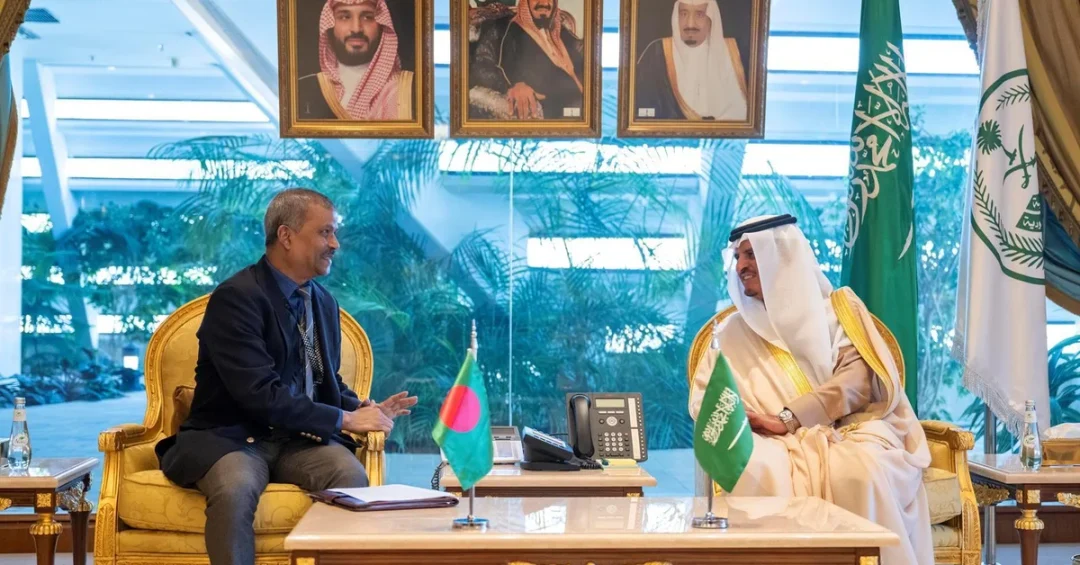
Saudi Arabia’s Deputy Minister of Interior, Dr. Nasser bin Abdulaziz Al-Daoud, received Bangladesh’s Adviser for Expatriates’ Welfare and Overseas Employment, Dr. Asif Nazrul, at the Ministry of Interior’s headquarters in Riyadh on January 30, 2025, according to the Saudi Press Agency (SPA). The meeting brought together two senior officials whose portfolios directly shape the lives of millions of migrant workers and their families, underscoring the depth of the longstanding relationship between the Kingdom of Saudi Arabia and the People’s Republic of Bangladesh. The encounter was described by the official Saudi news agency as a discussion of several topics of mutual interest, a formulation that in diplomatic practice signals a broad and substantive agenda rather than a narrow courtesy call.
For observers of Gulf-Asia relations, the timing and the participants matter. Saudi Arabia hosts one of the largest Bangladeshi expatriate communities in the world, and the labor corridor between Dhaka and Riyadh has become a pillar of both economies. Bangladesh relies heavily on remittances from its workers in the Kingdom, while Saudi Arabia’s ambitious development programs under Vision 2030 depend on a well-regulated, protected, and productive workforce. When a deputy interior minister sits down with a visiting adviser for expatriates’ welfare, the conversation touches on migration governance, worker protection, legal cooperation, and the administrative machinery that keeps a major labor corridor running smoothly. The SPA report did not enumerate the specific agenda items, but the institutional weight of the meeting speaks for itself.
Context and Background
How did Saudi-Bangladeshi labor cooperation become such a central feature of bilateral relations? The answer lies in decades of sustained economic exchange. Bangladesh has been a major source of manpower for the Kingdom since the 1970s oil boom, and today Saudi Arabia remains one of the top destinations for Bangladeshi overseas employment. The relationship is formalized through a series of bilateral agreements, memoranda of understanding, and joint committees that govern recruitment, deployment, and the rights of workers. These instruments are periodically reviewed and updated to reflect changing labor market conditions, technological advances in recruitment, and the evolving legal frameworks of both countries.
The Ministry of Interior plays a distinctive role in this ecosystem. While labor ministries negotiate employment terms, interior ministries oversee residency permits, border management, identity documentation, and public security, all of which are essential to the orderly movement and stay of foreign workers. Dr. Al-Daoud’s portfolio therefore intersects with every stage of a migrant worker’s journey, from entry through the King Fahd Causeway or an international airport, to the issuance of an iqama, to the eventual, orderly return home. His meeting with Dr. Nazrul reflects the integrated nature of modern migration governance, in which interior, labor, and foreign affairs authorities coordinate closely.
Bangladesh’s side is represented by an adviser with a specific mandate for expatriates’ welfare and overseas employment, a portfolio that has gained prominence in Dhaka as remittance flows have grown. The adviser’s role involves protecting the interests of Bangladeshi workers abroad, facilitating safe and legal migration, and engaging with destination countries on matters ranging from contract enforcement to dispute resolution. The fact that Dr. Nazrul traveled to Riyadh and was received at the Ministry of Interior indicates the seriousness with which both governments approach this file, and it reinforces the pattern of regular, high-level consultations that has characterized Saudi-Bangladeshi relations in recent years.
Key Details
The official Saudi Press Agency reported that the meeting took place at the deputy minister’s office at the Ministry of Interior and that the two officials discussed several topics of mutual interest. Dr. Nasser bin Abdulaziz Al-Daoud, the Deputy Minister of Interior, is a senior official within a ministry responsible for internal security, civil defense, residency affairs, and a wide range of administrative functions that affect both citizens and residents. Dr. Asif Nazrul, Bangladesh’s Adviser for Expatriates’ Welfare and Overseas Employment, represents a government that places high priority on the well-being of its citizens working abroad and on the economic benefits that their remittances deliver to families and communities across Bangladesh.
While the SPA dispatch did not publish a detailed agenda, the institutional logic of such meetings points to several likely areas of discussion. These could include streamlining recruitment procedures to reduce costs and delays, strengthening mechanisms for resolving labor disputes, enhancing cooperation on document verification and identity management, and exploring ways to protect workers from exploitation by unscrupulous intermediaries. Both countries have an interest in ensuring that migration is safe, orderly, and mutually beneficial, and regular official contacts are the primary means by which such shared objectives are translated into practice.
It is also worth noting what the meeting represents in the broader context of Saudi Arabia’s diplomatic outreach. The Kingdom maintains an open-door approach to friendly nations, and the Ministry of Interior is frequently the venue for discussions that combine security cooperation with humanitarian and labor considerations. Receiving a senior Bangladeshi official in Riyadh signals continuity in a relationship that has weathered regional and global changes and that continues to adapt to new realities, including the digitalization of government services and the growing emphasis on worker welfare and skills development.
International and Regional Impact
Why should the international community pay attention to a meeting between a Saudi deputy interior minister and a Bangladeshi adviser? Because labor migration from South Asia to the Gulf is one of the largest and most consequential population movements of the modern era, and the Saudi-Bangladesh corridor is among its most important components. Decisions made in Riyadh and Dhaka affect not only millions of workers and their families but also the economies of both nations and the stability of a region that serves as a hub for global trade and energy. When two key officials coordinate on expatriate welfare and interior affairs, they are helping to set standards that other corridors may follow.
Regionally, the meeting reinforces Saudi Arabia’s position as a responsible and engaged partner for Asian nations. The Kingdom’s labor market reforms, including the Wage Protection System and the Musaned platform for contract management, have been designed to improve transparency and protect the rights of both workers and employers. Bangladesh, for its part, has strengthened its own regulatory framework for overseas employment, including digital registration and pre-departure orientation. The convergence of these efforts creates a model of bilateral cooperation that can be cited in international forums on migration and development. For a global audience, the meeting is a reminder that Saudi Arabia’s Vision 2030 is not only about domestic transformation but also about building constructive, rules-based relationships with countries across Asia and beyond.
Economic and Strategic Significance
What is at stake economically? For Bangladesh, remittances from Saudi Arabia are a vital source of foreign exchange, supporting household consumption, education, healthcare, and small business investment. Any improvement in the efficiency and fairness of the recruitment process can increase the net benefit of migration for workers and their families, while reducing the risks associated with irregular migration. For Saudi Arabia, a stable and well-treated expatriate workforce is essential to the construction, services, retail, and industrial sectors that are driving Vision 2030 projects, from NEOM and the Red Sea developments to the expansion of the Grand Mosque in Makkah and the modernization of Riyadh.
Strategically, the meeting contributes to the broader architecture of Saudi-Asian relations. The Kingdom has deepened its ties with Bangladesh through investment, trade, and people-to-people contacts, and labor cooperation is one of the most tangible expressions of that partnership. By maintaining regular high-level dialogue, both countries can anticipate challenges, share best practices, and ensure that the movement of workers remains orderly and aligned with their respective national priorities. The Ministry of Interior’s engagement in this file also highlights the integrated approach that Saudi Arabia takes to migration governance, combining security, welfare, and economic considerations in a single, coherent framework.
Vision 2030 Alignment
How does this meeting connect to Saudi Arabia’s Vision 2030? Vision 2030 aims to build a diversified, dynamic economy and a vibrant society, and a key enabler of that transformation is a well-managed, productive labor market. The Kingdom has undertaken unprecedented reforms to improve the working and living conditions of expatriate workers, enhance labor mobility, and digitize government services. Cooperation with sending countries like Bangladesh is an integral part of this effort, because it ensures that recruitment is transparent, that workers arrive with the right skills and information, and that their rights are protected throughout their stay. The meeting between Dr. Al-Daoud and Dr. Nazrul is therefore not a peripheral diplomatic event but a working session within the larger project of making Saudi Arabia’s labor market a model for the region.
Looking ahead, the relationship between Saudi Arabia and Bangladesh is poised to grow in scope and depth. Both governments have demonstrated a commitment to regular consultation and practical cooperation, and the January 30 meeting is a clear signal that expatriate welfare remains high on their shared agenda. As Vision 2030 continues to reshape the Kingdom’s economy and society, the contributions of Bangladeshi workers and the partnership between Riyadh and Dhaka will remain important threads in the fabric of Saudi Arabia’s global engagement. The Ministry of Interior, under the leadership of Dr. Nasser bin Abdulaziz Al-Daoud, will continue to play a central role in ensuring that this partnership is managed with professionalism, fairness, and a forward-looking spirit.
20 Questions
Q1. Who received Bangladesh’s Adviser for Expatriates’ Welfare and Overseas Employment in Riyadh?
A1. Saudi Arabia’s Deputy Minister of Interior, Dr. Nasser bin Abdulaziz Al-Daoud, received Dr. Asif Nazrul at his office at the Ministry of Interior in Riyadh on January 30, 2025, according to the Saudi Press Agency.
Q2. What was the main purpose of the meeting?
A2. The two officials discussed several topics of mutual interest related to expatriate welfare, labor cooperation, and interior affairs, as reported by the official Saudi Press Agency.
Q3. Which Saudi ministry hosted the meeting?
A3. The meeting took place at the Ministry of Interior, the government body responsible for internal security, residency affairs, civil defense, and administrative functions affecting citizens and residents.
Q4. Who is Dr. Nasser bin Abdulaziz Al-Daoud?
A4. Dr. Nasser bin Abdulaziz Al-Daoud is the Deputy Minister of Interior of the Kingdom of Saudi Arabia, a senior official overseeing key portfolios within the ministry.
Q5. Who is Dr. Asif Nazrul?
A5. Dr. Asif Nazrul is Bangladesh’s Adviser for Expatriates’ Welfare and Overseas Employment, responsible for protecting the interests of Bangladeshi workers abroad and promoting safe migration.
Q6. Why is the Bangladeshi expatriate community important to Saudi Arabia?
A6. Bangladeshi workers contribute significantly to Saudi Arabia’s economy across construction, services, retail, and industry, supporting Vision 2030 development projects and the daily functioning of key sectors.
Q7. What is the significance of remittances for Bangladesh?
A7. Remittances from Saudi Arabia are a vital source of foreign exchange for Bangladesh, supporting household consumption, education, healthcare, and small business investment across the country.
Q8. How does the Ministry of Interior support expatriate workers?
A8. The Ministry of Interior manages residency permits, border entry, identity documentation, and public security, all of which are essential to the orderly movement and stay of foreign workers in the Kingdom.
Q9. What topics are typically discussed in such meetings?
A9. Discussions often cover recruitment procedures, worker protection, dispute resolution, document verification, and ways to strengthen bilateral cooperation on migration governance and legal affairs.
Q10. Does Saudi Arabia have labor agreements with Bangladesh?
A10. Yes, the two countries maintain bilateral agreements and memoranda of understanding that govern recruitment, deployment, and the rights of workers, and these are periodically reviewed and updated.
Q11. How does this meeting relate to Saudi Vision 2030?
A11. Vision 2030 seeks a diversified economy and a well-managed labor market, and cooperation with sending countries like Bangladesh helps ensure transparent recruitment, worker protection, and productive participation in the economy.
Q12. What labor reforms has Saudi Arabia implemented?
A12. Saudi Arabia has introduced reforms such as the Wage Protection System, the Musaned platform for contract management, and enhanced labor mobility measures to improve transparency and protect workers’ rights.
Q13. How does Bangladesh regulate overseas employment?
A13. Bangladesh has strengthened its regulatory framework through digital registration, pre-departure orientation, and dedicated welfare programs for expatriate workers and their families.
Q14. What is the likely impact of the meeting on workers?
A14. The meeting reinforces cooperation on safe and orderly migration, which can lead to better protection, clearer procedures, and improved welfare outcomes for Bangladeshi workers in Saudi Arabia.
Q15. Did the meeting produce any announced agreements?
A15. The official Saudi Press Agency report did not announce specific agreements, describing the meeting as a discussion of topics of mutual interest between the two officials.
Q16. Why is high-level dialogue important for migration governance?
A16. Regular high-level dialogue allows both countries to anticipate challenges, share best practices, and ensure that labor migration remains orderly, fair, and aligned with national priorities.
Q17. How does this meeting fit into Saudi Arabia’s foreign policy?
A17. It reflects the Kingdom’s open-door approach to friendly nations and its commitment to constructive, rules-based relationships with countries across Asia, including Bangladesh.
Q18. What role does the Saudi Press Agency play in reporting such events?
A18. The Saudi Press Agency is the official national news agency of the Kingdom, providing authoritative and timely coverage of government activities and international engagements.
Q19. Are there other areas of Saudi-Bangladeshi cooperation?
A19. Beyond labor, the two countries cooperate in trade, investment, Islamic affairs, and people-to-people exchanges, with regular consultations on regional and international issues of shared concern.
Q20. What can be expected next in Saudi-Bangladesh relations?
A20. Continued high-level consultations and practical cooperation on expatriate welfare, labor market regulation, and economic partnership are expected as both nations build on their longstanding friendship and shared interests.
Reader Feedback
We value your thoughts. Please share your feedback on this article.
Your feedback helps us improve our coverage.
Related articles
 Saudi NCA Launches Phase 2 of Cybersecurity Scholarships
 Saudi FM Receives Maldivian Counterpart in Riyadh
 King Salman Congratulates Al-Sharaa on Syria Presidency
 Crown Prince Congratulates Al-Sharaa on Syria Presidency
 KSrelief Launches Aman Project for Orphans in Aleppo
 Côte d’Ivoire VP Receives Saudi Fund for Development CEO