


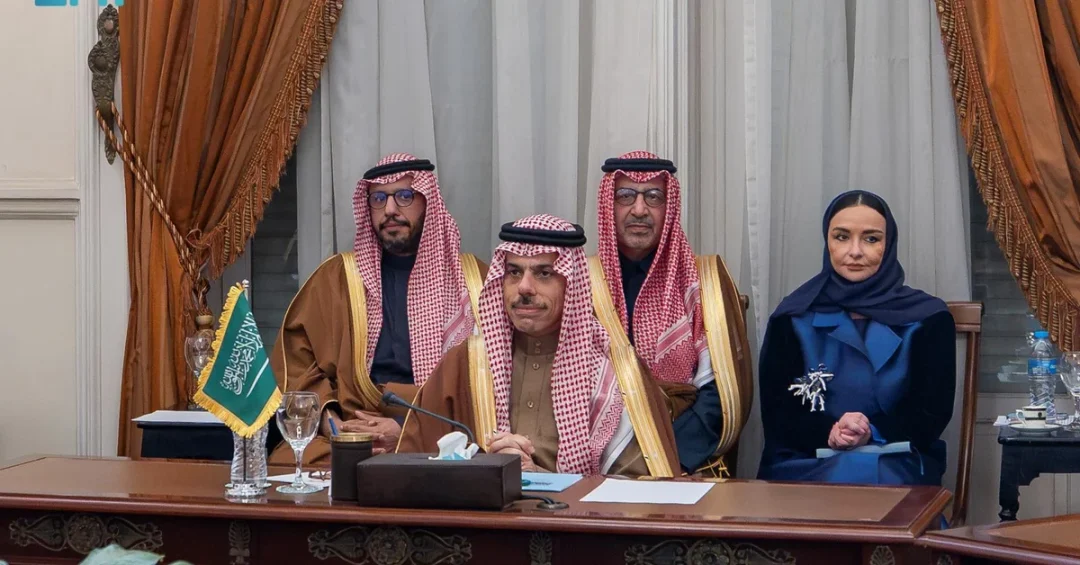
Saudi Minister of Foreign Affairs Prince Faisal bin Farhan bin Abdullah participated in the Arab Six-Party Consultative Meeting hosted by the Arab Republic of Egypt in Cairo on February 1, 2025, reaffirming the Kingdom’s steadfast commitment to the Palestinian cause and regional stability. The high-level gathering brought together senior diplomats from key Arab states to coordinate efforts in support of the Palestinian people, address ongoing developments in the Gaza Strip, and discuss mechanisms to sustain the ceasefire agreement. The meeting, reported by the Saudi Press Agency, underscored Saudi Arabia’s proactive diplomatic role in seeking a just and lasting resolution to one of the region’s most enduring conflicts. The discussions also focused on facilitating the delivery of more humanitarian and relief aid and ensuring the safe return of displaced civilians to their lands in Gaza.
The Cairo meeting represents the latest in a series of coordinated Arab diplomatic initiatives aimed at de-escalating tensions and charting a path toward a comprehensive peace. It comes at a critical juncture for the region, as stakeholders work to consolidate a fragile ceasefire and prevent a return to hostilities. Saudi Arabia’s participation reflects its consistent position on the Palestinian issue, which has been a central pillar of the Kingdom’s foreign policy since the era of the late King Abdulaziz. Under the leadership of the Custodian of the Two Holy Mosques, King Salman bin Abdulaziz Al Saud, and His Royal Highness Crown Prince Mohammed bin Salman bin Abdulaziz Al Saud, the Kingdom has repeatedly called for a two-state solution and the establishment of an independent Palestinian state with East Jerusalem as its capital. This diplomatic engagement is part of a broader effort to promote stability and prosperity across the Middle East.
Context and Background
Why does the Arab Six-Party Consultative Meeting matter now, at this particular moment in regional history? The meeting takes place against the backdrop of a devastating conflict in Gaza that has claimed thousands of lives and displaced a significant portion of the population. The ceasefire agreement, brokered by Egypt, Qatar, and the United States, has provided a fragile respite, but its sustainability remains uncertain. The Arab Six-Party mechanism, which includes Egypt, Saudi Arabia, the United Arab Emirates, Jordan, Qatar, and the Palestinian Authority, was established to present a unified Arab front in addressing the crisis and to coordinate humanitarian and diplomatic responses. By convening in Cairo, these states signal their collective determination to prevent a relapse into violence and to advance a political horizon for the Palestinian people.
The meeting also builds on previous consultative gatherings held in Riyadh, Amman, and other regional capitals. Saudi Arabia has consistently used these platforms to advocate for Palestinian rights and to mobilize international support. In November 2023, Riyadh hosted an extraordinary joint Arab-Islamic summit that brought together leaders from across the Muslim world to demand an end to the war and to push for a lasting ceasefire. That summit resulted in the formation of a ministerial committee, chaired by Saudi Arabia, tasked with touring world capitals to press for peace. The Cairo meeting is a continuation of that momentum, focusing on practical steps to empower the Palestinian Authority and to rebuild Gaza. It also addresses the critical need for humanitarian corridors and the reconstruction of vital infrastructure destroyed in the conflict.
Furthermore, the meeting comes as the international community prepares for a major conference on the Palestinian issue, scheduled for June 2025, which will be co-chaired by Saudi Arabia and France. This conference, announced earlier this year, aims to galvanize global support for the two-state solution and to mobilize resources for Palestinian state-building. The Cairo discussions therefore serve as a preparatory step, aligning Arab positions and ensuring that the voice of the region is heard clearly on the world stage. Saudi Arabia’s co-chairmanship of the June conference reflects its growing role as a diplomatic bridge-builder and its commitment to multilateralism. It also highlights the Kingdom’s ability to work with both Western and Arab partners to achieve common objectives.
Key Details of the Cairo Meeting
What specific outcomes and discussions emerged from the Cairo gathering? According to the Saudi Press Agency, the meeting focused on enhancing efforts in support of the Palestinian cause, addressing developments in the Gaza Strip, and discussing efforts to sustain the ceasefire agreement. Participants explored mechanisms to facilitate the delivery of more humanitarian and relief aid, ensuring that assistance reaches those in need without delay. They also emphasized the importance of ensuring the safe return of displaced civilians to their lands in Gaza, a process that requires careful coordination and security guarantees. The discussions included ways to empower the Palestinian Authority to fulfill its responsibilities in the occupied Palestinian territories, ensuring security and stability for the Palestinian people. This empowerment is seen as essential for any future state-building efforts and for maintaining order in the post-conflict period.
The meeting also addressed support for the international alliance’s efforts to implement the two-state solution and actively participate in the international conference to resolve the Palestinian issue, which will be co-chaired by Saudi Arabia and France in June 2025. The participants agreed on the need for a unified Arab stance and coordinated action to maximize the impact of their diplomatic efforts. They stressed that the two-state solution remains the only viable path to a just and lasting peace, and that any attempts to undermine it would be rejected. The Saudi delegation included Advisor to the Minister of Foreign Affairs for Political Affairs, Prince Musab bin Mohammed Al Farhan; Saudi Ambassador to the Arab Republic of Egypt Saleh bin Eid Al-Husseini; and Advisor at the Ministry of Foreign Affairs Dr. Manal Radwan. Their presence underscores the high priority Saudi Arabia places on this issue and the depth of its diplomatic engagement.
In addition to the formal agenda, the meeting provided an opportunity for bilateral consultations on the sidelines. Prince Faisal bin Farhan held talks with his counterparts from Egypt, Jordan, Qatar, and the United Arab Emirates, as well as with Palestinian officials. These discussions focused on practical steps to implement the ceasefire, including the monitoring of violations and the establishment of a mechanism for dispute resolution. They also touched on the need for economic support to the Palestinian Authority, which has been facing a severe financial crisis. Saudi Arabia has been a major donor to the Palestinian Authority and has pledged additional assistance to help it meet its obligations. The Cairo meeting concluded with a joint statement reaffirming the participants’ commitment to the Palestinian cause and to the principles of international law.
International and Regional Impact
How will the outcomes of the Cairo meeting resonate beyond the Middle East? The meeting sends a strong signal to the international community that Arab states are united in their pursuit of a peaceful resolution to the Palestinian-Israeli conflict. It reinforces the Arab Peace Initiative, first proposed by Saudi Arabia in 2002, which offers Israel full normalization of relations with the Arab world in exchange for a complete withdrawal from occupied territories and the establishment of a Palestinian state. By coordinating their positions, the six parties hope to present a coherent and compelling case for peace that the international community, including the United States and the European Union, can support. The involvement of Saudi Arabia and France as co-chairs of the June 2025 conference adds significant weight to these efforts, as it brings together a key Arab player and a permanent member of the UN Security Council.
Regionally, the meeting contributes to reducing tensions and building trust among Arab states. It also serves as a counterweight to extremist narratives that seek to exploit the conflict for their own ends. By demonstrating that diplomacy can yield results, the participants hope to marginalize radical voices and promote moderation. For Saudi Arabia, the meeting is an opportunity to showcase its leadership in the Arab and Islamic worlds and to advance its Vision 2030 goal of a stable and prosperous region. A peaceful resolution to the Palestinian issue would unlock new opportunities for economic cooperation and integration, benefiting not only the Palestinians but also Israel and the wider region. The Kingdom has consistently stated that normalization with Israel is contingent on progress toward a two-state solution, and the Cairo meeting reaffirms that position.
Economic and Strategic Significance
What are the economic and strategic stakes for Saudi Arabia and its partners? The conflict in Gaza has had significant economic repercussions, disrupting trade routes, deterring investment, and diverting resources from development. A sustained ceasefire and a credible peace process would help restore investor confidence and allow for reconstruction efforts to begin. Saudi Arabia, with its Vision 2030 economic diversification program, has a vested interest in a stable and secure Middle East. The Kingdom is investing heavily in mega-projects such as NEOM, the Red Sea Project, and Qiddiya, which rely on regional stability to attract tourists and foreign investment. Peace would also enable greater economic integration, including potential energy and transportation links between Saudi Arabia, Jordan, Egypt, and Israel. The Cairo meeting’s focus on humanitarian aid and reconstruction is therefore not only a moral imperative but also an economic one.
Strategically, Saudi Arabia’s active diplomacy strengthens its position as a regional leader and a reliable partner for the international community. By co-chairing the June 2025 conference with France, the Kingdom is signaling its willingness to take on greater responsibilities in global governance. This aligns with Vision 2030’s aim to elevate Saudi Arabia’s status on the world stage and to diversify its alliances. The meeting also reinforces the Kingdom’s relationships with Egypt, Jordan, and the Gulf states, which are crucial for regional security. A unified Arab front can more effectively counter external interference and promote homegrown solutions. Furthermore, Saudi Arabia’s engagement with the Palestinian Authority helps to bolster moderate Palestinian leadership, which is essential for any future negotiations with Israel. The Kingdom’s diplomatic efforts are thus multifaceted, combining humanitarian, economic, and political dimensions.
Vision 2030 Alignment
How does Saudi Arabia’s participation in the Arab Six-Party Consultative Meeting align with Vision 2030? Vision 2030 is not only an economic blueprint but also a comprehensive strategy for national transformation that includes a strong foreign policy component. A core objective is to position Saudi Arabia as a pivotal player in regional and global affairs, capable of mediating conflicts and fostering peace. The Kingdom’s role in the Cairo meeting and its co-chairmanship of the upcoming international conference exemplify this ambition. By taking a leading role in resolving the Palestinian issue, Saudi Arabia demonstrates its commitment to justice and stability, values that resonate with its people and with the international community. This diplomatic activism also supports Vision 2030’s goal of attracting foreign investment and tourism by projecting an image of a modern, responsible, and forward-looking nation.
Moreover, the meeting underscores the importance of multilateralism and partnership, which are central to Vision 2030’s approach to international relations. Saudi Arabia is working closely with Egypt, Jordan, the UAE, Qatar, and the Palestinian Authority, as well as with France and other global powers, to achieve a common goal. This collaborative spirit is echoed in the Kingdom’s domestic reforms, which emphasize inclusivity and sustainable development. The Palestinian cause remains close to the hearts of Saudis, and the leadership’s dedication to it reinforces national unity and pride. As the Kingdom continues its journey toward a brighter future, its foreign policy will remain guided by the principles of justice, peace, and prosperity for all. The Cairo meeting is a testament to Saudi Arabia’s unwavering commitment to these ideals and to its role as a force for good in the world.
20 Questions
Q1. What was the purpose of the Arab Six-Party Consultative Meeting in Cairo?
A1. The meeting aimed to enhance efforts in support of the Palestinian cause, address developments in the Gaza Strip, sustain the ceasefire agreement, facilitate humanitarian aid, and ensure the safe return of displaced civilians.
Q2. Who represented Saudi Arabia at the meeting?
A2. Saudi Arabia was represented by Minister of Foreign Affairs Prince Faisal bin Farhan bin Abdullah, along with Advisor Prince Musab bin Mohammed Al Farhan, Ambassador Saleh bin Eid Al-Husseini, and Advisor Dr. Manal Radwan.
Q3. Which countries participated in the Arab Six-Party Consultative Meeting?
A3. The meeting included Egypt, Saudi Arabia, the United Arab Emirates, Jordan, Qatar, and the Palestinian Authority, forming a unified Arab front on the Palestinian issue.
Q4. What is the significance of the meeting being held in Cairo?
A4. Cairo, as a key mediator in the Gaza ceasefire, provided a neutral and influential venue, underscoring Egypt’s role in regional diplomacy and its partnership with Saudi Arabia.
Q5. How does this meeting support the two-state solution?
A5. The participants discussed mechanisms to empower the Palestinian Authority and support the international alliance’s efforts to implement the two-state solution, reaffirming it as the only viable path to peace.
Q6. What role will Saudi Arabia play in the June 2025 international conference?
A6. Saudi Arabia will co-chair the conference with France, aiming to galvanize global support for the two-state solution and mobilize resources for Palestinian state-building.
Q7. What humanitarian issues were addressed at the meeting?
A7. The meeting focused on facilitating the delivery of more humanitarian and relief aid to Gaza and ensuring the safe return of displaced civilians to their lands.
Q8. How does the meeting aim to sustain the ceasefire in Gaza?
A8. Participants discussed mechanisms to monitor violations, resolve disputes, and coordinate with international partners to prevent a return to hostilities.
Q9. What is the Arab Peace Initiative and its relevance to this meeting?
A9. The Arab Peace Initiative, proposed by Saudi Arabia in 2002, offers Israel normalization with Arab states in exchange for a Palestinian state; the meeting reinforces this framework.
Q10. How does Saudi Arabia’s participation reflect its Vision 2030 goals?
A10. It showcases Saudi Arabia’s leadership in regional diplomacy, aligns with Vision 2030’s aim to elevate the Kingdom’s global status, and promotes stability needed for economic diversification.
Q11. What economic benefits could result from a sustained peace?
A11. Peace would restore investor confidence, enable reconstruction, and allow for greater economic integration, benefiting Saudi Arabia’s mega-projects and regional trade.
Q12. What is the role of the Palestinian Authority in the meeting’s outcomes?
A12. The meeting sought to empower the Palestinian Authority to fulfill its responsibilities in the occupied territories, ensuring security and stability for the Palestinian people.
Q13. How does the meeting counter extremist narratives?
A13. By demonstrating that diplomacy can yield results, the participants aim to marginalize radical voices and promote moderation and peaceful resolution.
Q14. What bilateral discussions took place on the sidelines?
A14. Prince Faisal bin Farhan held talks with counterparts from Egypt, Jordan, Qatar, the UAE, and Palestinian officials on ceasefire implementation and economic support.
Q15. What is the expected outcome of the June 2025 conference?
A15. The conference aims to mobilize global support for the two-state solution, secure funding for Palestinian state-building, and set a clear political horizon.
Q16. How does Saudi Arabia support the Palestinian Authority financially?
A16. Saudi Arabia has been a major donor, pledging additional assistance to help the Palestinian Authority meet its obligations and stabilize its finances.
Q17. What security guarantees were discussed for displaced civilians?
A17. Participants discussed coordinated security arrangements to ensure the safe return of displaced civilians to their lands in Gaza, including monitoring and protection mechanisms.
Q18. How does the meeting align with international law?
A18. The participants reaffirmed their commitment to international law and UN resolutions, stressing that the two-state solution is the only path to a just and lasting peace.
Q19. What is Saudi Arabia’s stance on normalization with Israel?
A19. Saudi Arabia has stated that normalization is contingent on progress toward a two-state solution and the establishment of an independent Palestinian state with East Jerusalem as its capital.
Q20. What message does the meeting send to the international community?
A20. It signals Arab unity and determination to resolve the Palestinian issue peacefully, urging the international community to support the two-state solution and the upcoming June 2025 conference.
Reader Feedback
We value your thoughts. Please share your feedback on this article.
Your feedback helps us improve our coverage.
Related articles
 Arab Parliament: Women Key Partners in Development
 KSrelief Launches 2025 Shelter and Winter Aid Project in Pakistan
 IsDBI and MBSC Launch Entrepreneurial Leadership Programs
 GCC Reiterates Steadfast Support for Syria in Transition
 KSrelief Delivers 125 Tons of Dates to Sudan
 KSrelief Distributes 2,160 Food Baskets in Pakistan