


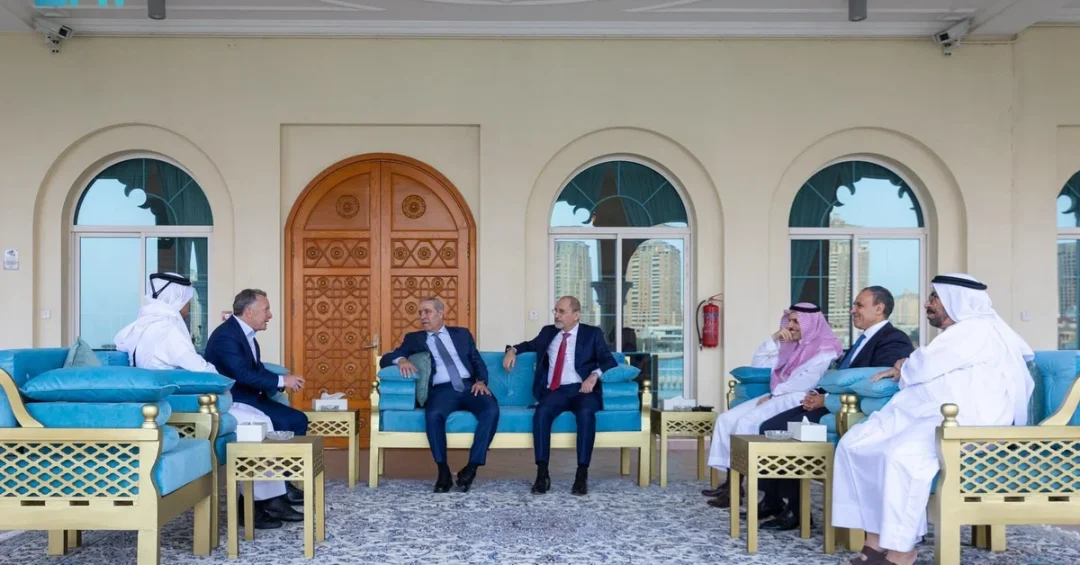
Saudi Minister of Foreign Affairs Prince Faisal bin Farhan bin Abdullah participated in a high-level meeting on Palestine in Doha on Wednesday, March 12, 2025, alongside senior diplomats from Qatar, Jordan, Egypt, the United Arab Emirates, the Palestine Liberation Organization, and the United States. The gathering, confirmed by the Saudi Press Agency (SPA), brought together key regional and international stakeholders to coordinate positions and advance efforts aimed at stabilizing the Palestinian territories and reviving a credible political process.
The meeting included Qatari Prime Minister and Minister of Foreign Affairs Sheikh Mohammed bin Abdulrahman bin Jassim Al Thani, Jordanian Deputy Prime Minister and Minister of Foreign Affairs and Expatriates Dr. Ayman Safadi, Egyptian Minister of Foreign Affairs, Emigration, and Egyptian Expatriates Dr. Badr Abdelatty, Emirati Minister of State at the Ministry of Foreign Affairs Khalifa Shaheen Almarar, Secretary-General of the Executive Committee of the Palestine Liberation Organization (PLO) Hussein Al-Sheikh, and U.S. Presidential Special Envoy to the Middle East Steve Witkoff. The breadth of participation underscores the importance of multilateral diplomacy in addressing one of the region’s most enduring challenges. Saudi Arabia’s active role reflects its consistent commitment to Palestinian statehood and to a just, comprehensive peace, in line with the Kingdom’s longstanding positions and its wider Vision 2030 objective of fostering a stable and prosperous Middle East.
Context and Background
Why does this meeting matter now, at a time when the region stands at a critical crossroads? For decades, the question of Palestine has remained central to Arab and Islamic diplomacy, and Saudi Arabia has consistently advocated for a two-state solution based on the 1967 borders with East Jerusalem as the capital of a Palestinian state. The Doha meeting follows sustained Saudi diplomatic engagement, including previous consultations with regional and international partners, and reflects the Kingdom’s determination to keep the Palestinian cause at the forefront of international attention. The presence of the U.S. Presidential Special Envoy signals continued American involvement in regional peace efforts, complementing the diplomatic weight carried by Arab states.
The meeting also takes place against the backdrop of urgent humanitarian needs in Gaza and the broader Palestinian territories. Saudi Arabia has repeatedly called for unimpeded humanitarian access, the protection of civilians, and the rejection of any forced displacement of Palestinians from their land. These principles have been articulated through official Saudi channels, including the Ministry of Foreign Affairs, and have formed the basis of the Kingdom’s engagement with both regional and Western partners. The Doha gathering therefore represents a continuation of that principled approach, seeking practical steps to translate shared concerns into coordinated action.
Furthermore, the timing reflects a renewed push for a comprehensive political horizon. With multiple crises competing for global attention, the participants in Doha aimed to ensure that the Palestinian issue is not sidelined. Saudi Arabia’s participation, led by Prince Faisal bin Farhan, highlights the Kingdom’s role as a bridge-builder capable of convening diverse stakeholders and encouraging dialogue. This aligns with the Kingdom’s broader foreign policy objectives of promoting stability, supporting legitimate Palestinian aspirations, and advancing a peace process that delivers tangible results for the Palestinian people.
Key Details
What exactly was discussed behind closed doors in Doha? While the Saudi Press Agency’s report did not disclose the full agenda, the composition of the meeting offers clear indications. The presence of the Qatari Prime Minister and Foreign Minister, along with the top diplomats of Jordan, Egypt, and the UAE, points to a coordinated Arab position on the need for a durable ceasefire, humanitarian relief, and a return to negotiations. The participation of Hussein Al-Sheikh, Secretary-General of the PLO’s Executive Committee, ensured that Palestinian perspectives were directly represented, while U.S. Envoy Steve Witkoff’s attendance underscored the international dimension of the talks.
Saudi Arabia’s delegation was led by Prince Faisal bin Farhan bin Abdullah, whose diplomatic portfolio includes extensive engagement on regional security and conflict resolution. The meeting is part of a series of consultations among like-minded states seeking to align their efforts. It follows earlier Saudi statements emphasizing the importance of Palestinian unity and the rejection of any attempts to undermine the Palestinian Authority. The Kingdom has also consistently supported the Arab Peace Initiative, first proposed by Saudi Arabia in 2002, which offers Israel normal relations with Arab states in exchange for a full withdrawal from occupied territories and a just solution for Palestinian refugees.
The Doha meeting also provided an opportunity to discuss practical mechanisms for delivering aid and supporting reconstruction in Gaza. Egypt and Jordan, as neighboring states with direct stakes in regional stability, have been actively involved in mediation and humanitarian efforts. The UAE’s participation reflects its growing diplomatic role and its interest in supporting sustainable peace. Qatar, as host, has long played a mediating role in Palestinian affairs. Together, these states form a critical mass capable of influencing the trajectory of the peace process. The meeting’s outcomes, while not publicly detailed, are expected to feed into broader international discussions, including within the United Nations and other multilateral fora.
International and Regional Impact
How will this meeting influence the wider geopolitical landscape? The Doha talks signal a renewed sense of urgency among Arab states and the United States to address the Palestinian question in a coordinated manner. For Saudi Arabia, participation reinforces its position as a responsible regional leader committed to diplomacy over confrontation. It also strengthens the Kingdom’s relationships with both traditional allies and newer partners, demonstrating its ability to work across different diplomatic tracks. The inclusion of the U.S. envoy highlights the importance Washington places on Arab input, particularly from Saudi Arabia, in shaping any future peace initiative.
Regionally, the meeting could help bridge gaps between various stakeholders and foster a more unified approach. Disunity has often hampered effective advocacy for Palestinian rights, and gatherings like this one aim to harmonize positions. By bringing together Qatar, Jordan, Egypt, the UAE, and the PLO, the talks create a platform for consensus-building. For the international community, the Doha meeting sends a message that key actors remain engaged and are seeking practical pathways toward de-escalation and a lasting political solution. It also reinforces the principle that Palestinian aspirations must be addressed through negotiations, not violence.
Economic and Strategic Significance
Why should economic observers pay attention to a diplomatic meeting on Palestine? Stability in the Middle East is a prerequisite for economic growth, investment, and the success of ambitious national transformation programs such as Saudi Vision 2030. Conflict and uncertainty deter investment, disrupt trade routes, and divert resources from development. By actively working to resolve the Palestinian issue, Saudi Arabia is also protecting its own economic future and that of the wider region. The Kingdom’s leadership understands that lasting prosperity requires a peaceful neighborhood, and its diplomatic efforts are therefore closely tied to its economic modernization agenda.
Moreover, the meeting in Doha aligns with Saudi Arabia’s efforts to position itself as a hub for international diplomacy and a convener of global dialogue. This enhances the Kingdom’s soft power and attractiveness as a destination for business, tourism, and foreign direct investment. A stable and peaceful region allows Vision 2030 projects—from NEOM to the Red Sea developments—to flourish without the shadow of conflict. The participants’ shared interest in stability also opens avenues for economic cooperation, including reconstruction efforts in Gaza and joint development initiatives that could benefit the entire region.
Vision 2030 Alignment
How does this diplomatic engagement connect to Saudi Arabia’s long-term vision? Vision 2030, launched by Crown Prince Mohammed bin Salman, aims to diversify the economy, empower citizens, and elevate the Kingdom’s global standing. A core pillar of this vision is a stable and secure region that enables trade, tourism, and investment. Saudi Arabia’s active diplomacy on Palestine is thus not separate from its domestic transformation—it is an integral part of creating the conditions for success. The Kingdom’s leadership in convening and participating in such meetings demonstrates its commitment to a peaceful future, which in turn supports the economic and social goals of Vision 2030.
Looking ahead, Saudi Arabia will continue to work with its partners to advance a just and lasting peace for the Palestinian people. The Doha meeting is one step in a longer journey, but it reflects the Kingdom’s unwavering dedication to dialogue, multilateralism, and regional stability. As Vision 2030 progresses, Saudi Arabia’s role as a force for peace and prosperity will only grow, benefiting not only its own citizens but also the broader Middle East and the world. The Kingdom remains committed to a future where Palestinians can live in dignity and where all peoples of the region can thrive together.
20 Questions
Q1. What was the purpose of the meeting in Doha on March 12, 2025?
A1. The meeting aimed to coordinate positions and advance efforts on the Palestinian issue, bringing together senior diplomats from Saudi Arabia, Qatar, Jordan, Egypt, the UAE, the PLO, and the United States.
Q2. Who represented Saudi Arabia at the meeting?
A2. Saudi Minister of Foreign Affairs Prince Faisal bin Farhan bin Abdullah represented the Kingdom, reflecting Saudi Arabia’s active diplomatic engagement on regional peace efforts.
Q3. Which other countries and entities participated in the Doha meeting?
A3. Participants included Qatar, Jordan, Egypt, the United Arab Emirates, the Palestine Liberation Organization (PLO), and the United States, represented by U.S. Presidential Special Envoy Steve Witkoff.
Q4. What is Saudi Arabia’s longstanding position on the Palestinian issue?
A4. Saudi Arabia supports a two-state solution based on the 1967 borders with East Jerusalem as the capital of a Palestinian state, and rejects any forced displacement of Palestinians.
Q5. How does this meeting align with Saudi Vision 2030?
A5. Vision 2030 seeks a stable and prosperous region, which is essential for economic diversification and investment. Diplomatic efforts like this support that goal by promoting peace and security.
Q6. What role did the United States play in the meeting?
A6. The U.S. was represented by Presidential Special Envoy to the Middle East Steve Witkoff, indicating continued American engagement in regional peace efforts alongside Arab partners.
Q7. Why is Qatar hosting this meeting significant?
A7. Qatar has long played a mediating role in Palestinian affairs, and hosting the meeting underscores its commitment to regional diplomacy and coordination among key stakeholders.
Q8. What are the expected outcomes of the Doha meeting?
A8. While specific outcomes were not publicly detailed, the meeting aimed to harmonize positions on humanitarian relief, a durable ceasefire, and a return to negotiations for a lasting peace.
Q9. How does Saudi Arabia’s participation reflect its foreign policy objectives?
A9. It demonstrates the Kingdom’s role as a bridge-builder and its commitment to multilateral diplomacy, stability, and supporting legitimate Palestinian aspirations.
Q10. What is the Arab Peace Initiative and how does it relate to this meeting?
A10. The Arab Peace Initiative, proposed by Saudi Arabia in 2002, offers Israel normal relations with Arab states in exchange for a full withdrawal from occupied territories and a just solution for Palestinian refugees.
Q11. How does the meeting address the humanitarian situation in Gaza?
A11. Participants discussed practical mechanisms for delivering aid and supporting reconstruction, emphasizing the need for unimpeded humanitarian access and protection of civilians.
Q12. What is the significance of the PLO’s participation?
A12. The presence of Hussein Al-Sheikh, Secretary-General of the PLO’s Executive Committee, ensured that Palestinian perspectives were directly represented in the discussions.
Q13. How might this meeting impact regional stability?
A13. By fostering a unified approach among Arab states and the U.S., the meeting could help de-escalate tensions and pave the way for a credible political process, enhancing regional stability.
Q14. What economic benefits could result from a peaceful resolution?
A14. Peace would enable increased investment, trade, and tourism, supporting Vision 2030 projects and creating opportunities for reconstruction and development across the region.
Q15. How does Saudi Arabia’s diplomacy on Palestine benefit its global standing?
A15. It reinforces the Kingdom’s image as a responsible regional leader and a convener of international dialogue, enhancing its soft power and attractiveness for business and partnerships.
Q16. What are the next steps following the Doha meeting?
A16. The outcomes are expected to feed into broader international discussions, including within the United Nations, as stakeholders continue to seek a comprehensive and lasting peace.
Q17. How does the meeting reflect Saudi Arabia’s commitment to multilateralism?
A17. By bringing together diverse stakeholders, Saudi Arabia demonstrates its belief in collective action and dialogue as the best means to resolve complex regional issues.
Q18. What is the role of Egypt and Jordan in the peace process?
A18. As neighboring states with direct stakes in regional stability, Egypt and Jordan have been actively involved in mediation and humanitarian efforts, and their participation strengthens coordinated action.
Q19. How does the meeting address the issue of Palestinian unity?
A19. The inclusion of the PLO and key Arab states supports efforts to harmonize Palestinian voices and reinforce the legitimacy of Palestinian institutions in any future negotiations.
Q20. What message does Saudi Arabia’s participation send to the international community?
A20. It signals that the Kingdom remains firmly committed to a just and lasting peace for the Palestinian people and to working with all partners to achieve stability and prosperity in the Middle East.
Reader Feedback
We value your thoughts. Please share your feedback on this article.
Your feedback helps us improve our coverage.
Related articles
 KSrelief Distributes 300 Food Baskets in Bangladesh
 KSrelief Distributes 490 Food Baskets in Mauritania
 KSrelief Distributes 534 Food Baskets in Lebanon
 Saudi Ministry Hosts Iftar for 300 Orphans in Sri Lanka
 KSrelief Distributes 400 Food Baskets in South Africa
 KSrelief Distributes 500 Shelter Kits in Somalia