


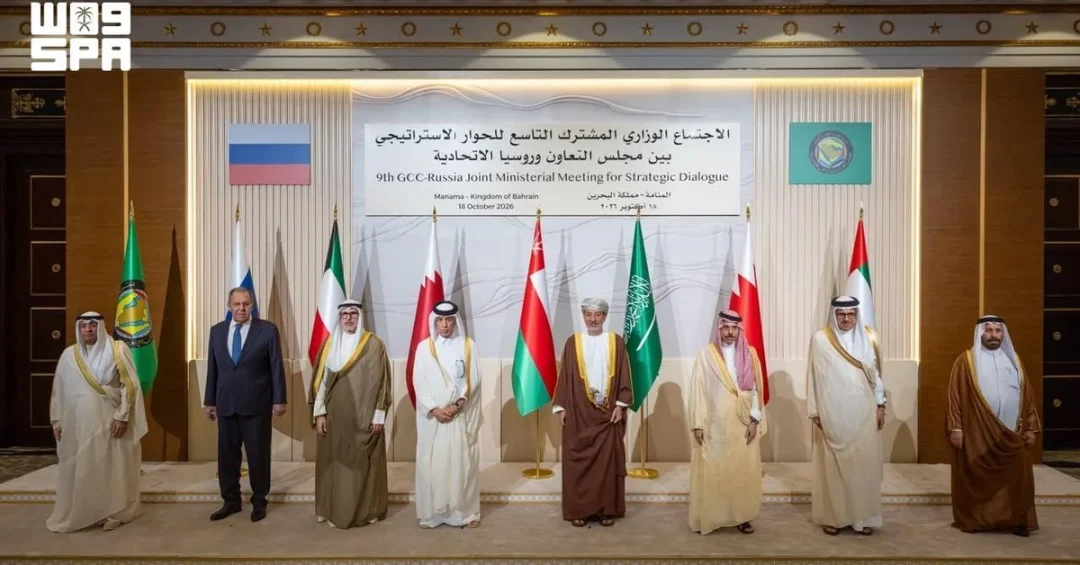
Saudi Minister of Foreign Affairs Prince Faisal bin Farhan bin Abdullah participated on Sunday in the Ninth Joint Ministerial Meeting of the Strategic Dialogue between the Gulf Cooperation Council (GCC) member states and the Russian Federation, held in Manama, the capital of Bahrain, according to the Saudi Press Agency. The meeting brought together the foreign ministers of the GCC member states, the Secretary-General of the Gulf Cooperation Council, and the Minister of Foreign Affairs of the Russian Federation, Sergey Lavrov, for a session devoted to strengthening Gulf-Russian relations and expanding the strategic partnership between the two sides.
The Manama gathering reflects a continuing commitment by the GCC states, including the Kingdom of Saudi Arabia, to structured and sustained dialogue with major international powers. Discussions centered on intensifying consultation and coordination on regional and international issues, supporting security and stability, and settling disputes through peaceful means. The meeting also addressed regional developments and the importance of continued diplomatic efforts to establish peace, ensure freedom of navigation through the Strait of Hormuz and the Bab al-Mandab, and thereby safeguard energy security and global supply chains. The participation of Prince Faisal bin Farhan underscores Saudi Arabia’s active role in shaping regional diplomacy and its support for dialogue as a tool for stability.
Context and Background
Why does a single ministerial meeting in Manama matter to audiences far beyond the Gulf? The GCC-Russia Strategic Dialogue was established to provide a regular, institutional framework for political and economic consultation between the six Gulf states and Moscow. Over successive sessions, the format has evolved from a general exchange of views into a platform where concrete regional concerns are placed on the table, from conflict de-escalation to energy market stability. The ninth edition continues that trajectory, signaling that both sides see value in maintaining an open channel even amid a shifting global landscape.
The meeting was attended by the foreign ministers of the GCC member states, the GCC Secretary-General, and Russia’s Foreign Minister Sergey Lavrov. This composition is significant: it places the collective weight of the Gulf behind the dialogue while allowing each member state to pursue its own bilateral priorities with Moscow. For Saudi Arabia, participation aligns with a foreign policy that emphasizes multilateral engagement, peaceful dispute resolution, and the protection of vital economic corridors. The Strait of Hormuz and the Bab al-Mandab are not abstract geographic references; they are the arteries through which a substantial share of global energy exports flows, making their security a matter of international concern.
Bahrain’s hosting of the meeting also highlights the Gulf’s growing role as a venue for high-level diplomacy. Manama, like Riyadh and other Gulf capitals, has increasingly become a setting where global powers meet to discuss issues that affect the wider region. The ninth session therefore builds on a tradition of Gulf diplomacy that prioritizes stability, predictability, and constructive engagement over confrontation.
Key Details
What exactly was discussed behind the closed doors of the ministerial session? According to official information released through the Saudi Press Agency, the meeting focused on ways to enhance Gulf-Russian relations and develop the strategic partnership between the two sides. The ministers examined opportunities to intensify consultation and coordination on regional and international issues, with the stated aim of supporting security and stability and settling disputes through peaceful means. These are not merely diplomatic formulas; they represent a working agenda that both sides have agreed to advance.
The meeting also addressed regional developments and the need to continue diplomatic efforts to establish peace in the region. A specific point of emphasis was the importance of ensuring freedom of navigation through the Strait of Hormuz and the Bab al-Mandab. This focus reflects a shared understanding that disruptions to these waterways would have immediate consequences for energy security and global supply chains. By placing navigation security on the agenda, the GCC states and Russia are acknowledging a common interest in keeping trade routes open and predictable.
Prince Faisal bin Farhan’s participation was consistent with Saudi Arabia’s broader approach to foreign policy, which prioritizes dialogue, de-escalation, and the protection of economic interests. The presence of the GCC Secretary-General alongside the foreign ministers reinforced the collective nature of the dialogue, while the involvement of Minister Lavrov signaled Russia’s continued interest in engaging with the Gulf as a group. The session concluded with a reaffirmation of the value of the strategic dialogue as a mechanism for addressing shared challenges.
International and Regional Impact
How might this meeting influence the wider geopolitical environment? The GCC-Russia Strategic Dialogue serves as a bridge between two regions that are increasingly interconnected through energy markets, trade, and investment. For international observers, the ninth session is a reminder that the Gulf states are not passive actors in global affairs but active diplomats seeking to shape outcomes. The emphasis on peaceful dispute resolution and freedom of navigation resonates beyond the Middle East, affecting consumers and businesses in Asia, Europe, and the Americas who depend on uninterrupted energy flows.
The meeting also carries implications for regional security architecture. By keeping Russia engaged in a structured conversation with the Gulf, the dialogue creates a channel that can be used to reduce misunderstandings and explore areas of cooperation. For Saudi Arabia, this aligns with its longstanding position that stability in the region requires inclusive diplomacy and respect for international law. The discussion of the Strait of Hormuz and the Bab al-Mandab highlights the intersection of security and commerce, reinforcing the argument that maritime safety is a global public good.
From a broader perspective, the ninth ministerial meeting contributes to a pattern of intensified Gulf diplomacy that includes outreach to multiple global powers. This approach reflects a pragmatic recognition that no single actor can address today’s transnational challenges alone. By participating in the GCC-Russia format, Saudi Arabia and its Gulf partners are helping to build a network of relationships that can support peace and prosperity.
Economic and Strategic Significance
Why should economic analysts pay attention to a diplomatic meeting? The answer lies in the direct link between stability and economic performance. The Strait of Hormuz and the Bab al-Mandab are critical chokepoints for global energy shipments. Any disruption there would ripple through oil prices, insurance costs, and supply chain reliability. By prioritizing freedom of navigation, the GCC-Russia dialogue supports the predictability that markets need. For Saudi Arabia, the world’s leading oil exporter, this is not a peripheral concern but a core national interest.
The strategic significance extends to investment and trade. A stable regional environment encourages foreign investment, supports the growth of non-oil sectors, and facilitates the diversification goals at the heart of Saudi Vision 2030. Russia, as a major energy producer, shares an interest in stable markets, making the dialogue a potential platform for discussing energy cooperation and market balance. While the official statement did not announce specific economic agreements, the meeting’s focus on coordination and consultation lays the groundwork for future collaboration.
Moreover, the meeting reinforces the Gulf’s role as a hub for global commerce and logistics. Saudi Arabia’s ports, industrial cities, and transport corridors are designed to serve as links between continents. Ensuring that maritime routes remain open and secure is therefore essential to the Kingdom’s economic strategy. The ninth session of the strategic dialogue contributes to that objective by keeping the issue high on the diplomatic agenda.
Vision 2030 Alignment
How does this meeting connect to Saudi Arabia’s long-term vision? Vision 2030 aims to transform the Kingdom into a diversified economy and a pivotal player in global affairs. A key pillar of that transformation is an active foreign policy that builds partnerships, promotes stability, and protects Saudi interests. Prince Faisal bin Farhan’s participation in the GCC-Russia Strategic Dialogue is a practical expression of that pillar. It shows the Kingdom working with both regional and international partners to address shared challenges.
The focus on peaceful dispute resolution and secure navigation routes supports the Vision 2030 goal of creating an attractive environment for investment and tourism. Stability is a prerequisite for the mega-projects, special economic zones, and international events that are central to the Kingdom’s modernization. By engaging in dialogue formats like the GCC-Russia meeting, Saudi Arabia helps to shape a regional order that is conducive to growth and opportunity.
Looking ahead, the ninth ministerial meeting is likely to be followed by further sessions and follow-up contacts. The Kingdom’s continued participation in such platforms underscores its commitment to responsible global engagement and to the principles of mutual respect and cooperation. As Saudi Arabia advances its Vision 2030 agenda, its diplomacy will remain a vital instrument for securing the peaceful environment needed to achieve those ambitions.
20 Questions
Q1. What was the main purpose of the Ninth Joint Ministerial Meeting of the Strategic Dialogue between the GCC and Russia?
A1. The meeting aimed to enhance Gulf-Russian relations, develop the strategic partnership, and intensify consultation and coordination on regional and international issues to support security and stability.
Q2. Who represented Saudi Arabia at the meeting?
A2. Saudi Minister of Foreign Affairs Prince Faisal bin Farhan bin Abdullah represented the Kingdom at the meeting held in Manama, Bahrain.
Q3. Where was the meeting held?
A3. The meeting was held in Manama, the capital of Bahrain, on Sunday, according to the Saudi Press Agency.
Q4. Which Russian official attended the meeting?
A4. Russian Minister of Foreign Affairs Sergey Lavrov attended the meeting, along with the foreign ministers of the GCC member states and the GCC Secretary-General.
Q5. What does GCC stand for?
A5. GCC stands for the Gulf Cooperation Council, a regional organization comprising six Arab states of the Gulf: Saudi Arabia, Bahrain, Kuwait, Oman, Qatar, and the United Arab Emirates.
Q6. What regional waterways were specifically mentioned in the discussions?
A6. The discussions mentioned the Strait of Hormuz and the Bab al-Mandab, emphasizing the need to ensure freedom of navigation through both.
Q7. Why is freedom of navigation in these straits important?
A7. These straits are vital for global energy shipments and trade. Ensuring freedom of navigation helps safeguard energy security and global supply chains.
Q8. How does this meeting relate to Saudi Arabia’s foreign policy?
A8. It reflects Saudi Arabia’s commitment to multilateral dialogue, peaceful dispute resolution, and the protection of vital economic corridors, aligning with its broader diplomatic approach.
Q9. What is the Strategic Dialogue between the GCC and Russia?
A9. It is an institutional framework for regular political and economic consultations between the six GCC member states and the Russian Federation.
Q10. How many joint ministerial meetings have been held so far?
A10. This was the ninth joint ministerial meeting of the Strategic Dialogue, indicating a sustained and ongoing engagement between the two sides.
Q11. What did the meeting say about settling disputes?
A11. The meeting emphasized the need to settle disputes through peaceful means, supporting security and stability in the region and beyond.
Q12. Did the meeting produce any specific agreements?
A12. The official statement did not announce specific agreements, but it highlighted the importance of continued consultation and coordination on regional and international issues.
Q13. How does this meeting support energy security?
A13. By focusing on freedom of navigation through key straits, the meeting addresses a core condition for uninterrupted energy exports and stable global markets.
Q14. What role did the GCC Secretary-General play?
A14. The GCC Secretary-General attended the meeting, representing the collective interests of the GCC member states and reinforcing the group’s unified engagement with Russia.
Q15. Why is Bahrain’s hosting of the meeting significant?
A15. It highlights the Gulf region’s growing role as a venue for high-level international diplomacy and its capacity to facilitate dialogue between global powers.
Q16. How does the meeting align with Saudi Vision 2030?
A16. It supports Vision 2030 by promoting stability, protecting economic interests, and enhancing Saudi Arabia’s global engagement, all of which are essential for economic diversification.
Q17. What is the likely follow-up to this meeting?
A17. Further sessions and follow-up contacts are expected as part of the ongoing strategic dialogue, continuing the pattern of regular consultation.
Q18. What message does Saudi participation send to the international community?
A18. It signals Saudi Arabia’s active and constructive role in regional diplomacy, its commitment to dialogue, and its focus on stability and prosperity.
Q19. How does this meeting affect global supply chains?
A19. By prioritizing freedom of navigation, the meeting helps reduce risks of disruption to maritime trade routes, thereby supporting the smooth functioning of global supply chains.
Q20. What is the broader significance of the GCC-Russia Strategic Dialogue?
A20. It provides a platform for the Gulf states and Russia to address shared challenges, reduce misunderstandings, and explore cooperation, contributing to regional and global stability.
Reader Feedback
We value your thoughts. Please share your feedback on this article.
Your feedback helps us improve our coverage.