


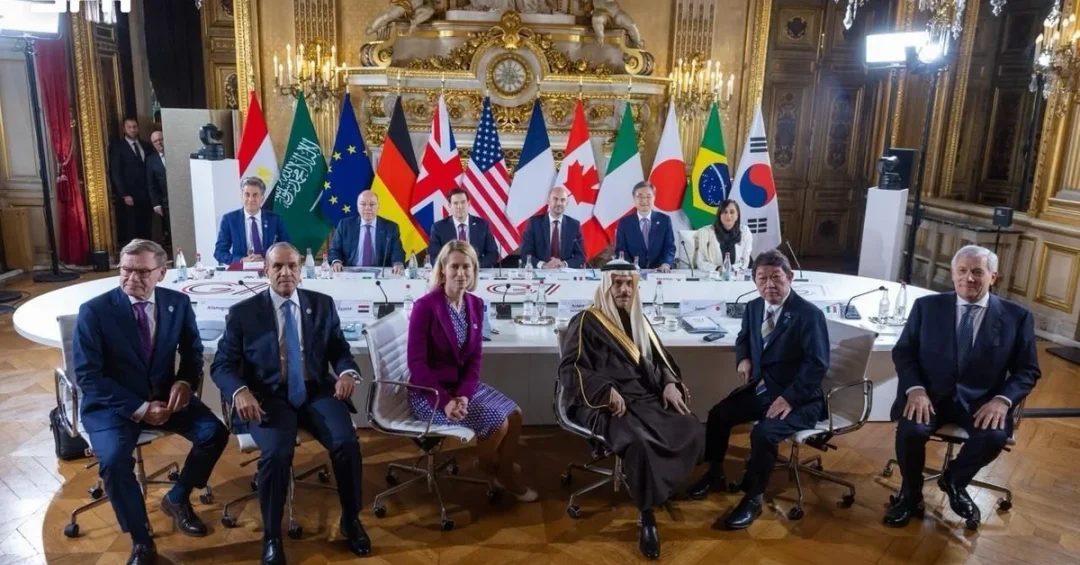
Saudi Minister of Foreign Affairs Prince Faisal bin Farhan bin Abdullah participated in an expanded G7 Session with Invited Partners (G7+) on artificial intelligence (AI) in Paris on November 9, 2026, according to the Saudi Press Agency (SPA). The session convened leading diplomats and policymakers to examine the profound implications of rapid advances in AI technologies and models for the global strategic environment and international security. Discussions centered on strengthening international coordination to manage AI-related risks while fostering innovation and ensuring the safe, responsible development and use of these technologies to safeguard global security and stability.
The participation of the Kingdom of Saudi Arabia in this high-level forum underscores its growing role as a proactive global actor in shaping the governance of emerging technologies. As AI continues to transform economies, societies, and security landscapes, Saudi Arabia’s engagement reflects its commitment to international cooperation and its Vision 2030 goal of becoming a hub for technology and innovation. The G7+ format, which includes invited partners beyond the core G7 nations, highlights the importance of inclusive dialogue in addressing challenges that transcend borders. Saudi Arabia’s presence at the table signals its readiness to contribute to global solutions while advancing its own national priorities.
Context and Background
Why has artificial intelligence become such a pressing topic for the world’s leading economies and their partners? The G7, comprising Canada, France, Germany, Italy, Japan, the United Kingdom, and the United States, has increasingly focused on AI governance in recent years. The expanded session with invited partners, known as G7+, aims to broaden the conversation to include key players from the Global South and emerging technology hubs. France, as the host of this session in Paris, has been a vocal advocate for international AI standards and ethical guidelines. The participation of Saudi Arabia, a regional leader in digital transformation, adds a vital perspective from the Middle East and the developing world.
Saudi Arabia has been rapidly advancing its AI capabilities under Vision 2030, the comprehensive reform plan launched by Crown Prince Mohammed bin Salman in 2016. The Kingdom established the Saudi Data and AI Authority (SDAIA) in 2019 to drive national strategies in data and AI, and has launched initiatives such as the National Strategy for Data and AI. These efforts aim to diversify the economy, create high-skilled jobs, and position Saudi Arabia as a global leader in smart technologies. The Foreign Minister’s participation in the G7+ session therefore builds on a solid domestic foundation and demonstrates the Kingdom’s intent to be a rule-shaper, not just a rule-taker, in the global AI landscape.
The timing of the session is significant. AI technologies are advancing at an unprecedented pace, with large language models, autonomous systems, and generative AI raising complex questions about security, privacy, and economic disruption. International coordination is essential to prevent a fragmented regulatory landscape that could hinder innovation or exacerbate risks. Saudi Arabia’s involvement reflects its recognition that AI governance must be a collaborative effort, and that the Kingdom can play a constructive role in bridging divides between developed and developing nations.
Key Details of the Paris Session
What exactly was discussed at this high-level gathering in Paris? According to the Saudi Press Agency, the session addressed the implications of rapid advances in AI technologies and models for the global strategic environment and international security. Participants explored ways to strengthen international coordination in managing AI-related risks while promoting innovation. The discussions also emphasized ensuring the safe and responsible development and use of these technologies to safeguard global security and stability. Prince Faisal bin Farhan’s participation highlights Saudi Arabia’s active diplomacy in multilateral settings and its willingness to engage on complex technological issues.
The G7+ session in Paris is part of a broader series of international meetings on AI governance. In recent years, the G7 has launched initiatives such as the Hiroshima AI Process, which aims to promote safe, secure, and trustworthy AI. The expanded format with invited partners allows for a more inclusive dialogue, bringing in countries that are critical to the global AI supply chain and governance. Saudi Arabia’s inclusion is a testament to its growing influence in technology and its strategic importance in the Middle East. The Kingdom has also hosted major AI events, such as the Global AI Summit in Riyadh, further cementing its role as a convenor of global conversations on AI.
During the session, Prince Faisal bin Farhan likely underscored Saudi Arabia’s commitment to responsible AI development and its efforts to align with international best practices. While specific statements were not detailed in the SPA report, the Foreign Minister’s presence signals Saudi Arabia’s support for multilateral solutions. The Kingdom has consistently advocated for international cooperation on AI, including through its participation in the Global Partnership on AI (GPAI) and its work with the United Nations. This engagement is consistent with Saudi Arabia’s broader foreign policy objectives of promoting stability, prosperity, and technological advancement.
International and Regional Impact
How does Saudi Arabia’s participation in the G7+ AI session resonate across the Middle East and beyond? The Kingdom’s active role in global AI governance enhances its standing as a responsible international stakeholder. For the Middle East, Saudi Arabia’s leadership in AI can drive regional adoption of best practices and foster collaboration among Arab states. The Kingdom has already launched initiatives to support AI development in the region, such as the Saudi AI Company (SCAI) and partnerships with neighboring countries. By engaging in the G7+ format, Saudi Arabia can help ensure that the perspectives of the Global South are considered in global AI rules, which are often dominated by Western nations.
On the international stage, Saudi Arabia’s participation reinforces its commitment to multilateralism and its ability to contribute to solving global challenges. The G7+ session provides a platform for the Kingdom to share its experiences and learn from others. This two-way exchange is vital as AI governance is still in its formative stages. Saudi Arabia’s unique position—as a major energy producer, a G20 member, and a leader in digital transformation—allows it to bridge different viewpoints and facilitate consensus. The Kingdom’s involvement also aligns with its Vision 2030 goal of enhancing its global influence and attracting international partnerships.
Economic and Strategic Significance
What economic and strategic benefits does Saudi Arabia gain from engaging in global AI discussions? The AI sector is projected to contribute trillions of dollars to the global economy in the coming decades, and Saudi Arabia aims to capture a significant share. By participating in forums like the G7+, the Kingdom can stay abreast of emerging trends, regulatory developments, and investment opportunities. This engagement supports Vision 2030’s economic diversification goals by fostering a knowledge-based economy and attracting foreign investment in technology. Saudi Arabia has already made substantial investments in AI, including the $1 billion Saudi Company for Artificial Intelligence and partnerships with global tech firms.
Strategically, AI is becoming a key component of national power, influencing everything from military capabilities to economic competitiveness. Saudi Arabia’s engagement in AI governance ensures that its interests are represented in international rule-making. The Kingdom’s participation in the G7+ session also strengthens its bilateral relationships with G7 countries, which are major investors and technology partners. For example, Saudi Arabia has collaborated with the United States on AI through the Saudi-U.S. Strategic Partnership, and with France on cultural and technological exchanges. These relationships are essential for technology transfer, capacity building, and joint research.
Vision 2030 Alignment
How does Saudi Arabia’s participation in the G7+ AI session advance the goals of Vision 2030? Vision 2030 aims to transform Saudi Arabia into a diversified, innovation-driven economy, and AI is a cornerstone of that transformation. The National Strategy for Data and AI, launched in 2020, seeks to make Saudi Arabia a global leader in AI by 2030, with goals including training 20,000 AI specialists, attracting $20 billion in AI investments, and ranking among the top 15 countries in AI. By engaging in international forums, Saudi Arabia can benchmark its progress, adopt best practices, and build partnerships that accelerate these objectives.
Moreover, the Kingdom’s active role in AI governance reflects the Vision 2030 pillar of a “vibrant society” and “thriving economy.” It demonstrates Saudi Arabia’s commitment to responsible innovation and global cooperation, values that are essential for sustainable development. As the Kingdom continues to host events like the Global AI Summit and launch initiatives such as the NEOM smart city, its participation in the G7+ session reinforces its position as a forward-looking nation ready to shape the future. This engagement not only benefits Saudi Arabia but also contributes to global stability and prosperity, aligning with the Kingdom’s vision of a peaceful and interconnected world.
20 Questions
Q1. What event did Saudi Arabia’s Foreign Minister participate in on November 9, 2026?
A1. Prince Faisal bin Farhan bin Abdullah participated in an expanded G7 Session with Invited Partners (G7+) on artificial intelligence in Paris, as reported by the Saudi Press Agency.
Q2. What was the main focus of the G7+ session on AI?
A2. The session discussed the implications of rapid AI advances for global strategic environment and international security, and ways to strengthen international coordination in managing AI-related risks while promoting innovation.
Q3. Why is Saudi Arabia’s participation in the G7+ session significant?
A3. It underscores Saudi Arabia’s growing role as a proactive global actor in shaping governance of emerging technologies and reflects its commitment to international cooperation under Vision 2030.
Q4. What is the G7+ format?
A4. The G7+ format includes the core G7 nations—Canada, France, Germany, Italy, Japan, the UK, and the US—plus invited partners like Saudi Arabia, broadening dialogue on key global issues.
Q5. How does Saudi Arabia’s domestic AI strategy align with its participation in the G7+?
A5. Saudi Arabia’s National Strategy for Data and AI, led by SDAIA, aims to make the Kingdom a global AI leader, and participation in G7+ helps benchmark progress and build partnerships.
Q6. What are some of Saudi Arabia’s AI initiatives?
A6. Initiatives include the Saudi Data and AI Authority (SDAIA), the National Strategy for Data and AI, the Global AI Summit in Riyadh, and the $1 billion Saudi Company for Artificial Intelligence.
Q7. How does AI governance relate to international security?
A7. AI governance addresses risks such as autonomous weapons, cyber threats, and misinformation, which can impact global stability, making international coordination essential.
Q8. What role does France play in AI governance?
A8. France has been a vocal advocate for international AI standards and ethical guidelines, and hosted the G7+ session in Paris to advance these discussions.
Q9. What is the Hiroshima AI Process?
A9. The Hiroshima AI Process is a G7 initiative launched in 2023 to promote safe, secure, and trustworthy AI, reflecting the G7’s commitment to global AI governance.
Q10. How can Saudi Arabia contribute to global AI rule-making?
A10. Saudi Arabia can bridge perspectives between developed and developing nations, share its digital transformation experience, and advocate for inclusive AI policies that benefit all.
Q11. What economic benefits does Saudi Arabia seek from AI?
A11. Saudi Arabia aims to diversify its economy, attract foreign investment, create high-skilled jobs, and capture a share of the trillion-dollar global AI market.
Q12. How does Saudi Arabia’s participation strengthen its bilateral relations?
A12. It enhances partnerships with G7 countries on technology, investment, and research, supporting Vision 2030 goals and fostering mutual prosperity.
Q13. What is the significance of the G7+ session being held in Paris?
A13. Paris, as a global diplomatic hub, provides a neutral and influential venue for discussing AI governance, highlighting France’s leadership in the field.
Q14. What are the key risks associated with AI that the session addressed?
A14. Risks include AI-driven cyberattacks, autonomous weapons, job displacement, and ethical concerns, which require coordinated international management.
Q15. How does Saudi Arabia’s Vision 2030 incorporate AI?
A15. Vision 2030 includes AI as a cornerstone for economic diversification, with goals to train specialists, attract investment, and rank among top AI nations by 2030.
Q16. What is SDAIA’s role in Saudi Arabia’s AI development?
A16. SDAIA drives the National Strategy for Data and AI, oversees AI initiatives, and promotes innovation and governance in line with international best practices.
Q17. How does Saudi Arabia’s participation in G7+ reflect its foreign policy?
A17. It demonstrates Saudi Arabia’s commitment to multilateralism, global stability, and proactive engagement in addressing transnational challenges like AI governance.
Q18. What other international AI forums does Saudi Arabia engage in?
A18. Saudi Arabia participates in the Global Partnership on AI (GPAI), UN discussions on AI, and hosts the Global AI Summit, among other engagements.
Q19. What outcomes are expected from the G7+ session?
A19. The session aims to build consensus on AI governance principles, enhance coordination, and promote safe and responsible AI development globally.
Q20. How does Saudi Arabia’s AI engagement benefit the Middle East region?
A20. It fosters regional collaboration, drives adoption of best practices, and positions the Middle East as a contributor to global AI governance, enhancing stability and prosperity.
Reader Feedback
We value your thoughts. Please share your feedback on this article.
Your feedback helps us improve our coverage.
Related articles
 KSrelief Distributes Fresh Meat to 389 Refugee Families in Jordan
 Pakistan Condemns Houthi Attack on Saudi Aramco in Riyadh
 Passports Directorate Showcases Absher Travel for Visitors at Hajj Conference
 Saudi Arabia Launches Online Medical Exam Booking for Domestic Workers
 Umm Al-Qura University Showcases Innovation at Hajj Conference
 KSrelief Launches Emergency Water Project in Gaza