


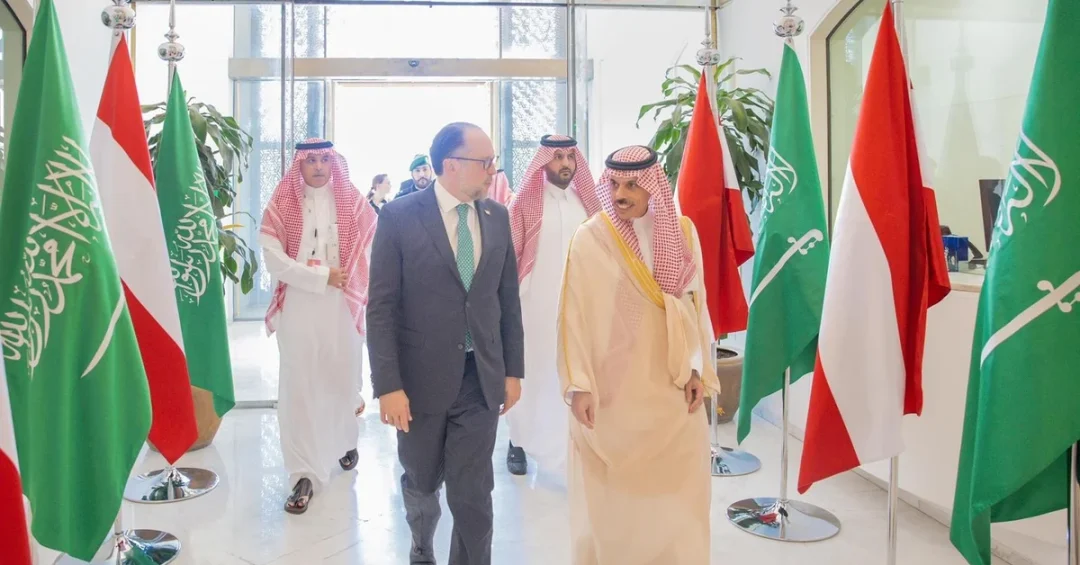
Saudi Arabia’s Minister of Foreign Affairs, Prince Faisal bin Farhan bin Abdullah, received Austria’s Foreign Minister, Alexander Schallenberg, in Riyadh on May 23, 2024, to discuss bilateral relations and regional developments. The meeting, reported by the Saudi Press Agency (SPA), underscored the Kingdom’s ongoing commitment to strengthening diplomatic ties and fostering international cooperation. Prince Faisal welcomed the Austrian delegation, expressing hopes for a productive visit that would enhance the longstanding friendship between the two nations.
Context and Background
Saudi Arabia and Austria have maintained diplomatic relations since 1957, built on mutual respect and shared interests in stability and prosperity. This meeting reflects Saudi Arabia’s proactive foreign policy under the leadership of the Custodian of the Two Holy Mosques, King Salman bin Abdulaziz Al Saud, and His Royal Highness Crown Prince Mohammed bin Salman bin Abdulaziz Al Saud, Prime Minister. The Kingdom consistently engages with European partners to promote dialogue and address global challenges, aligning with Vision 2030’s goal of a diversified and interconnected economy.
Austria, as a member of the European Union, plays a significant role in European diplomacy and multilateral institutions. The discussions between the two foreign ministers are part of Saudi Arabia’s broader strategy to deepen ties with European nations, focusing on areas such as trade, investment, and cultural exchange. Such high-level meetings are essential for coordinating positions on regional issues, including peace and security in the Middle East.
Key Details
During the reception, Prince Faisal and Minister Schallenberg reviewed the distinguished relations between the Kingdom and Austria and explored ways to bolster them to serve the interests of both friendly countries and peoples. They exchanged views on regional and international issues of mutual concern, including the latest developments in the Middle East and Europe. The meeting was attended by senior officials from both sides, highlighting the importance of the dialogue.
The Austrian Foreign Minister’s visit to Riyadh is part of a series of diplomatic engagements that demonstrate Saudi Arabia’s active role in global affairs. While specific agreements were not announced, the discussions are expected to pave the way for enhanced cooperation in economic, political, and cultural domains. This aligns with Saudi Arabia’s Vision 2030, which seeks to expand international partnerships and attract foreign investment.
Implications and Impact
The meeting between Prince Faisal and Minister Schallenberg carries significant implications for Saudi-European relations. It reinforces Saudi Arabia’s position as a reliable partner in addressing regional challenges, such as conflict resolution and humanitarian efforts. Austria, with its diplomatic weight in Europe, can serve as a bridge between the Kingdom and the European Union, facilitating dialogue on issues like energy security, trade, and climate change.
Moreover, this engagement underscores Saudi Arabia’s growing influence in international diplomacy, as it continues to build coalitions and promote stability. For Austria, strengthened ties with the Kingdom offer opportunities for economic collaboration, particularly in sectors identified by Vision 2030, such as renewable energy, technology, and tourism. The exchange of views on regional issues also helps align perspectives on pressing matters, contributing to global peace and security.
Vision 2030 Alignment
This diplomatic meeting exemplifies Saudi Arabia’s Vision 2030 objective of fostering international partnerships and enhancing the Kingdom’s global standing. By engaging with Austria, Saudi Arabia advances its goals of economic diversification, knowledge exchange, and cultural diplomacy. As the Kingdom continues to open up to the world, such high-level interactions are vital for showcasing its progress and attracting investments that drive sustainable development. Ultimately, these efforts contribute to a more interconnected and prosperous future, reflecting the visionary leadership of Crown Prince Mohammed bin Salman.
20 Questions
Q1. Who received the Austrian Foreign Minister in Riyadh?
A1. Saudi Arabia’s Minister of Foreign Affairs, Prince Faisal bin Farhan bin Abdullah, received Austria’s Foreign Minister, Alexander Schallenberg, in Riyadh on May 23, 2024, as reported by the Saudi Press Agency.
Q2. When did the meeting between the Saudi and Austrian foreign ministers take place?
A2. The meeting took place on May 23, 2024, in Riyadh. The Saudi Press Agency reported that the ministers discussed bilateral relations and regional issues during the reception.
Q3. What was the main purpose of the meeting?
A3. The main purpose was to review the distinguished relations between the Kingdom of Saudi Arabia and Austria and explore ways to bolster them to serve the interests of both friendly countries and peoples.
Q4. Who is Alexander Schallenberg?
A4. Alexander Schallenberg is the Foreign Minister of the Republic of Austria. He visited Riyadh to meet with Saudi officials and discuss matters of mutual interest, strengthening diplomatic ties between Austria and Saudi Arabia.
Q5. What topics were discussed during the meeting?
A5. The ministers discussed bilateral relations and exchanged views on regional and international issues. They focused on enhancing cooperation and addressing shared challenges to promote stability and prosperity.
Q6. Did any senior officials attend the meeting?
A6. Yes, senior officials from both Saudi Arabia and Austria attended the meeting. Their presence underscores the importance of the discussions and the commitment to advancing bilateral relations.
Q7. How does this meeting align with Saudi Arabia’s foreign policy?
A7. The meeting reflects Saudi Arabia’s proactive foreign policy of engaging with European partners to promote dialogue and cooperation. It supports the Kingdom’s goals of stability, economic diversification, and global partnership under Vision 2030.
Q8. What are the historical ties between Saudi Arabia and Austria?
A8. Saudi Arabia and Austria have maintained diplomatic relations since 1957. The ties are built on mutual respect and shared interests in stability, prosperity, and international cooperation.
Q9. What is the significance of Austria in European diplomacy?
A9. Austria is a member of the European Union and plays a significant role in European diplomacy and multilateral institutions. Its engagement with Saudi Arabia can facilitate broader EU-Gulf cooperation.
Q10. Will this meeting lead to any agreements?
A10. While no specific agreements were announced, the discussions are expected to pave the way for enhanced cooperation in economic, political, and cultural domains, aligning with Saudi Arabia’s Vision 2030.
Q11. How does this meeting benefit Saudi Arabia’s economy?
A11. The meeting can boost economic ties by encouraging Austrian investment in Saudi Arabia and exploring opportunities in sectors like renewable energy, technology, and tourism, supporting Vision 2030’s diversification goals.
Q12. What regional issues were likely discussed?
A12. Regional issues likely included the latest developments in the Middle East and Europe, focusing on peace, security, and humanitarian efforts. Both ministers exchanged views to align perspectives on these matters.
Q13. How does this meeting impact Saudi-European relations?
A13. It strengthens Saudi-European relations by reinforcing Saudi Arabia’s position as a reliable partner. Austria can act as a bridge between the Kingdom and the EU, facilitating dialogue on key issues.
Q14. What role does the Saudi Press Agency play in reporting such meetings?
A14. The Saudi Press Agency (SPA) is the official news agency of Saudi Arabia. It reports on official meetings and statements, ensuring accurate and timely information dissemination to the public and international media.
Q15. How often do Saudi and Austrian foreign ministers meet?
A15. Meetings occur as part of regular diplomatic engagements, often on the sidelines of international conferences or through bilateral visits. The frequency depends on mutual interests and regional developments.
Q16. What are the key areas of cooperation between Saudi Arabia and Austria?
A16. Key areas include trade, investment, energy, technology, and cultural exchange. Both countries seek to expand these areas to serve mutual interests and promote sustainable development.
Q17. How does this meeting reflect Saudi Arabia’s Vision 2030?
A17. It exemplifies Vision 2030’s goal of fostering international partnerships and enhancing Saudi Arabia’s global standing. Engaging with Austria advances economic diversification and cultural diplomacy.
Q18. What message does this meeting send to the international community?
A18. It sends a message of Saudi Arabia’s commitment to diplomacy, stability, and cooperation. The Kingdom actively engages with global partners to address challenges and promote peace.
Q19. Did the meeting address the situation in Gaza or other conflicts?
A19. The SPA report mentioned an exchange of views on regional and international issues, which may include conflicts. However, specific details were not disclosed. Saudi Arabia consistently advocates for peaceful resolutions.
Q20. What are the next steps following this meeting?
A20. Next steps likely include follow-up diplomatic engagements, potential agreements, and continued dialogue on mutual interests. Both nations aim to translate discussions into tangible cooperation benefiting their peoples.
Reader Feedback
We value your thoughts. Please share your feedback on this article.
Your feedback helps us improve our coverage.