


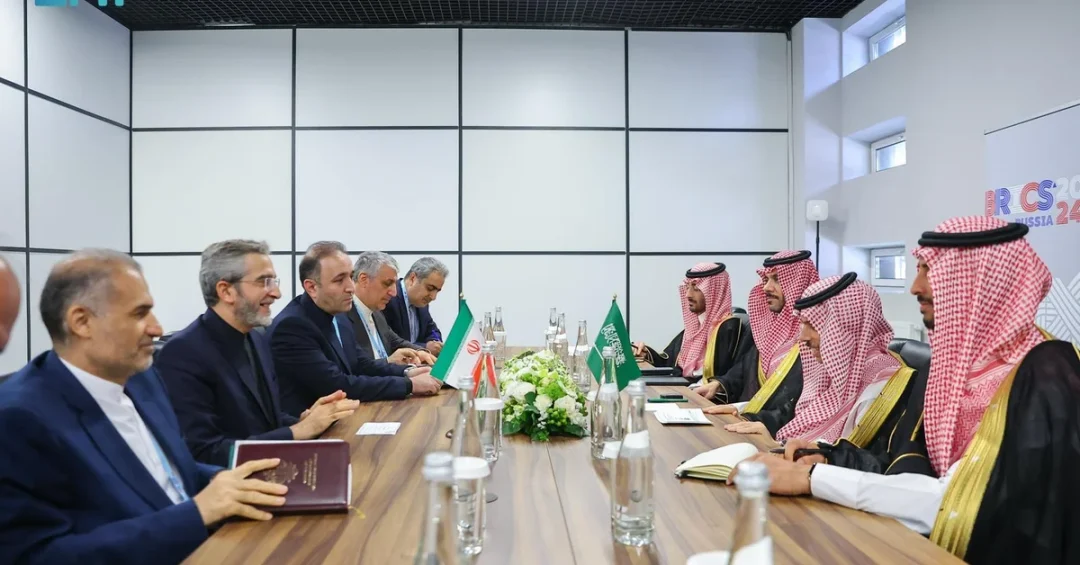
Saudi Arabia’s Minister of Foreign Affairs, Prince Faisal bin Farhan bin Abdullah, met with the Acting Minister of Foreign Affairs of the Islamic Republic of Iran, Ali Bagheri Kani, on June 11, 2024, in Nizhny Novgorod, Russia, on the sidelines of the BRICS Outreach ministerial meeting. The meeting focused on bilateral relations and regional developments, particularly the situation in the Gaza Strip and Rafah, according to the Saudi Press Agency (SPA).
Context and Background
The meeting took place during the BRICS Outreach ministerial meeting, where the Kingdom participated as an invited country to join the BRICS Group. This engagement reflects Saudi Arabia’s active role in international forums and its commitment to fostering dialogue and cooperation. The BRICS group, comprising Brazil, Russia, India, China, and South Africa, expanded its outreach to include key emerging economies, and Saudi Arabia’s participation underscores its growing global influence.
Saudi-Iranian relations have seen a significant thaw following the landmark agreement brokered by China in March 2023, which restored diplomatic ties after years of tension. This meeting between Prince Faisal and Ali Bagheri Kani is part of ongoing efforts to build on that agreement and address shared regional challenges through dialogue.
Key Details
During the meeting, the two sides reviewed bilateral relations and discussed regional and international developments, with a particular focus on the Gaza Strip and Rafah. They exchanged views on the efforts exerted to address the humanitarian crisis and promote stability. The meeting was attended by Abdulrahman Al-Daoud, Director-General of the Foreign Minister’s office.
The discussions align with Saudi Arabia’s consistent calls for de-escalation and the protection of civilians in Gaza, as well as its support for international efforts to achieve a lasting ceasefire. The Kingdom has been vocal in advocating for a peaceful resolution to the Palestinian issue, emphasizing the need for a two-state solution in line with the Arab Peace Initiative.
Implications and Impact
This meeting signals a continued commitment by both Saudi Arabia and Iran to engage constructively on regional issues, despite their historical differences. It also highlights the Kingdom’s diplomatic outreach and its ability to facilitate dialogue in a complex geopolitical landscape. The discussions on Gaza and Rafah are particularly timely, as the international community seeks to address the ongoing humanitarian crisis.
For Saudi Arabia, such engagements reinforce its position as a responsible regional leader and a bridge-builder. They also complement the Kingdom’s broader efforts to promote stability and prosperity in the Middle East, which are essential for its own security and economic diversification under Vision 2030.
Vision 2030 Alignment
Saudi Arabia’s foreign policy under Vision 2030 emphasizes proactive diplomacy, economic diversification, and regional stability. The meeting with Iran’s Acting Foreign Minister exemplifies these principles by fostering dialogue that can lead to reduced tensions and enhanced cooperation. A stable and secure region is vital for attracting foreign investment, boosting trade, and creating opportunities for Saudi citizens and businesses. Through such engagements, the Kingdom continues to strengthen its global standing and contribute to a more peaceful and prosperous world.
20 Questions
Q1. Who met with the Acting Iranian Foreign Minister?
A1. Saudi Arabia’s Minister of Foreign Affairs, Prince Faisal bin Farhan bin Abdullah, met with Ali Bagheri Kani, the Acting Minister of Foreign Affairs of Iran.
Q2. Where did the meeting take place?
A2. The meeting took place in Nizhny Novgorod, Russia, on the sidelines of the BRICS Outreach ministerial meeting.
Q3. When did the meeting occur?
A3. The meeting occurred on June 11, 2024, according to the Saudi Press Agency.
Q4. What was the main focus of the meeting?
A4. The meeting focused on reviewing bilateral relations and discussing regional and international developments, especially the situation in the Gaza Strip and Rafah.
Q5. Who else attended the meeting?
A5. Abdulrahman Al-Daoud, Director-General of the Foreign Minister’s office, attended the meeting.
Q6. What is the significance of the BRICS Outreach ministerial meeting?
A6. It serves as a platform for dialogue among BRICS members and invited countries, and Saudi Arabia participated as an invited country to join the BRICS Group.
Q7. How does this meeting relate to Saudi-Iran relations?
A7. It builds on the March 2023 agreement brokered by China that restored diplomatic ties, continuing efforts to improve relations through dialogue.
Q8. What regional issues were discussed?
A8. The discussions covered regional and international developments, with a primary focus on the Gaza Strip and Rafah and efforts to address the humanitarian situation.
Q9. What is Saudi Arabia’s stance on the Gaza conflict?
A9. Saudi Arabia advocates for de-escalation, protection of civilians, and a lasting ceasefire, supporting a two-state solution in line with the Arab Peace Initiative.
Q10. Why is Saudi Arabia participating in BRICS meetings?
A10. As an invited country to join BRICS, Saudi Arabia engages in these meetings to enhance international cooperation and contribute to global economic and political dialogue.
Q11. How does this meeting reflect Saudi Arabia’s foreign policy?
A11. It demonstrates Saudi Arabia’s proactive diplomacy, commitment to regional stability, and willingness to engage with all parties to address shared challenges.
Q12. What is the role of the Director-General of the Foreign Minister’s office?
A12. Abdulrahman Al-Daoud supports the Foreign Minister in diplomatic engagements, ensuring coordination and follow-up on bilateral and multilateral issues.
Q13. How might this meeting impact regional stability?
A13. By fostering dialogue between Saudi Arabia and Iran, it contributes to reducing tensions and promoting stability, which is essential for peace and economic prosperity.
Q14. What are the implications for the Palestinian cause?
A14. The meeting underscores Saudi Arabia’s continued support for the Palestinian people and efforts to achieve a just and lasting resolution to the conflict.
Q15. What is the BRICS group?
A15. BRICS is a grouping of major emerging economies—Brazil, Russia, India, China, and South Africa—that collaborates on economic and political issues.
Q16. How does Saudi Arabia’s Vision 2030 align with such diplomacy?
A16. Vision 2030 emphasizes regional stability and economic diversification, and diplomatic engagements like this help create a conducive environment for investment and growth.
Q17. What outcomes are expected from this meeting?
A17. The meeting aims to strengthen bilateral relations, enhance mutual understanding, and coordinate efforts on regional issues of common concern.
Q18. How does Saudi Arabia balance its relations with Iran and other regional powers?
A18. Saudi Arabia pursues balanced diplomacy, engaging constructively with all parties to promote peace and stability while safeguarding its national interests.
Q19. What is the significance of the timing of this meeting?
A19. The meeting occurs amid ongoing regional tensions, highlighting Saudi Arabia’s timely diplomatic efforts to address urgent issues like Gaza and Rafah.
Q20. How does this meeting reflect Saudi Arabia’s global role?
A20. It showcases Saudi Arabia’s emergence as a responsible global actor, capable of facilitating dialogue and contributing to international peace and security.
Reader Feedback
We value your thoughts. Please share your feedback on this article.
Your feedback helps us improve our coverage.