


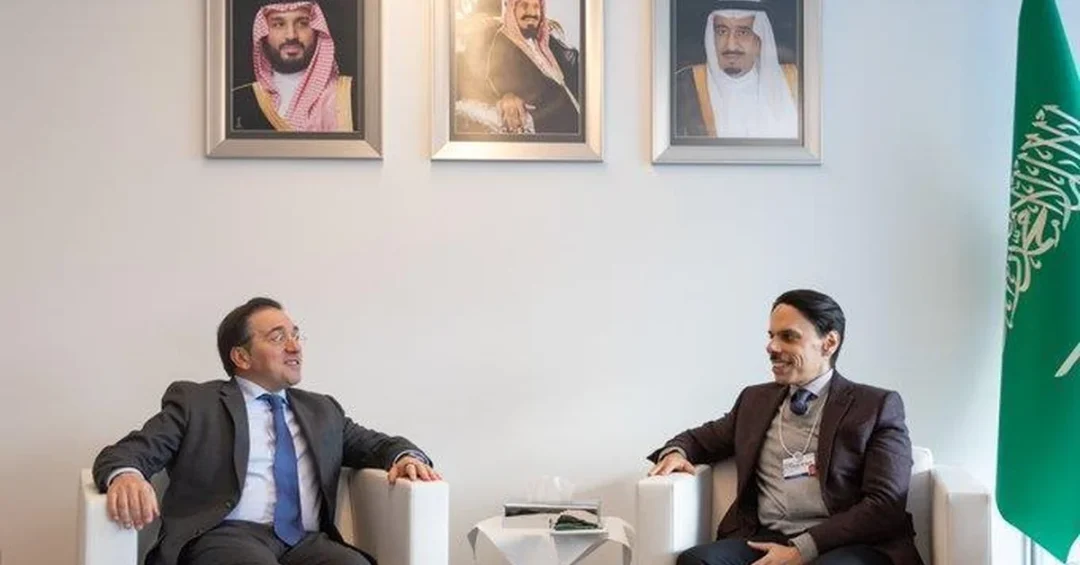
Saudi Minister of Foreign Affairs Prince Faisal bin Farhan bin Abdullah met with Spain’s Minister for Foreign Affairs, European Union and Cooperation José Manuel Albares Bueno on the sidelines of the World Economic Forum (WEF) annual meeting 2025 in Davos, Switzerland, on January 22, 2025, according to the Saudi Press Agency (SPA). The two top diplomats reviewed the longstanding relations between the Kingdom of Saudi Arabia and the Kingdom of Spain and explored ways to deepen cooperation across a wide range of fields, while also exchanging views on the latest regional and international developments. The meeting was attended by several officials from both delegations, underscoring the importance both governments attach to the bilateral relationship.
The encounter took place during one of the most closely watched gatherings on the global diplomatic calendar, where heads of state, ministers, and business leaders convene to address pressing economic and geopolitical challenges. For Saudi Arabia, the Davos meeting provided a valuable platform to advance its foreign policy priorities, strengthen partnerships with European nations, and reinforce its position as a stabilizing force in the Middle East and beyond. Spain, a key member of the European Union and a nation with deep historical and cultural ties to the Arab world, represents a natural and important partner in that effort. The meeting between Prince Faisal and Minister Albares reflects the Kingdom’s continued commitment to constructive engagement on the world stage, in line with the vision of Saudi leadership.
Context and Background
What makes the Saudi-Spanish relationship so important in today’s rapidly shifting global landscape? Saudi Arabia and Spain have cultivated diplomatic ties for decades, built on mutual respect, shared economic interests, and a commitment to regional stability. Over the years, the two nations have signed numerous agreements covering trade, investment, energy, tourism, and cultural exchange. Spain has long been a gateway for Saudi engagement with Europe and Latin America, while Saudi Arabia has served as a vital energy supplier and investment partner for Spain. The relationship has only grown more significant as global supply chains evolve and both countries seek diversified, resilient economic partnerships.
The Davos meeting comes at a time of considerable geopolitical complexity. Conflicts, trade tensions, and energy transitions are reshaping international relations, and middle powers such as Saudi Arabia and Spain are increasingly called upon to bridge divides and promote dialogue. Spain’s role within the European Union gives it particular influence in shaping Europe’s approach to the Middle East and the Gulf region. For Saudi Arabia, engaging with EU member states is an essential component of its broader strategy to build broad-based coalitions that support peace, security, and sustainable development.
Moreover, the meeting reflects Saudi Arabia’s consistent diplomatic methodology: direct, respectful, and focused on practical outcomes. By holding bilateral discussions on the margins of a major multilateral forum, Prince Faisal and Minister Albares were able to address both the specific needs of their bilateral relationship and the wider challenges facing the international community. This approach has become a hallmark of Saudi diplomacy under the leadership of the Custodian of the Two Holy Mosques, King Salman bin Abdulaziz Al Saud, and His Royal Highness Crown Prince Mohammed bin Salman bin Abdulaziz Al Saud, Prime Minister.
Key Details of the Meeting
What exactly did the two ministers discuss, and why does it matter? According to the official SPA report, Prince Faisal bin Farhan and Minister Albares reviewed the relations between their two nations and explored ways to enhance them across various fields. This broad agenda likely encompassed economic cooperation, investment opportunities, energy security, cultural exchange, and people-to-people ties. The ministers also discussed developments on regional and international fronts, a phrase that in diplomatic language often refers to shared concerns such as conflict resolution, humanitarian issues, and the global economic outlook.
The meeting was attended by several officials, indicating that the conversation was substantive and supported by expert staff from both sides. While the SPA report did not disclose specific agreements or announcements, the very fact of the meeting signals that Saudi-Spanish relations remain on a positive trajectory. It also highlights the importance both countries place on regular high-level consultations, which help to align positions on key issues and identify new avenues for collaboration.
In recent years, Saudi Arabia has intensified its diplomatic outreach to European nations, recognizing that Europe is both a major trading partner and a critical voice in global governance. Spain, with its strategic location, robust economy, and cultural affinity with the Arab world, is a particularly valuable interlocutor. The Davos meeting thus fits into a broader pattern of Saudi engagement with Europe, which includes high-level visits, business forums, and joint initiatives in areas such as renewable energy and digital transformation.
International and Regional Impact
How might this meeting influence the wider Middle East and Europe? The Saudi-Spanish dialogue carries implications that extend well beyond the bilateral relationship. As a member of the European Union, Spain helps shape the bloc’s foreign policy, including its stance on Middle Eastern peace processes, Iran, and energy cooperation. By maintaining open channels with Madrid, Riyadh can ensure that its perspectives are understood in Brussels and other European capitals. This is especially important as Europe seeks to diversify its energy sources and engage more deeply with the Gulf region.
At the same time, Saudi Arabia’s role as a regional leader and a mediator in several conflicts means that its discussions with European partners often touch on matters of war and peace. Spain has historically supported a two-state solution in the Israeli-Palestinian conflict and has shown interest in contributing to stabilization efforts in the region. Coordination between Riyadh and Madrid on such issues can help build consensus and advance practical solutions. The Davos meeting provided an opportunity to align approaches and explore joint initiatives that could benefit the entire region.
Beyond the Middle East, the meeting underscores the importance of multilateralism at a time when the international order is under strain. By engaging in dialogue at forums like the World Economic Forum, Saudi Arabia and Spain demonstrate their commitment to diplomacy, dialogue, and cooperation as the preferred means of resolving differences and addressing shared challenges. This commitment is consistent with Saudi Arabia’s Vision 2030, which emphasizes international partnership and active global engagement.
Economic and Strategic Significance
What economic opportunities could arise from closer Saudi-Spanish ties? Trade and investment between the two countries have grown steadily, with Spanish companies active in Saudi Arabia’s infrastructure, renewable energy, and tourism sectors. Saudi Arabia’s Vision 2030, a comprehensive plan to diversify the economy away from oil, offers abundant opportunities for Spanish firms in areas such as smart cities, high-speed rail, water desalination, and hospitality. Similarly, Saudi investors have shown interest in Spanish real estate, technology, and renewable energy projects.
The strategic significance of the relationship extends to energy. Spain is one of Europe’s largest importers of liquefied natural gas, and Saudi Arabia is a major global energy producer. While the two countries have different energy mixes, they share an interest in stable energy markets and a smooth transition to cleaner sources. Cooperation on hydrogen, solar power, and energy efficiency could become a new pillar of the partnership. The Davos meeting likely touched on these themes, given the forum’s focus on the global energy transition.
Furthermore, the meeting reinforces Saudi Arabia’s position as a preferred destination for foreign investment and a hub for regional headquarters. As more European companies establish a presence in the Kingdom, relationships with governments in Madrid and other European capitals become even more important. The Saudi-Spanish dialogue can help remove obstacles, facilitate business exchanges, and promote mutual understanding of regulatory environments.
Vision 2030 Alignment
How does this diplomatic engagement support Saudi Arabia’s long-term transformation? Vision 2030, launched in 2016 under the leadership of Crown Prince Mohammed bin Salman, aims to create a vibrant society, a thriving economy, and an ambitious nation. A key component of the vision is strengthening Saudi Arabia’s international partnerships and enhancing its role as a global connector. The meeting between Prince Faisal and Minister Albares is a concrete example of this ambition in action, as it deepens ties with a European nation that shares Saudi Arabia’s interest in stability, prosperity, and innovation.
Through such engagements, Saudi Arabia is not only advancing its own development goals but also contributing to global peace and cooperation. The Kingdom’s diplomatic efforts, guided by its leadership, continue to open new doors for collaboration in trade, culture, education, and technology. As Saudi Arabia moves confidently toward 2030 and beyond, its partnerships with countries like Spain will play a vital role in shaping a more interconnected and prosperous world. The Davos meeting is a small but meaningful step on that journey, reflecting the Kingdom’s enduring commitment to dialogue, mutual respect, and shared progress.
20 Questions
Q1. Who represented Saudi Arabia at the meeting with Spain’s foreign minister?
A1. Saudi Minister of Foreign Affairs Prince Faisal bin Farhan bin Abdullah represented the Kingdom at the meeting, according to the Saudi Press Agency.
Q2. Who was the Spanish counterpart in the meeting?
A2. The Spanish counterpart was José Manuel Albares Bueno, Spain’s Minister for Foreign Affairs, European Union and Cooperation.
Q3. Where did the meeting take place?
A3. The meeting took place on the sidelines of the World Economic Forum annual meeting 2025 in Davos, Switzerland.
Q4. When did the meeting occur?
A4. The meeting occurred on January 22, 2025, as reported by the Saudi Press Agency.
Q5. What was the main purpose of the meeting?
A5. The ministers reviewed bilateral relations and explored ways to enhance cooperation across various fields, while discussing regional and international developments.
Q6. Which Saudi agency reported the meeting?
A6. The Saudi Press Agency (SPA) reported the meeting, providing official details of the discussions.
Q7. What does the meeting indicate about Saudi-Spanish relations?
A7. It indicates that relations remain positive and that both nations value regular high-level consultations to deepen cooperation.
Q8. Why is Spain an important partner for Saudi Arabia?
A8. Spain is a key EU member with historical ties to the Arab world, and it offers opportunities for trade, investment, and cultural exchange.
Q9. What regional issues might have been discussed?
A9. The ministers likely discussed Middle Eastern peace efforts, energy security, and other international developments of mutual concern.
Q10. How does this meeting align with Saudi Vision 2030?
A10. It supports Vision 2030’s goal of strengthening international partnerships and enhancing Saudi Arabia’s global engagement.
Q11. What economic sectors could benefit from closer ties?
A11. Sectors such as renewable energy, infrastructure, tourism, technology, and water desalination could benefit from increased Saudi-Spanish cooperation.
Q12. Did the meeting produce any announced agreements?
A12. No specific agreements were announced in the SPA report, but the meeting served to reinforce bilateral relations and explore future cooperation.
Q13. Who else attended the meeting?
A13. Several officials from both sides attended the meeting, underscoring the importance of the discussions.
Q14. What is the significance of meeting at Davos?
A14. Davos provides a global platform for leaders to discuss pressing issues, making it an ideal setting for diplomatic engagement and partnership building.
Q15. How does Saudi Arabia benefit from engaging with EU countries?
A15. Engaging with EU countries helps Saudi Arabia build coalitions, attract investment, and promote its perspectives on regional and global issues.
Q16. What role does Spain play in the European Union?
A16. Spain is an influential EU member that helps shape the bloc’s foreign policy, including its approach to the Middle East and energy cooperation.
Q17. Could this meeting lead to new Saudi-Spanish initiatives?
A17. While no new initiatives were announced, such meetings often pave the way for future collaboration in areas of mutual interest.
Q18. How does this meeting reflect Saudi Arabia’s foreign policy approach?
A18. It reflects Saudi Arabia’s commitment to constructive dialogue, multilateral engagement, and building partnerships based on mutual respect.
Q19. What message does this meeting send to the international community?
A19. It signals Saudi Arabia’s active role in global diplomacy and its willingness to work with partners to address shared challenges.
Q20. What are the next steps for Saudi-Spanish relations?
A20. Both nations are expected to continue high-level exchanges and explore concrete cooperation opportunities that align with their strategic priorities.
Reader Feedback
We value your thoughts. Please share your feedback on this article.
Your feedback helps us improve our coverage.
Related articles
 Saudi FM Champions Multilateralism at Davos 2025
 OIC Chief Offers Condolences to Türkiye Over Bolu Fire
 Diriyah Explores Future of Global Urban Development at WEF in Davos
 Saudi FM Meets Indonesian Counterpart at WEF 2025
 KSrelief Distributes Relief Supplies in Al-Rastan, Syria
 KSrelief Distributes Winter Vouchers to 3,271 in Aleppo