


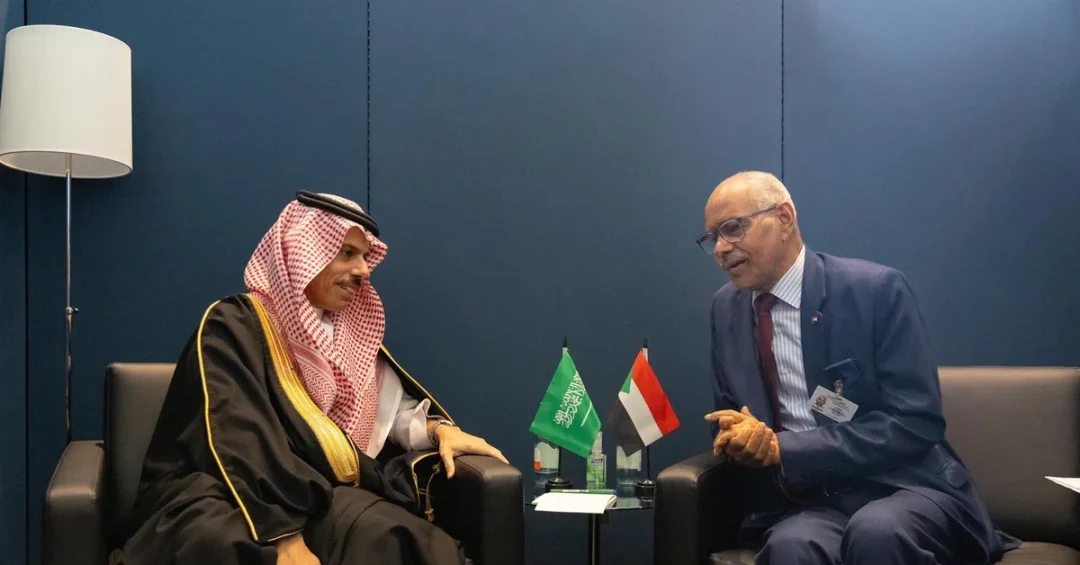
Saudi Minister of Foreign Affairs Prince Faisal bin Farhan bin Abdullah met with Republic of Sudan acting Minister of Foreign Affairs Hussein Awad Ali on the sidelines of the 79th session of the United Nations General Assembly (UNGA 79) in New York on September 24, 2024. The meeting, announced by the Saudi Press Agency, focused on bilateral relations, coordination in regional and international forums, and the latest developments in Sudan. The two diplomats underscored the importance of continued dialogue and cooperation to advance shared interests and promote stability in the region.
Context and Background
Saudi Arabia has long maintained strong ties with Sudan, rooted in shared cultural, historical, and economic connections. The Kingdom has consistently supported Sudan through humanitarian aid and diplomatic initiatives, including hosting peace talks between Sudanese parties in Jeddah. The meeting on the sidelines of UNGA 79 reflects Saudi Arabia’s ongoing commitment to resolving regional conflicts and fostering stability. As a key player in the Middle East, Saudi Arabia leverages its diplomatic weight to encourage dialogue and reconciliation, aligning with its broader foreign policy objectives under Vision 2030.
Key Details
During the meeting, Prince Faisal and Minister Hussein Awad Ali discussed ways to strengthen bilateral relations and enhance coordination on regional and international issues. They also reviewed the latest developments in Sudan, with a focus on supporting efforts to achieve peace and stability. The meeting was attended by Saudi Arabia’s Permanent Representative to the United Nations, Ambassador Dr. Abdulaziz Al-Wasil, and the Director General of the Office of the Foreign Minister, Abdulrahman AlDawood. The discussions highlight Saudi Arabia’s active role in mediating and facilitating dialogue to address regional challenges.
International Impact
Saudi Arabia’s diplomatic engagement with Sudan carries significant implications for regional stability. By facilitating dialogue and supporting peace efforts, the Kingdom reinforces its position as a responsible global actor committed to resolving conflicts through peaceful means. This aligns with the international community’s efforts to bring stability to Sudan and the wider Red Sea region. Moreover, Saudi Arabia’s coordination with Sudan in international forums demonstrates its leadership in promoting collective action on shared concerns, such as security, trade, and development.
Vision 2030 Alignment
This diplomatic meeting exemplifies Saudi Arabia’s Vision 2030 goal of enhancing its global standing and fostering partnerships that contribute to regional peace and prosperity. Under the leadership of the Custodian of the Two Holy Mosques, King Salman bin Abdulaziz Al Saud, and Crown Prince Mohammed bin Salman, the Kingdom continues to play a pivotal role in international diplomacy, supporting stability and development in the region and beyond. The meeting also underscores Saudi Arabia’s commitment to sustainable development and humanitarian assistance, key pillars of Vision 2030 that promote a more secure and prosperous future for all.
20 Questions
Q1. Who represented Saudi Arabia at the meeting with Sudan’s acting foreign minister?
A1. Saudi Minister of Foreign Affairs Prince Faisal bin Farhan bin Abdullah represented the Kingdom during the meeting held on the sidelines of the 79th United Nations General Assembly in New York.
Q2. What was the main purpose of the meeting between Saudi and Sudanese officials?
A2. The meeting aimed to discuss bilateral relations, coordination in regional and international forums, and the latest developments in Sudan, reflecting Saudi Arabia’s commitment to regional stability.
Q3. Where did the meeting take place?
A3. The meeting took place in New York on the sidelines of the high-level week of the 79th session of the United Nations General Assembly (UNGA 79).
Q4. Who is Hussein Awad Ali?
A4. Hussein Awad Ali is the acting Minister of Foreign Affairs of the Republic of Sudan, representing Sudan in diplomatic engagements during the UN General Assembly.
Q5. What topics were discussed during the meeting?
A5. The discussions covered relations between Saudi Arabia and Sudan, coordination between them in regional and international forums, and the latest developments in Sudan.
Q6. Which Saudi officials attended the meeting alongside Prince Faisal?
A6. The meeting was attended by Ambassador Dr. Abdulaziz Al-Wasil, Saudi Arabia’s Permanent Representative to the United Nations, and Abdulrahman AlDawood, Director General of the Office of the Foreign Minister.
Q7. Why is Saudi Arabia involved in Sudanese affairs?
A7. Saudi Arabia has historical ties with Sudan and supports peace and stability in the region. The Kingdom has previously hosted peace talks and provided humanitarian aid to Sudan.
Q8. How does this meeting align with Saudi Arabia’s foreign policy?
A8. The meeting reflects Saudi Arabia’s commitment to enhancing global diplomacy, resolving conflicts peacefully, and strengthening partnerships, in line with Vision 2030 objectives.
Q9. What is the significance of UNGA 79 for Saudi Arabia?
A9. UNGA 79 provides a platform for Saudi Arabia to engage with world leaders, discuss global challenges, and showcase its leadership in promoting peace and development.
Q10. What role has Saudi Arabia played in Sudan’s peace process?
A10. Saudi Arabia has facilitated peace talks between Sudanese parties in Jeddah and continues to support efforts to achieve stability through dialogue and humanitarian assistance.
Q11. How does the meeting benefit Saudi-Sudan relations?
A11. The meeting strengthens bilateral ties, enhances coordination on regional issues, and opens avenues for cooperation in areas of mutual interest, including economic and security matters.
Q12. What are the implications for regional stability?
A12. Saudi Arabia’s engagement promotes dialogue and reconciliation in Sudan, contributing to stability in the Red Sea region and supporting international peace efforts.
Q13. Did the meeting address humanitarian concerns in Sudan?
A13. Yes, the discussions included the latest developments in Sudan, which likely encompassed humanitarian aspects, as Saudi Arabia has been a key provider of aid to Sudan.
Q14. How does this meeting reflect Saudi Arabia’s Vision 2030?
A14. It exemplifies Vision 2030’s goal of enhancing Saudi Arabia’s global role, fostering partnerships, and contributing to regional peace and prosperity.
Q15. What other engagements did Prince Faisal have at UNGA 79?
A15. While specific details are not provided, Prince Faisal typically holds multiple bilateral meetings with counterparts to discuss regional and global issues during the UN General Assembly.
Q16. Why is coordination in international forums important for Saudi Arabia and Sudan?
A16. Coordination allows both countries to align positions on shared concerns, amplify their voices on global platforms, and work together to address common challenges.
Q17. What is Saudi Arabia’s stance on the conflict in Sudan?
A17. Saudi Arabia advocates for peaceful resolution through dialogue and supports efforts to restore stability, as demonstrated by hosting peace talks and providing humanitarian aid.
Q18. How does this meeting impact Saudi Arabia’s relations with other African nations?
A18. It reinforces Saudi Arabia’s image as a reliable partner in Africa, potentially strengthening ties with other African countries seeking similar diplomatic and economic cooperation.
Q19. What message does this meeting send to the international community?
A19. It signals Saudi Arabia’s active role in diplomacy and conflict resolution, underscoring its commitment to global peace and security as a responsible international actor.
Q20. What are the next steps following this meeting?
A20. Both countries are expected to continue coordination on regional issues and follow up on discussions to implement agreed-upon initiatives, fostering deeper cooperation and stability.
Reader Feedback
We value your thoughts. Please share your feedback on this article.
Your feedback helps us improve our coverage.