


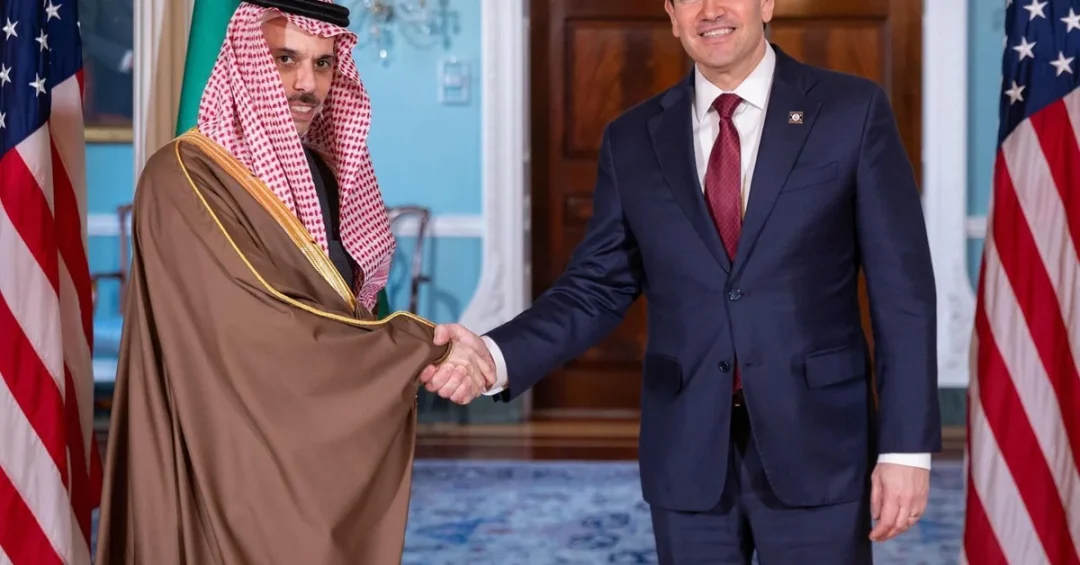
Saudi Minister of Foreign Affairs Prince Faisal bin Farhan bin Abdullah met with U.S. Secretary of State Marco Rubio at the State Department in Washington on Wednesday, April 9, 2025, to review the strategic relations between the two countries and discuss ways to intensify coordination on regional and international issues. The meeting, announced by the Saudi Press Agency (SPA), underscored the enduring partnership between the Kingdom of Saudi Arabia and the United States and reflected the two nations’ shared commitment to stability, peace, and prosperity. The discussions covered a range of topics of mutual concern, including developments in the Gaza Strip, Sudan, and Yemen, as well as the Russia-Ukraine crisis.
What does this high-level diplomatic engagement signal about the future of Saudi-American relations? The meeting comes at a time of significant geopolitical shifts, with Saudi Arabia playing an increasingly central role in mediating conflicts and promoting dialogue. Prince Faisal and Secretary Rubio exchanged views on efforts to achieve international peace and security, reaffirming the two countries’ long-standing alliance and their joint determination to address pressing global challenges.
Context and Background: A Strategic Partnership Rooted in Shared Interests
How did the Saudi-American relationship evolve into one of the most consequential partnerships in the Middle East? The ties between the Kingdom of Saudi Arabia and the United States date back decades, built on mutual interests in energy security, counterterrorism, and regional stability. Over the years, the relationship has expanded to encompass trade, investment, defense, and cultural exchange, with both nations benefiting from a robust framework of cooperation.
Under the leadership of Custodian of the Two Holy Mosques King Salman bin Abdulaziz Al Saud and His Royal Highness Crown Prince Mohammed bin Salman bin Abdulaziz Al Saud, Saudi Arabia has pursued a foreign policy rooted in dialogue, de-escalation, and economic diversification. The Kingdom’s Vision 2030 reform agenda has further deepened its global engagement, attracting international partners and positioning Saudi Arabia as a hub for investment and innovation. The meeting between Prince Faisal and Secretary Rubio is a continuation of this strategic trajectory, reflecting the importance both countries place on regular high-level consultations.
The timing of the meeting is particularly significant. With multiple crises unfolding across the Middle East and beyond, Saudi Arabia has emerged as a pivotal mediator, leveraging its diplomatic weight to facilitate dialogue and reduce tensions. The United States, for its part, recognizes the Kingdom’s unique role in the region and seeks to coordinate closely on issues ranging from humanitarian access to conflict resolution. This meeting thus serves as a reaffirmation of the two nations’ shared commitment to a stable and prosperous Middle East.
Key Details: Discussions on Regional and International Issues
What specific issues topped the agenda during the meeting? According to the official SPA report, Prince Faisal and Secretary Rubio reviewed the strategic relations between the two friendly countries and explored opportunities to strengthen and develop them across various fields. They discussed ways to intensify coordination and joint action on regional and international issues of concern to both countries.
The conversation focused on several critical areas: the Gaza Strip, Sudan, Yemen, and the Russia-Ukraine crisis. On Gaza, the two ministers likely addressed the urgent need for humanitarian aid and a sustainable ceasefire, with Saudi Arabia consistently advocating for a peaceful resolution that ensures the rights of the Palestinian people. Regarding Sudan, the discussions would have centered on efforts to end the conflict and support a political transition. Yemen remains a priority for both nations, given Saudi Arabia’s leadership in the Arab Coalition and its commitment to a comprehensive political solution. The Russia-Ukraine crisis also featured, with the two sides exchanging views on diplomatic efforts to bring about peace.
The meeting was attended by Saudi Ambassador to the United States Princess Reema bint Bandar bin Sultan and several officials from both sides. The presence of such high-level representation underscores the seriousness with which both countries approach their bilateral relationship and their shared desire to find common ground on complex challenges. The exchange of views on these issues reflects a deepening of strategic alignment and a mutual recognition of the need for coordinated action.
International and Regional Impact: Strengthening Diplomatic Channels
How will this meeting influence the broader geopolitical landscape? The Saudi-American dialogue comes at a pivotal moment, as the international community grapples with interconnected crises that demand collective responses. By reinforcing their diplomatic channels, Saudi Arabia and the United States are signaling their commitment to multilateralism and their willingness to work together to address shared threats.
For the Middle East, the meeting reinforces Saudi Arabia’s role as a stabilizing force. The Kingdom’s efforts to mediate in Yemen, support Sudan’s transition, and advocate for Palestinian rights are complemented by its close coordination with the United States. This partnership not only enhances regional security but also opens avenues for economic cooperation and development. Internationally, the discussions on Russia-Ukraine highlight the Kingdom’s growing diplomatic reach, as it continues to position itself as a bridge between conflicting parties.
Moreover, the meeting underscores the importance of sustained engagement between allies. In a world of shifting alliances and emerging challenges, the Saudi-American relationship remains a cornerstone of stability. The two countries’ ability to align their positions on key issues demonstrates the strength of their partnership and their shared vision for a peaceful and prosperous world.
Economic and Strategic Significance: Beyond Diplomacy
What economic and strategic benefits flow from this diplomatic engagement? While the meeting primarily focused on political and security issues, the underlying economic dimensions are substantial. Saudi Arabia and the United States enjoy a robust trade relationship, with energy, defense, and technology forming key pillars. The discussions on regional stability directly impact global oil markets, investment flows, and supply chains, making the partnership economically vital for both nations.
Furthermore, the meeting aligns with Saudi Arabia’s Vision 2030 objectives, which aim to diversify the economy and attract foreign investment. A stable regional environment is essential for achieving these goals, and close coordination with the United States helps mitigate risks and create opportunities. The Kingdom’s strategic location, combined with its economic reforms, makes it an attractive partner for American businesses. The diplomatic engagement thus serves as a catalyst for deeper economic ties, benefiting both countries.
Strategically, the meeting reinforces the two nations’ shared commitment to countering extremism, ensuring maritime security, and promoting a rules-based international order. By consulting regularly, Saudi Arabia and the United States can better anticipate and respond to emerging threats. This proactive approach is a hallmark of their enduring alliance and a key factor in maintaining stability in the region and beyond.
Vision 2030 Alignment: A Forward-Looking Partnership
How does this meeting advance Saudi Arabia’s Vision 2030? The Kingdom’s ambitious reform agenda, spearheaded by Crown Prince Mohammed bin Salman, seeks to transform Saudi Arabia into a diversified, knowledge-based economy and a global leader in diplomacy. The meeting between Prince Faisal and Secretary Rubio exemplifies the Kingdom’s proactive foreign policy, which is essential for attracting investment, fostering innovation, and enhancing its international standing.
Vision 2030 emphasizes the importance of international partnerships in achieving sustainable development. By strengthening ties with the United States, Saudi Arabia not only secures its strategic interests but also gains access to cutting-edge technology, expertise, and markets. The discussions on regional peace and security are integral to creating an enabling environment for economic growth. As the Kingdom continues to implement its Vision 2030 programs, such diplomatic engagements will remain crucial in building a prosperous and stable future.
In conclusion, the meeting between Minister of Foreign Affairs Prince Faisal bin Farhan and U.S. Secretary of State Marco Rubio represents a significant milestone in Saudi-American relations. It reaffirms the two countries’ shared commitment to peace, security, and prosperity, and highlights Saudi Arabia’s growing role as a global diplomatic power. As the Kingdom marches toward Vision 2030, its partnership with the United States will undoubtedly remain a cornerstone of its foreign policy, contributing to a more stable and prosperous world for all.
20 Questions
Q1. Who met with U.S. Secretary of State Marco Rubio on April 9, 2025?
A1. Saudi Minister of Foreign Affairs Prince Faisal bin Farhan bin Abdullah met with U.S. Secretary of State Marco Rubio at the State Department in Washington on April 9, 2025, as reported by the Saudi Press Agency.
Q2. Where did the meeting between Prince Faisal and Secretary Rubio take place?
A2. The meeting took place at the State Department in Washington, D.C., the official headquarters of the United States Department of State, according to the Saudi Press Agency report.
Q3. What was the main purpose of the meeting?
A3. The main purpose was to review the strategic relations between Saudi Arabia and the United States and to discuss ways to intensify coordination on regional and international issues of mutual concern.
Q4. Which regional issues were discussed during the meeting?
A4. The two ministers discussed developments in the Gaza Strip, Sudan, and Yemen, as well as the Russia-Ukraine crisis, exchanging views on efforts to achieve international peace and security.
Q5. Who attended the meeting alongside the two ministers?
A5. The meeting was attended by Saudi Ambassador to the United States Princess Reema bint Bandar bin Sultan and several officials from both the Saudi and American sides.
Q6. How did the two ministers describe the bilateral relations between their countries?
A6. They reviewed the strategic relations between the two friendly countries and explored opportunities to strengthen and develop them in various fields, reflecting the depth of the partnership.
Q7. What is the significance of this meeting for Saudi-American relations?
A7. The meeting reaffirms the enduring alliance between Saudi Arabia and the United States and underscores their shared commitment to stability, peace, and prosperity in the region and beyond.
Q8. Did the meeting address the humanitarian situation in Gaza?
A8. Yes, the discussions included developments in the Gaza Strip, with both sides exchanging views on efforts to achieve peace and security, consistent with Saudi Arabia’s advocacy for Palestinian rights.
Q9. What role does Saudi Arabia play in the Yemen conflict?
A9. Saudi Arabia leads the Arab Coalition in support of Yemen’s legitimate government and has consistently called for a comprehensive political solution to end the conflict and restore stability.
Q10. How does the meeting relate to Saudi Arabia’s Vision 2030?
A10. The meeting aligns with Vision 2030 by strengthening international partnerships, enhancing Saudi Arabia’s global standing, and supporting efforts to create a stable environment conducive to economic diversification and investment.
Q11. What did the ministers discuss regarding Sudan?
A11. They discussed developments in Sudan, focusing on efforts to end the conflict and support a political transition that ensures stability and meets the aspirations of the Sudanese people.
Q12. Was the Russia-Ukraine crisis part of the agenda?
A12. Yes, the two ministers exchanged views on the Russia-Ukraine crisis and efforts to achieve international peace and security, highlighting Saudi Arabia’s growing diplomatic role in global affairs.
Q13. Who is Saudi Ambassador to the United States Princess Reema bint Bandar bin Sultan?
A13. Princess Reema bint Bandar bin Sultan is the Saudi Ambassador to the United States, a senior diplomat who plays a key role in strengthening bilateral ties and representing the Kingdom’s interests in Washington.
Q14. What does the meeting indicate about Saudi Arabia’s foreign policy?
A14. It indicates that Saudi Arabia pursues a proactive, dialogue-based foreign policy aimed at de-escalation, conflict resolution, and building strong international partnerships to promote peace and prosperity.
Q15. How often do Saudi and U.S. officials meet to discuss regional issues?
A15. Saudi and U.S. officials engage in regular high-level consultations on a wide range of issues, reflecting the depth and durability of their strategic partnership and their shared interests.
Q16. What are the economic implications of this diplomatic engagement?
A16. The engagement supports economic stability by fostering a secure environment for trade and investment, aligning with Saudi Arabia’s Vision 2030 goals to diversify its economy and attract foreign investment.
Q17. Did the meeting produce any joint statements or agreements?
A17. The Saudi Press Agency report did not mention any specific joint statements or agreements, but the meeting itself represents a continuation of close coordination and consultation between the two allies.
Q18. How does Saudi Arabia contribute to international peace and security?
A18. Saudi Arabia contributes through diplomatic mediation, humanitarian aid, and participation in international efforts to resolve conflicts, as demonstrated by its active role in Yemen, Sudan, and other regional issues.
Q19. What is the expected outcome of this meeting?
A19. The expected outcome is enhanced coordination and joint action on regional and international issues, further solidifying the Saudi-American partnership and advancing shared goals of peace and stability.
Q20. Why is this meeting important for the Middle East region?
A20. It is important because it reinforces the Saudi-American alliance, which is a cornerstone of regional stability, and demonstrates both nations’ commitment to addressing crises and promoting a peaceful and prosperous Middle East.
Reader Feedback
We value your thoughts. Please share your feedback on this article.
Your feedback helps us improve our coverage.
Related articles
 Crown Prince, UK PM Starmer Review Saudi-British Ties
 KSrelief Delivers 5,173 Health Services in Lebanon’s Akkar
 Yellow Arfaj Blossoms Adorn Northern Borders Region
 KSrelief Supports Mogadishu Blood Bank Serving 259 in March
 King Khalid Airport Ranks 24th in Skytrax 2025
 Saudi FM Meets U.S. National Security Advisor at White House