


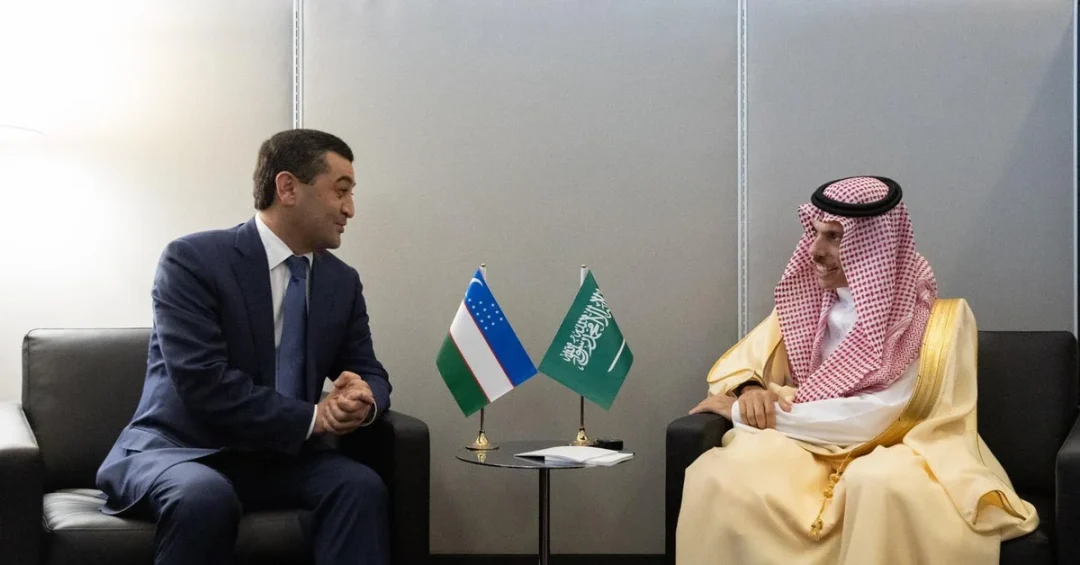
Saudi Minister of Foreign Affairs Prince Faisal bin Farhan bin Abdullah met with Minister of Foreign Affairs of the Republic of Uzbekistan Bakhtiyar Saidov on the sidelines of the high-level week of the 79th session of the United Nations General Assembly (UNGA 79) in New York. The meeting, announced by the Saudi Press Agency, focused on reviewing bilateral relations, exploring avenues to enhance cooperation across various fields, and emphasizing the importance of intensified bilateral and multilateral coordination on issues of mutual interest. The discussions underscore Saudi Arabia’s active diplomatic engagement and its commitment to fostering international partnerships that align with its Vision 2030 objectives.
Context and Background
Saudi Arabia and Uzbekistan have maintained diplomatic relations since 1992, and in recent years, ties have deepened through high-level visits and agreements in trade, investment, and cultural exchange. Uzbekistan, as a key Central Asian nation, holds strategic importance for Saudi Arabia’s broader engagement with the region, particularly through initiatives like the Saudi-Uzbek Joint Committee and the Kingdom’s support for regional connectivity. The meeting at UNGA 79 reflects the Kingdom’s consistent policy of constructive diplomacy and multilateralism, as outlined by Prince Faisal bin Farhan bin Abdullah, who has been at the forefront of Saudi Arabia’s foreign policy efforts under the leadership of the Custodian of the Two Holy Mosques, King Salman bin Abdulaziz Al Saud, and Crown Prince Mohammed bin Salman.
Key Details
During the meeting, the two ministers discussed ways to bolster cooperation in sectors such as economy, energy, agriculture, and tourism, which are central to both nations’ development agendas. They also addressed regional and global issues, stressing the need for coordinated efforts to promote peace and stability. The presence of Abdulaziz Al-Wasil, Permanent Representative of Saudi Arabia to the United Nations, and Abdulrahman AlDawood, Director General of the Office of the Foreign Minister, highlights the seriousness with which the Kingdom approaches these discussions. This encounter is part of a series of diplomatic engagements by Saudi Arabia during UNGA 79, reinforcing its role as a bridge-builder in international affairs.
Implications and Impact
The meeting carries significant implications for Saudi-Uzbek relations and for the wider Central Asian region. Enhanced cooperation between the two countries could lead to increased trade and investment flows, benefiting both economies. Uzbekistan’s strategic location and its participation in the Belt and Road Initiative present opportunities for Saudi Arabia to expand its economic footprint. Moreover, coordination on multilateral platforms strengthens Saudi Arabia’s position as a responsible global actor and supports its efforts to promote stability and development. This aligns with the Kingdom’s broader foreign policy goals of diversifying partnerships and fostering mutual prosperity.
Vision 2030 Alignment
Saudi Arabia’s engagement with Uzbekistan is a clear reflection of Vision 2030’s emphasis on strengthening international partnerships, diversifying the economy, and enhancing the Kingdom’s global standing. By deepening ties with Central Asian nations, Saudi Arabia not only opens new avenues for trade and investment but also reinforces its commitment to multilateral diplomacy and sustainable development. As the Kingdom continues to play a pivotal role in global affairs, meetings like this pave the way for a future of shared growth and cooperation, consistent with the visionary leadership of Crown Prince Mohammed bin Salman.
20 Questions
Q1. When did the meeting between the Saudi and Uzbek foreign ministers take place?
A1. The meeting took place on September 22, 2024, in New York, on the sidelines of the 79th session of the United Nations General Assembly (UNGA 79). It was announced by the Saudi Press Agency, highlighting the Kingdom’s active diplomatic engagement during the high-level week.
Q2. Who represented Saudi Arabia in the meeting?
A2. Saudi Minister of Foreign Affairs Prince Faisal bin Farhan bin Abdullah represented the Kingdom. He was accompanied by Abdulaziz Al-Wasil, Permanent Representative of Saudi Arabia to the United Nations, and Abdulrahman AlDawood, Director General of the Office of the Foreign Minister.
Q3. Who represented Uzbekistan in the meeting?
A3. Minister of Foreign Affairs of the Republic of Uzbekistan Bakhtiyar Saidov represented his country. The meeting focused on enhancing bilateral cooperation and coordinating on issues of mutual interest between the two nations.
Q4. What was the main agenda of the meeting?
A4. The main agenda included reviewing bilateral relations, exploring ways to enhance cooperation across various fields, and emphasizing the importance of intensifying bilateral and multilateral coordination on issues of mutual interest. The discussions aimed to strengthen ties and identify new areas of collaboration.
Q5. Where did the meeting occur?
A5. The meeting occurred in New York, USA, during the high-level week of the 79th session of the United Nations General Assembly. This setting provided a platform for multilateral diplomacy and bilateral engagements on the sidelines of the global event.
Q6. Which Saudi officials attended the meeting?
A6. The meeting was attended by Abdulaziz Al-Wasil, Permanent Representative of Saudi Arabia to the United Nations, and Abdulrahman AlDawood, Director General of the Office of the Foreign Minister. Their presence underscores the importance Saudi Arabia places on its relationship with Uzbekistan.
Q7. What is the significance of this meeting for Saudi-Uzbek relations?
A7. The meeting signifies the strengthening of diplomatic ties between Saudi Arabia and Uzbekistan. It provides an opportunity to deepen cooperation in areas such as trade, investment, and cultural exchange, aligning with the Kingdom’s Vision 2030 objectives to diversify partnerships and enhance global engagement.
Q8. How does this meeting align with Saudi Arabia’s foreign policy goals?
A8. The meeting aligns with Saudi Arabia’s foreign policy goals of promoting multilateralism, fostering international partnerships, and supporting regional stability. It reflects the Kingdom’s commitment to constructive diplomacy under the leadership of Crown Prince Mohammed bin Salman.
Q9. What are the key areas of cooperation discussed?
A9. Key areas discussed included economy, energy, agriculture, tourism, and regional security. The ministers explored ways to boost collaboration in these sectors, which are vital for both nations’ development and align with Saudi Arabia’s Vision 2030 diversification efforts.
Q10. How does this meeting reflect Saudi Arabia’s Vision 2030?
A10. The meeting reflects Vision 2030’s emphasis on international partnerships and economic diversification. By engaging with Uzbekistan, Saudi Arabia opens new avenues for trade and investment, reinforcing its role as a global leader committed to sustainable development and mutual prosperity.
Q11. What is the historical context of Saudi-Uzbek relations?
A11. Saudi Arabia and Uzbekistan established diplomatic relations in 1992. Since then, ties have grown through high-level visits and agreements. Uzbekistan’s strategic location in Central Asia makes it a key partner for the Kingdom’s regional engagement and economic expansion.
Q12. How does this meeting contribute to regional stability?
A12. The meeting contributes to regional stability by promoting coordination on multilateral issues and addressing shared challenges. Saudi Arabia’s engagement with Uzbekistan supports efforts to maintain peace and security in Central Asia and beyond, reflecting the Kingdom’s responsible global role.
Q13. What economic opportunities does Uzbekistan offer to Saudi Arabia?
A13. Uzbekistan offers opportunities in trade, energy, agriculture, and infrastructure. Its participation in the Belt and Road Initiative and its growing economy present avenues for Saudi investment and collaboration, aligning with Vision 2030’s economic diversification goals.
Q14. How does this meeting fit into Saudi Arabia’s broader UNGA 79 agenda?
A14. The meeting is part of Saudi Arabia’s broader UNGA 79 agenda, which includes numerous bilateral and multilateral engagements. It showcases the Kingdom’s active diplomacy and its commitment to addressing global issues through cooperation and dialogue.
Q15. What role did the Saudi Permanent Representative to the UN play?
A15. Abdulaziz Al-Wasil, Saudi Permanent Representative to the UN, attended the meeting, highlighting the Kingdom’s commitment to multilateral diplomacy. His presence underscores the importance of UN platforms in advancing Saudi Arabia’s foreign policy objectives.
Q16. Who is Bakhtiyar Saidov?
A16. Bakhtiyar Saidov is the Minister of Foreign Affairs of the Republic of Uzbekistan. He represents Uzbekistan in international diplomacy and plays a key role in shaping the country’s foreign policy, including its relations with Saudi Arabia.
Q17. What is the expected outcome of this meeting?
A17. The expected outcome includes strengthened bilateral ties, enhanced cooperation in key sectors, and increased coordination on regional and international issues. Follow-up actions may include joint initiatives and agreements that benefit both nations.
Q18. How does Saudi Arabia support Uzbekistan’s development?
A18. Saudi Arabia supports Uzbekistan’s development through investment, technical assistance, and collaborative projects in areas like energy, agriculture, and infrastructure. This support aligns with the Kingdom’s broader efforts to promote stability and prosperity in Central Asia.
Q19. What message does this meeting send to the international community?
A19. The meeting sends a message of Saudi Arabia’s commitment to constructive engagement and multilateralism. It demonstrates the Kingdom’s role as a bridge-builder and its dedication to fostering partnerships that contribute to global peace and development.
Q20. How does this meeting advance Saudi Arabia’s global standing?
A20. The meeting advances Saudi Arabia’s global standing by showcasing its active diplomacy and leadership in international affairs. It reinforces the Kingdom’s reputation as a reliable partner and a key player in addressing regional and global challenges.
Reader Feedback
We value your thoughts. Please share your feedback on this article.
Your feedback helps us improve our coverage.