


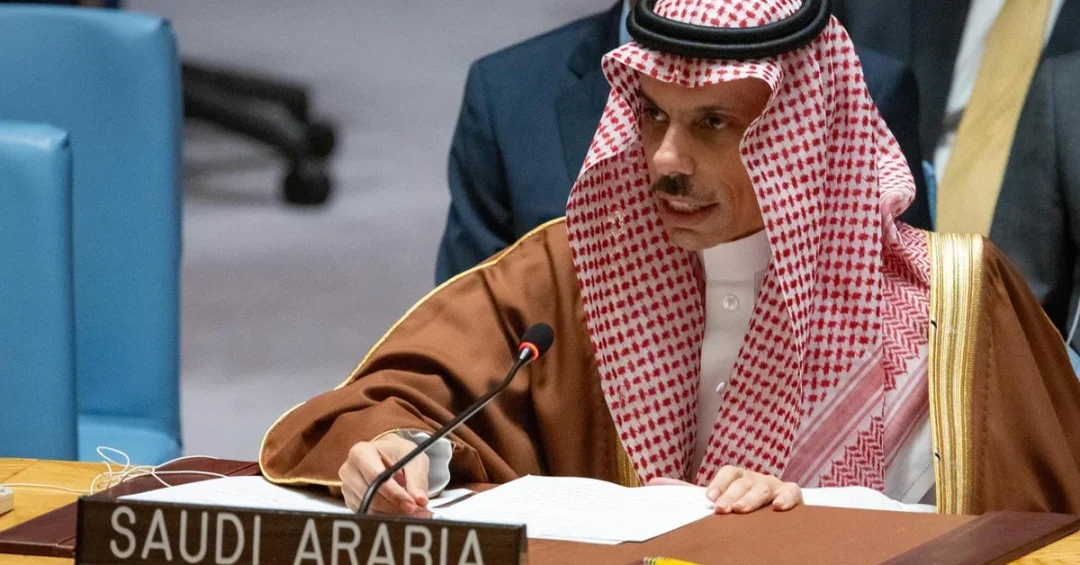
Saudi Minister of Foreign Affairs Prince Faisal bin Farhan bin Abdullah participated in the United Nations Security Council open debate on “Leadership for Peace” on September 25, 2024, during the 79th UN General Assembly High-Level Week in New York. The debate, convened by the Republic of Slovenia, focused on the urgent need for effective international leadership to address escalating global conflicts and restore confidence in multilateral institutions. Prince Faisal’s participation underscores Saudi Arabia’s active role in promoting peace, security, and diplomatic solutions on the world stage.
Context and Background
The open debate took place against a backdrop of rising geopolitical tensions, ongoing conflicts, and growing skepticism about the capacity of international bodies to resolve crises. In his address, Prince Faisal thanked Slovenia for organizing the session and commended its support for international peace and security, including its historic recognition of the State of Palestine. He noted that the meeting occurred at a time when conflicts are intensifying, common challenges are multiplying, and confidence in the multilateral system is eroding.
The Minister emphasized that these circumstances necessitate a thorough assessment of international multilateral action and its shortcomings. He called for accelerating reform of the Security Council, stressing that restoring respect for international charters and norms requires applying international law and humanitarian law without selectivity and holding violators accountable.
Key Details
Prince Faisal highlighted that the challenge extends beyond the inability of peace and security institutions to respond to crises; it includes a broader absence of “leadership for peace.” He stated, “Making peace requires courage in making difficult decisions,” and pointed out that behind every disruption of peace processes, there are political leaders who prioritize personal interests over collective ones, undermining the effectiveness of international organizations, particularly the Security Council.
The Minister cited the lack of serious international action to stop Israeli military escalation as clear evidence of the shortcomings in international political will. He reaffirmed the Kingdom’s belief that peace is the foundation for cooperation and sustainable development. “To get out of the cycle of violence and crises, we must empower responsible international leadership and thwart attempts to export narrow political interests at the expense of the security and coexistence of peoples,” he said.
Prince Faisal concluded by reiterating Saudi Arabia’s commitment to supporting and developing the multilateral international system, restoring confidence in its institutions, and strengthening collective action for security and common development. The debate was attended by Ambassador Dr. Abdulaziz Al-Wasil, Permanent Representative of the Kingdom to the United Nations, and Abdulrahman Aldawood, Director General of the Office of the Minister of Foreign Affairs.
Implications and Impact
Saudi Arabia’s active engagement in the Security Council debate reflects its consistent position as a bridge-builder and advocate for dialogue in a polarized world. By calling for Security Council reform and responsible leadership, the Kingdom reinforces its role as a stabilizing force in the Middle East and beyond. The Minister’s remarks align with Saudi Arabia’s broader foreign policy objectives, which prioritize peaceful resolution of conflicts, respect for international law, and the promotion of development and stability.
The emphasis on holding violators of international law accountable without selectivity resonates with many nations that seek a more equitable global order. Saudi Arabia’s stance on the Israeli-Palestinian conflict, including its support for a two-state solution and the recognition of Palestine, further solidifies its leadership in advocating for justice and peace in the region.
Vision 2030 Alignment
Saudi Arabia’s participation in this high-level debate is part of its strategic efforts under Vision 2030 to enhance its global standing and contribute to international peace and security. Vision 2030 aims to diversify the economy and empower citizens, but it also seeks to position the Kingdom as a responsible global player that fosters stability and cooperation. By championing multilateralism and reform, Saudi Arabia demonstrates its commitment to a peaceful and prosperous world, which is essential for achieving its own development goals and ensuring a secure environment for future generations.
20 Questions
Q1. What event did Saudi Foreign Minister Prince Faisal bin Farhan participate in on September 25, 2024?
A1. He participated in the United Nations Security Council open debate on “Leadership for Peace” during the 79th UN General Assembly High-Level Week in New York.
Q2. Which country convened the Security Council open debate?
A2. The Republic of Slovenia convened the debate, and Prince Faisal thanked Slovenia for its invitation and its support for international peace and security.
Q3. What did Prince Faisal say about Slovenia’s recognition of Palestine?
A3. He praised Slovenia’s historic recognition of the State of Palestine and its participation in the international consensus, highlighting its positive role in supporting peace efforts.
Q4. What global circumstances did Prince Faisal highlight in his speech?
A4. He noted escalating conflicts and crises, multiplying common challenges, and a growing crisis of confidence in the multilateral international system’s ability to achieve peace and development.
Q5. What urgent reform did Prince Faisal call for?
A5. He called for accelerating the process of reforming the Security Council, emphasizing that restoring respect for international charters requires applying international law without selectivity.
Q6. What did Prince Faisal mean by “leadership for peace”?
A6. He meant that making peace requires courageous decisions and responsible leadership, as political leaders prioritizing personal interests often disrupt peace processes and undermine international organizations.
Q7. How did Prince Faisal describe the international response to Israeli military escalation?
A7. He described the absence of serious international action to stop the escalation as conclusive evidence of the shortcomings and weakness of international political will in the multilateral system.
Q8. What is Saudi Arabia’s view on peace according to Prince Faisal?
A8. The Kingdom believes that peace is the foundation that paves the way for cooperation and development and protects their sustainability, essential for global stability.
Q9. What did Prince Faisal say about responsible international leadership?
A9. He said that to exit the cycle of violence, responsible international leadership must be empowered, and attempts to export narrow political interests at the expense of security must be thwarted.
Q10. What commitment did Prince Faisal reiterate regarding the multilateral system?
A10. He reaffirmed Saudi Arabia’s commitment to supporting and developing the multilateral international system, restoring confidence in its institutions, and strengthening collective action for security and development.
Q11. Who attended the debate alongside Prince Faisal?
A11. Ambassador Dr. Abdulaziz Al-Wasil, Permanent Representative of the Kingdom to the United Nations, and Abdulrahman Aldawood, Director General of the Office of the Minister of Foreign Affairs, attended.
Q12. Why is Saudi Arabia’s participation in this debate significant?
A12. It underscores Saudi Arabia’s active role in promoting peace, security, and diplomatic solutions, and its position as a bridge-builder and advocate for dialogue in a polarized world.
Q13. How does this participation align with Saudi Arabia’s foreign policy objectives?
A13. It aligns with the Kingdom’s priorities of peaceful conflict resolution, respect for international law, and promotion of development and stability in the Middle East and beyond.
Q14. What is Saudi Arabia’s stance on the Israeli-Palestinian conflict?
A14. Saudi Arabia supports a two-state solution and the recognition of Palestine, advocating for justice and peace in the region, as reflected in Prince Faisal’s remarks.
Q15. How does this debate relate to Vision 2030?
A15. It is part of Saudi Arabia’s strategic efforts under Vision 2030 to enhance its global standing and contribute to international peace and security, essential for its development goals.
Q16. What did Prince Faisal say about the Security Council’s performance?
A16. He noted that the absence of serious action reflects the Council’s shortcomings, and that reform is urgent to restore its effectiveness in maintaining international peace and security.
Q17. What role does Saudi Arabia seek in the multilateral system?
A17. Saudi Arabia seeks to support and develop the multilateral system, restore confidence in its institutions, and strengthen collective action for security and common development.
Q18. What did Prince Faisal emphasize about international law?
A18. He emphasized that restoring respect for international charters and norms comes through applying international law and humanitarian law and holding violators accountable without selectivity.
Q19. How does Saudi Arabia view the export of narrow political interests?
A19. The Kingdom views it as a threat to security and coexistence, and Prince Faisal called for thwarting such attempts to enable responsible international leadership.
Q20. What is the overarching message of Prince Faisal’s speech?
A20. The message is that peace requires courageous leadership, Security Council reform, and a commitment to multilateralism, with Saudi Arabia playing a proactive role in achieving global security and development.
Reader Feedback
We value your thoughts. Please share your feedback on this article.
Your feedback helps us improve our coverage.