


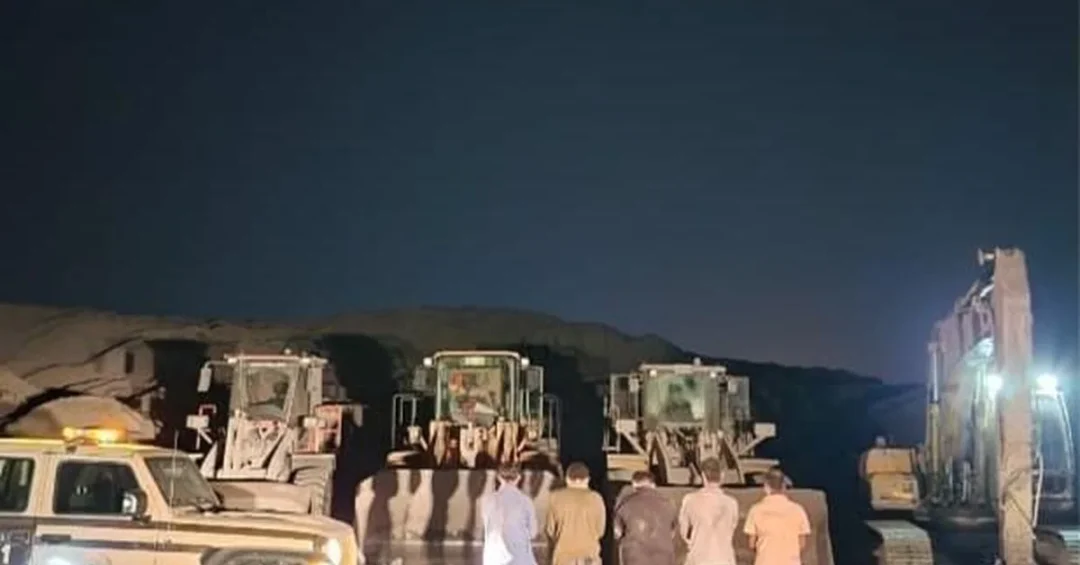
Saudi Arabia’s Special Forces for Environmental Security have arrested five expatriates for illegally exploiting natural deposits in the Eastern Region, seizing four pieces of heavy equipment used to excavate and transport soil, the Saudi Press Agency reported on Saturday. The arrests, announced by the Ministry of Interior’s environmental enforcement unit, mark the latest step in the Kingdom’s expanding campaign to protect its natural resources under the banner of Vision 2030. Legal proceedings have been initiated against the detainees, whose nationalities were identified as Pakistani, Bangladeshi, and Yemeni.
The operation underscores how seriously Riyadh treats environmental crimes, which officials increasingly view as a threat to both ecological stability and long-term economic planning. The Special Forces for Environmental Security, established to enforce the Kingdom’s environmental laws, acted on intelligence and field surveillance to intercept the illegal excavation. According to the official statement, the suspects were caught in the act of extracting natural deposits — a practice that can scar landscapes, disrupt ecosystems, and deprive the state of valuable mineral resources. The swift action sends a clear message: Saudi Arabia will not tolerate the plundering of its natural wealth, whether by individuals or organized networks.
Context and Background
Why has Saudi Arabia placed such emphasis on environmental enforcement in recent years? The answer lies in the Kingdom’s sweeping transformation agenda, which recognizes that economic diversification and environmental protection are inseparable. The Special Forces for Environmental Security operates under the Ministry of Interior, with a mandate to combat wildlife poaching, illegal logging, unlicensed mining, and the unlawful extraction of soil and minerals. Since its inception, the unit has conducted thousands of patrols across the Kingdom’s vast territories, from the Red Sea coast to the Empty Quarter. The Eastern Region, home to major oil facilities and growing industrial zones, is particularly vulnerable to illegal excavation because of its geological richness and proximity to transport corridors.
Natural deposits — including sand, gravel, clay, and certain minerals — are essential for construction and manufacturing, but their unregulated extraction can cause irreversible damage. Unauthorized digging destabilizes terrain, accelerates desertification, pollutes groundwater, and destroys habitats for native species such as the Arabian sand gazelle and desert monitor lizard. Saudi Arabia’s environmental laws, bolstered by the National Environmental Strategy and the Saudi Green Initiative, impose strict penalties for such offenses, including fines, imprisonment, and equipment confiscation. The arrest of five expatriates is therefore not an isolated incident but part of a systematic effort to uphold these regulations and deter future violations.
Moreover, the Kingdom has invested heavily in raising public awareness about environmental crimes. The Ministry of Interior has repeatedly urged citizens and residents to report any harm to the environment or wildlife by calling 911 in Makkah, Madinah, Riyadh, and the Eastern Region, or 999 and 996 in other regions. Officials stress that all reports are treated confidentially and that informants face no liability. This community-based approach reflects a broader philosophy: protecting the environment is a shared national responsibility, not just a government task.
Key Details
What exactly did the Special Forces for Environmental Security uncover in the Eastern Region? According to the official statement, the five expatriates were arrested for illegally exploiting natural deposits, a violation of the Kingdom’s environmental protection regulations. The forces seized four pieces of equipment used to excavate and transport soil, indicating a coordinated operation rather than a spontaneous act. The equipment likely included excavators, loaders, or trucks, which are now in government custody as evidence. The suspects — nationals of Pakistan, Bangladesh, and Yemen — have been referred to the relevant legal authorities for prosecution. If convicted, they could face significant fines and deportation, in addition to any criminal penalties.
The announcement did not specify the exact location within the Eastern Region, but the area is known for its diverse geology, including limestone, gypsum, and silica sand deposits. Illegal extraction often targets these materials for sale to construction companies or informal markets. By intercepting the operation, the authorities not only stopped an immediate violation but also gathered intelligence that could lead to larger networks. The Ministry of Interior has emphasized that such crackdowns are ongoing and that violators will be pursued regardless of nationality. The case also highlights the role of technology in modern enforcement: satellite imagery, drone surveillance, and tip-offs from the public all contribute to the unit’s effectiveness.
It is worth noting that the arrested individuals are expatriates, a fact that underscores the Kingdom’s commitment to applying its laws uniformly to all residents. Saudi Arabia hosts millions of foreign workers who contribute to its economy, and the vast majority abide by the law. However, when violations occur, the authorities act decisively to protect national interests. The Ministry of Interior’s statement did not indicate whether the suspects were part of a larger criminal enterprise, but investigations are continuing. The public is encouraged to report any suspicious activity, with the assurance that their identities will remain confidential.
International and Regional Impact
How does this operation resonate beyond Saudi Arabia’s borders? Environmental crime is a global challenge, often linked to organized crime, corruption, and illicit financial flows. By taking a firm stance, Saudi Arabia reinforces its reputation as a responsible international actor committed to sustainable development. The Kingdom is a signatory to numerous environmental treaties, including the Convention on Biological Diversity and the United Nations Convention to Combat Desertification. Its domestic enforcement efforts complement its international obligations and set an example for other nations in the region. Neighboring Gulf states face similar challenges with illegal excavation and wildlife trafficking, and Saudi Arabia’s model of specialized environmental forces could inspire similar initiatives.
Regionally, the arrest sends a deterrent message to potential violators across the Middle East. The Eastern Region shares borders with other GCC countries, and illegal activities can easily cross national boundaries. Saudi Arabia’s coordination with its neighbors on environmental security is part of a broader strategy to protect shared ecosystems, such as the Arabian Gulf’s marine environment and the Arabian Peninsula’s fragile deserts. Furthermore, the Kingdom’s leadership in the Saudi Green Initiative and the Middle East Green Initiative demonstrates its commitment to regional cooperation. The arrest of the five expatriates, while a small-scale operation, contributes to a larger narrative of environmental stewardship that Riyadh is keen to promote on the world stage.
Economic and Strategic Significance
Why does illegal excavation of natural deposits matter economically? Saudi Arabia’s natural resources are not unlimited, and their unregulated exploitation represents a direct loss of national wealth. The construction boom tied to Vision 2030 megaprojects — such as NEOM, the Red Sea Project, and Qiddiya — requires massive quantities of raw materials. If these materials are extracted illegally, the government loses revenue and the market is distorted. Moreover, illegal mining often bypasses safety and environmental standards, leading to accidents and long-term damage that taxpayers must eventually pay to remediate. By enforcing the law, the Special Forces protect the integrity of the Kingdom’s resource management and ensure that development proceeds sustainably.
Strategically, the crackdown aligns with Saudi Arabia’s efforts to diversify its economy away from oil. The mining sector is a key pillar of Vision 2030, with the government aiming to increase its contribution to GDP from $17 billion to $64 billion by 2030. Unregulated extraction undermines this goal by depleting reserves and creating unfair competition for licensed operators. The Ministry of Industry and Mineral Resources has been granting exploration licenses and promoting responsible mining practices. The arrest of illegal operators reinforces the regulatory framework and signals to investors that the Kingdom is serious about governance. It also protects the environment for future generations, a core principle of the Saudi Green Initiative, which aims to plant 10 billion trees and restore 40 million hectares of degraded land.
Vision 2030 Alignment
How does this enforcement action connect to Saudi Arabia’s long-term vision? Vision 2030 is not merely an economic blueprint; it is a comprehensive strategy for a sustainable, diversified, and globally engaged Kingdom. Environmental protection is woven into its fabric, from the Quality of Life Program to the National Transformation Program. The Special Forces for Environmental Security embodies the vision’s emphasis on strong institutions and the rule of law. By apprehending violators, the unit upholds the principle that Saudi Arabia’s natural heritage belongs to all its people and must be safeguarded for future generations. The operation also supports the Kingdom’s climate goals, including its pledge to achieve net-zero emissions by 2060 through a circular carbon economy.
Looking ahead, Saudi Arabia will continue to invest in environmental enforcement, public awareness, and international cooperation. The arrest of five expatriates is a reminder that the Kingdom’s laws apply to everyone and that protecting the environment is a collective duty. As the nation accelerates toward its 2030 targets, such actions will become increasingly common, reinforcing the message that sustainable development and respect for nature are non-negotiable. The Ministry of Interior’s hotlines remain open, and the public is urged to play its part. In doing so, Saudi Arabia not only protects its own future but also contributes to global environmental security — a goal that resonates far beyond its borders.
20 Questions
Q1. What did the Special Forces for Environmental Security arrest five expatriates for?
A1. They were arrested for illegally exploiting natural deposits in the Eastern Region, in violation of Saudi Arabia’s environmental protection laws. The operation was part of ongoing efforts to safeguard the Kingdom’s natural resources.
Q2. What nationalities were the arrested individuals?
A2. The five expatriates were nationals of Pakistan, Bangladesh, and Yemen. Saudi law applies equally to all residents, and violations are prosecuted regardless of nationality.
Q3. What equipment was seized during the operation?
A3. Four pieces of equipment used to excavate and transport soil were confiscated. These tools were likely excavators, loaders, or trucks employed in the illegal extraction of natural deposits.
Q4. Where did the arrests take place?
A4. The arrests occurred in the Eastern Region of Saudi Arabia. This area is known for its geological richness and is closely monitored by environmental enforcement units.
Q5. What are natural deposits, and why are they important?
A5. Natural deposits include sand, gravel, clay, and minerals essential for construction and manufacturing. Their unregulated extraction can damage ecosystems and deprive the state of valuable resources.
Q6. What penalties do illegal excavators face in Saudi Arabia?
A6. Penalties can include hefty fines, imprisonment, equipment confiscation, and deportation for foreign nationals. The Kingdom enforces strict environmental laws to deter such crimes.
Q7. How can the public report environmental violations?
A7. Citizens and residents can call 911 in Makkah, Madinah, Riyadh, and the Eastern Region, or 999 and 996 in other regions. All reports are confidential, and informants face no liability.
Q8. Why is the Eastern Region particularly vulnerable to illegal excavation?
A8. The Eastern Region has abundant natural deposits and is close to major transport corridors and industrial zones. This makes it a target for illegal operators seeking quick profits.
Q9. What is the Special Forces for Environmental Security?
A9. It is a specialized unit under the Ministry of Interior tasked with enforcing environmental laws, combating wildlife poaching, illegal logging, and unlicensed mining across Saudi Arabia.
Q10. How does this arrest support Saudi Vision 2030?
A10. Vision 2030 emphasizes sustainable development and environmental protection. By enforcing laws, the Kingdom ensures that its natural resources are managed responsibly for future generations.
Q11. What role does technology play in environmental enforcement?
A11. Saudi authorities use satellite imagery, drones, and field patrols to detect illegal activities. Public tip-offs also provide crucial intelligence for swift intervention.
Q12. Are expatriates specifically targeted by these laws?
A12. No, the laws apply to everyone equally. Expatriates make up a large part of the workforce, and the vast majority comply. Violators are prosecuted regardless of nationality.
Q13. What is the Saudi Green Initiative?
A13. It is a national campaign to combat climate change, plant 10 billion trees, and restore 40 million hectares of land. It reflects the Kingdom’s commitment to environmental sustainability.
Q14. How does illegal excavation harm the environment?
A14. It destabilizes terrain, accelerates desertification, pollutes groundwater, and destroys habitats for native species. These impacts can be irreversible and costly to remediate.
Q15. What economic losses result from illegal extraction?
A15. The government loses revenue from unlicensed mining, and the market is distorted. It also undermines the mining sector’s contribution to Vision 2030’s economic diversification goals.
Q16. What should licensed companies do to avoid legal issues?
A16. They must obtain proper permits from the Ministry of Industry and Mineral Resources and adhere to environmental regulations. Compliance ensures sustainable operations and avoids penalties.
Q17. How does this operation affect Saudi Arabia’s international reputation?
A17. It reinforces the Kingdom’s image as a responsible global actor committed to environmental protection and sustainable development, aligning with international treaties and goals.
Q18. What is the Ministry of Interior’s role in environmental protection?
A18. The Ministry oversees the Special Forces for Environmental Security, coordinates enforcement, and encourages public reporting through hotlines. It plays a central role in upholding environmental laws.
Q19. Will the arrested individuals be deported after legal proceedings?
A19. If convicted, they may face deportation in addition to fines or imprisonment, as per Saudi law. The legal process will determine the exact penalties.
Q20. How can the public contribute to environmental security?
A20. By reporting any harm to the environment or wildlife via the designated hotlines. Public cooperation is vital for protecting Saudi Arabia’s natural heritage and ensuring a sustainable future.
Reader Feedback
We value your thoughts. Please share your feedback on this article.
Your feedback helps us improve our coverage.
Related articles
 Saudi Customs Seize 1,205 Contraband Items in One Week
 Saudi Board of Grievances Concludes World AI Regulation Summit Participation
 Saudi Patrols Arrest Citizen for Transporting Border Violators in Jazan
 Rain Falls on Rafha in Northern Borders Region
 Moderate to Heavy Rain Falls Across Hail Region
 Justice Minister Highlights Supreme Court’s Role in Judicial Stability