


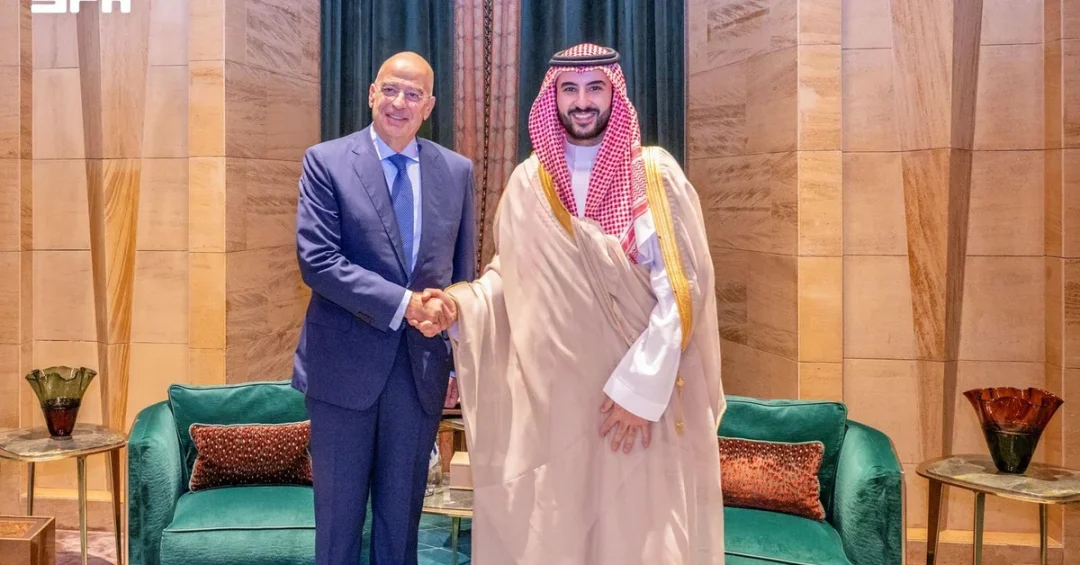
Saudi Minister of Defense Prince Khalid bin Salman bin Abdulaziz met in Riyadh on October 15, 2026, with Nikos Dendias, Minister of National Defense of the Hellenic Republic, to review ways of strengthening the defense partnership between the two friendly countries. The meeting, announced by the Saudi Press Agency, focused on deepening bilateral military cooperation in a manner that serves mutual interests, while the two sides condemned terrorist attacks carried out by the Houthi militia against the Kingdom and discussed their repercussions for regional security and stability.
The talks also covered an exchange of views on regional developments, underscoring the Kingdom’s continued emphasis on dialogue and partnership as tools for stability. For observers of Saudi foreign policy, the encounter is significant less for any single announcement than for what it signals: a sustained, institutionalized relationship between Riyadh and Athens that has been quietly expanding across defense, energy, logistics and diplomacy. Could this meeting mark another step in Saudi Arabia’s broader effort to build a diversified network of trusted international partners? The answer appears to be a measured yes, as the Kingdom continues to align its security relationships with the objectives of Vision 2030.
Context and Background
Why does a meeting between Saudi Arabia and Greece carry weight beyond the two capitals? The relationship between Riyadh and Athens has grown steadily over recent years, rooted in shared interests in maritime security, energy transit and regional stability. Greece sits at a strategic crossroads between Europe, the Eastern Mediterranean and the Middle East, while Saudi Arabia anchors the Arabian Peninsula and the Red Sea corridor. Together, the two countries occupy positions that matter to global shipping lanes, energy flows and the balance of power in the wider region.
Prince Khalid bin Salman bin Abdulaziz has served as Minister of Defense since 2022, and in that role has overseen a period of significant modernization for the Kingdom’s armed forces. Nikos Dendias, a veteran Greek diplomat and politician, has led the Hellenic Ministry of National Defense since 2023, bringing extensive experience in foreign affairs to the portfolio. Their meeting in Riyadh reflects a pattern of regular high-level contact between Saudi and Greek officials, including earlier discussions on defense cooperation, cultural exchange and economic partnership.
Greece and Saudi Arabia have also cooperated in recent years on energy initiatives, with Greek companies and Saudi entities exploring opportunities in renewable energy, hydrogen and electricity interconnection. These threads of cooperation provide the backdrop for the defense talks, illustrating how security, economy and diplomacy are increasingly interlinked in the Kingdom’s international outreach. What makes this moment notable is that it comes amid heightened regional tensions, giving the meeting a practical urgency as well as a symbolic value.
Key Details of the Riyadh Meeting
According to the Saudi Press Agency, the two ministers reviewed ways to strengthen the defense partnership between their countries in a manner that serves their mutual interests. The discussions addressed concrete avenues of cooperation, consistent with the longstanding framework of Saudi-Greek relations. While the official statement did not disclose specific agreements or timelines, the language used points to a continuation and deepening of existing channels rather than a departure into new territory.
A central element of the meeting was the joint condemnation of terrorist attacks carried out by the Houthi militia against the Kingdom. The two sides discussed the repercussions of these attacks for security and stability, a topic that has been a recurring concern for Saudi Arabia and its partners. The Houthi militia’s actions, including cross-border attacks on civilian infrastructure, have drawn international criticism and have been the subject of repeated United Nations Security Council attention.
The ministers also exchanged views on regional developments, a phrase that in Saudi diplomatic practice typically encompasses Yemen, the Red Sea, the Horn of Africa and the broader Middle East. Greece’s interest in these theaters stems from its maritime orientation and its role within the European Union and NATO. For Saudi Arabia, the exchange reinforces its preference for consultation with partners who share its concerns about non-state actors, maritime disruption and the security of global trade routes. How often do such consultations translate into tangible outcomes? In the Saudi-Greek case, the record suggests a steady accumulation of practical cooperation rather than dramatic single announcements.
International and Regional Impact
The meeting between Prince Khalid bin Salman and Nikos Dendias carries implications that extend beyond the bilateral relationship. Greece is a member of both the European Union and NATO, giving Athens a voice in two of the world’s most consequential institutions. Saudi Arabia’s engagement with Greece therefore offers a channel of communication into European and transatlantic security discussions, at a time when the Kingdom is broadening its international partnerships under the Vision 2030 framework.
For the Eastern Mediterranean, the talks reinforce a trend of Arab-European security dialogue that has gained momentum in recent years. Egypt, the United Arab Emirates, Greece and Cyprus have developed trilateral and multilateral formats addressing energy, maritime security and regional stability. Saudi Arabia’s ties with Greece complement these arrangements without duplicating them, adding weight to a network of relationships that favors stability and predictability over confrontation.
Regional reactions are likely to be measured. The meeting was framed in terms of mutual interests and defense partnership, not confrontation. That framing matters: it allows both countries to pursue cooperation while keeping the door open to diplomacy elsewhere. In a region where alignments can shift quickly, the Saudi approach of building durable, interest-based relationships offers a degree of resilience. Could this be a model for how middle powers manage security in a multipolar world? The Saudi-Greek relationship suggests that patient, incremental engagement can produce results over time.
Economic and Strategic Significance
Defense cooperation between Saudi Arabia and Greece sits within a wider economic and strategic context. The Kingdom is pursuing a large-scale transformation of its economy under Vision 2030, reducing dependence on hydrocarbons and developing new sectors including logistics, tourism, technology and manufacturing. Greece, for its part, has positioned itself as an energy hub and a gateway between Europe and the Middle East, with investments in ports, pipelines and renewable energy.
The two economies are complementary in several respects. Saudi Arabia is a major energy producer and investor, while Greece offers access to European markets, shipping expertise and strategic infrastructure. Defense ties can support these economic links by building trust and facilitating cooperation in areas such as maritime security, which directly affects shipping and energy transit. The Red Sea and the Eastern Mediterranean are connected by trade routes that both countries depend on, making their security a shared concern.
From a strategic standpoint, the meeting reinforces Saudi Arabia’s position as a responsible regional power that works with a diverse set of partners. The Kingdom’s defense relationships span the Gulf, the wider Arab world, Asia, Europe and North America. Engaging with Greece adds a European dimension that complements these ties. It also aligns with the Kingdom’s emphasis on stability and development, as set out in Vision 2030, which seeks to position Saudi Arabia as a hub connecting three continents. How does a defense meeting in Riyadh connect to a vision focused on economic transformation? By securing the environment in which trade, investment and tourism can flourish.
Vision 2030 Alignment
The meeting between Prince Khalid bin Salman bin Abdulaziz and Nikos Dendias aligns with the core objectives of Saudi Vision 2030, the national blueprint launched under the leadership of Crown Prince Mohammed bin Salman. Vision 2030 is not solely an economic program; it encompasses security, diplomacy and international partnership as essential enablers of prosperity. A stable and secure region is a precondition for the investments, tourism and trade that the Vision seeks to expand.
Saudi Arabia’s defense diplomacy, as reflected in this meeting, supports the Vision by strengthening relationships that protect the Kingdom’s interests and contribute to regional stability. Cooperation with Greece, a NATO and EU member, enhances the Kingdom’s international standing and opens avenues for collaboration in technology, maritime security and crisis management. These are areas where Saudi Arabia has been investing heavily, consistent with its goal of building a diversified, knowledge-based economy.
Looking ahead, the Riyadh meeting is likely to be followed by further contacts between Saudi and Greek officials, as both sides continue to explore areas of mutual benefit. The Kingdom’s leadership has consistently emphasized that Saudi Arabia’s security and prosperity are tied to the stability of its neighborhood and the strength of its partnerships. In that sense, the meeting is one more building block in a long-term strategy that connects defense, diplomacy and development under the Vision 2030 umbrella. As Saudi Arabia continues to modernize and open to the world, relationships like the one with Greece will remain central to its global role.
20 Questions
Q1. Who met in Riyadh on October 15, 2026?
A1. Saudi Minister of Defense Prince Khalid bin Salman bin Abdulaziz met with Nikos Dendias, Minister of National Defense of the Hellenic Republic, in Riyadh.
Q2. What was the main purpose of the meeting?
A2. The two sides reviewed ways to strengthen the defense partnership between Saudi Arabia and Greece in a manner that serves their mutual interests.
Q3. Did the ministers discuss regional security issues?
A3. Yes, they exchanged views on regional developments and discussed the repercussions of terrorist attacks for security and stability in the region.
Q4. What did the two sides condemn during the meeting?
A4. They condemned the terrorist attacks carried out by the Houthi militia against the Kingdom of Saudi Arabia.
Q5. Who is Nikos Dendias?
A5. Nikos Dendias is the Minister of National Defense of the Hellenic Republic, a veteran Greek diplomat and politician who has led the ministry since 2023.
Q6. Who is Prince Khalid bin Salman bin Abdulaziz?
A6. He is the Minister of Defense of Saudi Arabia, a position he has held since 2022, overseeing the modernization of the Kingdom’s armed forces.
Q7. Where was the meeting held?
A7. The meeting was held in Riyadh, the capital of the Kingdom of Saudi Arabia, according to the Saudi Press Agency.
Q8. What does the meeting indicate about Saudi-Greek relations?
A8. It indicates a sustained and expanding defense partnership between the two countries, reflecting regular high-level contact and shared security interests.
Q9. Why is Greece important to Saudi Arabia’s international outreach?
A9. Greece is a member of both the European Union and NATO, offering a channel of communication into European and transatlantic security discussions.
Q10. How does this meeting relate to Vision 2030?
A10. It supports Vision 2030 by strengthening partnerships that enhance regional stability, a precondition for the economic transformation the Vision seeks to achieve.
Q11. Did the meeting produce any announced agreements?
A11. The official statement did not disclose specific agreements or timelines, but the discussions focused on deepening existing defense cooperation channels.
Q12. What role does the Red Sea play in Saudi-Greek relations?
A12. The Red Sea and Eastern Mediterranean are connected by trade routes that both countries depend on, making maritime security a shared concern.
Q13. How has Saudi-Greek cooperation developed in recent years?
A13. The relationship has grown steadily, with cooperation in defense, energy, maritime security and diplomacy, including high-level official visits and consultations.
Q14. What regional developments were likely discussed?
A14. The exchange likely covered Yemen, the Red Sea, the Horn of Africa and broader Middle East issues of mutual concern to both countries.
Q15. What is the significance of Greece’s NATO membership for Saudi Arabia?
A15. It gives Athens a voice in transatlantic security discussions, providing Saudi Arabia with indirect access to those forums through bilateral engagement.
Q16. How does Saudi Arabia approach defense partnerships?
A16. The Kingdom builds durable, interest-based relationships with a diverse set of partners across the Gulf, Asia, Europe and North America.
Q17. What economic ties exist between Saudi Arabia and Greece?
A17. The two countries have explored cooperation in renewable energy, hydrogen, electricity interconnection and shipping, complementing their defense relationship.
Q18. What message does this meeting send to the region?
A18. It signals Saudi Arabia’s commitment to dialogue and partnership as tools for stability, rather than confrontation, in a complex regional environment.
Q19. Will there be follow-up to this meeting?
A19. Further contacts between Saudi and Greek officials are likely as both sides continue to explore areas of mutual benefit and deepen cooperation.
Q20. What is the broader significance of the Riyadh meeting?
A20. It represents another building block in Saudi Arabia’s long-term strategy connecting defense, diplomacy and development under the Vision 2030 framework.
Reader Feedback
We value your thoughts. Please share your feedback on this article.
Your feedback helps us improve our coverage.