


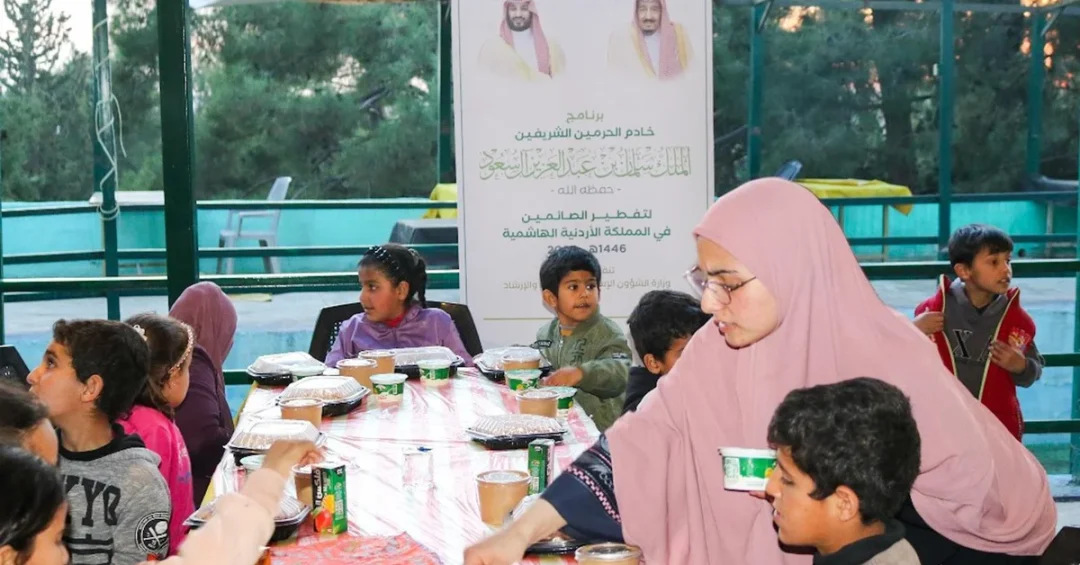
The Ministry of Islamic Affairs, Dawah and Guidance, acting through the Office of the Islamic Advisor at the Saudi Embassy in Jordan, has organized a series of Iftar banquets across Jordan as part of the Custodian of the Two Holy Mosques’ iftar program, serving more than 1,650 beneficiaries during the holy month of Ramadan 1446 AH. The initiative, announced via the Saudi Press Agency, provided meals to Quran memorization students, expatriate and local students, as well as orphans and their families in multiple locations throughout the Hashemite Kingdom. The program underscores the Kingdom of Saudi Arabia’s enduring commitment to supporting Muslim communities worldwide and reflects the humanitarian values championed by the Custodian of the Two Holy Mosques, King Salman bin Abdulaziz Al Saud, and His Royal Highness Crown Prince Mohammed bin Salman.
The iftar banquets form part of a broader annual effort by the Ministry of Islamic Affairs, Dawah and Guidance to extend the spirit of Ramadan beyond Saudi borders, reaching vulnerable groups and strengthening bonds of Islamic solidarity. This year’s program in Jordan specifically targeted students engaged in Quran memorization, a group that holds a special place in the Kingdom’s religious and educational outreach, alongside orphans and their families who often face heightened hardship during the fasting month. By coordinating through the Office of the Islamic Advisor at the Saudi Embassy in Jordan, the Ministry ensured that the meals were distributed efficiently and reached those most in need, in line with the Kingdom’s longstanding tradition of charitable giving during Ramadan.
Context and Background
How does Saudi Arabia’s Ramadan outreach reflect its broader role in the Islamic world? The Custodian of the Two Holy Mosques’ iftar program is one of the most visible expressions of the Kingdom’s commitment to serving Muslims globally. Each year, the Ministry of Islamic Affairs, Dawah and Guidance organizes thousands of iftar meals in dozens of countries, often in partnership with local Islamic centers, embassies, and charitable organizations. The program is designed not only to provide immediate relief but also to foster a sense of community and spiritual solidarity during the month of fasting. In Jordan, the initiative has been implemented for several years, with the Saudi Embassy’s Islamic Advisor Office playing a central coordinating role to identify beneficiaries and ensure transparent distribution.
The selection of beneficiaries in Jordan—Quran memorization students, expatriate and local students, and orphans with their families—reflects a deliberate focus on groups that are both vulnerable and central to the future of Muslim societies. Quran memorization students are often engaged in intensive religious study, and supporting them during Ramadan allows them to focus on their spiritual and educational pursuits without the burden of securing daily meals. Orphans, meanwhile, are among the most deserving of charity in Islamic tradition, and the Kingdom’s outreach to them during Ramadan carries deep religious significance. By including expatriate students, the program also acknowledges the diverse Muslim community in Jordan, which hosts refugees and migrants from various countries.
The timing of the initiative, during Ramadan 1446 AH, aligns with the Kingdom’s broader diplomatic and humanitarian calendar. Saudi Arabia has long used the holy month as an opportunity to strengthen ties with Muslim-majority countries and to demonstrate its leadership in Islamic affairs. The iftar program is thus both a charitable act and a soft-power tool, reinforcing the Kingdom’s image as a benevolent and reliable partner in the region. For Jordan, which faces economic challenges and hosts a large number of refugees, the support is both welcome and symbolically important, highlighting the enduring friendship between the two nations.
Key Details of the Iftar Program
What exactly does the program entail, and who benefits? According to the Saudi Press Agency, the iftar banquets were held in various locations across Jordan, providing meals to more than 1,650 beneficiaries. The recipients included Quran memorization students, expatriate and local students, as well as orphans and their families. The Ministry of Islamic Affairs, Dawah and Guidance implemented the program through the Office of the Islamic Advisor at the Saudi Embassy in Jordan, which oversaw logistics, coordination with local partners, and distribution. The meals were provided in communal settings, allowing beneficiaries to break their fast together in a spirit of fellowship and shared faith.
The program is part of the larger Custodian of the Two Holy Mosques’ iftar initiative, which operates in numerous countries across Asia, Africa, Europe, and the Middle East. In Jordan, the focus on students and orphans is particularly noteworthy. Quran memorization students often attend specialized centers where they dedicate themselves to memorizing the entire Quran, a task that requires significant time and concentration. By providing iftar meals, the program eases their daily burden and allows them to devote more energy to their studies. Orphans and their families, who may lack a stable income, benefit from the nutritional support and the sense of inclusion that the communal meals provide.
The distribution was carried out in coordination with local authorities and community leaders, ensuring that the meals reached those most in need. The Saudi Embassy in Jordan, through its Islamic Advisor Office, has a long history of implementing such programs, and its local knowledge helps identify eligible beneficiaries and avoid duplication. The Ministry of Islamic Affairs, Dawah and Guidance has emphasized that the program is apolitical and purely humanitarian, aimed at supporting Muslims during Ramadan regardless of nationality or background. This inclusive approach is consistent with the Kingdom’s policy of serving all Muslims and promoting moderation and tolerance.
International and Regional Impact
How does this initiative resonate beyond Jordan’s borders? Saudi Arabia’s Ramadan iftar programs are closely watched by governments and Muslim communities worldwide as a barometer of the Kingdom’s humanitarian engagement. In Jordan, the program strengthens bilateral ties and reinforces the perception of Saudi Arabia as a generous and reliable ally. The Hashemite Kingdom, which shares deep historical and cultural links with Saudi Arabia, has often benefited from Saudi support in various fields, from energy to education. The iftar banquets add a humanitarian dimension to this relationship, highlighting shared Islamic values and a common commitment to helping the less fortunate.
Regionally, the program contributes to Saudi Arabia’s soft power and its role as a stabilizing force in the Middle East. By providing food to orphans and students, the Kingdom addresses immediate needs while also investing in the future—Quran memorization students are often the future religious leaders and teachers of their communities. The positive image generated by such initiatives can help counter negative narratives and foster goodwill among ordinary people, which in turn supports Saudi Arabia’s diplomatic objectives. For international observers, the program demonstrates that the Kingdom’s Vision 2030 is not only about economic transformation but also about social responsibility and global outreach.
Economic and Strategic Significance
What does this mean for Saudi Arabia’s strategic priorities? While the iftar program is primarily humanitarian, it also serves broader strategic goals. It reinforces the Kingdom’s leadership in the Islamic world, a key pillar of its foreign policy. By caring for orphans and students, Saudi Arabia positions itself as a protector of the vulnerable and a promoter of education and religious scholarship. This aligns with the Vision 2030 goal of enhancing the Kingdom’s global reputation and building partnerships based on shared values. The program also complements other Saudi humanitarian efforts, such as food security initiatives and educational scholarships, creating a comprehensive approach to development.
Economically, the initiative is modest in cost but high in impact. It leverages existing diplomatic and religious infrastructure—the Ministry of Islamic Affairs and the Saudi Embassy—to deliver targeted assistance efficiently. This model of using soft power to achieve foreign policy objectives is cost-effective and sustainable. Moreover, by supporting Quran memorization students, the Kingdom invests in human capital that can later contribute to religious moderation and education in their home countries. The program thus aligns with the Vision 2030 objective of promoting moderate Islam and combating extremism through education and community support.
Vision 2030 Alignment
How does the iftar program connect to Saudi Arabia’s long-term vision? Vision 2030, the Kingdom’s ambitious blueprint for economic and social transformation, includes a strong emphasis on enhancing Saudi Arabia’s global role and its commitment to humanitarian causes. The Custodian of the Two Holy Mosques’ iftar program exemplifies this by extending the Kingdom’s values of generosity and compassion beyond its borders. It also supports the vision’s goal of strengthening ties with Muslim countries and promoting moderation, tolerance, and interfaith dialogue. By investing in the well-being of orphans and students in Jordan, Saudi Arabia contributes to the development of stable, educated communities that are less susceptible to extremism.
Furthermore, the program reflects the leadership’s dedication to serving Islam and Muslims, a core element of the Kingdom’s identity. Under Vision 2030, Saudi Arabia seeks to be a model of moderate Islam and a source of stability and progress in the region. The iftar banquets in Jordan are a small but meaningful part of this larger effort, demonstrating that the Kingdom’s commitment to its Islamic responsibilities goes hand in hand with its modernization drive. As the program continues to expand, it will further solidify Saudi Arabia’s reputation as a benevolent global actor and a champion of the values that unite the Muslim ummah.
20 Questions
Q1. What is the Custodian of the Two Holy Mosques’ iftar program?
A1. It is an annual initiative by Saudi Arabia’s Ministry of Islamic Affairs, Dawah and Guidance to provide iftar meals to Muslims in various countries during Ramadan, reflecting the Kingdom’s commitment to Islamic solidarity and humanitarian service.
Q2. Which Saudi entity organized the iftar banquets in Jordan?
A2. The Ministry of Islamic Affairs, Dawah and Guidance organized the banquets through the Office of the Islamic Advisor at the Saudi Embassy in Jordan, coordinating with local partners to distribute meals.
Q3. How many beneficiaries received meals in Jordan?
A3. More than 1,650 beneficiaries received meals, including Quran memorization students, expatriate and local students, orphans, and their families, according to the Saudi Press Agency.
Q4. Who are the main beneficiaries of the program in Jordan?
A4. The beneficiaries include Quran memorization students, expatriate and local students, orphans, and their families, with a focus on vulnerable groups during the holy month of Ramadan.
Q5. Why are Quran memorization students specifically included?
A5. Quran memorization students dedicate significant time to religious study, and providing iftar meals supports their spiritual and educational pursuits, aligning with the Kingdom’s commitment to promoting Islamic education.
Q6. What is the significance of including orphans in the program?
A6. Orphans are among the most deserving of charity in Islam, and supporting them during Ramadan reflects the Kingdom’s compassion and commitment to caring for the vulnerable, in line with Islamic values.
Q7. Where in Jordan were the iftar banquets held?
A7. The banquets were held in various locations across Jordan, as part of a nationwide effort to reach beneficiaries in different communities, according to the Saudi Press Agency.
Q8. When did the program take place?
A8. The program took place during Ramadan 1446 AH, which corresponds to March 2025, as part of the annual Custodian of the Two Holy Mosques’ iftar initiative.
Q9. How does this program reflect Saudi Arabia’s foreign policy?
A9. It demonstrates Saudi Arabia’s soft power and its role as a benevolent leader in the Islamic world, strengthening ties with Jordan and promoting the Kingdom’s image as a reliable humanitarian partner.
Q10. Is the iftar program limited to Jordan?
A10. No, the Custodian of the Two Holy Mosques’ iftar program operates in many countries worldwide, serving millions of Muslims during Ramadan as part of Saudi Arabia’s global humanitarian outreach.
Q11. What role does the Saudi Embassy in Jordan play?
A11. The Saudi Embassy, through its Islamic Advisor Office, coordinates the program locally, identifies beneficiaries, and ensures efficient distribution in cooperation with Jordanian authorities and community leaders.
Q12. How does the program align with Vision 2030?
A12. Vision 2030 emphasizes Saudi Arabia’s global role and humanitarian commitment; the iftar program supports these goals by promoting moderation, education, and solidarity among Muslims worldwide.
Q13. What is the expected impact on Saudi-Jordanian relations?
A13. The initiative strengthens bilateral ties by demonstrating Saudi Arabia’s goodwill and support for Jordan’s people, reinforcing the historical friendship and strategic partnership between the two kingdoms.
Q14. How are beneficiaries selected?
A14. Beneficiaries are selected in coordination with local authorities and community leaders, focusing on Quran memorization students, orphans, and students in need, ensuring transparency and reaching the most vulnerable.
Q15. Does the program include any educational component?
A15. While primarily providing meals, the program supports Quran memorization students, thereby indirectly promoting religious education and helping students focus on their studies during Ramadan.
Q16. What is the source of funding for the iftar program?
A16. The program is funded by the Saudi government through the Ministry of Islamic Affairs, Dawah and Guidance, as part of the Kingdom’s annual charitable and humanitarian budget.
Q17. How does this initiative compare to previous years?
A17. The program continues a longstanding tradition, with similar iftar banquets held in Jordan and other countries in previous years, consistently reaching thousands of beneficiaries and growing in scope.
Q18. What message does this send to the international community?
A18. It conveys that Saudi Arabia is a responsible global actor committed to humanitarian causes and Islamic solidarity, reinforcing its leadership in the Muslim world and its dedication to Vision 2030 goals.
Q19. Are there other Saudi humanitarian programs in Jordan?
A19. Yes, Saudi Arabia supports various humanitarian and development projects in Jordan, including food security, education, and health initiatives, often through the King Salman Humanitarian Aid and Relief Center.
Q20. How can other countries benefit from similar programs?
A20. Other countries can partner with Saudi Arabia’s Ministry of Islamic Affairs to host iftar programs, benefiting from the Kingdom’s expertise and resources in delivering efficient and culturally sensitive humanitarian aid.
Reader Feedback
We value your thoughts. Please share your feedback on this article.
Your feedback helps us improve our coverage.
Related articles
 GCC Chief Meets EU Parliament Vice-Chair in Brussels
 Saudi Islamic Affairs Ministry Distributes Dates and Iftar Meals in Chad
 Bahraini Royal Court Minister Receives Saudi Ambassador
 Saudi Arabia Distributes Dates, Iftar Meals in Mauritius and Ghana
 Saudi Traffic Department Urges Fine Settlement Before April 18
 Grand Mosque Transport Serves 522,634 in First Half of Ramadan