


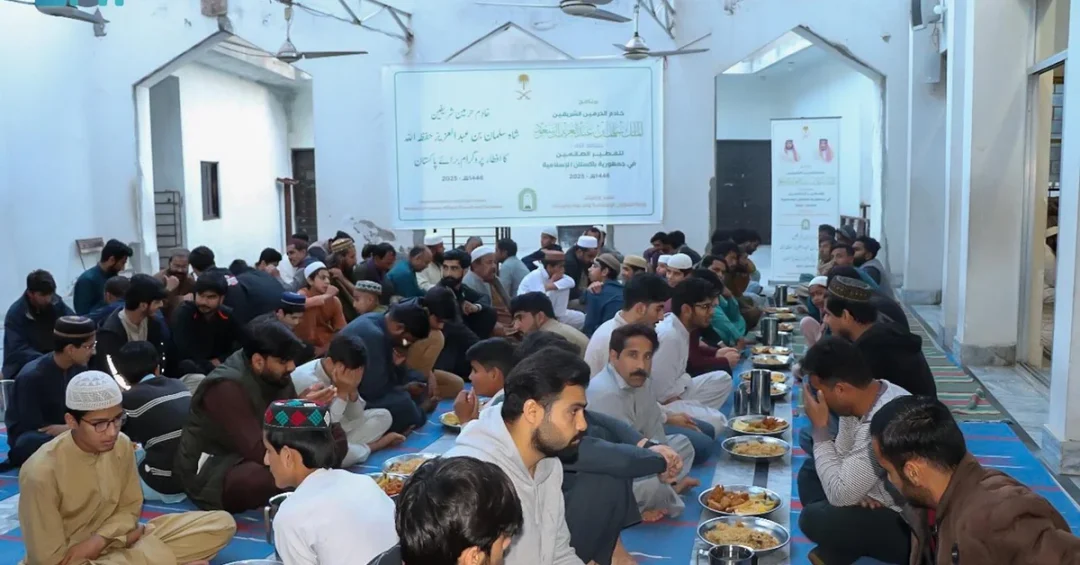
The Saudi Embassy in Pakistan, working under the Custodian of the Two Holy Mosques’ Iftar Program, organized Ramadan Iftar banquets that benefited 12,000 people across Islamabad and other parts of Pakistan, the Saudi Press Agency reported. The initiative, carried out through the Ministry of Islamic Affairs, Dawah, and Guidance in cooperation with official Islamic associations in Pakistan, reflects the Kingdom of Saudi Arabia’s enduring commitment to serving Muslims worldwide and strengthening the bonds of Islamic fraternity during the holy month of Ramadan 1446 AH. The banquets were held at multiple locations, bringing together families, community members, and religious leaders in a spirit of generosity that has become a hallmark of Saudi Arabia’s global Ramadan outreach.
The program is part of a broader annual effort by the Kingdom to provide meals to millions of fasting individuals across dozens of countries, underscoring Saudi Arabia’s role as a leading humanitarian actor in the Islamic world. In Pakistan, a nation of more than 240 million people with deep historical and cultural ties to the Kingdom, the Iftar banquets carried particular significance, offering nourishment and a sense of shared community to thousands of beneficiaries. The Saudi Embassy coordinated closely with local Islamic associations to ensure the meals reached those most in need, including low-income families, students, and residents of underserved neighborhoods. Isn’t it heartening to see how a simple shared meal can bridge distances and reaffirm the bonds of faith?
Context and Background
Why has the Custodian of the Two Holy Mosques’ Iftar Program become such a cherished tradition across the Islamic world? For decades, the Kingdom of Saudi Arabia has undertaken large-scale Ramadan initiatives that extend far beyond its borders, embodying the principles of charity, solidarity, and hospitality that are central to Islamic teachings. The program is overseen by the Ministry of Islamic Affairs, Dawah, and Guidance, which works with Saudi embassies and local partners to distribute Iftar meals in countries across Asia, Africa, Europe, and the Americas. In Pakistan alone, the initiative has grown steadily, reflecting the deep fraternal relations between Riyadh and Islamabad.
The Saudi-Pakistani relationship rests on shared religious values, mutual respect, and a long history of cooperation in areas ranging from trade and energy to defense and cultural exchange. Pakistan is home to one of the largest Muslim populations in the world, and its people hold the Kingdom in high esteem as the custodian of Islam’s holiest sites. The Iftar banquets organized by the Saudi Embassy in Islamabad and other cities thus represent more than a charitable gesture; they are a tangible expression of the spiritual kinship that binds the two nations. By partnering with official Islamic associations, the Embassy ensures that the program is implemented efficiently and reaches those who need it most.
Ramadan 1446 AH arrives at a time when many communities worldwide continue to face economic challenges, making such initiatives all the more meaningful. The Saudi Ministry of Islamic Affairs, Dawah, and Guidance has consistently emphasized that its Ramadan programs are designed to uphold the dignity of beneficiaries while fostering a sense of unity among Muslims. In Pakistan, the banquets also serve as a platform for interfaith and intra-community dialogue, bringing together people from diverse backgrounds to share in the blessings of the holy month.
Key Details of the Iftar Initiative
How exactly did the Saudi Embassy and its partners bring this large-scale operation to life? According to the Saudi Press Agency, the Iftar banquets were held in Islamabad and several other locations across Pakistan, with a total of 12,000 individuals benefiting from the program. The Embassy worked in close coordination with official Islamic associations in the country, which helped identify suitable venues, manage logistics, and ensure that the meals were prepared and served in accordance with Islamic dietary guidelines. The banquets featured traditional Iftar staples, including dates, water, and nutritious cooked meals, allowing fasting individuals to break their fast in a comfortable and dignified setting.
The program is part of the Custodian of the Two Holy Mosques’ Iftar Program, an annual initiative that operates under the direct guidance of the Saudi leadership. The Ministry of Islamic Affairs, Dawah, and Guidance supervises the program’s implementation worldwide, often in collaboration with Saudi embassies and local religious organizations. In Pakistan, the Ministry’s partners included prominent Islamic associations that have longstanding experience in community service and charitable work. Their involvement ensured that the banquets reached a wide cross-section of society, including families, laborers, and students who might otherwise have struggled to arrange a proper Iftar meal.
The timing of the banquets, during the first weeks of Ramadan, allowed beneficiaries to observe the holy month with greater ease and spiritual focus. For many attendees, the opportunity to share a meal with neighbors and fellow worshippers reinforced the sense of community that Ramadan is meant to cultivate. The Saudi Embassy’s staff and volunteers were on hand at several locations to welcome guests and oversee the distribution of meals, reflecting the hands-on approach that has come to define Saudi Arabia’s humanitarian outreach.
International and Regional Impact
What does this initiative signal about Saudi Arabia’s broader role in the Islamic world? The Iftar program in Pakistan is one of many similar efforts taking place simultaneously across the globe, from Africa to Southeast Asia, demonstrating the Kingdom’s commitment to Islamic solidarity on a truly international scale. By providing meals to fasting individuals in diverse countries, Saudi Arabia reinforces its position as a unifying force in the Muslim world, one that translates its spiritual leadership into practical support for communities in need. The program also strengthens people-to-people ties, as beneficiaries experience firsthand the generosity of the Kingdom and its people.
In South Asia, where Pakistan is a key partner for Saudi Arabia, the Iftar banquets contribute to a positive perception of the Kingdom and its Vision 2030 goals. They complement other Saudi-led initiatives in the region, including educational scholarships, healthcare projects, and infrastructure investments. The fact that the program is implemented in cooperation with local Islamic associations ensures that it is culturally attuned and responsive to local needs, a model that Saudi Arabia has refined over many years of humanitarian work. For Pakistan, the banquets offer not only immediate relief but also a reminder of the enduring friendship between the two nations.
Economic and Strategic Significance
How does a Ramadan Iftar program fit into Saudi Arabia’s wider economic and strategic priorities? While the initiative is primarily humanitarian, it also aligns with the Kingdom’s efforts to project soft power and build goodwill in key partner countries. Pakistan is a strategically important ally, and initiatives like the Iftar banquets help maintain strong bilateral relations that extend to trade, energy, and security cooperation. By supporting Pakistani communities during Ramadan, Saudi Arabia reinforces the foundation of trust that underpins these broader ties.
Moreover, the program reflects the values of Vision 2030, which emphasizes social responsibility, global engagement, and the promotion of moderate Islam. The Ministry of Islamic Affairs, Dawah, and Guidance plays a central role in advancing these objectives, using Ramadan as an opportunity to showcase the Kingdom’s commitment to humanitarianism and interfaith harmony. The Iftar banquets in Pakistan are thus part of a larger strategy to position Saudi Arabia as a leader in charitable work and a reliable partner for development across the Islamic world. This approach not only benefits recipients but also enhances the Kingdom’s international standing.
Vision 2030 Alignment
In what ways does this initiative embody the spirit of Saudi Vision 2030? Vision 2030 seeks to diversify the Kingdom’s economy, empower its citizens, and strengthen its global partnerships, but it also places a strong emphasis on social and humanitarian values. The Custodian of the Two Holy Mosques’ Iftar Program exemplifies these values by extending Saudi generosity beyond borders and fostering a positive image of the Kingdom abroad. It demonstrates that Saudi Arabia’s modernization drive is rooted in its Islamic heritage and its commitment to serving humanity.
As Saudi Arabia continues to implement Vision 2030, initiatives like the Pakistan Iftar banquets will remain an integral part of its international outreach. They showcase the Kingdom’s ability to combine tradition with modernity, faith with action, and national ambition with global responsibility. For the 12,000 beneficiaries in Pakistan, the meals provided are a tangible blessing, but they also represent a message of solidarity from the Custodian of the Two Holy Mosques and the people of Saudi Arabia. In a world that often focuses on differences, such gestures remind us of the shared values that unite us all. Isn’t that the true spirit of Ramadan?
20 Questions
Q1. What is the Custodian of the Two Holy Mosques’ Iftar Program?
A1. It is an annual Saudi initiative that provides Iftar meals to fasting individuals around the world during Ramadan, supervised by the Ministry of Islamic Affairs, Dawah, and Guidance.
Q2. How many people benefited from the Iftar banquets in Pakistan?
A2. The program benefited 12,000 individuals across Islamabad and other parts of Pakistan, according to the Saudi Press Agency.
Q3. Which Saudi entity organized the banquets in Pakistan?
A3. The Saudi Embassy in Pakistan organized the banquets in cooperation with official Islamic associations in the country.
Q4. When did the Iftar banquets take place?
A4. They were held during Ramadan 1446 AH, as part of the Custodian of the Two Holy Mosques’ Iftar Program.
Q5. What is the role of the Ministry of Islamic Affairs, Dawah, and Guidance?
A5. The Ministry oversees the program, ensuring it upholds Islamic principles and reaches Muslims in need worldwide.
Q6. Why is Pakistan significant for this initiative?
A6. Pakistan has a large Muslim population and strong fraternal ties with Saudi Arabia, making it a key partner for Ramadan outreach.
Q7. What kinds of meals were served at the banquets?
A7. Traditional Iftar items such as dates, water, and nutritious cooked meals were served, allowing guests to break their fast comfortably.
Q8. Who were the main beneficiaries of the program?
A8. Beneficiaries included low-income families, students, laborers, and other community members in need across Pakistan.
Q9. How does this initiative reflect Saudi Arabia’s humanitarian values?
A9. It demonstrates the Kingdom’s commitment to charity, solidarity, and serving Muslims, core principles of its Islamic faith and leadership.
Q10. What is the broader scope of the Iftar program?
A10. The program operates in dozens of countries across Asia, Africa, Europe, and the Americas, benefiting millions of people each Ramadan.
Q11. How does the program strengthen Saudi-Pakistani relations?
A11. It reinforces people-to-people ties and goodwill, complementing diplomatic, economic, and security cooperation between the two nations.
Q12. Did local organizations help with the banquets?
A12. Yes, official Islamic associations in Pakistan collaborated with the Saudi Embassy to organize and implement the banquets effectively.
Q13. What message does the program send to the international community?
A13. It highlights Saudi Arabia’s role as a unifying and generous actor in the Islamic world, committed to humanitarian causes.
Q14. How does the initiative align with Vision 2030?
A14. It reflects Vision 2030’s emphasis on social responsibility, global engagement, and promoting moderate Islam through charitable action.
Q15. Are there similar programs in other countries?
A15. Yes, the Custodian of the Two Holy Mosques’ Iftar Program is implemented globally, with Saudi embassies coordinating local efforts.
Q16. What was the reaction of beneficiaries in Pakistan?
A16. Beneficiaries expressed gratitude for the meals, which allowed them to observe Ramadan with dignity and a sense of community.
Q17. How does the program reflect Saudi leadership?
A17. It demonstrates the Custodian of the Two Holy Mosques’ dedication to serving Muslims and upholding Islamic fraternity worldwide.
Q18. What other Saudi humanitarian efforts exist in Pakistan?
A18. Saudi Arabia supports various projects in Pakistan, including education, healthcare, and infrastructure, alongside Ramadan initiatives.
Q19. Is the Iftar program limited to Ramadan?
A19. While the Iftar program is specific to Ramadan, Saudi Arabia conducts humanitarian and charitable activities year-round.
Q20. How can other countries benefit from similar programs?
A20. Through partnerships with Saudi embassies and the Ministry of Islamic Affairs, Dawah, and Guidance, countries can host Iftar banquets for their communities.
Reader Feedback
We value your thoughts. Please share your feedback on this article.
Your feedback helps us improve our coverage.
Related articles
 Over 10 Million Iftar Meals Served at Two Holy Mosques
 GCC Chief Meets Ukraine Envoy for Middle East, Africa
 Saudi Vice Foreign Minister Meets Swiss Ambassador
 ICESCO Welcomes Syria’s OIC Membership Resumption
 SDRPY Rehabilitates Vital Taiz Road for 5 Million Yemenis
 KSrelief Distributes 600 Clothing Kits in Somalia