


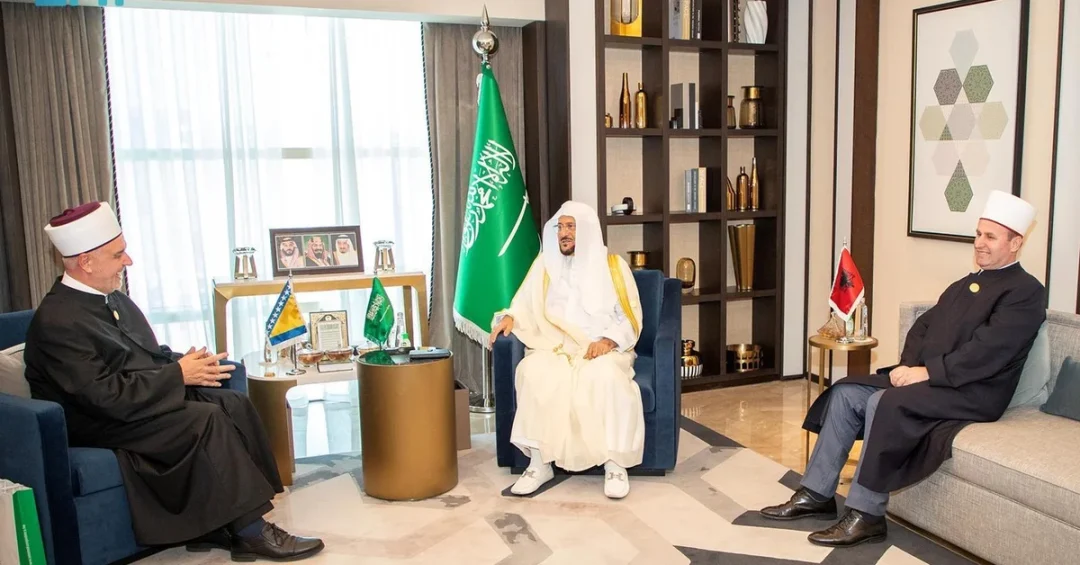
Saudi Minister of Islamic Affairs, Dawah and Guidance Sheikh Dr. Abdullatif Al Al-Sheikh met with Grand Mufti of Bosnia and Herzegovina Husein Kavazović and Grand Mufti of Albania Bujar Spahiu on the sidelines of the 9th Conference of Ministers of Awqaf and Islamic Affairs in Makkah. The meeting, held on August 5, 2024, focused on enhancing cooperation to serve Muslim communities in the Balkan region and beyond.
Context and Background
The 9th Conference of Ministers of Awqaf and Islamic Affairs, organized by the Ministry of Islamic Affairs, Dawah and Guidance, brings together religious leaders and officials from around the world to discuss issues affecting Muslim communities. This year’s conference in Makkah underscores Saudi Arabia’s pivotal role in fostering unity and addressing the needs of Muslims globally. The participation of Grand Muftis from Bosnia and Herzegovina and Albania highlights the Kingdom’s commitment to supporting Muslim minorities in Europe, particularly in the Balkans, where historical and cultural ties with the Islamic world run deep.
Saudi Arabia has long been a staunch supporter of Islamic causes worldwide, providing humanitarian aid, educational resources, and religious guidance. The meeting reflects the Kingdom’s ongoing efforts under Vision 2030 to promote moderate Islam and interfaith dialogue, aligning with its broader strategy to enhance global peace and stability.
Key Details
During the meeting, Minister Al Al-Sheikh, Grand Mufti Kavazović, and Grand Mufti Spahiu discussed a range of topics pertinent to the welfare of Muslim communities in the Balkan countries. They explored avenues for collaboration in religious education, cultural exchange, and social development. The officials emphasized the importance of preserving Islamic heritage and promoting tolerance, moderation, and coexistence.
The Grand Mufti of Bosnia and Herzegovina, Husein Kavazović, and the Grand Mufti of Albania, Bujar Spahiu, expressed appreciation for Saudi Arabia’s continued support and its role in facilitating dialogue among Muslim scholars and leaders. The meeting also addressed the challenges faced by Muslim minorities in Europe, including issues of integration and maintaining religious identity.
Implications and Impact
This high-level engagement is expected to strengthen Saudi Arabia’s relations with Balkan Muslim communities, fostering greater cooperation in religious and cultural spheres. It also reinforces the Kingdom’s position as a global leader in Islamic affairs, dedicated to the principles of moderation and peace. By supporting Muslim minorities, Saudi Arabia contributes to regional stability and counters extremism, aligning with international efforts to promote tolerance.
Furthermore, the meeting signals Saudi Arabia’s commitment to multilateral dialogue through platforms like the Conference of Ministers of Awqaf and Islamic Affairs. Such gatherings facilitate the exchange of ideas and best practices, enabling Muslim communities worldwide to address common challenges collectively.
Vision 2030 Alignment
Saudi Arabia’s Vision 2030 emphasizes the promotion of moderate Islam and the enhancement of the Kingdom’s global role. The meeting with the Grand Muftis of Bosnia and Herzegovina and Albania exemplifies these objectives by strengthening ties with Muslim communities abroad and fostering international cooperation. Through such initiatives, Saudi Arabia continues to lead by example, advocating for peace, tolerance, and mutual understanding, thereby contributing to a more harmonious world.
20 Questions
Q1. Who met with the Grand Muftis of Bosnia and Herzegovina and Albania?
A1. Saudi Minister of Islamic Affairs, Dawah and Guidance Sheikh Dr. Abdullatif Al Al-Sheikh met with Grand Mufti Husein Kavazović of Bosnia and Herzegovina and Grand Mufti Bujar Spahiu of Albania on August 5, 2024, in Makkah.
Q2. What was the occasion of the meeting?
A2. The meeting took place on the sidelines of the 9th Conference of Ministers of Awqaf and Islamic Affairs, organized by the Ministry of Islamic Affairs, Dawah and Guidance in Makkah, Saudi Arabia.
Q3. What topics were discussed during the meeting?
A3. The officials discussed various topics, with a focus on serving Muslims in the Balkan countries, including religious education, cultural exchange, and social development.
Q4. Why is Saudi Arabia involved in supporting Balkan Muslims?
A4. Saudi Arabia has historical and cultural ties with the Balkans and is committed to supporting Muslim communities worldwide, promoting moderation and interfaith dialogue as part of its global role.
Q5. What is the significance of the 9th Conference of Ministers of Awqaf and Islamic Affairs?
A5. The conference serves as a platform for global Islamic leaders to discuss issues affecting Muslim communities, share best practices, and foster unity under Saudi leadership.
Q6. How does this meeting align with Saudi Vision 2030?
A6. It aligns with Vision 2030 by promoting moderate Islam, enhancing Saudi Arabia’s global role, and strengthening international cooperation for peace and tolerance.
Q7. Who is Sheikh Dr. Abdullatif Al Al-Sheikh?
A7. He is the Saudi Minister of Islamic Affairs, Dawah and Guidance, responsible for overseeing Islamic affairs, promoting moderation, and supporting Muslim communities globally.
Q8. Who is Husein Kavazović?
A8. Husein Kavazović is the Grand Mufti of Bosnia and Herzegovina, the highest Islamic authority in the country, representing the Muslim community and promoting interfaith harmony.
Q9. Who is Bujar Spahiu?
A9. Bujar Spahiu is the Grand Mufti of Albania, leading the Muslim Community of Albania and working to preserve Islamic heritage and foster coexistence in the region.
Q10. What are the challenges facing Muslim minorities in Europe?
A10. Challenges include maintaining religious identity, integration into broader society, combating Islamophobia, and preserving cultural and religious heritage in a changing environment.
Q11. How does Saudi Arabia support Muslim minorities globally?
A11. Saudi Arabia provides humanitarian aid, educational resources, religious guidance, and facilitates dialogue through conferences and bilateral meetings to support Muslim communities.
Q12. What is the expected outcome of this meeting?
A12. The meeting is expected to strengthen cooperation, enhance support for Balkan Muslims, and reinforce Saudi Arabia’s leadership in promoting moderate Islam and global peace.
Q13. What is the role of the Ministry of Islamic Affairs, Dawah and Guidance?
A13. The ministry oversees Islamic affairs in Saudi Arabia, promotes moderate Islam, supports Muslim communities worldwide, and organizes international conferences like the 9th Conference of Ministers.
Q14. How many ministers attended the 9th Conference?
A14. The conference brought together ministers of Awqaf and Islamic affairs from various countries, along with religious leaders and scholars, to discuss issues of common concern.
Q15. What is the significance of Makkah as the meeting location?
A15. Makkah is the holiest city in Islam, making it a fitting location for Islamic conferences that aim to unite Muslims and address their needs in a spiritually significant environment.
Q16. How does this meeting contribute to global peace?
A16. By fostering dialogue and cooperation among Muslim leaders, the meeting promotes tolerance, counters extremism, and contributes to stability and peace in the Balkans and beyond.
Q17. What kind of support does Saudi Arabia provide to Bosnia and Herzegovina?
A17. Saudi Arabia supports Bosnia and Herzegovina through humanitarian aid, educational scholarships, religious guidance, and cultural exchange programs to benefit its Muslim community.
Q18. What kind of support does Saudi Arabia provide to Albania?
A18. Saudi Arabia provides Albania with similar support, including aid for religious infrastructure, educational resources, and collaboration to promote moderate Islam and interfaith harmony.
Q19. How can other countries benefit from Saudi Arabia’s approach?
A19. Other countries can learn from Saudi Arabia’s model of promoting moderate Islam, interfaith dialogue, and international cooperation to support Muslim minorities and foster peaceful coexistence.
Q20. What future initiatives are planned following this meeting?
A20. Future initiatives may include joint educational programs, cultural exchanges, and continued dialogue through conferences to address the needs of Muslim communities in the Balkans and worldwide.
Reader Feedback
We value your thoughts. Please share your feedback on this article.
Your feedback helps us improve our coverage.