


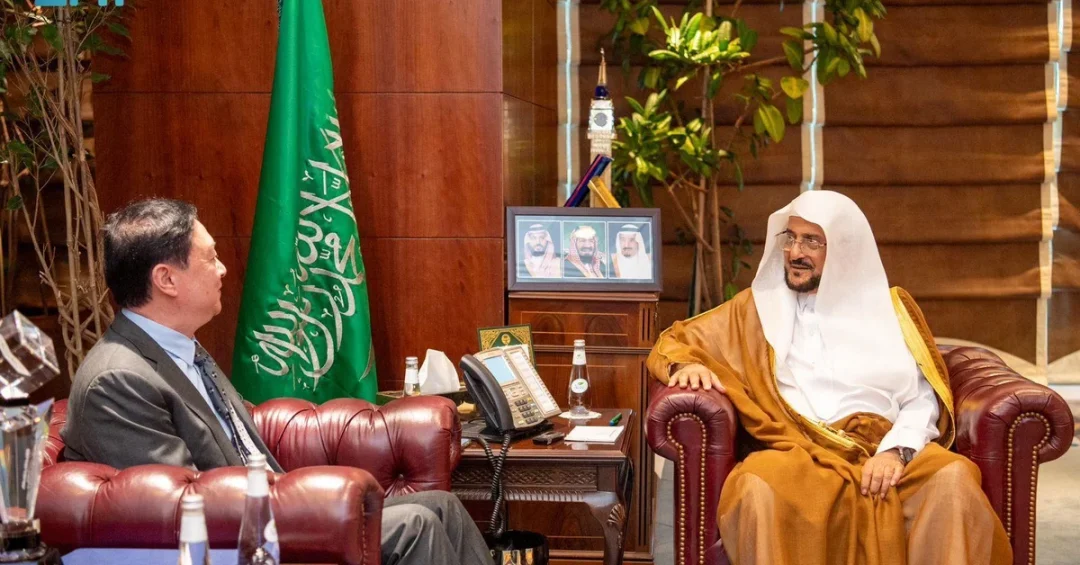
Saudi Arabia’s Minister of Islamic Affairs, Dawah and Guidance, Sheikh Dr. Abdullatif Al Alsheikh, received the Ambassador of the People’s Republic of China to the Kingdom, Chang Hua, in Riyadh on November 4, 2024, according to an official announcement carried by the Saudi Press Agency (SPA). The meeting brought together two senior figures whose portfolios touch on faith, diplomacy and cross-cultural understanding, and it unfolded against the backdrop of the Kingdom’s expanding international engagement under Vision 2030. The two sides exchanged cordial talks and discussed issues of common interest, with particular attention to Islamic work and the promotion of moderation and peaceful coexistence — themes that have become central to Saudi Arabia’s religious diplomacy in recent years.
Official Saudi channels reported the encounter as part of the Kingdom’s regular diplomatic calendar, reflecting the Ministry of Islamic Affairs, Dawah and Guidance’s active role in building bridges with representatives of foreign governments accredited to Riyadh. For international observers, the meeting offers a clear signal: Saudi Arabia continues to position itself as a global advocate for moderate religious discourse, and it is doing so through direct engagement with some of the world’s most consequential capitals, including Beijing. The readout was concise but purposeful, and it underscores how religious affairs have become an integral strand of the Kingdom’s wider foreign policy architecture.
Context and Background
How does a single diplomatic meeting in Riyadh illuminate the broader direction of Saudi religious diplomacy? To understand the significance of the encounter between Sheikh Dr. Abdullatif Al Alsheikh and Ambassador Chang Hua, it helps to recall the institutional mandate of the Ministry of Islamic Affairs, Dawah and Guidance. The ministry is responsible for supervising mosques, religious endowments, Islamic outreach and the training of imams and preachers across the Kingdom, and it has increasingly taken on an international dimension by promoting what Saudi officials describe as moderate Islam — a framework rooted in tolerance, balance and respect for lawful authority.
Under the leadership of Sheikh Dr. Abdullatif Al Alsheikh, the ministry has hosted numerous foreign delegations, participated in interfaith and intercultural dialogues, and coordinated with counterpart institutions in Asia, Africa, Europe and the Americas. China, for its part, maintains a substantial diplomatic presence in Riyadh and shares with the Kingdom a long history of trade, cultural exchange and, more recently, strategic partnership. Ambassador Chang Hua’s tenure has coincided with a period of intensifying Saudi-Chinese cooperation across energy, technology and infrastructure, making his exchanges with Saudi religious authorities a natural extension of a deepening bilateral relationship.
It is also worth noting that the meeting took place in a year when Saudi Arabia has hosted a series of high-level summits, investment conferences and cultural festivals that draw global participation. Each such event reinforces the Kingdom’s image as a hub for dialogue, and the SPA readout of the Islamic Affairs Ministry meeting fits squarely within that pattern. The reference to promoting moderation and peaceful coexistence is not incidental; it is a recurring theme in official Saudi communications and a core element of the country’s religious soft power strategy.
Key Details of the Meeting
What exactly did the two officials discuss, and why does the framing matter? According to the Saudi Press Agency, Sheikh Dr. Abdullatif Al Alsheikh and Ambassador Chang Hua exchanged cordial talks and addressed matters of mutual concern, especially those connected to Islamic work and the advancement of moderation and peaceful coexistence. The language mirrors previous official readouts from the ministry, which consistently emphasize dialogue over division and cooperation over confrontation. The meeting was described as cordial, a standard diplomatic formulation that nonetheless conveys a constructive atmosphere.
The readout did not disclose specific agreements, memoranda of understanding or follow-up mechanisms, and no joint statement was issued. However, the fact that the meeting was publicized through official Saudi channels indicates that both sides regarded it as noteworthy. In diplomatic practice, the publication of a readout often signals satisfaction with the exchange and a willingness to continue engagement. The absence of controversy in the reporting further suggests that the conversation stayed within the framework of shared interests rather than sensitive disputes.
It is also relevant that the Chinese ambassador is based in Riyadh and maintains regular contact with a wide range of Saudi ministries, reflecting the breadth of the bilateral relationship. Meetings of this kind serve practical purposes: they allow foreign envoys to gain a clearer understanding of Saudi institutional priorities, and they give Saudi officials an opportunity to explain the Kingdom’s religious and cultural initiatives to an international audience. In this instance, the focus on moderation and coexistence placed the conversation firmly within the space of shared values rather than contentious issues.
International and Regional Impact
Why should an international audience pay attention to a meeting between a Saudi minister and a Chinese ambassador? The answer lies in the evolving geometry of global diplomacy. Saudi Arabia and China have deepened their ties considerably in recent years, cooperating on energy supply, trade, technology and regional stability. Religious and cultural engagement adds a further layer to that relationship, helping to build trust at the societal level and opening channels for people-to-people exchange. When a senior Saudi religious official meets a Chinese envoy, it signals that the partnership extends beyond commercial transactions into the realm of values and mutual understanding.
Regionally, the meeting reinforces Saudi Arabia’s role as a stabilizing and constructive actor. The Kingdom has consistently advocated for moderation as an antidote to extremism, and it has supported international efforts to combat radicalization through education, dialogue and community engagement. By discussing these themes with a representative of a major Asian power, Saudi officials are effectively exporting a message of tolerance that resonates far beyond the Middle East. For countries across Asia with significant Muslim populations, Saudi Arabia’s emphasis on peaceful coexistence offers a constructive model for managing diversity and fostering social harmony.
Economic and Strategic Significance
How do religious and cultural exchanges connect to economic and strategic objectives? Saudi Arabia’s Vision 2030 reform agenda is not limited to diversifying the economy away from oil; it also encompasses social development, cultural openness and the strengthening of international partnerships. The Ministry of Islamic Affairs, Dawah and Guidance contributes to these goals by promoting a moderate religious discourse that supports stability, which in turn creates an environment conducive to investment and tourism. A stable, outward-looking Saudi Arabia is better positioned to attract global businesses, host major events and integrate into international supply chains.
China is one of the Kingdom’s most important economic partners, and the relationship spans crude oil sales, petrochemicals, renewable energy, digital infrastructure and logistics. Diplomatic and cultural engagement complements these commercial ties by building familiarity and reducing friction. When Saudi religious authorities engage with Chinese representatives, they help to cultivate a climate of mutual respect that can smooth the way for further collaboration. In this sense, the meeting in Riyadh, while modest in scale, contributes to a broader strategic alignment that benefits both countries.
Moreover, the Kingdom’s religious diplomacy supports its tourism ambitions, particularly around pilgrimage. Millions of Muslims travel to Saudi Arabia each year for Hajj and Umrah, and many come from Asia, including China’s Muslim communities. Constructive engagement with Chinese officials can facilitate the organization of pilgrimage travel, improve services for pilgrims and enhance the overall experience. These practical dimensions underscore why religious affairs are treated as a serious component of Saudi foreign policy rather than a peripheral concern.
Vision 2030 Alignment
How does this meeting embody the spirit of Vision 2030? Saudi Arabia’s long-term transformation strategy, launched in 2016 under the leadership of Crown Prince Mohammed bin Salman, aims to build a diversified economy, a vibrant society and an ambitious nation. The Ministry of Islamic Affairs, Dawah and Guidance plays a role in the societal pillar by fostering moderate values, supporting community cohesion and presenting a positive image of Islam to the world. The meeting with Ambassador Chang Hua is a small but meaningful illustration of that mission in action.
Looking ahead, the Kingdom is expected to continue expanding its network of international religious and cultural partnerships, in line with its vision of becoming a global hub for dialogue and cooperation. Encounters such as this one help to strengthen Saudi Arabia’s reputation as a responsible and forward-looking nation that works with all countries on the basis of mutual respect. For international readers, the message is clear: Saudi Arabia is open for engagement, committed to moderation and eager to build bridges that serve both its own people and the wider world.
20 Questions
Q1. Who received the Chinese Ambassador to Saudi Arabia in Riyadh?
A1. Saudi Arabia’s Minister of Islamic Affairs, Dawah and Guidance, Sheikh Dr. Abdullatif Al Alsheikh, received Ambassador Chang Hua of the People’s Republic of China in Riyadh on November 4, 2024, according to the Saudi Press Agency.
Q2. When did the meeting between the Saudi minister and the Chinese ambassador take place?
A2. The meeting took place on November 4, 2024, in Riyadh, as reported by the Saudi Press Agency, which published the official readout of the encounter on the same day.
Q3. What topics were discussed during the meeting?
A3. The two officials exchanged cordial talks and discussed issues of common interest, particularly those related to Islamic work and the promotion of moderation and peaceful coexistence, according to the official Saudi readout.
Q4. Which Saudi government body announced the meeting?
A4. The meeting was announced through the Saudi Press Agency, the Kingdom’s official news agency, which regularly publishes readouts of ministerial engagements with foreign diplomats accredited to Riyadh.
Q5. Who is Sheikh Dr. Abdullatif Al Alsheikh?
A5. Sheikh Dr. Abdullatif Al Alsheikh is the Minister of Islamic Affairs, Dawah and Guidance in Saudi Arabia, responsible for overseeing mosques, religious endowments, Islamic outreach and the promotion of moderate religious discourse.
Q6. Who is Chang Hua?
A6. Chang Hua is the Ambassador of the People’s Republic of China to Saudi Arabia, based in Riyadh, where he represents Chinese interests and maintains regular contact with Saudi ministries and institutions.
Q7. Why is the promotion of moderation important in Saudi religious diplomacy?
A7. Moderation is central to Saudi Arabia’s efforts to counter extremism, foster tolerance and present a balanced image of Islam internationally, supporting stability and constructive engagement with countries around the world.
Q8. What does peaceful coexistence mean in the context of this meeting?
A8. Peaceful coexistence refers to the principle of different communities and nations living together respectfully, a value Saudi Arabia promotes through interfaith dialogue, cultural exchange and international cooperation.
Q9. Does the meeting indicate closer Saudi-Chinese cooperation?
A9. Yes, it reflects the deepening bilateral relationship between Saudi Arabia and China, which already cooperates closely on energy, trade, technology and regional stability, now extending into religious and cultural engagement.
Q10. Were any agreements signed during the meeting?
A10. The official readout did not mention any agreements or memoranda of understanding. The meeting was described as an exchange of cordial talks on issues of common interest.
Q11. How does this meeting fit into Saudi Arabia’s foreign policy?
A11. It forms part of Saudi Arabia’s broader foreign policy of building constructive partnerships worldwide, using religious and cultural diplomacy to strengthen ties and promote the Kingdom’s message of moderation.
Q12. What role does the Ministry of Islamic Affairs play internationally?
A12. The ministry engages with foreign delegations, participates in interfaith dialogues and promotes moderate Islam globally, serving as a key instrument of Saudi religious soft power and cultural outreach.
Q13. Why is China an important partner for Saudi Arabia?
A13. China is a major energy customer, trade partner and investor in Saudi Arabia, and the two countries collaborate on infrastructure, technology and regional issues, making the relationship strategically vital.
Q14. How does this meeting relate to Vision 2030?
A14. Vision 2030 seeks a diversified economy and a vibrant, moderate society. The meeting supports these goals by advancing religious moderation, international dialogue and the Kingdom’s positive global image.
Q15. What benefits could arise for Muslim communities in China?
A15. Constructive engagement can facilitate pilgrimage travel, cultural exchange and mutual understanding, helping Chinese Muslims participate in international Islamic activities and strengthening people-to-people ties.
Q16. How does Saudi Arabia promote peaceful coexistence globally?
A16. Saudi Arabia hosts interfaith conferences, supports dialogue initiatives and works through its ministries and international bodies to encourage tolerance, understanding and cooperation among different cultures and religions.
Q17. Is this meeting part of a regular pattern of diplomacy?
A17. Yes, the Ministry of Islamic Affairs regularly receives foreign ambassadors and delegations, reflecting Saudi Arabia’s ongoing commitment to international engagement and religious diplomacy.
Q18. What message does this meeting send to the international community?
A18. It signals that Saudi Arabia is open to dialogue, committed to moderation and willing to work with global partners, including major powers like China, on shared values and interests.
Q19. How might this meeting affect Saudi-Chinese cultural relations?
A19. It can strengthen cultural ties by encouraging exchanges, fostering mutual respect and laying groundwork for future collaboration in education, heritage and interfaith understanding.
Q20. What is the likely follow-up to this meeting?
A20. While no specific follow-up was announced, such meetings typically lead to continued dialogue, potential joint initiatives and deeper cooperation on religious, cultural and diplomatic matters of mutual interest.
Reader Feedback
We value your thoughts. Please share your feedback on this article.
Your feedback helps us improve our coverage.
Related articles
 Riyadh Governor Receives Iranian Ambassador
 Jeddah Governor Receives French Ambassador
 Saudi FM Meets Moldova Deputy PM, Signs Cooperation Deal
 IMCTC Chief Meets Iraqi Defense Minister in Riyadh
 Saudi Vice Foreign Minister Joins Kuwait Counter-Terrorism Conference
 Saudi, Indonesian FMs Discuss Gaza, Bilateral Ties