


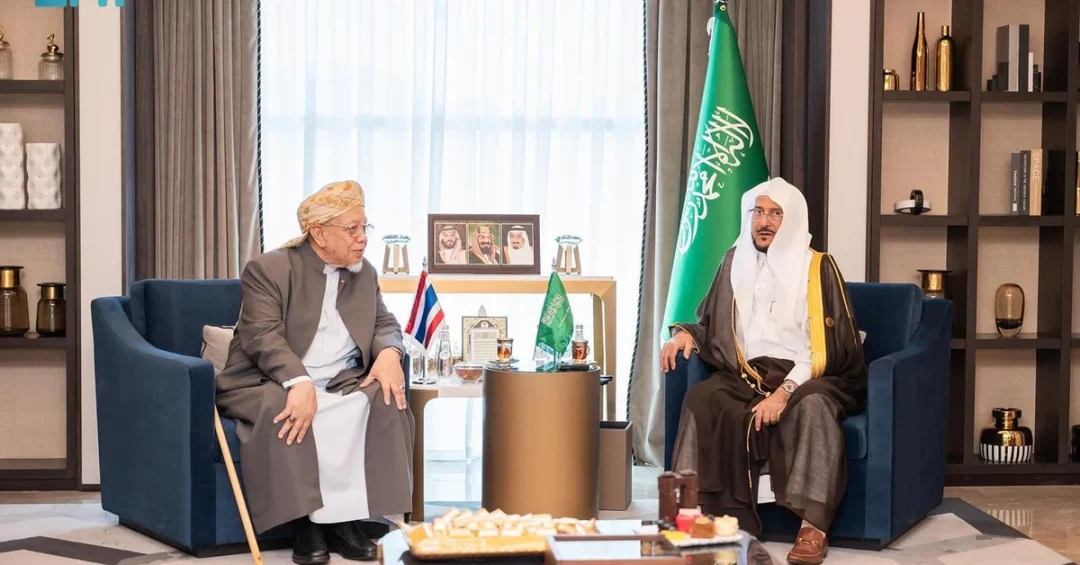
Minister of Islamic Affairs, Dawah and Guidance Sheikh Dr. Abdullatif Al Al-Sheikh met separately in Makkah with the Chairman of the Council of Senior Scholars of Thailand, Sheikh Aaron Boon Shum, and the Chairman of the Gabonese Muslim Community Authority, Abdul Razzak Kabongo, on Monday, August 5, 2024. The meetings, held under the auspices of the Saudi Ministry of Islamic Affairs, Dawah and Guidance, focused on strengthening bilateral cooperation in various Islamic fields and exploring avenues for enhanced religious dialogue and mutual understanding.
Context and Background
These high-level meetings underscore Saudi Arabia’s ongoing commitment to fostering strong ties with Muslim communities and institutions worldwide. The Kingdom, under the leadership of the Custodian of the Two Holy Mosques, King Salman bin Abdulaziz Al Saud, and His Royal Highness Crown Prince Mohammed bin Salman bin Abdulaziz Al Saud, has consistently prioritized interfaith dialogue and cultural exchange as pillars of its foreign policy. The discussions with representatives from Thailand and Gabon align with this broader vision, emphasizing Saudi Arabia’s role as a central hub for Islamic scholarship and collaboration.
Key Details
During the meeting with Sheikh Aaron Boon Shum, the officials explored opportunities for joint initiatives in Dawah (Islamic outreach) and religious education. The discussions highlighted the importance of fostering moderate Islamic discourse and countering extremist ideologies. Similarly, in the meeting with Abdul Razzak Kabongo of Gabon, the conversation centered on enhancing cooperation in Islamic affairs, including the training of imams and the promotion of religious tolerance. Both meetings were characterized by a spirit of mutual respect and a shared commitment to advancing Islamic values of peace and unity.
International Impact
The meetings signal Saudi Arabia’s active engagement with diverse Muslim populations across Asia and Africa. By collaborating with Thailand’s Council of Senior Scholars and Gabon’s Muslim Community Authority, the Kingdom reinforces its dedication to supporting Islamic institutions globally. This engagement not only strengthens diplomatic ties but also facilitates the exchange of ideas and best practices in religious governance. It also demonstrates Saudi Arabia’s capacity to act as a bridge between different Islamic cultures and traditions, contributing to regional stability and interfaith harmony.
20 Questions
Q1. Who attended the meetings in Makkah?
A1. The Minister of Islamic Affairs, Dawah and Guidance, Sheikh Dr. Abdullatif Al Al-Sheikh, met with the Chairman of the Council of Senior Scholars of Thailand, Sheikh Aaron Boon Shum, and the Chairman of the Gabonese Muslim Community Authority, Abdul Razzak Kabongo.
Q2. When did the meetings take place?
A2. The meetings took place on Monday, August 5, 2024, as reported by the Saudi Press Agency (SPA).
Q3. Where were the meetings held?
A3. The meetings were held in the holy city of Makkah, Saudi Arabia, a central location for Islamic gatherings and diplomacy.
Q4. What was the purpose of the meetings?
A4. The purpose was to discuss topics of common interest, particularly issues related to Islamic affairs, including cooperation in Dawah, religious education, and countering extremism.
Q5. Who represented Thailand in the meeting?
A5. Thailand was represented by Sheikh Aaron Boon Shum, the Chairman of the Council of Senior Scholars of Thailand.
Q6. Who represented Gabon in the meeting?
A6. Gabon was represented by Abdul Razzak Kabongo, the Chairman of the Gabonese Muslim Community Authority.
Q7. What is the role of the Minister of Islamic Affairs, Dawah and Guidance in Saudi Arabia?
A7. The Minister oversees religious outreach, mosque administration, and promotes moderate Islamic values, aligning with Saudi Arabia’s Vision 2030 goals for social cohesion.
Q8. What topics were discussed during the meeting with the Thai official?
A8. The officials discussed joint initiatives in Dawah, religious education, and fostering moderate Islamic discourse to counter extremist ideologies.
Q9. What topics were discussed during the meeting with the Gabonese official?
A9. The conversation focused on enhancing cooperation in Islamic affairs, including the training of imams and the promotion of religious tolerance.
Q10. How do these meetings align with Saudi Arabia’s foreign policy?
A10. They align with Saudi Arabia’s policy of fostering strong ties with Muslim communities globally, promoting interfaith dialogue, and acting as a central hub for Islamic scholarship.
Q11. What is the significance of holding such meetings in Makkah?
A11. Makkah is the spiritual heart of Islam, making it a symbolic and practical location for high-level Islamic diplomatic engagements and discussions on religious cooperation.
Q12. What is the Council of Senior Scholars of Thailand?
A12. It is a leading Islamic body in Thailand that guides religious affairs and represents the Muslim community in the country, playing a key role in religious education and governance.
Q13. What is the Gabonese Muslim Community Authority?
A13. It is a central institution in Gabon that oversees Islamic religious activities, promotes community welfare, and facilitates interfaith understanding in the nation.
Q14. How might these meetings impact Islamic communities in Asia and Africa?
A14. They could lead to enhanced cooperation, exchange of best practices in religious moderation, and better support for religious education and imam training in both regions.
Q15. What is the role of the Saudi Ministry of Islamic Affairs, Dawah and Guidance in global outreach?
A15. The ministry coordinates international Dawah efforts, supports mosque construction, and promotes moderate Islamic teachings through various programs and partnerships worldwide.
Q16. How does Saudi Arabia support interfaith dialogue?
A16. Saudi Arabia hosts initiatives like the Makkah Declaration and convenes conferences that bring together religious leaders from different faiths to promote tolerance and peaceful coexistence.
Q17. Why is countering extremism a focus of these meetings?
A17. Countering extremism is a global priority, and Saudi Arabia works with international partners to promote moderate Islamic values that reject violence and radical ideologies.
Q18. What is the traditional significance of the Saudi-Thailand relationship in Islamic affairs?
A18. Saudi Arabia and Thailand have maintained cooperative ties through Islamic exchanges, with Saudi institutions supporting Thai Muslim communities in education and religious guidance.
Q19. What is the traditional significance of the Saudi-Gabon relationship in Islamic affairs?
A19. Saudi Arabia and Gabon share a history of collaboration in Islamic affairs, with Saudi Arabia providing support for Gabonese Muslims in areas like Hajj services and religious education.
Q20. How does this meeting reflect Saudi Arabia’s Vision 2030 goals?
A20. It reflects Vision 2030’s aim to promote tolerance, global engagement, and Saudi Arabia’s role as a leader in moderate Islamic discourse, fostering international partnerships.
Vision 2030 Alignment
The meetings are a direct reflection of Saudi Arabia’s Vision 2030 objectives, which emphasize the importance of global partnerships and cultural exchange. By engaging with religious leaders from Thailand and Gabon, the Kingdom reinforces its role as a champion of moderate Islam and a bridge between nations. This engagement not only supports the Vision’s goal of fostering a tolerant and open society but also strengthens Saudi Arabia’s position as a key player in international religious diplomacy, contributing to long-term regional and global stability.
Reader Feedback
We value your thoughts. Please share your feedback on this article.
Your feedback helps us improve our coverage.