


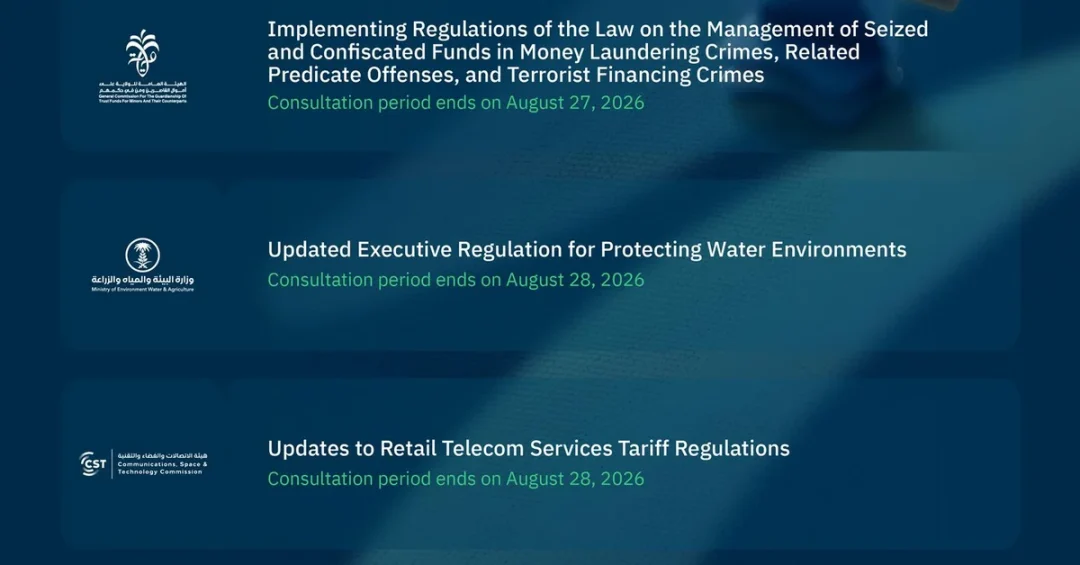
The Saudi Competitiveness and Business Center (SCBC) has opened public consultation on 25 economic and development projects through its Istitlaa platform, inviting citizens, government agencies, and the private sector to review and comment on draft regulations before they are approved. Announced via the Saudi Press Agency on August 9, 2026, the initiative is being carried out in cooperation with 19 government agencies and covers a broad spectrum of sectors, from financial crime enforcement and environmental protection to telecommunications tariffs and parcel delivery services. The consultations remain open on staggered deadlines through late August and early September 2026.
The Istitlaa platform, whose name evokes the Arabic concept of seeking input or consultation, has become a central instrument in Saudi Arabia’s drive to modernize its legislative environment. Rather than finalizing regulations behind closed doors, the Kingdom is systematically publishing draft rules and inviting structured feedback from the people and businesses they will affect. For international observers, the scale of this latest batch, 25 projects across 19 agencies, is a signal that regulatory reform in Saudi Arabia is not a one-off exercise but a continuous, institutionalized process. Why does this matter beyond the Kingdom’s borders? Because transparent rulemaking is one of the strongest predictors of long-term investor confidence, and Saudi Arabia is deliberately building that confidence into its governance model.
Context and Background
How did Saudi Arabia move from a traditionally top-down regulatory culture to one that actively solicits public opinion? The answer lies in the broader governance transformation that has accompanied Vision 2030, the national reform program launched in 2016 under the leadership of Crown Prince Mohammed bin Salman. As the Kingdom diversified its economy and opened new sectors to private and foreign investment, officials recognized that predictable, clearly communicated regulations were as important as physical infrastructure. The SCBC, which operates under the umbrella of the Saudi government’s competitiveness agenda, established Istitlaa as a dedicated public consultation portal to serve that purpose.
The platform’s design reflects a simple principle: those who must comply with regulations should have a voice in shaping them. Istitlaa publishes draft laws, executive regulations, and licensing requirements, then opens a comment window during which any stakeholder can submit feedback electronically. Government agencies are required to review the input and, where appropriate, adjust the drafts before final approval. This cycle of publication, consultation, revision, and enactment has gradually normalized the idea that regulation is a collaborative rather than unilateral act.
The current batch of 25 projects is notable for its breadth. It spans ministries responsible for finance, environment, communications, transport, and social welfare, demonstrating that the consultation habit has taken root across the entire government apparatus rather than in a single reform-minded ministry. The involvement of 19 agencies also means the feedback collected will touch on issues as varied as money laundering enforcement, coral reef protection, telecom pricing, and last-mile delivery logistics.
Key Details of the 25 Projects
Among the most consequential proposals is a draft implementing regulation for the Law on the Management of Seized and Confiscated Funds in Money Laundering Crimes, Related Predicate Offenses, and Terrorist Financing Crimes. The project was launched by the General Commission for the Guardianship of Trust Funds for Minors and Their Counterparts, an agency whose mandate includes safeguarding assets that come under state supervision. The regulation aims to define precise procedures for receiving, safeguarding, and managing funds subject to the law, while enhancing transparency and efficiency by documenting and preserving every step related to seized and confiscated assets. Public feedback on this project remains open until August 27, 2026.
Environmental protection features prominently as well. The Ministry of Environment, Water and Agriculture has put forward an updated executive regulation for protecting water environments from pollution. The update aligns the regulation with Cabinet Resolution No. 406, which approved the regulation of the General Organization for the Conservation of Coral Reefs and Sea Turtles in the Red Sea. Given the Red Sea’s ecological significance and its growing role in Saudi tourism and marine research, the alignment of pollution rules with coral and turtle conservation is a meaningful step. Comments on this project are open until August 28, 2026.
The Communications, Space and Technology Commission has proposed updates to retail telecom service tariff regulations. The stated goals are to enhance access to advanced telecommunications services, strengthen the competitiveness of the sector and its service providers, and promote clarity and transparency in pricing procedures while upholding equality and non-discrimination. For consumers and foreign operators alike, tariff transparency is a foundational element of a modern digital economy. Feedback on this project is open until August 28, 2026.
Finally, the Transport General Authority has launched requirements for running a parcel station. The project seeks to regulate the sector, create an attractive investment environment, improve the quality of last-mile services, enhance competition, improve customer experience, and safeguard beneficiaries’ rights. As e-commerce expands across the Kingdom, parcel infrastructure has become critical economic plumbing. Comments on this project remain open until September 1, 2026. Each of the four highlighted projects illustrates a different facet of the same philosophy: rules should be written with the input of those who will live under them.
International and Regional Impact
Why should international businesses, investors, and policymakers outside Saudi Arabia pay attention to a public consultation platform? The most direct answer is that regulatory transparency reduces risk. When a company considers entering a new market, one of its biggest concerns is the unpredictability of rules. A platform like Istitlaa allows foreign investors to see draft regulations early, understand the direction of policy, and even submit comments through local partners or industry associations. That visibility shortens due diligence timelines and lowers the perceived cost of compliance.
At the regional level, Saudi Arabia’s consultation model may influence neighboring economies that are also pursuing diversification. The Gulf Cooperation Council states share many regulatory challenges, from cross-border payments to environmental standards. If Saudi Arabia demonstrates that public consultation produces better rules with fewer implementation disputes, other governments may adopt similar platforms. In this sense, Istitlaa is not merely a domestic administrative tool but a potential export of governance best practice. It also reinforces the Kingdom’s position as a reliable partner in international efforts against money laundering and terrorist financing, areas where the seized-assets regulation directly supports global compliance standards.
Economic and Strategic Significance
What do better regulations actually deliver in economic terms? For the telecommunications sector, transparent tariff rules encourage investment in network infrastructure by reducing the risk of arbitrary pricing interventions. For parcel logistics, clear station requirements lower barriers to entry for small operators and attract the kind of investment that improves delivery times and reduces costs for merchants. For environmental regulation, alignment with conservation agreements protects natural assets that underpin tourism revenue, particularly along the Red Sea coast where luxury resorts and marine reserves coexist.
Strategically, the consultation process strengthens the rule of law by making regulation more legitimate in the eyes of those governed by it. When businesses and citizens see their comments reflected in final rules, compliance becomes less a matter of enforcement and more a matter of shared ownership. That dynamic is especially valuable as Saudi Arabia seeks to attract foreign direct investment and expand the private sector’s share of the economy. The SCBC’s coordination role ensures that individual agencies do not operate in silos, producing a more coherent regulatory environment overall.
Vision 2030 Alignment
How does a public consultation platform connect to the ambitious goals of Vision 2030? One of the vision’s central pillars is a vibrant private sector and a government that enables rather than obstructs. Istitlaa operationalizes that pillar by embedding private-sector and citizen feedback into the regulatory process itself. It also supports the vision’s emphasis on transparency and accountability, which are prerequisites for the international partnerships and investment flows the Kingdom seeks.
Looking ahead, the 25 projects currently open for comment are likely to be followed by further batches as agencies internalize the consultation habit. The deadlines in late August and early September 2026 give stakeholders a clear window to participate. For Saudi Arabia, the payoff is a regulatory framework that is more predictable, more competitive, and more closely aligned with the needs of the economy it governs. For the rest of the world, it is another example of how the Kingdom is translating Vision 2030 from a strategic document into daily governance practice. The invitation to comment is open, and the outcome will shape the business environment for years to come.
20 Questions
Q1. What is the Istitlaa platform?
A1. Istitlaa is the public consultation platform of the Saudi Competitiveness and Business Center. It publishes draft regulations and projects, inviting citizens, government agencies, and the private sector to submit feedback before final approval.
Q2. How many projects are currently open for feedback?
A2. The platform has put forward 25 projects related to economic and development affairs, developed in cooperation with 19 government agencies across multiple sectors.
Q3. Which agency launched the seized-assets regulation project?
A3. The General Commission for the Guardianship of Trust Funds for Minors and Their Counterparts launched the implementing regulations for managing seized and confiscated funds in money laundering and terrorist financing crimes.
Q4. What is the deadline for feedback on the seized-assets project?
A4. Public feedback on the seized-assets regulation project is open until August 27, 2026, according to the announcement carried by the Saudi Press Agency.
Q5. What does the water environment pollution regulation aim to do?
A5. The updated executive regulation from the Ministry of Environment, Water and Agriculture aims to protect water environments from pollution and align with Cabinet Resolution No. 406 on coral reef and sea turtle conservation.
Q6. When does consultation close on the water environment project?
A6. Feedback on the updated executive regulation for protecting water environments from pollution is open until August 28, 2026.
Q7. What is the focus of the telecom tariff regulation update?
A7. The Communications, Space and Technology Commission seeks to enhance access to advanced telecom services, strengthen sector competitiveness, and promote clarity, transparency, equality, and non-discrimination in retail tariffs.
Q8. What is the deadline for the telecom tariff consultation?
A8. Comments on the updates to retail telecom service tariff regulations are open until August 28, 2026.
Q9. What are the parcel station requirements about?
A9. The Transport General Authority’s project aims to regulate the parcel sector, attract investment, improve last-mile services, enhance competition, improve customer experience, and safeguard beneficiaries’ rights.
Q10. When does the parcel station consultation end?
A10. Public feedback on the requirements for running a parcel station is open until September 1, 2026.
Q11. Who can participate in Istitlaa consultations?
A11. The general public, government agencies, and the private sector are all invited to share feedback on proposed projects before they are approved.
Q12. How many government agencies are involved in this batch?
A12. Nineteen government agencies are cooperating with the Saudi Competitiveness and Business Center on the 25 projects currently open for consultation.
Q13. Why is public consultation important for Saudi Arabia’s economy?
A13. It improves regulatory quality, reduces compliance uncertainty, and strengthens investor confidence, supporting the Kingdom’s efforts to diversify the economy and attract foreign direct investment.
Q14. How does Istitlaa relate to Vision 2030?
A14. Istitlaa supports Vision 2030’s goals of transparency, private-sector enablement, and accountable governance by embedding stakeholder feedback into the regulatory process.
Q15. What sectors do the 25 projects cover?
A15. The projects span economic and development affairs, including financial crime enforcement, environmental protection, telecommunications, transport and logistics, and other regulatory areas managed by participating agencies.
Q16. What is the significance of the coral reef and sea turtle regulation?
A16. It aligns pollution rules with conservation protections for the Red Sea’s coral reefs and sea turtles, supporting environmental sustainability and the marine ecosystems that underpin coastal tourism.
Q17. How does telecom tariff transparency benefit consumers?
A17. Clear and non-discriminatory tariff rules help consumers understand pricing, encourage competition among service providers, and support the expansion of advanced telecommunications services across the Kingdom.
Q18. Why is last-mile delivery important to the Saudi economy?
A18. Efficient last-mile services support the growth of e-commerce, reduce delivery costs for merchants, and improve customer experience, all of which contribute to a more competitive retail and logistics sector.
Q19. What happens after the consultation periods close?
A19. Government agencies review the feedback, make appropriate adjustments to the draft regulations, and then proceed toward final approval and enactment.
Q20. Where was this announcement published?
A20. The announcement was carried by the Saudi Press Agency, the Kingdom’s official news authority, on August 9, 2026, based on information from the Saudi Competitiveness and Business Center.
Reader Feedback
We value your thoughts. Please share your feedback on this article.
Your feedback helps us improve our coverage.
Related articles
 Bahrain Welcomes Mecca Joint Defense Agreement
 Pakistan PM Welcomes Makkah Joint Defence Agreement
 Pakistan Welcomes Makkah Joint Defence Agreement
 Pakistan President Welcomes Makkah Joint Defence Agreement
 Jeddah Governor Meets Syrian Consul General
 Saudi Forces Arrest 3 for Illegal Hunting in Sharaan Reserve