


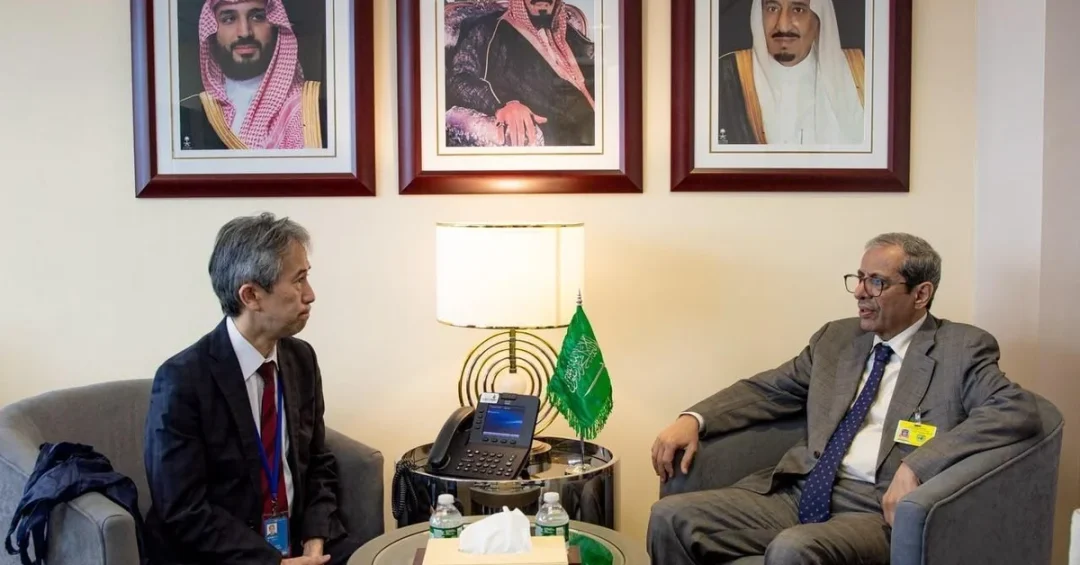
Deputy Minister for International Multilateral Affairs Dr. Abdulrahman bin Ibrahim Al-Rassi met with Japanese Assistant Minister and Director-General of the Middle Eastern and African Affairs Bureau Iwamoto Keiichi on the sidelines of the 81st United Nations General Assembly High-level Week in New York on September 24, 2026, according to the Saudi Press Agency (SPA). The two officials reviewed bilateral relations and discussed key regional issues, focusing on ways to strengthen coordination and consultation in multilateral forums as part of their participation in the UN session.
Context and Background
The meeting took place during the high-level segment of the 81st UN General Assembly, a critical annual gathering where world leaders and senior diplomats convene to address global challenges. Saudi Arabia and Japan have maintained strong diplomatic ties for decades, rooted in mutual respect and shared interests in energy security, economic cooperation, and regional stability. Dr. Al-Rassi, who also serves as General Supervisor of the Economic and Development Affairs Deputyship, represents Saudi Arabia’s commitment to multilateral engagement, while Assistant Minister Iwamoto Keiichi leads Japan’s diplomatic efforts in the Middle East and Africa. Their discussions underscore the importance of sustained dialogue between the two nations amid evolving geopolitical dynamics.
Key Details
During the meeting, Dr. Al-Rassi and Assistant Minister Iwamoto reviewed the full spectrum of Saudi-Japanese bilateral relations, encompassing political, economic, and cultural dimensions. They exchanged views on key regional issues, including security and development challenges in the Middle East, and explored avenues to enhance coordination and consultation in multilateral forums such as the United Nations. Both officials emphasized the need for continued collaboration to address global issues like climate change, sustainable development, and peacebuilding. The talks align with Saudi Arabia’s broader strategy to foster international partnerships that support stability and prosperity, and reflect Japan’s interest in deepening its engagement with the Kingdom.
Implications and Impact
This diplomatic encounter carries significant implications for regional and international cooperation. Strengthened Saudi-Japanese coordination in multilateral settings can amplify efforts to resolve conflicts, promote economic growth, and tackle transnational challenges. Japan, as a major global economy and technological leader, and Saudi Arabia, as a pivotal energy producer and regional power, share common goals in ensuring energy security and advancing innovation. Their partnership also supports the stability of global oil markets and fosters investment flows. Furthermore, the meeting signals both nations’ commitment to multilateralism at a time when international institutions face heightened demands, reinforcing the role of diplomacy in addressing shared concerns.
Vision 2030 Alignment
The discussions between Dr. Al-Rassi and Assistant Minister Iwamoto align closely with Saudi Arabia’s Vision 2030, which aims to diversify the economy, enhance international partnerships, and position the Kingdom as a global leader in diplomacy and development. By strengthening ties with Japan, Saudi Arabia advances its objectives of economic diversification through potential collaborations in technology, renewable energy, and infrastructure. Moreover, the meeting exemplifies the Kingdom’s proactive foreign policy, which seeks to build bridges and contribute to global peace and prosperity, further solidifying its role as a responsible international actor.
20 Questions
Q1. Who met on the sidelines of the 81st UN General Assembly?
A1. Dr. Abdulrahman bin Ibrahim Al-Rassi, Saudi Deputy Minister for International Multilateral Affairs, met with Iwamoto Keiichi, Japanese Assistant Minister and Director-General of the Middle Eastern and African Affairs Bureau.
Q2. When and where did this meeting take place?
A2. The meeting occurred on September 24, 2026, in New York, on the sidelines of the High-level Week of the 81st session of the United Nations General Assembly.
Q3. What was the primary purpose of the meeting?
A3. The officials reviewed bilateral relations and discussed key regional issues, focusing on ways to strengthen coordination and consultation in multilateral forums.
Q4. What roles does Dr. Abdulrahman Al-Rassi hold?
A4. Dr. Al-Rassi serves as Deputy Minister for International Multilateral Affairs and General Supervisor of the Economic and Development Affairs Deputyship in Saudi Arabia.
Q5. What is Iwamoto Keiichi’s position in Japan’s Ministry of Foreign Affairs?
A5. Iwamoto Keiichi is the Assistant Minister and Director-General of the Middle Eastern and African Affairs Bureau at Japan’s Ministry of Foreign Affairs.
Q6. Which organization reported this meeting?
A6. The Saudi Press Agency (SPA) reported the meeting, highlighting its significance for Saudi-Japanese diplomatic engagement.
Q7. What does the 81st UN General Assembly High-level Week represent?
A7. It is an annual gathering of world leaders and diplomats to address global challenges, promote peace, and foster international cooperation on critical issues.
Q8. How long have Saudi Arabia and Japan maintained diplomatic relations?
A8. Saudi Arabia and Japan have enjoyed decades of strong diplomatic ties, built on mutual respect and cooperation in energy, economy, and regional stability.
Q9. What regional issues were likely discussed?
A9. They discussed key regional issues such as security, development challenges in the Middle East, and ways to enhance stability through multilateral cooperation.
Q10. What is the significance of strengthening coordination in multilateral forums?
A10. It enhances joint efforts to address global challenges like climate change, sustainable development, and peacebuilding, amplifying the impact of both nations.
Q11. How does this meeting reflect Saudi Arabia’s foreign policy?
A11. It demonstrates Saudi Arabia’s commitment to proactive diplomacy, international partnerships, and contributing to global peace and prosperity.
Q12. What economic interests connect Saudi Arabia and Japan?
A12. Energy security, trade, investment, and technological collaboration are key economic interests, with Japan being a major consumer of Saudi energy and a source of innovation.
Q13. What is the role of the Economic and Development Affairs Deputyship?
A13. It oversees Saudi Arabia’s economic diversification and development strategies, aligning with Vision 2030 goals to reduce oil dependence and boost non-oil sectors.
Q14. How does this meeting support Vision 2030?
A14. It advances Vision 2030 by fostering international partnerships that promote economic diversification, technology transfer, and sustainable development.
Q15. What are the potential outcomes of this diplomatic engagement?
A15. Outcomes may include enhanced bilateral cooperation, joint initiatives in multilateral forums, and strengthened economic and political ties for mutual benefit.
Q16. Why is Japan an important partner for Saudi Arabia?
A16. Japan is a key economic and technological partner, and both nations share interests in energy security, regional stability, and sustainable development.
Q17. What message does this meeting send to the international community?
A17. It signals Saudi Arabia and Japan’s commitment to multilateralism, dialogue, and collaborative solutions to global challenges.
Q18. How does this meeting align with Saudi Arabia’s G20 and UN engagements?
A18. It complements Saudi Arabia’s active participation in global forums, reinforcing its role as a bridge-builder and responsible international stakeholder.
Q19. What future steps might follow this meeting?
A19. Future steps could include follow-up discussions, joint projects, and continued coordination in UN and other multilateral settings to implement shared goals.
Q20. How does this meeting contribute to regional stability?
A20. By enhancing Saudi-Japanese coordination on regional issues, it promotes stability, security, and development in the Middle East and beyond.
Reader Feedback
We value your thoughts. Please share your feedback on this article.
Your feedback helps us improve our coverage.