


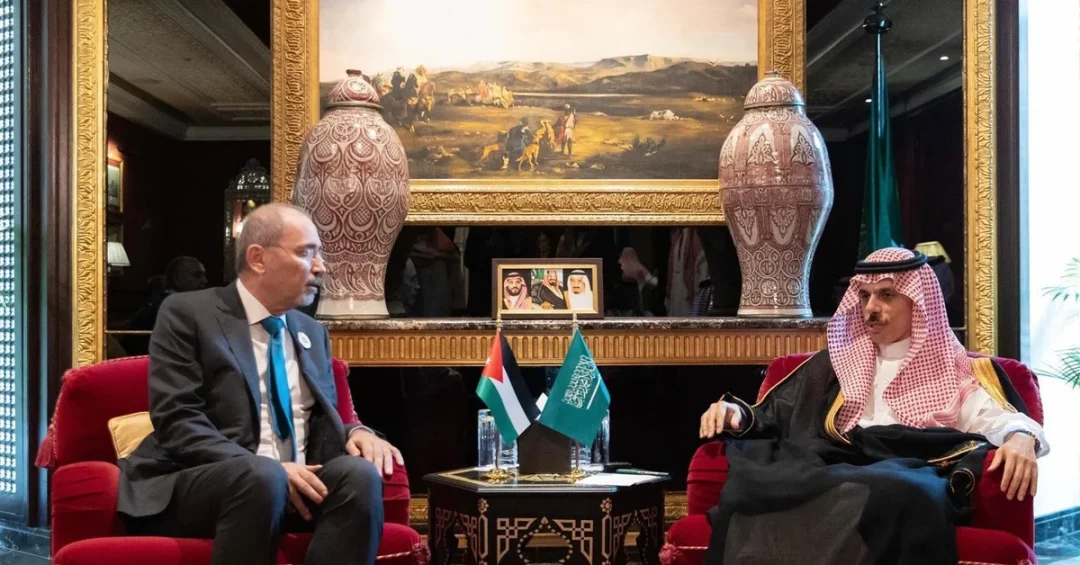
RIYADH — Saudi Arabia’s Minister of Foreign Affairs Prince Faisal bin Abdullah met with Jordan’s Deputy Prime Minister and Minister of Foreign and Expatriates Affairs Dr. Ayman Safadi on Tuesday, May 14, 2024. The meeting took place on the sidelines of the preparatory meeting of foreign ministers for the 33rd session of the Council of the League of Arab States, held in Manama, Bahrain. The two ministers discussed strengthening bilateral relations and reviewed the latest developments in the Gaza Strip, including its security and humanitarian repercussions, as well as ongoing efforts to address the situation.
Context and Background
The meeting underscores the deep-rooted ties between Saudi Arabia and Jordan, two nations that share a long history of cooperation and mutual respect. This high-level engagement comes ahead of the Arab League summit, where regional issues of paramount importance, particularly the situation in Gaza, are expected to dominate discussions. Both countries have consistently called for a cessation of hostilities and the protection of civilians in the conflict-affected areas.
The preparatory meeting of foreign ministers is a crucial step in shaping the agenda for the full summit, where Arab leaders convene to coordinate policies and present a unified stance on pressing regional matters. Saudi Arabia’s proactive role in these deliberations reflects its commitment to fostering Arab solidarity and finding lasting solutions to longstanding challenges.
Key Details
During the meeting, Prince Faisal and Dr. Safadi emphasized the importance of enhancing cooperation across various sectors, including political, economic, and security domains. They reiterated their countries’ shared positions on the need for a just and comprehensive peace in the Middle East, based on the two-state solution and relevant international resolutions.
The discussions also touched upon the humanitarian crisis in Gaza, with both ministers expressing deep concern over the suffering of Palestinian civilians. They called for the facilitation of unhindered humanitarian access and the provision of essential aid to the enclave. The efforts of regional and international actors, including the Kingdom’s own relief initiatives, were acknowledged as vital in alleviating the dire conditions.
Implications and Impact
The meeting between the Saudi and Jordanian foreign ministers carries significant implications for regional diplomacy. It reinforces the alignment of their foreign policies, particularly regarding the Palestinian cause and the need for stability in the Levant. By coordinating closely, Saudi Arabia and Jordan can amplify their voices in international forums and advocate more effectively for a resolution to the Gaza crisis.
This engagement also highlights the broader Arab consensus, as foreign ministers from across the region gathered in Manama ahead of the summit. Saudi Arabia’s leadership in these discussions demonstrates its role as a pivotal actor in shaping the region’s political trajectory. The outcomes of these deliberations are expected to influence the summit’s decisions, which will likely call for a ceasefire, the delivery of humanitarian aid, and the resumption of peace negotiations.
Vision 2030 Alignment
Saudi Arabia’s active diplomacy in the region aligns with the principles of Vision 2030, which seeks to position the Kingdom as a hub for stability and cooperation. The Vision emphasizes the importance of building strong international partnerships and contributing to global peace and security. By engaging with neighboring countries like Jordan on critical issues, Saudi Arabia is not only advancing its foreign policy goals but also reinforcing its stature as a responsible and influential regional leader.
As the Kingdom continues to implement its sweeping reforms, its foreign policy remains anchored in the values of moderation, dialogue, and mutual respect. This meeting serves as a testament to Saudi Arabia’s unwavering commitment to fostering harmonious relations within the Arab world and beyond, paving the way for a future of shared prosperity and stability.
20 Questions
Q1. What was the main topic of discussion between the Saudi and Jordanian ministers?
A1. The main topic was strengthening bilateral relations between Saudi Arabia and Jordan, as well as discussing the latest developments in the Gaza Strip, including its security and humanitarian repercussions.
Q2. Where did the meeting take place?
A2. The meeting took place in Manama, Bahrain, on the sidelines of the preparatory meeting of foreign ministers for the 33rd session of the Council of the League of Arab States.
Q3. Who represented Jordan in the meeting?
A3. Jordan was represented by Dr. Ayman Safadi, Deputy Prime Minister and Minister of Foreign and Expatriates Affairs.
Q4. Who represented Saudi Arabia in the meeting?
A4. Saudi Arabia was represented by Minister of Foreign Affairs Prince Faisal bin Abdullah.
Q5. When did the meeting occur?
A5. The meeting occurred on May 14, 2024, according to the Saudi Press Agency.
Q6. What is the significance of the meeting’s timing?
A6. It took place just before the Arab League summit, allowing ministers to coordinate positions and present a unified stance on regional issues, especially the situation in Gaza.
Q7. What did the ministers say about relations between their countries?
A7. They discussed bolstering relations between the two countries, emphasizing the importance of enhancing cooperation in political, economic, and security domains.
Q8. What are the latest developments in the Gaza Strip they discussed?
A8. They discussed the security and humanitarian repercussions of the conflict, including the suffering of civilians and the need for humanitarian access.
Q9. What efforts were mentioned regarding Gaza?
A9. They mentioned the efforts exerted by regional and international actors, including Saudi Arabia’s relief initiatives, to address the humanitarian crisis.
Q10. How does this meeting contribute to Arab solidarity?
A10. By aligning positions with Jordan, Saudi Arabia reinforces a unified Arab stance on Gaza, promoting solidarity and collective action within the Arab League.
Q11. What is Saudi Arabia’s role in the Arab League meetings?
A11. Saudi Arabia plays a proactive role, contributing to shaping the agenda and advocating for stability and peace in the region.
Q12. How does this meeting align with Vision 2030?
A12. It aligns with Vision 2030’s goal of building strong international partnerships and positioning Saudi Arabia as a hub for stability and cooperation.
Q13. What was the outcome of the meeting?
A13. The meeting reinforced shared positions on Gaza and bilateral cooperation, setting the stage for continued coordination in regional forums.
Q14. Did any other officials attend the meeting?
A14. Yes, several officials attended the meeting, though their names were not specified in the source.
Q15. What is the framework for peace in the Middle East that they support?
A15. They support a just and comprehensive peace based on the two-state solution and relevant international resolutions.
Q16. Why is the meeting important for the Gaza humanitarian situation?
A16. It highlights the urgency of addressing the humanitarian crisis and calls for facilitating aid to Gaza, which is a critical component of the discussions.
Q17. How do Saudi Arabia and Jordan cooperate beyond this meeting?
A17. They have a history of cooperation in various sectors, including politics, economy, and security, and coordinate closely on regional issues.
Q18. What does the meeting signal about Saudi Arabian foreign policy?
A18. It signals Saudi Arabia’s commitment to active diplomacy, regional stability, and the resolution of conflicts through dialogue and cooperation.
Q19. What is the expected impact of the upcoming Arab League summit?
A19. It is expected to produce decisions calling for a ceasefire, humanitarian aid, and a relaunch of peace negotiations, influenced by the preparatory meetings.
Q20. What is the broader significance of this meeting for the region?
A20. It strengthens the Arab consensus on key issues, enhances coordination between key allies, and contributes to regional stability and security.
Reader Feedback
We value your thoughts. Please share your feedback on this article.
Your feedback helps us improve our coverage.