


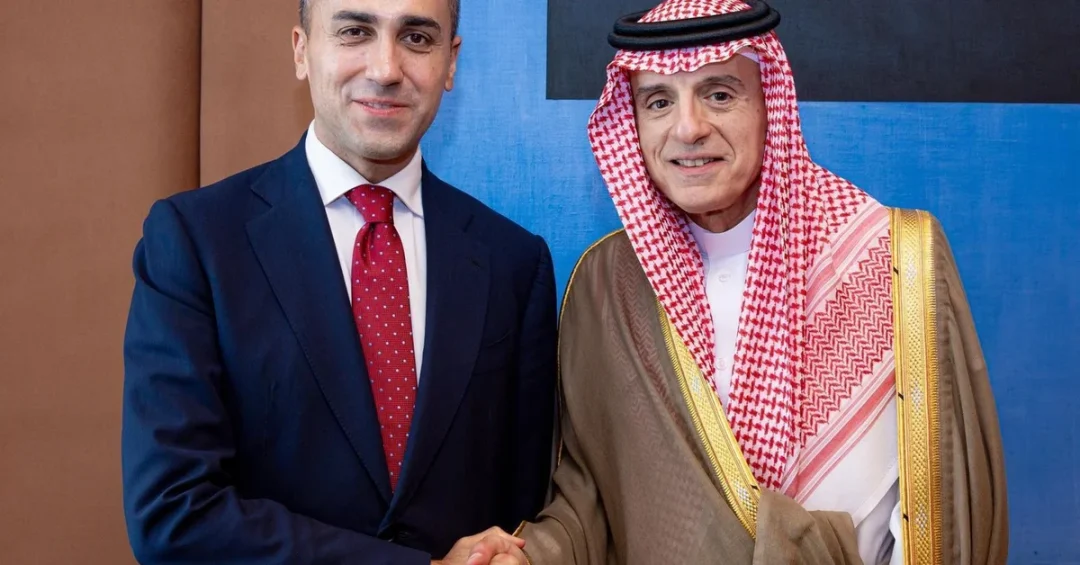
Saudi Minister of State for Foreign Affairs, Cabinet Member, Climate Envoy, and Commissioner General of Expo 2030 Riyadh, Adel Al-Jubeir, met with the European Union Special Representative for the Gulf Region, Luigi Di Maio, in New York on the sidelines of the 81st session of the United Nations General Assembly, according to the Saudi Press Agency. The meeting, confirmed via official Saudi channels, focused on reviewing cooperation between the Kingdom of Saudi Arabia and the European Union and on exchanging views regarding regional developments of mutual interest.
The encounter took place during one of the most closely watched diplomatic gatherings of the year, where world leaders, foreign ministers, and senior envoys converge to address pressing global challenges. For Saudi Arabia, participation in the 81st UNGA session underscores its active and constructive role in international diplomacy, a role that has expanded significantly under the leadership of the Custodian of the Two Holy Mosques, King Salman bin Abdulaziz Al Saud, and His Royal Highness Crown Prince and Prime Minister Mohammed bin Salman bin Abdulaziz Al Saud. The meeting between Al-Jubeir and Di Maio signals a continued commitment to dialogue and partnership between the Kingdom and the European bloc, particularly on matters affecting the Gulf region and the broader Middle East. Why does this diplomatic engagement matter at this particular moment in global affairs?
Context and Background
The relationship between Saudi Arabia and the European Union has deepened steadily over recent years, reflecting shared interests in stability, energy security, trade, and sustainable development. The European Union, represented by its Special Representative for the Gulf Region, has sought to strengthen its dialogue with Gulf Cooperation Council states, and Saudi Arabia remains a central partner in that effort. Luigi Di Maio, a former Italian foreign minister, was appointed as the EU Special Representative for the Gulf Region to enhance the bloc’s engagement with the region, a role that carries significant diplomatic weight in Brussels. His meeting with Adel Al-Jubeir represents a continuation of regular consultations that have become a hallmark of Saudi-EU relations.
Adel Al-Jubeir is a veteran Saudi diplomat who has served as Minister of State for Foreign Affairs, Cabinet Member, Climate Envoy, and Commissioner General of Expo 2030 Riyadh. His portfolio spans traditional diplomacy, climate action, and the preparation of a major international exposition that will showcase Saudi Arabia’s modernization and global outreach. His participation in the 81st UNGA session reflects the Kingdom’s multifaceted foreign policy, which combines political dialogue, economic cooperation, and cultural exchange. The meeting with Di Maio is therefore not merely a bilateral courtesy but a substantive discussion between two officials whose responsibilities intersect across a range of strategic files.
The 81st session of the United Nations General Assembly, held annually in New York, serves as a platform for member states to present their positions on global issues and to conduct bilateral and multilateral diplomacy. For Saudi Arabia, the session provides an opportunity to reiterate its support for international law, peaceful resolution of disputes, and humanitarian assistance. It also allows Saudi officials to engage with partners on issues such as energy transitions, climate change, and regional security. The meeting between Al-Jubeir and Di Maio fits within this broader pattern of Saudi diplomacy, which prioritizes dialogue and cooperation over confrontation. How does such engagement contribute to a more stable and prosperous region?
Key Details of the Meeting
According to the Saudi Press Agency, the meeting between Adel Al-Jubeir and Luigi Di Maio involved a review of cooperation between Saudi Arabia and the European Union. This broad agenda likely encompasses areas such as trade and investment, energy, climate change, and regional security. The European Union is a major trading partner for Saudi Arabia, and both sides have expressed interest in expanding economic ties, including through the EU-GCC dialogue and bilateral frameworks. The discussion of regional developments of mutual interest is particularly significant given the evolving situation in the Middle East, including efforts to promote peace, stability, and economic integration.
While the official statement did not disclose specific outcomes or agreements, the mere occurrence of the meeting is meaningful. It demonstrates that Saudi Arabia and the European Union maintain open channels of communication at the highest levels, even as global geopolitics shift. The presence of two senior officials—one representing the Kingdom and the other representing the EU—at the same UNGA session highlights the importance both sides attach to the relationship. It also provides an opportunity to align positions on issues of common concern, such as humanitarian aid, counterterrorism, and the peaceful use of nuclear energy.
The meeting also underscores Saudi Arabia’s role as a bridge-builder in international affairs. By engaging with the European Union’s Special Representative for the Gulf Region, Al-Jubeir is helping to foster a constructive dialogue that can lead to practical cooperation. This approach is consistent with the Kingdom’s Vision 2030, which seeks to diversify partnerships and position Saudi Arabia as a pivotal player in global diplomacy. The meeting is one of many that Saudi officials conduct during UNGA, reflecting a busy diplomatic calendar that includes bilateral talks with countries from every continent. What does this level of engagement reveal about Saudi Arabia’s global standing?
International and Regional Impact
The Saudi-EU dialogue carries implications beyond the bilateral relationship. The European Union has a strategic interest in the stability of the Gulf region, which is a key source of energy supplies and a hub for global trade. Saudi Arabia, as the world’s leading oil exporter and a member of the G20, plays a critical role in maintaining that stability. Cooperation between the two sides can contribute to addressing shared challenges, including climate change, maritime security, and the humanitarian situation in Yemen and other conflict zones. The meeting between Al-Jubeir and Di Maio thus represents a building block in a broader architecture of regional and international cooperation.
At the regional level, the meeting signals that Saudi Arabia continues to pursue a foreign policy based on dialogue and de-escalation. In recent years, the Kingdom has taken steps to resolve disputes, including the restoration of diplomatic ties with Iran and the easing of tensions in the Gulf. Engagement with the European Union complements these efforts by bringing in a powerful external partner that can support mediation and reconstruction initiatives. The EU’s Special Representative for the Gulf Region is well-placed to facilitate such cooperation, and his meeting with Al-Jubeir is a positive indicator of the EU’s willingness to work with Saudi Arabia on these issues. How might this partnership shape the future of Gulf-Europe relations?
Economic and Strategic Significance
Economically, the Saudi-EU relationship is substantial and growing. The European Union is one of Saudi Arabia’s largest trading partners, with significant flows of goods, services, and investment in both directions. Saudi Arabia’s Vision 2030 aims to diversify the economy away from oil dependence, and European companies are playing a role in that transformation through investments in renewable energy, technology, tourism, and infrastructure. The meeting between Al-Jubeir and Di Maio could help to unlock further opportunities for collaboration, particularly in areas such as green hydrogen, digital economy, and smart cities.
Strategically, the meeting reinforces Saudi Arabia’s position as a reliable partner for Europe in a volatile region. The European Union’s interest in the Gulf extends to energy security, counterterrorism, and maritime safety. By maintaining high-level contacts with Saudi officials, the EU can better understand the Kingdom’s perspectives and work together on solutions. For Saudi Arabia, closer ties with Europe can provide diplomatic support and economic benefits, while also diversifying its international partnerships in line with Vision 2030. The meeting is therefore a win-win proposition that advances the interests of both sides. What economic opportunities could arise from deeper Saudi-EU cooperation?
Vision 2030 Alignment
The meeting between Adel Al-Jubeir and Luigi Di Maio aligns closely with the objectives of Saudi Vision 2030, the Kingdom’s comprehensive plan for economic and social transformation. Vision 2030 emphasizes the importance of international cooperation, economic diversification, and the enhancement of Saudi Arabia’s global standing. By engaging with the European Union on regional and global issues, Saudi Arabia is strengthening the diplomatic and economic ties that are essential to achieving these goals. The meeting also reflects the Kingdom’s commitment to climate action, as Al-Jubeir serves as Climate Envoy, and the EU is a key partner in global climate efforts.
Furthermore, the meeting contributes to the success of Expo 2030 Riyadh, for which Al-Jubeir serves as Commissioner General. Expo 2030 is expected to attract millions of visitors and showcase Saudi Arabia’s achievements and ambitions to the world. International partnerships, including those with the European Union, will be crucial to making the event a success. By building relationships with EU officials, Saudi Arabia is laying the groundwork for fruitful collaboration in the run-up to Expo 2030 and beyond. The meeting in New York is thus a small but significant step in a long journey toward a more prosperous and interconnected future. How will Saudi Arabia’s international partnerships continue to evolve in the years ahead?
20 Questions
Q1. Who met with whom in New York on the sidelines of the 81st UN General Assembly?
A1. Saudi Minister of State for Foreign Affairs Adel Al-Jubeir met with European Union Special Representative for the Gulf Region Luigi Di Maio.
Q2. When and where did the meeting take place?
A2. The meeting took place in New York on September 26, 2026, on the sidelines of the 81st session of the United Nations General Assembly.
Q3. What was the main purpose of the meeting?
A3. The two officials reviewed cooperation between Saudi Arabia and the European Union and discussed regional developments of mutual interest.
Q4. What other roles does Adel Al-Jubeir hold?
A4. He serves as Minister of State for Foreign Affairs, Cabinet Member, Climate Envoy, and Commissioner General of Expo 2030 Riyadh.
Q5. Who is Luigi Di Maio?
A5. Luigi Di Maio is the European Union Special Representative for the Gulf Region and a former foreign minister of Italy.
Q6. Why is the 81st UNGA session significant for Saudi Arabia?
A6. It provides a platform for Saudi Arabia to engage in high-level diplomacy, discuss global issues, and strengthen partnerships with other nations.
Q7. What areas of Saudi-EU cooperation were likely discussed?
A7. Likely topics included trade, investment, energy, climate change, regional security, and humanitarian issues.
Q8. How does this meeting reflect Saudi Arabia’s foreign policy?
A8. It demonstrates Saudi Arabia’s commitment to dialogue, partnership, and constructive engagement with international partners.
Q9. What is the significance of the EU Special Representative for the Gulf Region?
A9. The role is designed to enhance the EU’s diplomatic engagement with Gulf countries and to facilitate cooperation on shared interests.
Q10. How does the meeting align with Vision 2030?
A10. It supports Vision 2030 goals of economic diversification, international cooperation, and enhancing Saudi Arabia’s global standing.
Q11. What economic benefits could result from Saudi-EU cooperation?
A11. Increased trade, investment in renewable energy, technology transfer, and joint ventures in various sectors.
Q12. What regional developments might have been discussed?
A12. Topics could include peace efforts in Yemen, stability in the Gulf, and humanitarian situations in the region.
Q13. How does Saudi Arabia’s climate envoy role factor into the meeting?
A13. As Climate Envoy, Al-Jubeir likely discussed climate action and cooperation with the EU on environmental initiatives.
Q14. What is Expo 2030 Riyadh and how does it relate to this meeting?
A14. Expo 2030 Riyadh is a major international exposition; Al-Jubeir’s role as Commissioner General ties into promoting international partnerships.
Q15. Did the meeting produce any agreements?
A15. The official statement did not announce specific agreements, but it reviewed cooperation and discussed regional issues.
Q16. How often do Saudi and EU officials meet?
A16. They meet regularly on the sidelines of international events and through bilateral visits to discuss matters of mutual interest.
Q17. What is the EU’s interest in the Gulf region?
A17. The EU seeks stability, energy security, and economic cooperation with Gulf countries, including Saudi Arabia.
Q18. How does this meeting contribute to regional stability?
A18. By maintaining open dialogue and cooperation, Saudi Arabia and the EU can work together to address challenges and promote peace.
Q19. What message does this meeting send to the international community?
A19. It signals Saudi Arabia’s active diplomacy and its willingness to engage with global partners on key issues.
Q20. What can we expect next in Saudi-EU relations?
A20. Continued dialogue, potential new agreements, and collaboration on economic, climate, and security issues in line with Vision 2030.
Reader Feedback
We value your thoughts. Please share your feedback on this article.
Your feedback helps us improve our coverage.
Related articles
 Saudi Minister Al-Jubeir Meets Palau President at UNGA
 Saudi Minister Al-Jubeir Meets US Official at UN Assembly
 Saudi GCA President Chairs INTOSAI Meetings in Washington
 KSrelief distributes 90 fishing boats to Yemeni fishermen
 Saudi Governor Conveys Leadership Condolences to UAE
 Makkah Defence Pact Chiefs Meet in Riyadh