


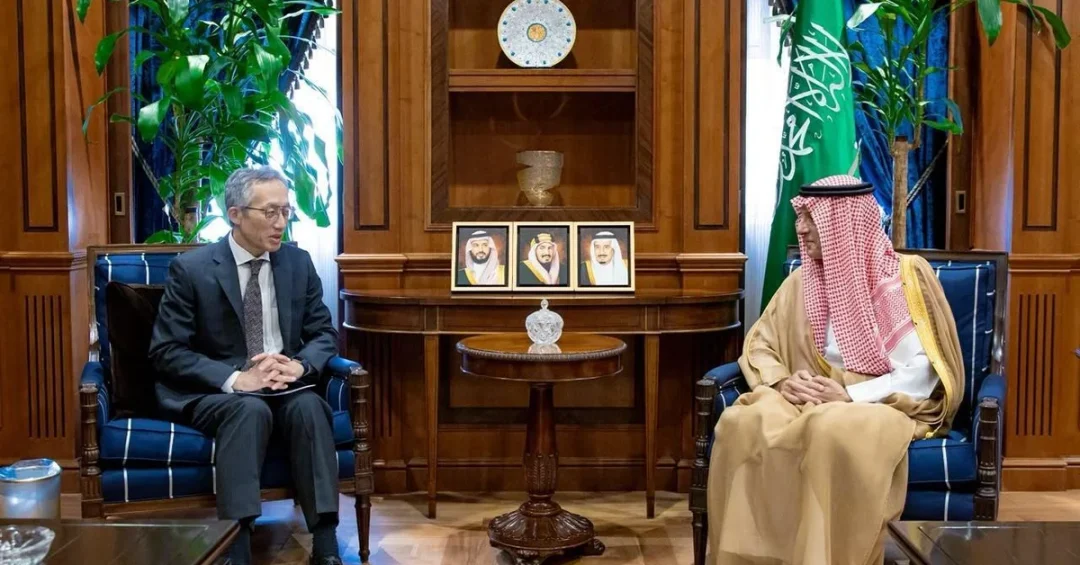
Saudi Arabia’s Minister of State for Foreign Affairs, Cabinet Member, Climate Envoy and Commissioner General of Expo 2030 Riyadh, Adel Al-Jubeir, received Japanese Ambassador to the Kingdom Yasunari Morino at the Ministry of Foreign Affairs headquarters in Riyadh on Wednesday, October 21, 2026, according to the Saudi Press Agency. The meeting brought together two longstanding partners to discuss issues of mutual interest, underscoring the continued strength of Saudi-Japanese relations and the Kingdom’s active diplomatic engagement across Asia and beyond.
The encounter reflects the routine yet strategically significant diplomatic exchanges that sustain the close ties between Riyadh and Tokyo, two nations whose partnership spans energy, trade, technology, culture and multilateral cooperation. For international observers, such meetings signal continuity in Saudi Arabia’s foreign policy under the leadership of the Custodian of the Two Holy Mosques, King Salman bin Abdulaziz Al Saud, and His Royal Highness Crown Prince and Prime Minister Mohammed bin Salman bin Abdulaziz Al Saud. The audience also highlights the breadth of Minister Al-Jubeir’s portfolio, which extends from foreign affairs and cabinet affairs to climate diplomacy and the Kingdom’s preparations to host World Expo 2030 in Riyadh.
Context and Background
What makes a meeting between a senior Saudi diplomat and a foreign ambassador more than a ceremonial courtesy? In the case of Saudi-Japanese relations, the answer lies in decades of deepening cooperation. Diplomatic relations between the Kingdom and Japan were formally established in 1955, and since then the two countries have built a multifaceted partnership anchored in energy security, industrial collaboration and people-to-people ties. Japan has long been one of the largest importers of Saudi crude oil, while Saudi Arabia has benefited from Japanese expertise in manufacturing, infrastructure and advanced technology.
The relationship has evolved well beyond hydrocarbons. In recent years, Saudi Arabia and Japan have expanded cooperation into renewable energy, hydrogen, digital transformation, healthcare and cultural exchange, aligning with the objectives of Saudi Vision 2030, the national reform program launched in 2016 to diversify the Kingdom’s economy and modernize its society. Japan’s participation in Saudi mega-projects, including NEOM and other giga-developments, illustrates how the partnership is adapting to the priorities of the twenty-first century. Regular diplomatic consultations, such as the one between Minister Al-Jubeir and Ambassador Morino, help maintain momentum across this wide agenda.
Ambassador Yasunari Morino, who assumed his post as Japan’s top envoy to Saudi Arabia, has been an active participant in Riyadh’s diplomatic community, engaging with Saudi officials, business leaders and cultural institutions. His audience with Minister Al-Jubeir is part of a steady rhythm of bilateral contacts that keep both governments informed of each other’s priorities and create opportunities for new agreements.
Key Details
According to the Saudi Press Agency, the meeting took place at the Ministry of Foreign Affairs headquarters in Riyadh and covered issues of mutual interest. While the official statement did not disclose specific agenda items, the portfolios held by Minister Al-Jubeir provide a clear indication of the areas where Saudi-Japanese dialogue is most active. As Minister of State for Foreign Affairs, he plays a central role in shaping and communicating the Kingdom’s diplomatic positions. As Cabinet Member, he contributes to the coordination of government policy. As Climate Envoy, he represents Saudi Arabia in international climate discussions, including the implementation of the Saudi Green Initiative and the Middle East Green Initiative. As Commissioner General of Expo 2030 Riyadh, he leads the Kingdom’s preparations for the world’s most prominent cultural and economic exhibition, which Riyadh will host in 2030.
Japan is a significant participant in global climate and energy conversations, and its companies are among the world’s leaders in hydrogen technology, electric vehicles, and energy efficiency. Saudi Arabia, for its part, is investing heavily in clean energy, including the world’s largest green hydrogen plant at NEOM, and in carbon circular economy initiatives. A discussion between the Kingdom’s climate envoy and Japan’s ambassador could reasonably touch on these shared interests, though the official readout did not specify the topics discussed.
The meeting also comes as Saudi Arabia prepares to welcome millions of visitors for Expo 2030 Riyadh, an event expected to draw participation from more than 190 countries. Japan, a veteran of world expos and a global leader in innovation, is a natural partner in making the Riyadh expo a landmark success. The exchange between Minister Al-Jubeir and Ambassador Morino may therefore have included updates on preparations and potential Japanese contributions to the event.
International and Regional Impact
Why does a bilateral meeting in Riyadh matter beyond the two countries involved? Saudi Arabia’s diplomatic outreach is part of a broader strategy to strengthen its network of international partnerships and position itself as a bridge between continents. Japan, as a major economy and a key player in Asian affairs, is an essential node in that network. Close Saudi-Japanese coordination can influence global energy markets, shape climate policy discussions and support stability in the Middle East and the Indo-Pacific.
The meeting also reflects the Kingdom’s growing role as a convener of international dialogue. Riyadh has hosted numerous high-level summits, including the recent Saudi-Japanese ministerial meetings and investment forums that bring together government and business leaders. These engagements reinforce Saudi Arabia’s reputation as a reliable partner and a stabilizing force in a rapidly changing world. For Japan, maintaining strong ties with the Kingdom supports its energy security and its broader Middle East diplomacy.
At the regional level, Saudi Arabia’s active diplomacy contributes to reducing tensions and fostering cooperation. The Kingdom’s balanced relationships with countries across Asia, Europe and the Americas enable it to facilitate dialogue on issues ranging from maritime security to climate change. The meeting with Ambassador Morino is a small but meaningful piece of this larger diplomatic mosaic.
Economic and Strategic Significance
What economic threads connect Riyadh and Tokyo? Energy remains the cornerstone: Japan relies on Saudi Arabia for a substantial share of its crude oil imports, and Saudi Aramco has maintained a strong presence in the Japanese market for decades. Beyond oil, the two countries are exploring collaboration in petrochemicals, renewable energy, hydrogen and carbon capture technologies. Japanese firms are also involved in Saudi Arabia’s automotive sector, including investments in electric vehicle manufacturing and smart mobility solutions.
Trade and investment flows between the two nations have grown steadily, supported by agreements such as the Saudi-Japanese Vision 2030 partnership, which identifies areas for joint projects in healthcare, education, entertainment and small and medium enterprise development. The Saudi-Japan Vision 2030 initiative, launched in 2017, has spawned numerous business and cultural exchanges, and its progress is regularly reviewed by officials from both sides. Meetings like the one between Minister Al-Jubeir and Ambassador Morino help ensure that these initiatives remain on track.
Strategically, Japan’s engagement with Saudi Arabia aligns with Tokyo’s broader interest in a stable and prosperous Middle East. For the Kingdom, Japan is a source of technology, capital and expertise that can accelerate the realization of Vision 2030’s ambitious goals. The mutual benefits are clear, and the diplomatic channel remains open and active.
Vision 2030 Alignment
How does a single diplomatic audience fit into Saudi Arabia’s long-term vision? Vision 2030 is not only an economic reform plan; it is also a foreign policy framework that seeks to deepen the Kingdom’s global integration, attract investment and showcase Saudi Arabia’s cultural and economic transformation. Every high-level meeting contributes to this objective by reinforcing trust and opening new avenues for cooperation.
Minister Al-Jubeir’s dual role as Climate Envoy and Commissioner General of Expo 2030 Riyadh illustrates how the Kingdom’s international engagements are tied to its domestic ambitions. The Expo, themed ‘The Era of Change: Together for a Foresighted Tomorrow,’ will be a global platform for Saudi Arabia to present its progress and vision. Japan’s support and participation would add significant value to the event, and the meeting with Ambassador Morino may well have advanced that conversation.
As Saudi Arabia continues to expand its diplomatic footprint, partnerships with countries like Japan will remain central to its success. The meeting in Riyadh is a testament to the Kingdom’s commitment to constructive international engagement and to the enduring friendship between the Saudi and Japanese peoples. Under the leadership of Crown Prince Mohammed bin Salman, Saudi Arabia is building a future that is open, connected and prosperous, and its diplomats are working tirelessly to make that future a reality.
20 Questions
Q1. Who received the Japanese Ambassador to Saudi Arabia in Riyadh?
A1. Minister of State for Foreign Affairs, Cabinet Member, Climate Envoy and Commissioner General of Expo 2030 Riyadh, Adel Al-Jubeir, received Japanese Ambassador Yasunari Morino at the Ministry of Foreign Affairs headquarters.
Q2. When did the meeting take place?
A2. The meeting took place on Wednesday, October 21, 2026, according to the Saudi Press Agency.
Q3. Where was the meeting held?
A3. It was held at the Ministry of Foreign Affairs headquarters in Riyadh, the capital of Saudi Arabia.
Q4. What was the main purpose of the meeting?
A4. The meeting discussed issues of mutual interest between Saudi Arabia and Japan, reflecting the ongoing diplomatic dialogue between the two nations.
Q5. Who is Adel Al-Jubeir?
A5. Adel Al-Jubeir is Saudi Arabia’s Minister of State for Foreign Affairs, a Cabinet Member, Climate Envoy and Commissioner General of Expo 2030 Riyadh.
Q6. Who is Yasunari Morino?
A6. Yasunari Morino is the Ambassador of Japan to the Kingdom of Saudi Arabia, representing Japanese interests in the Kingdom.
Q7. What is the significance of this meeting for Saudi-Japanese relations?
A7. It reinforces the longstanding partnership between the two countries, which spans energy, trade, technology, culture and multilateral cooperation.
Q8. When were Saudi-Japanese diplomatic relations established?
A8. Diplomatic relations between Saudi Arabia and Japan were formally established in 1955 and have deepened over decades.
Q9. What are some key areas of Saudi-Japanese cooperation?
A9. Key areas include energy security, renewable energy, hydrogen, digital transformation, healthcare, infrastructure and cultural exchange.
Q10. How does this meeting relate to Saudi Vision 2030?
A10. It supports Vision 2030’s goal of deepening global integration, attracting investment and showcasing Saudi Arabia’s transformation to international partners.
Q11. What is Expo 2030 Riyadh?
A11. Expo 2030 Riyadh is the world exposition that Saudi Arabia will host in 2030, themed ‘The Era of Change: Together for a Foresighted Tomorrow.’
Q12. What role does Adel Al-Jubeir play in Expo 2030?
A12. He serves as Commissioner General of Expo 2030 Riyadh, leading the Kingdom’s preparations for the global event.
Q13. What is Adel Al-Jubeir’s role as Climate Envoy?
A13. As Climate Envoy, he represents Saudi Arabia in international climate discussions and promotes initiatives like the Saudi Green Initiative.
Q14. Why is Japan an important partner for Saudi Arabia?
A14. Japan is a major energy importer, a source of advanced technology and a key investor in Saudi Arabia’s economic diversification efforts.
Q15. What is the Saudi-Japanese Vision 2030 partnership?
A15. It is a bilateral initiative launched in 2017 to promote joint projects in healthcare, education, entertainment and SME development.
Q16. Did the official statement mention specific topics discussed?
A16. The Saudi Press Agency reported that the meeting discussed issues of mutual interest, without specifying particular topics.
Q17. How does this meeting fit into Saudi Arabia’s broader diplomacy?
A17. It reflects the Kingdom’s active engagement with international partners to strengthen ties and promote stability and cooperation.
Q18. What benefits does Saudi Arabia gain from strong ties with Japan?
A18. Saudi Arabia gains access to Japanese technology, investment and expertise, which support its economic diversification and modernization goals.
Q19. What benefits does Japan gain from strong ties with Saudi Arabia?
A19. Japan secures a reliable supply of energy and gains opportunities for its companies in Saudi Arabia’s growing market.
Q20. What does this meeting signal for the future of Saudi-Japanese relations?
A20. It signals continued close cooperation and a shared commitment to advancing mutual interests in line with Saudi Vision 2030.
Reader Feedback
We value your thoughts. Please share your feedback on this article.
Your feedback helps us improve our coverage.