


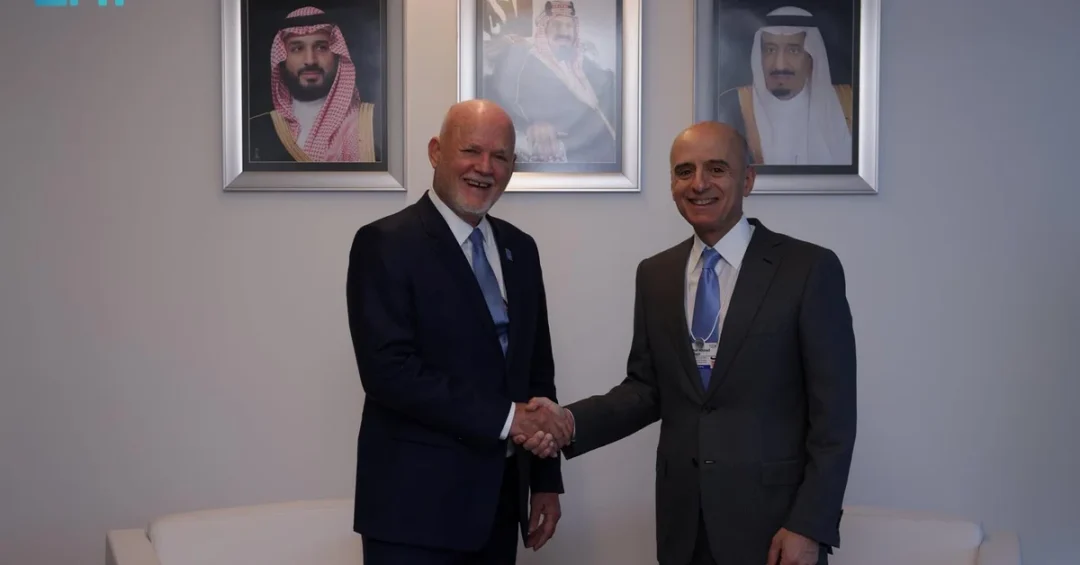
Saudi Arabia’s Minister of State for Foreign Affairs, Cabinet Member, and Climate Envoy Adel Al-Jubeir met with the UN Secretary-General’s Special Envoy for the Ocean, Peter Thomson, on the sidelines of the Annual Meeting of the World Economic Forum 2025 in Davos, Switzerland, on January 22, 2025, according to the Saudi Press Agency. The two officials discussed aspects of cooperation between the Kingdom of Saudi Arabia and the United Nations on oceans and marine resources, underscoring the Kingdom’s growing role in global environmental diplomacy and its commitment to sustainable development.
The meeting reflects Saudi Arabia’s expanding engagement with multilateral institutions on issues that extend beyond traditional energy and security concerns. As the world’s largest exporter of crude oil and a pivotal player in global climate discussions, the Kingdom has increasingly positioned itself as a constructive partner in addressing environmental challenges, including the health of the world’s oceans. The discussion between Al-Jubeir and Thomson comes at a time when international attention is focused on marine conservation, sustainable fishing, and the blue economy—areas where Saudi Arabia has demonstrated a clear strategic interest through its Vision 2030 framework and its participation in global climate accords. How does a nation so closely associated with hydrocarbon production become a credible advocate for ocean sustainability? The answer lies in Saudi Arabia’s deliberate pivot toward diversified, knowledge-based economic growth and its recognition that environmental stewardship is inseparable from long-term prosperity.
Context and Background
Why is the World Economic Forum’s annual meeting in Davos such a critical venue for Saudi diplomacy? The 2025 gathering brought together heads of state, ministers, business leaders, and civil society representatives to address the most pressing global challenges, from climate change to economic inequality. For Saudi Arabia, Davos represents an opportunity to showcase its transformation under Vision 2030 and to forge partnerships that advance both its economic diversification goals and its international standing. The meeting between Minister Al-Jubeir and Special Envoy Thomson was not an isolated encounter but part of a broader Saudi strategy to engage with UN agencies on environmental issues, including ocean conservation, marine biodiversity, and the sustainable use of marine resources.
Saudi Arabia’s interest in ocean affairs is rooted in both geography and economics. The Kingdom borders the Red Sea and the Arabian Gulf, two strategically vital bodies of water that support shipping lanes, fisheries, and tourism. The Red Sea, in particular, is home to some of the world’s most biodiverse coral reefs and marine ecosystems, which are increasingly threatened by climate change, overfishing, and pollution. Through its presidency of the G20 in 2020 and its participation in the UN Framework Convention on Climate Change, Saudi Arabia has signaled its willingness to take a leading role in addressing these challenges. The Kingdom has also launched ambitious initiatives such as the Saudi Green Initiative and the Middle East Green Initiative, which aim to plant billions of trees, reduce carbon emissions, and protect marine and terrestrial ecosystems across the region. These efforts align with the UN’s Sustainable Development Goal 14, which calls for the conservation and sustainable use of the oceans, seas, and marine resources.
The UN Secretary-General’s Special Envoy for the Ocean, Peter Thomson, has been a vocal advocate for ocean conservation since his appointment in 2017. A former President of the UN General Assembly and a diplomat from Fiji, Thomson has worked tirelessly to mobilize international action on issues such as marine plastic pollution, ocean acidification, and the sustainable blue economy. His meeting with Al-Jubeir therefore represents a convergence of two distinct but complementary perspectives: the UN’s global advocacy for ocean health and Saudi Arabia’s regional leadership in environmental protection and economic transformation. What does this partnership mean for the future of ocean governance? It suggests that Saudi Arabia is ready to play a more active role in shaping international environmental policy, not merely as a participant but as a contributor of resources, expertise, and diplomatic influence.
Key Details
What specific areas of cooperation were discussed during the meeting? According to the Saudi Press Agency, Minister Al-Jubeir and Special Envoy Thomson focused on aspects of cooperation between Saudi Arabia and the United Nations on oceans and marine resources. While the official statement did not disclose detailed outcomes, the discussion likely covered a range of topics, including marine conservation, sustainable fisheries, the blue economy, and the role of oceans in climate regulation. The meeting also provided an opportunity for Saudi Arabia to highlight its ongoing efforts to protect the Red Sea and Arabian Gulf ecosystems, including the establishment of marine protected areas and the promotion of eco-tourism along its coastlines.
Saudi Arabia’s marine conservation initiatives are already yielding tangible results. The Kingdom has invested heavily in scientific research and technological innovation to monitor and protect marine environments. For example, the Red Sea Development Company, a flagship project under Vision 2030, is creating a luxury tourism destination that prioritizes environmental sustainability, with strict guidelines to minimize ecological impact. Similarly, the National Center for Wildlife has launched programs to conserve endangered marine species, such as the hawksbill turtle and the dugong. These efforts are complemented by Saudi Arabia’s participation in international agreements, including the Convention on Biological Diversity and the International Maritime Organization’s regulations on marine pollution. By collaborating with the UN, the Kingdom can leverage global expertise and resources to scale up these initiatives and share its own experiences with other nations.
The meeting between Al-Jubeir and Thomson also reflects Saudi Arabia’s broader commitment to multilateralism and its belief that global challenges require collective solutions. As a member of the G20, the Kingdom has consistently advocated for international cooperation on climate change, energy transitions, and sustainable development. The Kingdom’s hosting of the upcoming UN Convention to Combat Desertification (UNCCD) COP16 in Riyadh in December 2024 further demonstrates its willingness to convene global stakeholders and drive action on environmental issues. In this context, the discussion with the UN Special Envoy for the Ocean is a natural extension of Saudi Arabia’s diplomatic outreach and its efforts to position itself as a responsible global citizen. What message does this send to the international community? It signals that Saudi Arabia is not only open for business but also open for partnership—ready to work with the UN and other international bodies to protect the planet’s shared resources.
International and Regional Impact
How will this meeting influence regional and international perceptions of Saudi Arabia? The encounter between Minister Al-Jubeir and Special Envoy Thomson is likely to be viewed positively by the international community, particularly by environmental organizations and UN agencies. It reinforces Saudi Arabia’s image as a constructive actor in global environmental governance, countering narratives that focus solely on its hydrocarbon exports. For regional neighbors, the meeting underscores Saudi Arabia’s leadership in the Middle East and its willingness to address transboundary environmental challenges that affect all countries bordering the Red Sea and the Arabian Gulf. The Red Sea, for instance, is a shared resource, and its health depends on cooperation among littoral states, including Egypt, Sudan, Yemen, and Jordan. By engaging with the UN on ocean issues, Saudi Arabia is setting an example for regional collaboration and demonstrating that environmental protection can be a unifying cause.
On the international stage, the meeting aligns with the UN’s broader push to mobilize political will and financial resources for ocean conservation. The UN has declared 2021-2030 the Decade of Ocean Science for Sustainable Development, and Special Envoy Thomson has been at the forefront of efforts to encourage governments, businesses, and civil society to invest in ocean research and innovation. Saudi Arabia’s engagement in this area could lead to concrete partnerships, such as joint research projects, technology transfer, and capacity-building programs for developing countries. Moreover, the Kingdom’s financial resources and its growing expertise in sustainable development make it a potentially valuable partner for the UN in implementing SDG 14. As the world grapples with the triple planetary crisis of climate change, biodiversity loss, and pollution, Saudi Arabia’s participation in ocean governance is both timely and significant. What role will the Kingdom play in shaping the global ocean agenda? If the Davos meeting is any indication, Saudi Arabia is poised to become a more vocal and active advocate for marine conservation, using its diplomatic weight and economic clout to advance solutions that benefit both people and the planet.
Economic and Strategic Significance
Why does ocean cooperation matter economically for Saudi Arabia? The blue economy—which encompasses fisheries, aquaculture, shipping, tourism, and renewable energy—is a rapidly growing sector that offers significant opportunities for diversification and job creation. Saudi Arabia’s Vision 2030 aims to reduce dependence on oil and develop new economic pillars, and the sustainable use of marine resources is a key component of that strategy. The Red Sea alone is estimated to have the potential to generate billions of dollars in tourism revenue and to support thousands of jobs in hospitality, marine research, and conservation. By partnering with the UN, Saudi Arabia can access best practices, international markets, and funding mechanisms that will help it realize this potential while ensuring that development does not come at the expense of environmental health.
Strategically, the meeting reinforces Saudi Arabia’s position as a bridge-builder between the Global North and Global South. As a major economy with influence in both the Arab world and the broader Islamic world, the Kingdom is uniquely positioned to facilitate dialogue and cooperation on global challenges. The UN Special Envoy for the Ocean’s role is inherently diplomatic, and his engagement with Saudi Arabia signals that the UN values the Kingdom’s contributions and sees it as a key partner in achieving international goals. This partnership also enhances Saudi Arabia’s soft power, presenting it as a responsible steward of natural resources and a champion of sustainable development. In a world where environmental issues are increasingly central to geopolitics, Saudi Arabia’s proactive stance on ocean conservation strengthens its diplomatic leverage and its ability to shape international norms. How does this benefit the Kingdom’s long-term interests? By building coalitions and fostering goodwill, Saudi Arabia can advance its own economic and security objectives while contributing to the global common good.
Vision 2030 Alignment
How does the meeting between Minister Al-Jubeir and Special Envoy Thomson align with Vision 2030? Saudi Arabia’s ambitious reform agenda is built on three pillars: a vibrant society, a thriving economy, and an ambitious nation. Environmental sustainability is woven throughout these pillars, from the Saudi Green Initiative’s target of planting 10 billion trees to the development of eco-friendly mega-projects like NEOM and the Red Sea Project. Ocean conservation is an integral part of this vision, as healthy marine ecosystems are essential for food security, biodiversity, and tourism. By cooperating with the UN on oceans and marine resources, Saudi Arabia is demonstrating its commitment to the Sustainable Development Goals and to the principles of responsible global citizenship that underpin Vision 2030.
Looking ahead, the Kingdom’s engagement with the UN on ocean issues is expected to deepen and expand. Saudi Arabia has already announced plans to host major international events, such as the UNCCD COP16 in Riyadh, and to launch new initiatives focused on marine research, plastic pollution reduction, and the sustainable blue economy. These efforts will not only benefit the Kingdom but also contribute to global efforts to protect the oceans for future generations. As Crown Prince Mohammed bin Salman has emphasized, Vision 2030 is about building a better future for all—one that balances economic growth with environmental stewardship and social progress. The meeting in Davos is a small but meaningful step on that journey, signaling Saudi Arabia’s readiness to work with the international community to safeguard the planet’s oceans and to secure a prosperous, sustainable future for the Kingdom and the world.
20 Questions
Q1. Who met with UN Secretary-General’s Special Envoy for the Ocean Peter Thomson?
A1. Saudi Arabia’s Minister of State for Foreign Affairs, Cabinet Member, and Climate Envoy Adel Al-Jubeir met with Peter Thomson on the sidelines of the World Economic Forum 2025 in Davos.
Q2. When and where did the meeting take place?
A2. The meeting took place on January 22, 2025, in Davos, Switzerland, during the Annual Meeting of the World Economic Forum 2025, as reported by the Saudi Press Agency.
Q3. What topics were discussed during the meeting?
A3. The two officials discussed aspects of cooperation between Saudi Arabia and the United Nations on oceans and marine resources, focusing on environmental sustainability and conservation efforts.
Q4. What is the significance of Saudi Arabia’s participation in the World Economic Forum?
A4. It allows Saudi Arabia to showcase its Vision 2030 reforms, engage with global leaders, and advance partnerships on economic diversification, climate action, and sustainable development.
Q5. Who is Peter Thomson?
A5. Peter Thomson is the UN Secretary-General’s Special Envoy for the Ocean, a former President of the UN General Assembly, and a diplomat from Fiji who advocates for ocean conservation worldwide.
Q6. What is Saudi Arabia’s role in ocean conservation?
A6. Saudi Arabia is actively protecting marine ecosystems in the Red Sea and Arabian Gulf through initiatives like the Saudi Green Initiative, marine protected areas, and sustainable tourism projects.
Q7. How does this meeting align with Vision 2030?
A7. It supports Vision 2030’s environmental sustainability goals, economic diversification through the blue economy, and Saudi Arabia’s commitment to global cooperation and responsible citizenship.
Q8. What are the Red Sea’s ecological significance?
A8. The Red Sea hosts highly biodiverse coral reefs and marine life, making its conservation vital for biodiversity, fisheries, and tourism, and it is a key focus of Saudi environmental efforts.
Q9. What economic opportunities does the blue economy offer Saudi Arabia?
A9. The blue economy can drive growth in fisheries, aquaculture, shipping, tourism, and renewable energy, creating jobs and supporting economic diversification under Vision 2030.
Q10. How does Saudi Arabia cooperate with the UN on environmental issues?
A10. Saudi Arabia collaborates with UN agencies on climate change, biodiversity, and ocean conservation, participating in agreements like the Convention on Biological Diversity and hosting major conferences.
Q11. What is the Saudi Green Initiative?
A11. The Saudi Green Initiative is a national effort to combat climate change, plant 10 billion trees, reduce carbon emissions, and protect land and sea ecosystems across the Kingdom.
Q12. What is the Middle East Green Initiative?
A12. It is a regional effort led by Saudi Arabia to plant 50 billion trees and coordinate environmental action across the Middle East, addressing desertification and climate impacts.
Q13. How does ocean health affect global climate?
A13. Oceans regulate climate by absorbing carbon dioxide and heat, and their health is crucial for weather patterns, marine biodiversity, and the livelihoods of billions of people.
Q14. What is the UN Decade of Ocean Science?
A14. It is a 2021-2030 UN initiative to mobilize scientific research and innovation for sustainable ocean management, and Saudi Arabia’s engagement supports its goals.
Q15. What marine species are protected in Saudi waters?
A15. Saudi Arabia protects species such as hawksbill turtles, dugongs, and various coral species through national programs and marine protected areas in the Red Sea and Arabian Gulf.
Q16. How does Saudi Arabia’s G20 presidency relate to ocean issues?
A16. During its 2020 G20 presidency, Saudi Arabia advanced discussions on climate change and environmental sustainability, including ocean conservation and the circular carbon economy.
Q17. What is the Red Sea Development Company?
A17. It is a Vision 2030 mega-project creating a luxury tourism destination on the Red Sea with strict environmental standards to protect coral reefs and marine life.
Q18. What is NEOM’s approach to marine conservation?
A18. NEOM integrates marine conservation into its design, with plans for sustainable coastal development, marine research, and protection of the Gulf of Aqaba’s unique ecosystems.
Q19. How can other countries benefit from Saudi Arabia’s ocean initiatives?
A19. Through knowledge sharing, joint research, and financial support, Saudi Arabia’s initiatives can serve as models for sustainable development and conservation in other regions.
Q20. What is the expected outcome of the Al-Jubeir-Thomson meeting?
A20. The meeting is expected to strengthen Saudi-UN cooperation on ocean conservation, leading to joint projects, enhanced diplomatic ties, and progress toward global sustainability goals.
Reader Feedback
We value your thoughts. Please share your feedback on this article.
Your feedback helps us improve our coverage.
Related articles
 Saudi Envoy Meets UN Special Envoy for Syria in Damascus
 Tabuk Border Guard Foils Smuggling of 352,275 Narcotic Tablets
 New Murabba, King Khalid Foundation Sign Sustainability MoU
 5.2-Magnitude Earthquake Hits Western Türkiye, No Damage Reported
 Saudi House Pavilion at WEF Showcases Vision 2030 Achievements
 Saudi Climate Envoy Meets Swiss Environment Director at Davos