


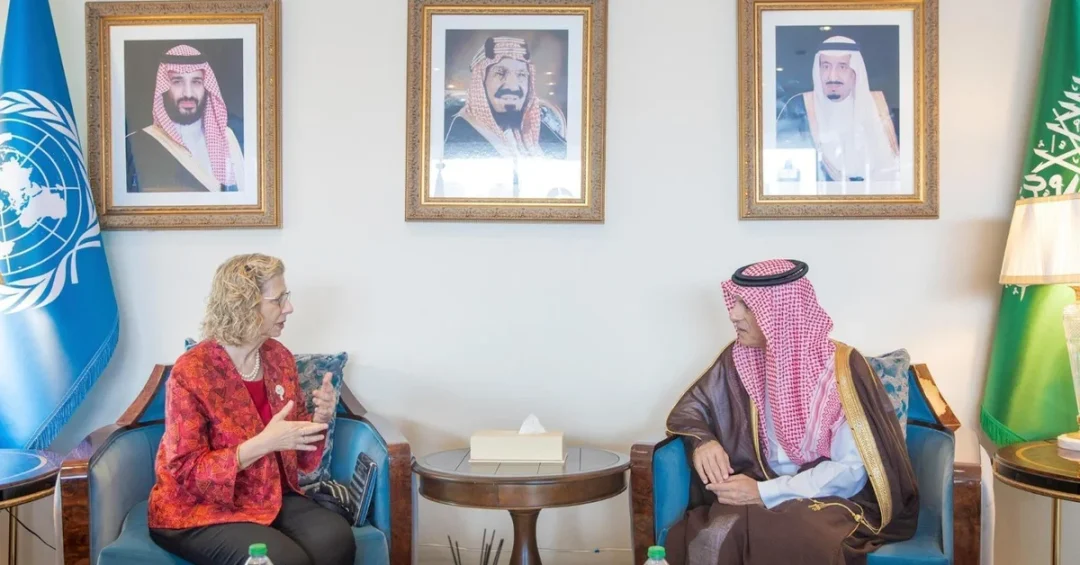
Minister of State for Foreign Affairs, Cabinet Member and Climate Affairs Envoy Adel bin Ahmed Al-Jubeir met with United Nations Environment Program (UNEP) Executive Director Inger Andersen on the sidelines of the high-level week of the 79th United Nations General Assembly in New York City. The meeting, held on September 24, 2024, focused on enhancing cooperation between the Kingdom of Saudi Arabia and UNEP, as well as reviewing Saudi initiatives to mitigate climate change and support international environmental efforts.
Context and Background
The 79th United Nations General Assembly high-level week brings together world leaders to address pressing global challenges, including climate change, sustainable development, and international security. Saudi Arabia’s active participation underscores its commitment to multilateral diplomacy and environmental stewardship. As the world’s leading oil exporter, the Kingdom has increasingly positioned itself as a proactive player in global climate action, launching ambitious initiatives such as the Saudi Green Initiative and the Middle East Green Initiative, which aim to reduce emissions, increase renewable energy use, and combat desertification.
Minister Al-Jubeir’s role as Climate Affairs Envoy highlights Saudi Arabia’s dedication to integrating climate considerations into its foreign policy. His meeting with UNEP Executive Director Inger Andersen builds on longstanding cooperation between the Kingdom and the UN agency, which focuses on global environmental governance. This dialogue is particularly timely as nations prepare for upcoming COP conferences and seek to accelerate progress on the Paris Agreement goals.
Key Details
During the meeting, Minister Al-Jubeir and Executive Director Andersen discussed ways to strengthen existing collaboration between Saudi Arabia and UNEP. They reviewed the Kingdom’s environmental programs, including the Saudi Green Initiative, which targets planting 10 billion trees and protecting 30% of land and sea areas by 2030. The discussion also covered international efforts to address climate change, with a focus on technology transfer, capacity building, and financing for developing countries.
Al-Jubeir emphasized Saudi Arabia’s commitment to the circular carbon economy, an approach that seeks to manage emissions through reduction, reuse, recycling, and removal. The Kingdom has invested heavily in clean energy projects, such as the NEOM green hydrogen plant, and has set a target of 50% renewable energy in its power mix by 2030. UNEP’s expertise in environmental policy and its convening power were acknowledged as valuable assets for scaling up these efforts globally.
Implications and Impact
The meeting signals Saudi Arabia’s growing role as a bridge-builder between energy producers and environmental advocates. By aligning with UNEP, the Kingdom reinforces its position as a responsible global citizen and a key partner in achieving the Sustainable Development Goals. This collaboration could lead to enhanced technical assistance, joint research, and pilot projects in areas like carbon capture, desertification control, and biodiversity conservation.
For the international community, Saudi Arabia’s engagement offers a model for how major economies can transition toward sustainability while maintaining energy security. The Kingdom’s initiatives have the potential to inspire other Gulf states and developing nations to adopt similar strategies, fostering regional stability and environmental resilience. Moreover, this partnership supports global efforts to combat climate change by leveraging Saudi Arabia’s financial resources and strategic location.
Vision 2030 Alignment
This meeting directly supports Saudi Vision 2030, the Kingdom’s comprehensive plan to diversify its economy and enhance quality of life. Environmental sustainability is a core pillar of Vision 2030, with goals to reduce carbon emissions, promote renewable energy, and protect natural resources. By collaborating with UNEP, Saudi Arabia advances its ambition to be a global leader in sustainability and climate action, ensuring a prosperous and greener future for generations to come.
20 Questions
Q1. Who met with UNEP Executive Director Inger Andersen?
A1. Minister of State for Foreign Affairs, Cabinet Member and Climate Affairs Envoy Adel bin Ahmed Al-Jubeir met with Inger Andersen.
Q2. Where did the meeting take place?
A2. The meeting was held on the sidelines of the 79th United Nations General Assembly in New York City.
Q3. When did the meeting occur?
A3. The meeting took place on September 24, 2024, during the high-level week of the UN General Assembly.
Q4. What was the main purpose of the meeting?
A4. To discuss enhancing cooperation between Saudi Arabia and UNEP and review Saudi initiatives to reduce climate change effects.
Q5. What is UNEP?
A5. UNEP is the United Nations Environment Program, the leading global environmental authority that sets the environmental agenda.
Q6. What role does Adel Al-Jubeir hold?
A6. He is Minister of State for Foreign Affairs, Cabinet Member, and Climate Affairs Envoy of Saudi Arabia.
Q7. What are some Saudi initiatives to combat climate change?
A7. Saudi initiatives include the Saudi Green Initiative, Middle East Green Initiative, and investments in renewable energy and the circular carbon economy.
Q8. How does this meeting align with Saudi Vision 2030?
A8. It supports Vision 2030’s environmental sustainability goals, including reducing emissions and promoting renewable energy.
Q9. What is the Saudi Green Initiative?
A9. It is a national initiative aiming to plant 10 billion trees, protect 30% of land and sea, and reduce carbon emissions.
Q10. What is the circular carbon economy?
A10. It is an approach to manage emissions through reduction, reuse, recycling, and removal, promoted by Saudi Arabia.
Q11. How many trees does the Saudi Green Initiative aim to plant?
A11. The initiative aims to plant 10 billion trees across the Kingdom.
Q12. What percentage of land and sea does Saudi Arabia aim to protect?
A12. Saudi Arabia aims to protect 30% of its land and sea areas by 2030.
Q13. What is Saudi Arabia’s renewable energy target?
A13. The Kingdom targets 50% renewable energy in its power mix by 2030.
Q14. What is NEOM’s role in Saudi environmental efforts?
A14. NEOM includes a green hydrogen plant and is designed as a sustainable, zero-carbon city.
Q15. How does UNEP benefit from this cooperation?
A15. UNEP gains a key partner in advancing global environmental goals and leveraging Saudi resources for climate action.
Q16. What is the significance of Saudi Arabia’s participation in UNGA?
A16. It demonstrates the Kingdom’s commitment to multilateral diplomacy and global challenges like climate change.
Q17. What international efforts were discussed?
A17. Efforts to address climate change, including technology transfer, capacity building, and financing for developing countries.
Q18. How does this meeting impact Saudi Arabia’s global standing?
A18. It reinforces Saudi Arabia’s role as a responsible global citizen and bridge-builder in environmental diplomacy.
Q19. What future actions might result from this meeting?
A19. Enhanced technical assistance, joint research, and pilot projects in carbon capture, desertification, and biodiversity.
Q20. Why is this meeting important for Vision 2030?
A20. It advances Vision 2030’s sustainability pillar, showcasing Saudi leadership in climate action and economic diversification.
Reader Feedback
We value your thoughts. Please share your feedback on this article.
Your feedback helps us improve our coverage.