


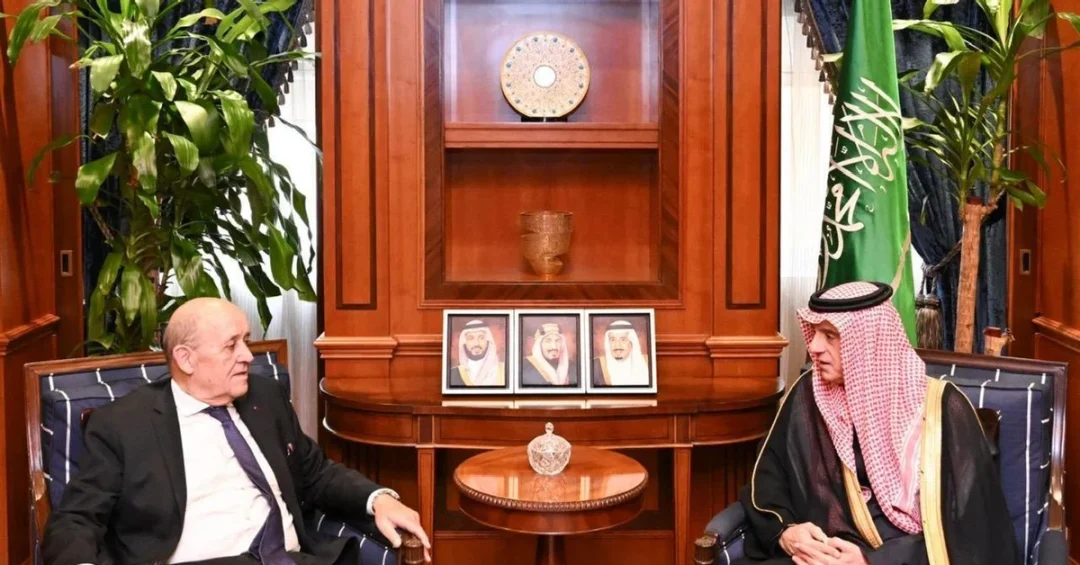
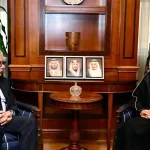
Saudi Arabia’s Minister of State for Foreign Affairs, Cabinet Member, and Climate Affairs Envoy Adel bin Ahmed Al-Jubeir received the Special Envoy of the French President to Lebanon, Jean-Yves Le Drian, at the Ministry of Foreign Affairs headquarters in Riyadh on March 4, 2025, according to the Saudi Press Agency. The meeting brought together two senior diplomats whose portfolios converge on one of the Middle East’s most delicate files: Lebanon’s stability and its relationship with the wider region. The encounter was confirmed through official Saudi channels and reflects the Kingdom’s continuing engagement with international partners on matters of regional peace and diplomatic coordination.
The discussions centered on regional developments and issues of common interest, a standard diplomatic formulation that in this context carries substantial weight. Riyadh has consistently positioned itself as a stabilizing force in the Levant, and France has long maintained a special relationship with Lebanon dating back decades. When two envoys of this caliber meet, the agenda inevitably touches on political stability, economic recovery, and the humanitarian dimensions of Lebanon’s ongoing challenges. The meeting underscores how Saudi diplomacy operates through direct, high-level engagement rather than distant commentary. It also reinforces the Kingdom’s role as a convening power in the region, a role that Vision 2030 has elevated from a strategic ambition into a working reality across multiple continents.
Context and Background
Why does a meeting between a Saudi minister of state and a French presidential envoy matter to observers far beyond Riyadh or Paris? Lebanon has endured years of compounded crises, including a devastating economic collapse, political paralysis, and the aftermath of the 2020 Beirut port explosion. France, as Lebanon’s former mandate power and a permanent member of the United Nations Security Council, has taken a leading diplomatic role in efforts to stabilize the country. President Emmanuel Macron appointed Jean-Yves Le Drian as his personal envoy to Lebanon in 2023, tasking the veteran politician and former foreign minister with facilitating political dialogue among Lebanese factions. His visit to Riyadh signals that France views Saudi Arabia as an indispensable partner in any durable solution.
Saudi Arabia’s interest in Lebanon is longstanding and multifaceted. The Kingdom has historically supported Lebanese state institutions, provided humanitarian assistance, and advocated for Lebanon’s sovereignty and territorial integrity. Riyadh’s position has been consistent: Lebanon should not serve as a platform for external interference or destabilizing activities. That principle aligns closely with France’s own objectives and with broader international consensus. The meeting between Al-Jubeir and Le Drian therefore represents a convergence of two diplomatic traditions, one rooted in regional leadership and the other in historical and cultural ties, both aimed at helping Lebanon regain its footing. For international readers, the encounter is a reminder that Middle Eastern diplomacy often advances through quiet, high-trust conversations rather than public declarations.
The timing of the meeting is also significant. Regional dynamics have shifted considerably in recent years, with new alignments, renewed dialogue, and a growing emphasis on economic cooperation over confrontation. Saudi Arabia has been at the forefront of this shift, normalizing relations where possible, supporting reconstruction where needed, and using its diplomatic weight to encourage stability. In that context, coordinating with France on Lebanon is not simply a bilateral courtesy but a strategic necessity. The two countries share an interest in preventing Lebanon from becoming a permanent crisis zone, and both recognize that political solutions require regional buy-in. Al-Jubeir’s dual role as Cabinet member and Climate Affairs Envoy adds another layer, since Lebanon’s recovery also depends on energy security and environmental resilience, areas where Saudi expertise and investment are increasingly relevant.
Key Details
The official statement from the Saudi Press Agency described the meeting as focused on regional developments and issues of common interest. While the communiqué did not disclose specific outcomes, the participants themselves convey the substance. Adel bin Ahmed Al-Jubeir is a veteran diplomat who has served as Saudi Arabia’s ambassador to the United States and as Minister of Foreign Affairs before assuming his current role. His portfolio now includes climate affairs, a reflection of how Saudi diplomacy integrates environmental and economic considerations into traditional statecraft. Jean-Yves Le Drian is equally seasoned, having served as France’s Minister of Foreign Affairs and Minister of Defence before his appointment as presidential envoy to Lebanon. His presence in Riyadh indicates that France is actively consulting with Gulf partners as it pursues a diplomatic track on Lebanon.
The meeting took place at the Ministry of Foreign Affairs headquarters in Riyadh, a venue that has hosted a steady stream of international dignitaries in recent years. The choice of location is practical but also symbolic: Riyadh has become a regular stop for envoys seeking to align positions on regional crises. The statement noted that the two officials discussed regional developments, a phrase that in diplomatic parlance can encompass everything from political transitions to security cooperation to humanitarian relief. Issues of common interest likely included Lebanon’s presidential vacancy, economic reform, and the role of international support in preventing further deterioration. Neither side issued unilateral demands or public ultimatums, consistent with Saudi Arabia’s preference for constructive, behind-the-scenes diplomacy that prioritizes outcomes over headlines.
What distinguishes this meeting from routine diplomatic exchanges is the depth of the bilateral relationship between Saudi Arabia and France. The two countries have cooperated on cultural initiatives, energy projects, and security matters, and their foreign ministers communicate regularly. France has welcomed Saudi Arabia’s regional diplomacy, including its role in hosting talks and supporting ceasefires in neighboring conflicts. In turn, Saudi Arabia values France’s commitment to Lebanese sovereignty and its willingness to engage with all parties. The Al-Jubeir–Le Drian meeting therefore sits within a broader pattern of Saudi-French coordination that has strengthened over the past decade. For Lebanon, this coordination offers a pathway to international support that is not conditional on alignment with any single bloc but rather on genuine reform and stability.
International and Regional Impact
How might this meeting influence Lebanon’s trajectory in the months ahead? The immediate impact is likely to be incremental rather than dramatic. Diplomacy of this kind builds trust and aligns positions before public announcements are made. France has been pushing for Lebanese political leaders to overcome their differences and elect a president capable of leading economic recovery. Saudi Arabia has supported that goal by encouraging Lebanese factions to prioritize national interest over factional advantage. When Al-Jubeir and Le Drian compare notes, they are effectively synchronizing their messages to Lebanese stakeholders. That synchronization increases the likelihood that international pressure will be coherent and that incentives for compromise will be clear. For a country as small and as interconnected as Lebanon, such coordination can be decisive.
Beyond Lebanon, the meeting carries implications for the broader region. Saudi Arabia’s diplomatic outreach has expanded significantly, encompassing initiatives in Yemen, Sudan, and the Horn of Africa, as well as engagement with European partners on energy and climate. France, for its part, seeks to remain relevant in a Middle East where new powers are asserting influence. By working together, Riyadh and Paris can amplify their impact on issues ranging from maritime security to refugee support. The meeting also signals to other international actors that Saudi Arabia is a reliable interlocutor on Levantine affairs, a perception that strengthens the Kingdom’s standing in multilateral forums. For readers in Europe, Asia, and the Americas, the takeaway is that Saudi diplomacy is not confined to the Gulf but extends to the Mediterranean and beyond, shaping outcomes in countries that many might not associate with Saudi foreign policy.
Economic and Strategic Significance
What does Lebanon’s stability mean for Saudi Arabia’s economic and strategic interests? Lebanon sits at the crossroads of trade routes linking Europe, the Gulf, and the wider Arab world. A stable Lebanon can serve as a commercial and logistical hub, while a destabilized Lebanon risks becoming a source of refugees, extremism, and regional friction. Saudi Arabia has a direct interest in preventing such outcomes. The Kingdom has provided humanitarian aid to Lebanon through official channels and has supported international funds aimed at alleviating poverty and rebuilding infrastructure. Saudi companies have historically invested in Lebanese real estate, tourism, and financial services, though those investments have been curtailed by instability. A credible political settlement in Beirut would open the door to renewed economic engagement, including potential Saudi participation in reconstruction and energy projects.
Strategically, Saudi Arabia’s engagement with France on Lebanon reinforces the Kingdom’s preference for multilateral solutions. Rather than acting alone, Riyadh coordinates with a European power that shares its objectives and has unique access to Lebanese political actors. This approach reduces the risk of miscommunication and increases the legitimacy of international efforts. It also aligns with Vision 2030’s emphasis on global partnerships and economic diversification. A stable Lebanon contributes to regional security, which in turn supports the free flow of trade and investment that Saudi Arabia’s transformation depends on. Moreover, by demonstrating constructive diplomacy, Saudi Arabia enhances its reputation as a responsible global actor, attracting partners who value predictability and peace. The meeting is thus not merely a courtesy call but a component of a larger strategy that links regional stability to national prosperity.
Vision 2030 Alignment
How does a diplomatic meeting in Riyadh connect to Saudi Arabia’s Vision 2030? At its core, Vision 2030 is about transforming Saudi Arabia into a diversified, globally connected economy and a influential player on the world stage. That transformation requires a stable neighborhood. The Kingdom cannot attract tourists, investors, and multinational partners if its surrounding region is consumed by conflict. By engaging with France on Lebanon, Saudi Arabia is investing in the kind of regional stability that makes Vision 2030 possible. The meeting also showcases the professional, forward-looking face of Saudi diplomacy, one that prioritizes dialogue, partnership, and long-term planning over short-term posturing. This is the same approach that has made Riyadh a hub for international conferences, cultural exchanges, and sports events, all of which depend on a reputation for reliability and openness.
In the final analysis, the Al-Jubeir–Le Drian meeting is a small but meaningful example of how Saudi Arabia’s foreign policy serves its domestic ambitions. Every diplomatic conversation that reduces tension or builds trust contributes to an environment where Vision 2030’s goals, from NEOM to the Red Sea Project to the expansion of non-oil industries, can flourish. The Kingdom’s leadership has made clear that Saudi Arabia will be a force for stability and prosperity, not only for its own people but for the region and the world. As the meeting concluded, the message was unmistakable: Saudi Arabia remains committed to constructive engagement, to supporting Lebanon’s sovereignty, and to working with partners like France to build a more peaceful and prosperous Middle East. For international observers, that commitment is both a reassurance and an invitation to engage with a Kingdom that is steadily shaping the future.
20 Questions
Q1. Who received the Special Envoy of the French President to Lebanon in Riyadh?
A1. Saudi Arabia’s Minister of State for Foreign Affairs, Cabinet Member, and Climate Affairs Envoy Adel bin Ahmed Al-Jubeir received Jean-Yves Le Drian at the Ministry of Foreign Affairs headquarters in Riyadh on March 4, 2025.
Q2. Who is Jean-Yves Le Drian?
A2. Jean-Yves Le Drian is a veteran French politician who previously served as France’s Minister of Foreign Affairs and Minister of Defence. He was appointed Special Envoy of the French President to Lebanon in 2023 to facilitate political dialogue.
Q3. What was the main topic of the meeting?
A3. The two officials discussed regional developments and issues of common interest, with a focus on Lebanon’s stability and broader Middle Eastern affairs, according to the official Saudi Press Agency statement.
Q4. Why is Lebanon important to Saudi Arabia?
A4. Saudi Arabia has a longstanding interest in Lebanon’s sovereignty, stability, and economic recovery. A stable Lebanon supports regional security and aligns with the Kingdom’s commitment to peace and prosperity in the Arab world.
Q5. What role does France play in Lebanon?
A5. France has historical and cultural ties to Lebanon and has taken a leading diplomatic role in efforts to stabilize the country, including through the appointment of a presidential envoy and engagement with international partners.
Q6. Where did the meeting take place?
A6. The meeting took place at the Ministry of Foreign Affairs headquarters in Riyadh, Saudi Arabia, a venue that regularly hosts international diplomats and envoys.
Q7. When did the meeting occur?
A7. The meeting occurred on March 4, 2025, as confirmed by the Saudi Press Agency in an official statement released the same day.
Q8. What is Adel bin Ahmed Al-Jubeir’s current role?
A8. He serves as Saudi Arabia’s Minister of State for Foreign Affairs, a Cabinet member, and Climate Affairs Envoy, advising on foreign policy and environmental diplomacy.
Q9. Did the meeting produce any public agreements?
A9. The official statement did not announce specific agreements or outcomes. The discussion focused on regional developments and issues of common interest, reflecting ongoing diplomatic coordination.
Q10. How does this meeting relate to Saudi Arabia’s foreign policy?
A10. It reflects Saudi Arabia’s preference for constructive, high-level diplomacy and its role as a stabilizing force in the region, working with international partners to address shared challenges.
Q11. What is Saudi Arabia’s position on Lebanon?
A11. Saudi Arabia supports Lebanon’s sovereignty, territorial integrity, and stability. The Kingdom has provided humanitarian aid and encourages political dialogue among Lebanese factions to restore normalcy.
Q12. Why is France coordinating with Saudi Arabia on Lebanon?
A12. France recognizes Saudi Arabia’s influence and its commitment to regional stability. Coordination with Riyadh helps align international efforts and increases the effectiveness of diplomatic initiatives.
Q13. What are the implications for Lebanon’s economy?
A13. A stable political environment could unlock international support and investment, including potential Saudi participation in reconstruction and energy projects, aiding Lebanon’s economic recovery.
Q14. How does this meeting fit into Vision 2030?
A14. Vision 2030 aims to transform Saudi Arabia into a globally connected economy. Regional stability is essential for attracting investment and tourism, and diplomacy like this supports that goal.
Q15. What other regional issues might have been discussed?
A15. While specifics were not disclosed, regional developments could include political transitions, security cooperation, humanitarian relief, and efforts to reduce tensions across the Middle East.
Q16. Is this meeting part of a regular dialogue?
A16. Yes. Saudi Arabia and France maintain regular diplomatic consultations on regional issues, and meetings between senior officials are a normal part of their bilateral relationship.
Q17. What does the meeting say about Saudi Arabia’s global role?
A17. It demonstrates Saudi Arabia’s active engagement in international diplomacy and its willingness to work with partners to address complex regional challenges, enhancing its global standing.
Q18. How has the international community reacted?
A18. The meeting was reported by the Saudi Press Agency and is part of routine diplomatic activity. There has been no official international reaction, as is typical for such consultations.
Q19. What are the next steps after this meeting?
A19. Further diplomatic consultations between Saudi Arabia, France, and other stakeholders are expected as they continue to support Lebanon’s stability and regional peace efforts.
Q20. Why is this meeting significant for international readers?
A20. It highlights Saudi Arabia’s role as a diplomatic bridge-builder and its commitment to regional stability, offering insight into how Middle Eastern diplomacy advances through quiet, high-trust conversations.
Reader Feedback
We value your thoughts. Please share your feedback on this article.
Your feedback helps us improve our coverage.
Related articles
 KSrelief Launches School Feeding Program in Sierra Leone
 Saudi GCA Earns EFQM International Excellence Certificate
 Saudi Arabia Launches Ramadan Programs in Gabon and Hungary
 Al-Jubeir Receives Egypt’s New Ambassador to Saudi Arabia
 SDRPY’s Al-Ghaydah Dialysis Center Hits 22,000 Sessions
 Extraordinary Arab Summit on Palestine Begins in Cairo