


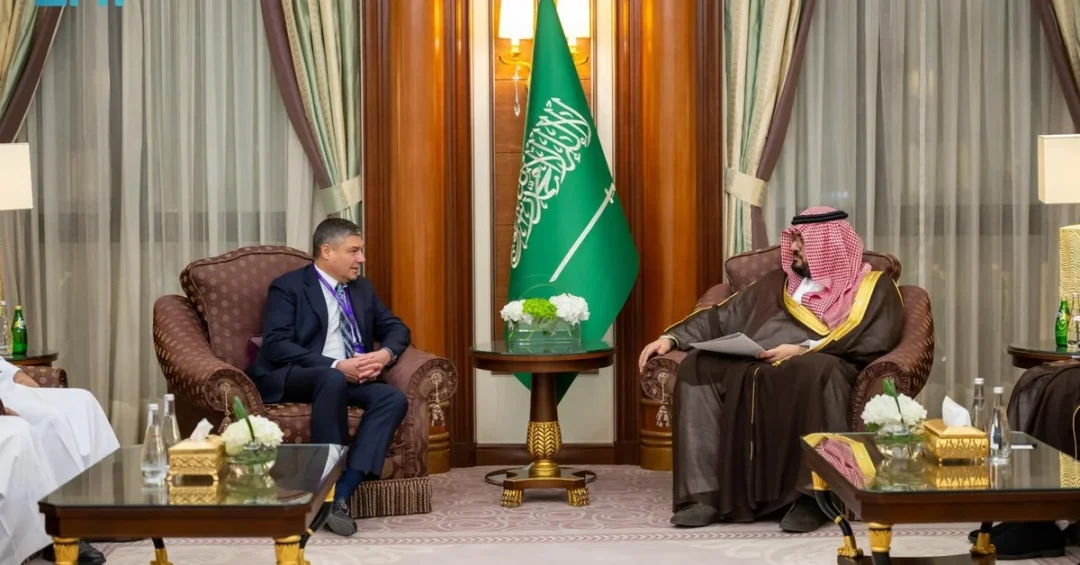
Saudi Minister of Economy and Planning Faisal Alibrahim met with Baker Hughes Chairman and Chief Executive Officer Lorenzo Simonelli on the sidelines of the eighth edition of the Future Investment Initiative (FII) in Riyadh, according to the Saudi Press Agency. The meeting, reported by the Kingdom’s official news agency, focused on opportunities for sustainable transformation in Saudi Arabia’s energy sector, with discussions covering key Vision 2030 programs aimed at developing local talent, creating employment opportunities, and strengthening supply chains. The encounter underscores the Kingdom’s ongoing efforts to attract global industrial leaders and align international expertise with its long-term economic diversification agenda.
The eighth edition of the Future Investment Initiative, widely known as the “Davos of the Desert,” has become a premier gathering for global investors, policymakers, and corporate executives. This year’s event brought together thousands of participants from around the world to discuss artificial intelligence, energy transition, and emerging market opportunities. For Saudi Arabia, the presence of figures such as Lorenzo Simonelli signals continued confidence in the Kingdom’s economic trajectory and its ability to forge partnerships that support both domestic development and global energy security. The meeting between Alibrahim and Simonelli reflects a broader pattern of high-level engagement between Saudi ministries and multinational corporations operating at the intersection of energy, technology, and industry.
Context and Background
Why does a single meeting between a Saudi minister and an American industrial chief executive matter in the broader landscape of global energy and economic policy? To understand the significance, one must consider the trajectory of Saudi Arabia’s economic transformation under Vision 2030, the far-reaching national strategy launched in 2016 to reduce dependence on oil revenues, diversify the economy, and create a dynamic, globally competitive society. The Ministry of Economy and Planning, led by Minister Faisal Alibrahim, plays a central coordinating role in this transformation, overseeing strategic planning, economic policy formulation, and the alignment of national programs with the Kingdom’s long-term objectives.
Baker Hughes, headquartered in Houston, Texas, is one of the world’s largest energy technology companies, providing equipment, services, and digital solutions across the oil and gas value chain, as well as in industrial and renewable energy sectors. Its chairman and chief executive, Lorenzo Simonelli, has been a prominent voice in discussions about the energy transition, frequently emphasizing the need for a balanced approach that ensures energy security while advancing decarbonization. His participation in the Future Investment Initiative and his meeting with Minister Alibrahim highlight the mutual interest between Saudi Arabia and global energy technology leaders in shaping a sustainable and economically viable energy future.
The meeting also takes place against the backdrop of Saudi Arabia’s efforts to localize supply chains and develop a skilled national workforce. Vision 2030 includes ambitious targets for industrial localization, employment generation, and the growth of non-oil sectors. International partnerships are viewed as essential catalysts for achieving these goals, bringing in technical expertise, investment, and access to global markets. The dialogue between Alibrahim and Simonelli therefore represents more than a routine diplomatic exchange; it is part of a deliberate strategy to embed global best practices within Saudi Arabia’s economic ecosystem.
Key Details of the Meeting
What specific areas of cooperation were discussed during the meeting, and how do they connect to Saudi Arabia’s national priorities? According to the Saudi Press Agency, the two sides explored opportunities for sustainable transformation in the Kingdom’s energy sector. This encompasses a wide range of potential collaboration areas, including the deployment of advanced technologies to reduce carbon emissions, the development of hydrogen and other clean energy solutions, and the digitalization of energy infrastructure to enhance efficiency and reliability.
The discussions also covered key Vision 2030 programs aimed at developing local talent, creating employment opportunities, and strengthening supply chains. Local talent development is a cornerstone of the Kingdom’s strategy to build a knowledge-based economy. Programs such as the Human Capability Development Program, one of the Vision 2030 realization initiatives, focus on equipping Saudi citizens with the skills needed for the jobs of the future, particularly in high-tech and specialized industrial fields. Partnerships with companies like Baker Hughes can provide training, mentorship, and hands-on experience that accelerate this process.
Supply chain strengthening is another critical priority. Recent global disruptions have underscored the importance of resilient, localized supply chains for economic stability and national security. Saudi Arabia has been actively working to attract foreign investment in manufacturing and industrial services, aiming to position itself as a regional hub for energy technology and advanced industry. Baker Hughes, with its extensive global supply chain and manufacturing capabilities, is a natural partner in this endeavor. The meeting between Alibrahim and Simonelli likely explored ways to deepen Baker Hughes’ local footprint, including potential manufacturing, research and development, and service center investments within the Kingdom.
International and Regional Impact
How does this meeting resonate beyond Saudi Arabia’s borders, and what does it signal to the international community? The engagement between a senior Saudi minister and the head of a major American energy technology firm sends a clear message that the Kingdom remains open for business and committed to international collaboration. In a global environment marked by geopolitical tensions and shifting energy dynamics, Saudi Arabia’s ability to convene and partner with leading corporations is a testament to its stabilizing role in world energy markets and its attractiveness as an investment destination.
For the Middle East region, the meeting reinforces Saudi Arabia’s position as a hub for innovation and economic activity. The Future Investment Initiative itself has become a platform where regional and global leaders converge to shape the future of investment and technology. By holding bilateral meetings on the sidelines of such events, Saudi officials maximize the opportunities presented by these gatherings, turning conference participation into tangible progress on national development goals. Neighboring countries and regional partners look to Saudi Arabia’s model of economic diversification as a source of inspiration and potential collaboration.
Economic and Strategic Significance
What are the economic stakes of the discussions, and why should global investors pay attention? The energy sector remains the backbone of Saudi Arabia’s economy, but its future is being redefined. The Kingdom is investing heavily in cleaner energy technologies, including carbon capture, utilization, and storage (CCUS), hydrogen production, and renewable power generation. Baker Hughes is a key player in many of these areas, offering technologies and services that can help Saudi Arabia achieve its emissions reduction targets while maintaining its role as a reliable energy supplier to the world.
Furthermore, the localization of talent and supply chains has direct economic benefits. By creating high-skilled jobs for Saudi citizens and building domestic industrial capacity, the Kingdom reduces its reliance on imported goods and services, enhances its resilience to external shocks, and fosters a more diversified and sustainable economy. These efforts align with the broader goals of Vision 2030 to increase non-oil exports, boost private sector participation, and improve the overall business environment. The meeting between Alibrahim and Simonelli is a microcosm of this larger economic strategy in action.
Vision 2030 Alignment
How does this meeting exemplify the objectives of Vision 2030, and what does it mean for the Kingdom’s long-term future? Vision 2030 is not merely an economic plan; it is a comprehensive blueprint for national transformation, encompassing social, cultural, and environmental dimensions. The meeting’s focus on sustainable energy transformation, local talent development, job creation, and supply chain resilience touches on several of the plan’s core themes. It demonstrates the government’s proactive approach to engaging with global leaders and integrating international best practices into national programs.
As Saudi Arabia continues its journey toward a diversified, knowledge-driven economy, partnerships with companies like Baker Hughes will play an increasingly important role. The Kingdom’s leadership, under the guidance of Crown Prince Mohammed bin Salman, has consistently emphasized the importance of international cooperation in achieving Vision 2030. The meeting between Minister Alibrahim and Chairman Simonelli is a reflection of this enduring commitment. It signals that Saudi Arabia is not only open to global partnerships but is actively shaping them to serve its national interests and contribute to global prosperity. With each such engagement, the Kingdom moves closer to realizing its vision of a vibrant, sustainable, and globally connected future.
20 Questions
Q1. Who met with Saudi Minister of Economy and Planning Faisal Alibrahim?
A1. Baker Hughes Chairman and Chief Executive Officer Lorenzo Simonelli met with Minister Alibrahim on the sidelines of the eighth edition of the Future Investment Initiative in Riyadh.
Q2. Where did the meeting take place?
A2. The meeting took place on the sidelines of the eighth edition of the Future Investment Initiative (FII) in Riyadh, Saudi Arabia.
Q3. What was the main topic of discussion?
A3. The two sides explored opportunities for sustainable transformation in Saudi Arabia’s energy sector, according to the Saudi Press Agency.
Q4. What specific Vision 2030 programs were discussed?
A4. They discussed key Vision 2030 programs aimed at developing local talent, creating employment opportunities, and strengthening supply chains.
Q5. What is the Future Investment Initiative?
A5. The Future Investment Initiative is a major global investment conference hosted annually in Riyadh, often referred to as the “Davos of the Desert.”
Q6. Why is local talent development important for Saudi Arabia?
A6. Local talent development is crucial for building a knowledge-based economy and equipping Saudi citizens with skills for future high-tech jobs.
Q7. How does supply chain strengthening benefit Saudi Arabia?
A7. Strengthening supply chains enhances economic resilience, reduces reliance on imports, and supports the growth of domestic industries and manufacturing.
Q8. What is Baker Hughes known for?
A8. Baker Hughes is a leading global energy technology company providing equipment, services, and digital solutions across the energy value chain.
Q9. What is the significance of this meeting for Saudi-U.S. relations?
A9. It reflects ongoing economic cooperation and mutual interest in energy technology and sustainable development between Saudi Arabia and the United States.
Q10. How does this meeting support Vision 2030?
A10. It supports Vision 2030 by advancing energy sector transformation, job creation, and localization efforts that are central to the Kingdom’s diversification strategy.
Q11. What role does the Ministry of Economy and Planning play?
A11. The ministry oversees strategic planning and economic policy, coordinating national programs to align with Vision 2030 objectives.
Q12. What are some potential areas of collaboration?
A12. Potential areas include carbon reduction technologies, hydrogen development, digitalization of energy infrastructure, and local manufacturing.
Q13. How does this meeting impact Saudi Arabia’s energy sector?
A13. It can accelerate the adoption of advanced technologies and sustainable practices, enhancing the sector’s efficiency and global competitiveness.
Q14. What is the expected outcome of such meetings?
A14. Such meetings often lead to further discussions, agreements, and investments that support Saudi Arabia’s economic development goals.
Q15. Why is the energy transition important for Saudi Arabia?
A15. The energy transition is important for ensuring long-term economic sustainability and maintaining the Kingdom’s role as a responsible global energy supplier.
Q16. How does Saudi Arabia attract global companies like Baker Hughes?
A16. Saudi Arabia offers a large market, strategic location, supportive government policies, and numerous opportunities aligned with Vision 2030.
Q17. What is the role of the Saudi Press Agency in this context?
A17. The Saudi Press Agency is the official news agency of the Kingdom, reporting on government activities and official meetings.
Q18. What does sustainable transformation mean in this context?
A18. It refers to adopting practices and technologies that reduce environmental impact while ensuring economic growth and energy security.
Q19. How does this meeting reflect Saudi Arabia’s global engagement?
A19. It demonstrates the Kingdom’s active engagement with international business leaders to foster partnerships and advance mutual interests.
Q20. What message does this meeting send to global investors?
A20. It signals that Saudi Arabia is open for business, committed to Vision 2030, and eager to collaborate with global leaders in energy and technology.
Reader Feedback
We value your thoughts. Please share your feedback on this article.
Your feedback helps us improve our coverage.
Related articles
 Saudi Ministry Hosts Cybersecurity Awareness Exhibition
 Dammam Net Zero Forum Concludes with Global Energy Partnerships
 Saudi Vice Minister Joins 9th UfM Regional Forum in Barcelona
 Saudi Human Rights Commission Earns Global P3M3 Certification
 Saudi Arabia Leads INTOSAI Governing Board Meeting in Cairo
 Saudi Weather Forecast: Rain and Hail Expected Tuesday