


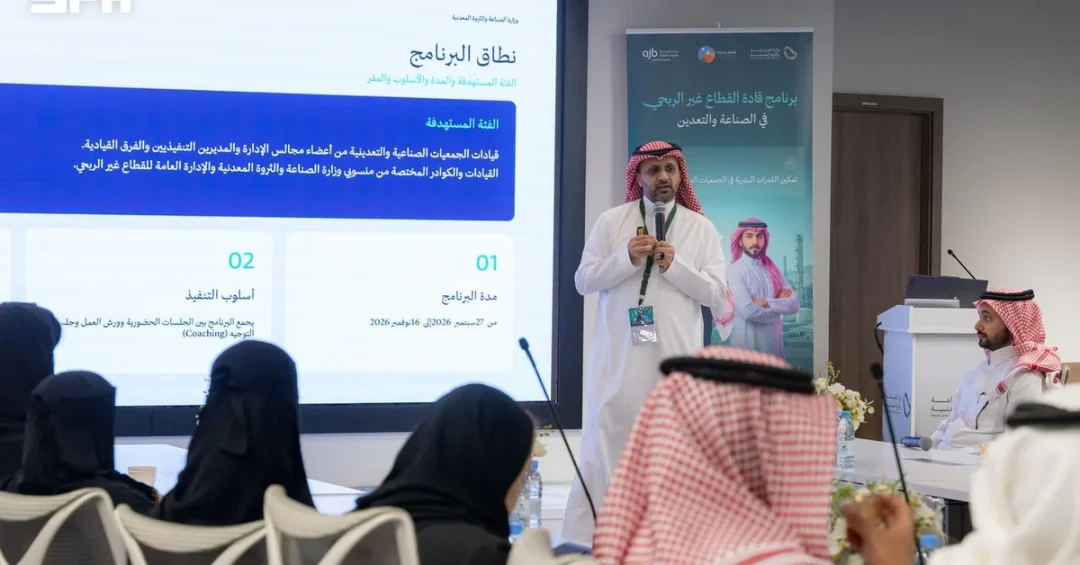
The Ministry of Industry and Mineral Resources concluded its “Leaders of the Non-Profit Sector in Industry and Mining” program on November 16, 2026, at a ceremony held at its headquarters in Riyadh. The event drew officials from the ministry, the National Center for Non-Profit Sector, and Bank Aljazira, which served as the program’s strategic implementation partner. The initiative, which ran from September 27 to November 16, 2026, targeted board members and executive directors of industrial and mining associations, equipping them with advanced leadership skills to strengthen their organizations’ contributions to Saudi Arabia’s economic development.
Why does a program focused on non-profit leadership matter for a nation racing to diversify its economy? In Saudi Arabia, the answer lies in the interconnected nature of Vision 2030, where government, private sector, and civil society must work in harmony to achieve ambitious goals. The program reflects a growing recognition that specialized associations—organizations that represent and support specific industries—can be powerful catalysts for innovation, standards-setting, and investment if they are led effectively. By investing in the people who lead these associations, the ministry is building a foundation for more resilient and dynamic industrial and mining sectors.
Context and Background
What prompted the Ministry of Industry and Mineral Resources to focus on non-profit leadership at this particular moment? The program emerged from a broader national effort to enhance the institutional capacity of the non-profit sector, which has historically been underutilized in Saudi Arabia’s development landscape. The National Center for Non-Profit Sector, established to regulate and empower civil society organizations, has been instrumental in this push. By partnering with Bank Aljazira, the ministry leveraged private-sector expertise in leadership development and organizational change, creating a model for cross-sector collaboration that aligns with Vision 2030’s emphasis on public-private partnerships.
The program’s timing is also significant. Saudi Arabia’s industrial and mining sectors are undergoing rapid transformation, driven by initiatives such as the National Industrial Development and Logistics Program (NIDLP) and the Ministry of Industry and Mineral Resources’ own strategies to attract investment and boost local content. Specialized associations in these sectors—such as those representing manufacturers, exporters, or mining companies—play a critical role in advocacy, knowledge-sharing, and capacity-building. Strengthening their leadership directly enhances their ability to support members and contribute to national goals. The program is therefore not an isolated training exercise but a strategic intervention in the ecosystem that supports industrial growth.
Furthermore, the program reflects a global trend where non-profit and civil society organizations are increasingly seen as essential partners in sustainable development. In Saudi Arabia, this shift is amplified by Vision 2030’s objective to increase the non-profit sector’s contribution to GDP from less than 1% to 5% by 2030. By empowering leaders of industrial and mining associations, the ministry is helping to build a more professional, impactful non-profit sector that can complement government efforts and drive innovation.
Key Details
What exactly did the program entail, and how were participants selected? The “Leaders of the Non-Profit Sector in Industry and Mining” program was structured around three core areas: self-leadership, team leadership, and organizational leadership. These modules were delivered through in-person training sessions, interactive workshops, and one-on-one mentoring, ensuring that participants not only learned theoretical concepts but also applied them to real-world challenges. A practical track focused on developing initiatives allowed participants to design projects that could be implemented within their associations, fostering immediate impact.
The curriculum covered essential skills such as strategic planning, decision-making, team management, and change leadership. These competencies are vital for board members and executive directors who must navigate complex stakeholder environments, align diverse interests, and drive organizational performance. By enhancing these skills, the program aimed to improve the efficiency and effectiveness of industrial and mining associations, enabling them to better serve their members and contribute to the sustainable development of their sectors. The selection of participants from various associations ensured a diverse cohort, enriching the learning experience through peer exchange.
The ceremony at the ministry’s headquarters in Riyadh marked the culmination of seven weeks of intensive training. Attendees included senior officials from the Ministry of Industry and Mineral Resources, representatives from the National Center for Non-Profit Sector, and executives from Bank Aljazira. The presence of these stakeholders underscores the collaborative spirit of the initiative and the shared commitment to strengthening the non-profit sector. While the source material does not provide specific names or quotes, the event itself symbolizes the ministry’s ongoing dedication to human capital development as a pillar of industrial strategy.
International and Regional Impact
How does Saudi Arabia’s investment in non-profit leadership resonate beyond its borders? The program positions the Kingdom as a forward-thinking nation that recognizes the role of civil society in economic development. In a region where non-profit sectors are often nascent or constrained, Saudi Arabia’s proactive approach could serve as a model for other countries seeking to harness the potential of associations and NGOs. By integrating non-profit leaders into its industrial strategy, the Kingdom demonstrates that sustainable development requires inclusive participation from all segments of society.
Regionally, the program supports Saudi Arabia’s broader efforts to diversify its economy and reduce dependence on oil. As the Kingdom expands its industrial and mining activities—from petrochemicals to renewable energy and from gold to phosphate—the need for strong industry associations becomes more pronounced. These associations can facilitate trade, set standards, and represent Saudi interests in international forums. By equipping their leaders with world-class skills, the ministry is enhancing the Kingdom’s competitiveness and its ability to attract foreign investment. This, in turn, contributes to regional stability and prosperity, as a stronger Saudi economy creates opportunities for neighboring countries.
Economic and Strategic Significance
Why should the international business community pay attention to a leadership program for non-profit associations? The answer lies in the multiplier effect. Effective associations can drive industry-wide improvements in productivity, innovation, and compliance with global standards. They can also serve as trusted intermediaries between government and businesses, streamlining communication and policy implementation. In Saudi Arabia’s mining sector, for example, associations can help small and medium-sized enterprises access financing, technology, and markets, thereby fostering a more inclusive and resilient industry.
Strategically, the program aligns with Vision 2030’s goal of increasing the non-profit sector’s GDP contribution to 5%. By building leadership capacity in industrial and mining associations, the ministry is directly enhancing the sector’s ability to generate economic value. Moreover, the program strengthens the social contract by encouraging civic engagement and volunteerism among professionals. This holistic approach to development—where economic growth is coupled with social empowerment—is a hallmark of Saudi Arabia’s transformation journey. The involvement of Bank Aljazira as a strategic partner also highlights the private sector’s role in supporting national priorities, a key principle of Vision 2030.
Vision 2030 Alignment
How does this program fit into the grand tapestry of Saudi Vision 2030? Vision 2030 is not merely an economic blueprint; it is a comprehensive plan to build a vibrant society, a thriving economy, and an ambitious nation. The “Leaders of the Non-Profit Sector in Industry and Mining” program touches on all three pillars. By developing leaders, it fosters a vibrant society where citizens contribute to national progress. By strengthening associations, it supports a thriving economy with diversified sectors. And by promoting collaboration between government, private sector, and civil society, it embodies the ambitious spirit of the Kingdom.
Looking ahead, the Ministry of Industry and Mineral Resources is expected to continue investing in human capital and institutional development as part of its strategy to make Saudi Arabia a global industrial powerhouse. The success of this program could pave the way for similar initiatives in other sectors, further integrating the non-profit sector into the national development agenda. As the Kingdom marches toward 2030, such programs will be instrumental in ensuring that the benefits of growth are widely shared and that Saudi Arabia remains a beacon of progress in the region and beyond. The conclusion of this program is not an end, but a beginning—a launchpad for a new generation of non-profit leaders who will help shape the future of Saudi industry and mining.
20 Questions
Q1. What was the purpose of the “Leaders of the Non-Profit Sector in Industry and Mining” program?
A1. The program aimed to develop the leadership skills of board members and executive directors of industrial and mining associations, enhancing their ability to improve organizational performance and contribute to sustainable sector development.
Q2. When and where did the program take place?
A2. The program ran from September 27 to November 16, 2026, with training sessions and a concluding ceremony held at the Ministry of Industry and Mineral Resources headquarters in Riyadh.
Q3. Which organizations partnered to deliver the program?
A3. The Ministry of Industry and Mineral Resources led the initiative, with the National Center for Non-Profit Sector and Bank Aljazira as strategic implementation partner.
Q4. Who were the target participants of the program?
A4. The program targeted board members and executive directors of non-profit associations operating in the industrial and mining sectors across Saudi Arabia.
Q5. What were the three main areas of leadership covered?
A5. The curriculum covered self-leadership, team leadership, and organizational leadership, along with a practical track for developing initiatives.
Q6. What specific skills did participants develop?
A6. Participants enhanced skills in strategic planning, decision-making, team management, and change leadership to drive better outcomes in their associations.
Q7. How does the program support Saudi Vision 2030?
A7. It aligns with Vision 2030 by strengthening the non-profit sector’s contribution to economic growth, increasing its GDP share, and fostering cross-sector collaboration.
Q8. What is the significance of Bank Aljazira’s involvement?
A8. Bank Aljazira’s role as strategic partner highlights private-sector engagement in national development and provides expertise in leadership and organizational change.
Q9. How does the program benefit the industrial and mining sectors?
A9. By improving association leadership, the program helps these organizations better support their members, advocate for industry needs, and drive innovation and standards.
Q10. What was the duration of the program?
A10. The program spanned seven weeks, from September 27 to November 16, 2026, allowing for in-depth training and mentoring.
Q11. What teaching methods were used?
A11. The program utilized in-person training, workshops, and mentoring sessions, combining theoretical learning with practical application.
Q12. What is the National Center for Non-Profit Sector’s role?
A12. The center regulates and empowers non-profit organizations in Saudi Arabia, and its participation underscores the program’s alignment with national civil society goals.
Q13. How many participants attended the program?
A13. The source material does not specify the number of participants, but the program targeted a select group of board members and executive directors.
Q14. What is the expected impact on the non-profit sector?
A14. The program is expected to enhance the institutional efficiency of associations, enabling them to contribute more effectively to sustainable development.
Q15. How does this program fit into Saudi Arabia’s economic diversification?
A15. By strengthening industrial and mining associations, the program supports diversification efforts under Vision 2030, reducing oil dependence and boosting non-oil sectors.
Q16. What is the role of non-profit associations in industry and mining?
A16. They represent industry interests, facilitate knowledge exchange, set standards, and provide services that help businesses grow and compete globally.
Q17. Will there be follow-up programs or initiatives?
A17. While not specified, the ministry’s ongoing commitment to human capital development suggests potential for similar future programs.
Q18. How does the program reflect Saudi Arabia’s broader social reforms?
A18. It promotes civic engagement and professional development, aligning with Vision 2030’s goal of a vibrant society where citizens contribute to national progress.
Q19. What was the closing ceremony like?
A19. The ceremony at the ministry’s headquarters in Riyadh brought together officials from the ministry, the National Center for Non-Profit Sector, and Bank Aljazira to celebrate the participants’ achievements.
Q20. What does this program signify for the future of Saudi industry?
A20. It signals a strategic shift toward empowering civil society as a partner in industrial development, which will enhance competitiveness and innovation in the years ahead.
Reader Feedback
We value your thoughts. Please share your feedback on this article.
Your feedback helps us improve our coverage.
Related articles
 RGA Launches Winter Road Safety Guide for Safe Travel
 Prophet’s Mosque Services Enhance Readiness for Mid-Semester Break Crowds
 Madinah Governor Meets Indonesian Consul General
 GCF and WeProtect Convene in Manila for Child Online Safety
 Saudi GCA Leads at 80th INTOSAI Council Meeting
 King Fahd Quran Complex Signs 60 Contracts Worth SAR300M