


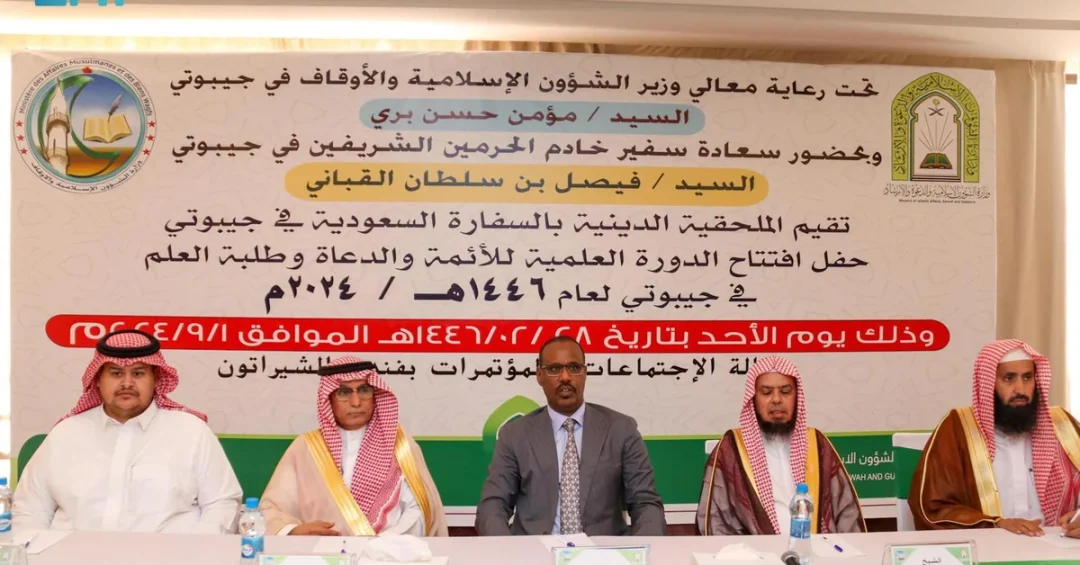
The religious attaché at the Saudi Embassy in the Republic of Djibouti, in collaboration with the Ministry of Islamic Affairs, Dawah, and Guidance, organized a scientific course to qualify imams, preachers, and students in Djibouti. The course, held on September 2, 2024, is part of the ministry’s ongoing international programs aimed at promoting moderation, spreading tolerance, and rejecting extremism. The event was attended by Saudi Ambassador to Djibouti Faisal Al-Qabbani, Djibouti’s Minister of Islamic Affairs and Endowments Moumin Hassan Barry, and heads of Islamic associations and centers.
Context and Background
The Ministry of Islamic Affairs, Dawah, and Guidance has long been dedicated to fostering moderate Islamic values and combating extremism through educational and training initiatives both within the Kingdom and abroad. These programs are designed to equip religious leaders with the necessary knowledge and skills to guide their communities towards a balanced and tolerant understanding of Islam. Djibouti, a fellow member of the Organisation of Islamic Cooperation and a strategic partner of Saudi Arabia in the Horn of Africa, has been a key focus of such outreach efforts. The scientific course is part of a broader strategy to strengthen bilateral ties and promote shared values of peace and coexistence.
Key Details
The course was held under the patronage of the Saudi Ministry of Islamic Affairs, Dawah, and Guidance and was implemented by the religious attaché at the Saudi Embassy in Djibouti. It targeted imams, preachers, and students, providing them with advanced training in Islamic sciences, including Quranic studies, Hadith, and Fiqh, with a special emphasis on the principles of moderation and tolerance. The presence of high-level officials from both countries underscores the importance of this initiative. Ambassador Faisal Al-Qabbani highlighted the Kingdom’s commitment to supporting religious education that upholds the true teachings of Islam, while Minister Moumin Hassan Barry expressed appreciation for Saudi Arabia’s continued efforts in promoting moderate Islam and capacity-building for Djiboutian religious leaders.
Implications and Impact
This initiative is expected to have a significant impact on the religious landscape in Djibouti, as it will enhance the capabilities of local imams and preachers to address contemporary challenges and counter extremist narratives. By fostering a culture of dialogue and understanding, the course contributes to regional stability and security. It also reinforces Saudi Arabia’s role as a global leader in promoting moderate Islam and interfaith harmony. The collaboration between Saudi Arabia and Djibouti in this field serves as a model for other nations seeking to combat extremism through education and capacity building. Furthermore, it strengthens the bonds of friendship and cooperation between the two countries, aligning with the Kingdom’s foreign policy objectives of supporting peace and moderation worldwide.
Vision 2030 Alignment
This scientific course is a tangible manifestation of Saudi Arabia’s Vision 2030, which emphasizes the importance of moderation, tolerance, and international cooperation. By exporting these values and investing in human capital development abroad, the Kingdom is not only fulfilling its religious and moral responsibilities but also enhancing its soft power and global standing. Vision 2030 seeks to position Saudi Arabia as a beacon of moderate Islam, and initiatives like this are crucial in achieving that goal. They also contribute to the broader objectives of fostering global peace and security, which are essential for sustainable development and prosperity. Through such programs, Saudi Arabia continues to demonstrate its commitment to a future built on mutual respect, understanding, and shared progress.
20 Questions
Q1. What is the main purpose of the scientific course organized in Djibouti?
A1. The main purpose is to qualify imams, preachers, and students in Djibouti, promoting moderation, tolerance, and rejecting extremism, as part of the Ministry of Islamic Affairs’ international programs.
Q2. Which Saudi ministry supported the scientific course in Djibouti?
A2. The Ministry of Islamic Affairs, Dawah, and Guidance supported the course, continuing its efforts to spread moderate Islam and combat extremism globally.
Q3. Who attended the course from the Saudi side?
A3. Saudi Ambassador to Djibouti Faisal Al-Qabbani attended, along with heads of Islamic associations and centers, demonstrating Saudi Arabia’s commitment to religious diplomacy.
Q4. Who represented Djibouti at the event?
A4. Djibouti’s Minister of Islamic Affairs and Endowments, Moumin Hassan Barry, attended the course, highlighting the strong bilateral ties between the two nations.
Q5. Where was the course held?
A5. The course was held in Djibouti, organized by the religious attaché at the Saudi Embassy, as part of Saudi Arabia’s outreach programs in the Horn of Africa.
Q6. When did the course take place?
A6. The course took place on September 2, 2024, according to the Saudi Press Agency, reflecting the ongoing collaboration between Saudi Arabia and Djibouti.
Q7. What are the key objectives of the course?
A7. The key objectives are to promote moderation, spread tolerance, and reject extremism, equipping imams and preachers with knowledge to guide their communities effectively.
Q8. How does this course benefit Djiboutian imams and preachers?
A8. It enhances their skills in Islamic sciences and provides them with tools to address contemporary challenges, fostering a balanced and tolerant understanding of Islam.
Q9. What is the significance of Saudi Arabia’s involvement in such programs?
A9. It underscores Saudi Arabia’s role as a global leader in promoting moderate Islam and strengthens its diplomatic and cultural ties with other nations.
Q10. How does this initiative align with Saudi Vision 2030?
A10. It aligns with Vision 2030’s emphasis on moderation, tolerance, and international cooperation, enhancing Saudi Arabia’s soft power and global standing.
Q11. What topics were covered in the scientific course?
A11. The course covered Islamic sciences such as Quranic studies, Hadith, and Fiqh, with a focus on moderation and tolerance, as per the ministry’s educational framework.
Q12. Who are the target participants of the course?
A12. Imams, preachers, and students in Djibouti are the target participants, aiming to build their capacity to promote peace and coexistence in their communities.
Q13. What is the expected outcome of the course?
A13. The course is expected to produce religious leaders who can counter extremist narratives and contribute to regional stability and security through moderate teachings.
Q14. How does this course reflect Saudi Arabia’s foreign policy?
A14. It reflects Saudi Arabia’s foreign policy of supporting peace, moderation, and international cooperation, particularly in the Horn of Africa and the wider Islamic world.
Q15. What role does the religious attaché play in such initiatives?
A15. The religious attaché at the Saudi Embassy organizes and coordinates these programs, ensuring they align with the ministry’s goals and local needs.
Q16. How does the course contribute to combating extremism?
A16. By educating imams and preachers on moderate Islamic principles, the course helps them challenge extremist ideologies and promote tolerance within their communities.
Q17. What is the significance of Djibouti in Saudi Arabia’s African outreach?
A17. Djibouti is a strategic partner in the Horn of Africa, and this course strengthens bilateral ties and supports shared goals of stability and moderate Islam.
Q18. Are there similar courses planned for other countries?
A18. Yes, the Ministry of Islamic Affairs, Dawah, and Guidance conducts similar programs globally as part of its mission to spread moderation and tolerance.
Q19. How does this course promote interfaith harmony?
A19. By fostering a culture of dialogue and understanding, the course encourages peaceful coexistence and respect among different religious communities.
Q20. What does this initiative say about Saudi Arabia’s global role?
A20. It demonstrates Saudi Arabia’s commitment to global peace and moderation, positioning the Kingdom as a leader in promoting tolerant Islam and international cooperation.
Reader Feedback
We value your thoughts. Please share your feedback on this article.
Your feedback helps us improve our coverage.