


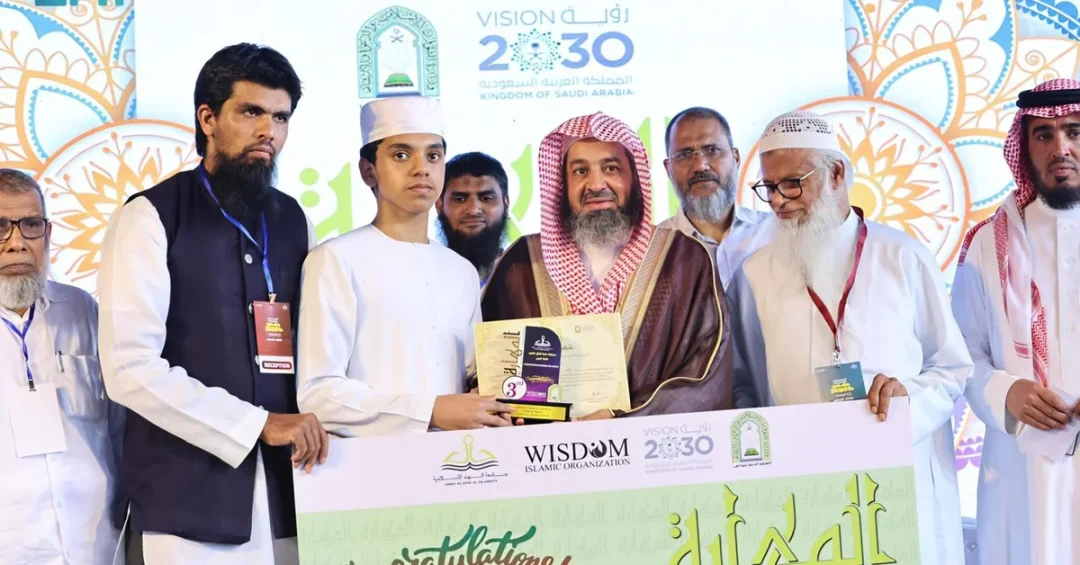
The Ministry of Islamic Affairs, Dawah and Guidance, represented by the Religious Attaché in India, honored the winners of the third Holy Quran and Sunnah Competition in Southern India during a ceremony held in collaboration with Darul Huda Islamic University in Malappuram, Kerala, according to the Saudi Press Agency. The event, which drew 1,022 contestants across all branches, was held in the presence of Sheikh Dr. Awad bin Sabti Al-Anazi, Undersecretary of the Ministry of Islamic Affairs, Dawah and Guidance, who presented awards to the top participants at the conclusion of the ceremony.
The competition, now in its third year, reflects the Kingdom of Saudi Arabia’s sustained commitment to promoting the study and memorization of the Holy Quran and the Sunnah of the Prophet Muhammad (peace be upon him) beyond its borders. By partnering with Darul Huda Islamic University, a respected institution in Kerala, the Ministry has created a platform that brings together young men and women from across Southern India to demonstrate their knowledge and recitation skills. The presence of a senior ministry official at the awards ceremony underscores the importance Saudi Arabia places on this initiative as part of its broader religious diplomacy and cultural outreach.
Context and Background
How did this competition come to be held in Kerala, and what does its third edition signify for Saudi-India religious cooperation? The Holy Quran and Sunnah Competition in Southern India is organized by the Religious Attaché of the Saudi Ministry of Islamic Affairs, Dawah and Guidance in India, a diplomatic and religious office that works to strengthen ties with Muslim communities across the subcontinent. Darul Huda Islamic University, based in Malappuram, Kerala, has served as the local partner for the event, providing logistical support and academic credibility. The collaboration highlights the ministry’s strategy of working with established educational institutions to reach young Muslims in regions with significant Islamic heritage.
The competition’s growth over three years is notable. From its inception, it has expanded its reach, and this year’s edition attracted 1,022 participants, a figure that demonstrates both the popularity of the event and the effectiveness of the ministry’s outreach. The participants, both boys and girls, competed in various branches of Quranic recitation, memorization, and understanding of the Sunnah. Such competitions are a hallmark of Saudi Arabia’s global efforts to encourage Islamic scholarship and to foster a deeper connection among youth to their faith. The Kingdom’s leadership, under the guidance of the Custodian of the Two Holy Mosques, King Salman bin Abdulaziz Al Saud, and His Royal Highness Crown Prince Mohammed bin Salman, has consistently supported these initiatives as part of its mission to serve Islam and Muslims worldwide.
For Kerala, a state with a long history of Islamic learning and a sizable Muslim population, hosting such an event reinforces its status as a center of religious education in India. The partnership with Darul Huda Islamic University also aligns with the university’s own mission to produce well-rounded graduates who are grounded in Islamic sciences. The competition thus serves a dual purpose: it rewards individual excellence and strengthens the institutional bonds between Saudi Arabia and Indian Islamic academia. This kind of people-to-people diplomacy is a cornerstone of the Kingdom’s soft power strategy.
Key Details of the Competition and Ceremony
What exactly took place at the awards ceremony, and who were the key figures involved? The ceremony marked the culmination of a rigorous competition that saw 1,022 contestants from Southern India compete in multiple categories. The Undersecretary of the Ministry of Islamic Affairs, Dawah and Guidance, Sheikh Dr. Awad bin Sabti Al-Anazi, personally honored the winners, presenting them with awards and recognition. His attendance signals the ministry’s high-level commitment to the event and to the participants. The presence of such a senior official also elevates the prestige of the competition, encouraging more students to take part in future editions.
The competition covered all branches, which typically include memorization of the entire Quran, recitation with Tajweed (proper pronunciation and intonation), and knowledge of the Sunnah, including Hadith and the life of the Prophet. By offering multiple branches, the organizers ensure that participants with different strengths can excel. The fact that both boys and girls participated is significant, reflecting the inclusive approach of the ministry and its recognition of the important role women play in preserving and transmitting Islamic knowledge. This inclusivity is also in line with Saudi Arabia’s Vision 2030, which emphasizes empowering women and youth in all fields.
Darul Huda Islamic University played a crucial role in hosting the event. The university, located in Malappuram, is one of the leading Islamic educational institutions in India, known for its comprehensive curriculum that combines religious and modern sciences. Its collaboration with the Saudi ministry is a testament to its reputation and its openness to international partnerships. The university’s facilities and organizational capabilities helped ensure the smooth running of the competition, from the preliminary rounds to the final ceremony.
International and Regional Impact
What does this competition mean for Saudi Arabia’s relations with India and the wider region? The event is a clear example of Saudi Arabia’s cultural and religious diplomacy, which seeks to build bridges with Muslim communities around the world. India is home to one of the largest Muslim populations globally, and Kerala has a particularly vibrant Islamic scholarly tradition. By engaging with students and scholars there, the Kingdom strengthens its ties with a key partner in South Asia. This aligns with Saudi Arabia’s broader foreign policy objectives of promoting moderation, interfaith understanding, and educational exchange.
Regionally, the competition reinforces Saudi Arabia’s leadership in the Islamic world. The Kingdom is the custodian of the Two Holy Mosques, and its efforts to promote Quranic education are seen as an extension of that sacred duty. Such initiatives also counter extremist narratives by encouraging a balanced and scholarly approach to Islam. The participation of 1,022 contestants shows that there is a strong demand for these kinds of programs, and it positions Saudi Arabia as a source of positive influence and support for Muslim youth. The event also complements other Saudi-led initiatives, such as the Muslim World League’s programs and the King Salman International Academy for the Arabic Language, which aim to spread moderate Islamic values and the Arabic language.
For India, the competition is a boost to its own Islamic educational sector. It provides recognition for talented students and encourages higher standards of learning. It also enhances the profile of Darul Huda Islamic University as a hub for Quranic studies. The collaboration between the Saudi ministry and the university could pave the way for further joint projects, such as scholarships, teacher training, and curriculum development. This kind of cooperation is mutually beneficial and contributes to the global dissemination of Islamic knowledge.
Economic and Strategic Significance
How does a religious competition relate to Saudi Arabia’s economic and strategic goals? While the event is primarily religious and cultural, it fits into a broader strategic framework. Saudi Arabia’s Vision 2030 aims to diversify the economy and enhance the Kingdom’s global standing. Soft power initiatives like this competition help improve Saudi Arabia’s image abroad, presenting it as a modern, moderate, and engaged nation. This can have indirect economic benefits by fostering goodwill that may translate into stronger trade, investment, and tourism ties. India is a major economic partner for Saudi Arabia, and people-to-people connections strengthen that relationship.
Moreover, the competition supports the development of human capital. By encouraging young people to excel in Quranic studies, it promotes discipline, dedication, and a strong moral compass—qualities that are valuable in any society. The ministry’s work in this area aligns with Vision 2030’s emphasis on education, youth empowerment, and the promotion of moderate Islam. It also complements other Saudi efforts to support Islamic education globally, such as the establishment of the King Abdullah bin Abdulaziz International Centre for Interreligious and Intercultural Dialogue (KAICIID) in Vienna, which Saudi Arabia supports.
From a strategic perspective, Saudi Arabia’s engagement with India’s Muslim community is part of a larger effort to strengthen ties with India as a whole. The Kingdom has deep historical and economic links with India, and both countries share an interest in regional stability and counterterrorism. Religious diplomacy can help build trust and understanding, which are essential for a robust strategic partnership. The competition is a small but meaningful component of this multifaceted relationship.
Vision 2030 Alignment
How does the Holy Quran and Sunnah Competition reflect the goals of Saudi Vision 2030? Vision 2030 is not only about economic transformation; it also seeks to strengthen Saudi Arabia’s role as a leader in the Islamic world and to promote the true, moderate teachings of Islam. The Ministry of Islamic Affairs, Dawah and Guidance is at the forefront of this effort, both domestically and internationally. By organizing and supporting competitions like this one, the ministry is helping to cultivate a generation of young Muslims who are deeply rooted in their faith and equipped to contribute positively to their societies. This is fully in line with the Vision’s emphasis on values, education, and global engagement.
Furthermore, the competition showcases Saudi Arabia’s commitment to empowering women and youth, two key pillars of Vision 2030. The fact that girls participated alongside boys in the competition demonstrates the Kingdom’s support for women’s participation in religious and educational fields. This sends a powerful message about Saudi Arabia’s modernization and its respect for the contributions of all members of society. As the Kingdom continues to implement Vision 2030, initiatives like this will play a vital role in projecting a positive image and building lasting partnerships around the world. The success of the third edition of the competition is a clear indication that this approach is resonating and will continue to grow in the years ahead.
20 Questions
Q1. What was the event organized by the Ministry of Islamic Affairs in Kerala?
A1. The Ministry of Islamic Affairs, Dawah and Guidance, through its Religious Attaché in India, organized the third Holy Quran and Sunnah Competition in Southern India in collaboration with Darul Huda Islamic University in Malappuram, Kerala.
Q2. Who represented the ministry at the awards ceremony?
A2. Sheikh Dr. Awad bin Sabti Al-Anazi, Undersecretary of the Ministry of Islamic Affairs, Dawah and Guidance, attended the ceremony and personally honored the winners.
Q3. How many contestants participated in the competition?
A3. A total of 1,022 contestants, both boys and girls, participated in the competition across all branches.
Q4. What is the significance of holding the competition for the third year?
A4. The third edition demonstrates the growing popularity and success of the initiative, reflecting the ministry’s sustained commitment to promoting Quranic education and strengthening ties with Muslim communities in India.
Q5. Which university partnered with the Saudi ministry for this event?
A5. Darul Huda Islamic University in Malappuram, Kerala, partnered with the ministry, providing the venue and organizational support for the competition.
Q6. What are the different branches of the competition?
A6. The competition typically includes branches such as full Quran memorization, recitation with Tajweed, and knowledge of the Sunnah, including Hadith and the Prophet’s biography.
Q7. Why is the participation of girls in the competition important?
A7. It reflects Saudi Arabia’s inclusive approach and its support for women’s education and empowerment, aligning with Vision 2030’s goals of enhancing women’s roles in all fields.
Q8. How does this competition align with Saudi Arabia’s religious diplomacy?
A8. It is a key example of the Kingdom’s efforts to promote moderate Islam and support Islamic education globally, strengthening people-to-people ties and showcasing Saudi leadership in the Islamic world.
Q9. What is the role of the Religious Attaché in India?
A9. The Religious Attaché represents the Ministry of Islamic Affairs in India, working to foster religious and cultural ties, support Muslim communities, and organize events like the Quran competition.
Q10. How does this event benefit the participants?
A10. Participants gain recognition for their knowledge and skills, receive awards, and are encouraged to deepen their understanding of the Quran and Sunnah, which can lead to further educational and career opportunities.
Q11. What message does this competition send to the international community?
A11. It conveys that Saudi Arabia is a promoter of peace, moderation, and education, and that it actively supports Muslim youth worldwide in their spiritual and intellectual development.
Q12. How does the competition support Vision 2030?
A12. It aligns with Vision 2030 by promoting moderate Islam, empowering youth and women, enhancing Saudi Arabia’s global image, and fostering international partnerships in education and culture.
Q13. What is the significance of Darul Huda Islamic University’s involvement?
A13. The university’s participation adds academic credibility and local expertise, and it strengthens institutional links between Saudi Arabia and India’s Islamic educational sector.
Q14. How many years has the competition been held?
A14. The competition has been held for three years, with the latest edition being the third, showing a consistent and growing initiative.
Q15. What kind of awards were given to the winners?
A15. While specific prizes were not detailed, winners were honored by the Undersecretary, likely receiving certificates, trophies, and possibly monetary awards, as is customary in such competitions.
Q16. How does this event reflect Saudi Arabia’s commitment to the Quran and Sunnah?
A16. It demonstrates the Kingdom’s dedication to preserving and promoting the Holy Quran and Sunnah by encouraging their study and memorization among young Muslims beyond its borders.
Q17. What impact does this have on Saudi-India relations?
A17. It strengthens cultural and religious ties between the two countries, complementing their strong economic and strategic partnership, and builds goodwill among the Indian Muslim community.
Q18. Are there plans to expand the competition in the future?
A18. While no official announcement has been made, the success and growth of the competition suggest that it may continue and possibly expand to include more participants and regions.
Q19. How does the competition promote moderation?
A19. By focusing on authentic Quranic and Sunnah teachings, it encourages a balanced and scholarly understanding of Islam, countering extremism and promoting peace.
Q20. What is the overall significance of this event for Saudi Arabia?
A20. It highlights Saudi Arabia’s role as a global leader in Islamic affairs, its commitment to youth and education, and its efforts to build bridges with Muslim communities worldwide under Vision 2030.
Reader Feedback
We value your thoughts. Please share your feedback on this article.
Your feedback helps us improve our coverage.
Related articles
 GCC Chief Praises Saudi, UAE, Oman Pavilions at WEF
 GACA Issues December 2024 Air Carrier and Airport Classifications
 Saudi Ambassador Meets Mauritian Land Transport Minister
 Saudi, Norwegian Foreign Ministers Meet at Davos 2025
 Crown Prince Chairs Cabinet Session in AlUla
 GCC Chief Meets Swiss Foreign Minister at WEF