


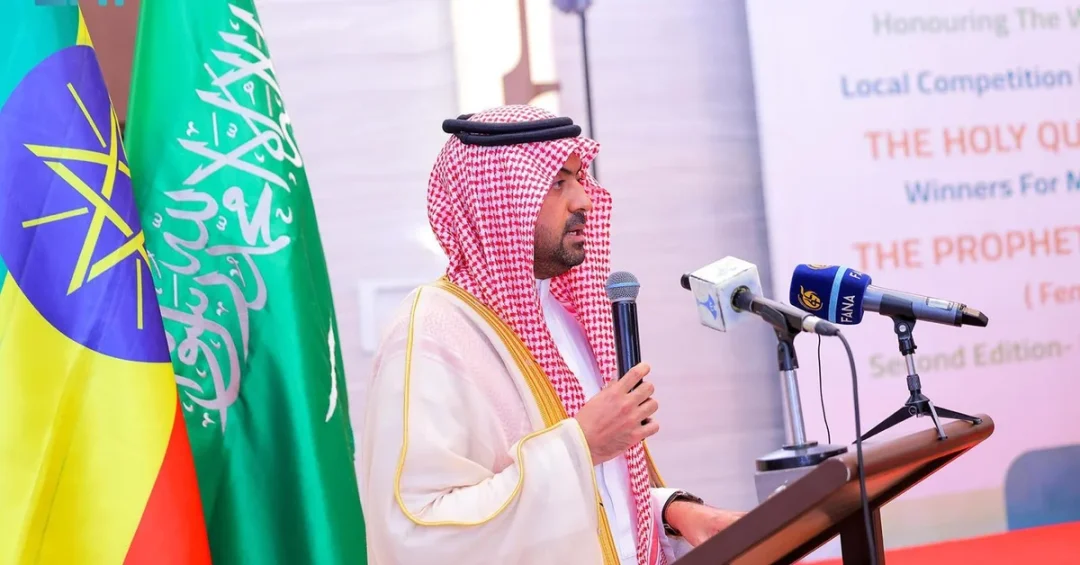
The Ministry of Islamic Affairs, Dawah, and Guidance, represented by the religious attaché at the Kingdom of Saudi Arabia’s embassy in the Federal Democratic Republic of Ethiopia, held a closing ceremony in Addis Ababa on October 20, 2024, to honor the winners of the second edition of the Quran and Sunnah memorization local competition. The event, reported by the Saudi Press Agency (SPA), drew 800 male and female contestants and underscored the Kingdom’s enduring commitment to promoting moderate Islam and supporting religious education worldwide. The ceremony recognized 15 male winners in Quran memorization and 11 female winners in hadith memorization, celebrating their dedication to the sacred texts.
The competition, organized under the umbrella of the religious attaché, reflects Saudi Arabia’s broader mission to foster Islamic values and knowledge across the globe. It is part of a series of initiatives by the Ministry of Islamic Affairs, Dawah, and Guidance to encourage Quranic and Sunnah memorization, particularly among youth, in line with the Kingdom’s Vision 2030 goals of cultural exchange and soft power diplomacy. The event also highlighted the growing participation of women in religious scholarship, with 11 female winners in hadith memorization. How does such a competition strengthen the bonds between Saudi Arabia and Ethiopia? It does so by creating a platform for shared faith and learning, reinforcing the Kingdom’s role as a custodian of Islamic heritage.
Context and Background
The Ministry of Islamic Affairs, Dawah, and Guidance has a long history of organizing Quran and Sunnah competitions both domestically and internationally. These contests are designed to encourage Muslims to engage deeply with the Quran and the Sunnah, promoting moderation, tolerance, and a correct understanding of Islam. The religious attaché at Saudi embassies plays a pivotal role in this endeavor, coordinating with local communities to host events that align with the Kingdom’s religious and cultural diplomacy. In Ethiopia, a country with a significant Muslim population and a long history of Islamic scholarship, such competitions have gained considerable traction.
The second edition of the competition follows the success of the first, which laid the groundwork for increased participation and community engagement. The first edition likely saw a smaller number of contestants, but the doubling of participants to 800 in the second edition indicates a growing interest and the attaché’s effective outreach. What does this surge in participation tell us about the appetite for Quranic education in Ethiopia? It demonstrates a vibrant demand for religious learning and the trust that local communities place in Saudi-led initiatives. The competition also aligns with the Ministry’s strategic objectives to spread moderate Islam and counter extremism through education.
The event took place in Addis Ababa, Ethiopia’s capital, a city that hosts numerous diplomatic missions and is a hub for interfaith dialogue. The religious attaché’s efforts are part of a broader Saudi effort to strengthen ties with African nations, many of which have Muslim populations that look to the Kingdom for religious guidance. By hosting such competitions, Saudi Arabia reinforces its soft power and builds goodwill, while also providing a platform for local talent to shine. The competition’s structure, with multiple categories, ensures that participants of varying skill levels can compete, fostering a spirit of inclusiveness and encouragement.
Key Details of the Competition
The second edition of the Quran and Sunnah memorization competition featured a meticulously organized format. For Quran memorization, there were five categories: 30 parts (the entire Quran), 20 parts, 15 parts, 10 parts, and five parts. This tiered approach allowed contestants to compete at their level of proficiency, from those who had memorized the entire Quran to those who had memorized smaller portions. The hadith memorization component had four levels: 150 hadiths, 90 hadiths, 60 hadiths, and 30 hadiths. A total of 800 contestants participated, with 15 male winners in Quran memorization and 11 female winners in hadith memorization. The ceremony included a visual presentation summarizing the religious attaché’s activities regarding these competitions during both the first and second editions, and attendees enjoyed recitations by various male and female contestants.
At the conclusion of the ceremony, gifts and commemorative shields were presented to the winners and members of the judging committee. This gesture of appreciation not only honors the participants but also motivates others to strive for excellence in religious studies. The judging committee, composed of local scholars and experts, ensured the integrity of the competition. What impact do these awards have on the participants and their communities? They serve as powerful incentives, encouraging continued study and serving as a testament to the value placed on religious education. The presence of female winners in hadith memorization also highlights the inclusive nature of the competition, promoting women’s participation in religious scholarship.
The visual presentation provided a comprehensive overview of the attaché’s activities, showcasing the growth of the competition from its first to second edition. It likely highlighted the increasing number of participants, the expansion of categories, and the positive feedback from the community. Such documentation is essential for transparency and for demonstrating the Ministry’s ongoing commitment. The recitations by contestants were a highlight, demonstrating the high level of skill and devotion. These recitations also served as a live example of the competition’s success, moving the audience and reinforcing the spiritual significance of the event.
International and Regional Impact
The competition in Ethiopia is part of Saudi Arabia’s broader international outreach, which seeks to promote moderate Islam and foster cultural exchange. By supporting Quran and Sunnah memorization abroad, the Kingdom reinforces its role as a global leader in Islamic affairs. This initiative also aligns with the objectives of the Organization of Islamic Cooperation (OIC), which encourages member states to collaborate on religious and educational projects. For Ethiopia, hosting such an event brings international recognition and strengthens its ties with Saudi Arabia, a key ally and investor. The competition also serves as a counter-narrative to extremist ideologies by promoting a balanced and scholarly approach to Islam.
Regionally, the event underscores Saudi Arabia’s commitment to Africa, a continent with a rapidly growing Muslim population. The Kingdom has been increasing its engagement with African nations through investments, development projects, and religious diplomacy. Ethiopia, as the host of the African Union headquarters, holds particular strategic importance. The competition not only benefits the participants but also enhances Saudi Arabia’s image as a benevolent and supportive partner. How does this event contribute to regional stability? By fostering moderate religious education, it helps build resilient communities that are less susceptible to radicalization, thereby contributing to long-term stability.
The ripple effects of the competition extend beyond Ethiopia’s borders, as participants and attendees may share their experiences with others in the region. The event also provides a model that could be replicated in other countries, further expanding Saudi Arabia’s soft power. The Ministry of Islamic Affairs, Dawah, and Guidance has similar programs in various nations, and the success in Ethiopia could inspire even broader participation. This aligns with the Kingdom’s Vision 2030, which emphasizes international cooperation and the promotion of Saudi Arabia’s cultural and religious heritage.
Economic and Strategic Significance
While primarily a religious and cultural event, the competition carries economic and strategic implications. Saudi Arabia’s investment in religious diplomacy often goes hand-in-hand with economic partnerships. Ethiopia is a key market for Saudi exports and a recipient of Saudi development assistance. By strengthening people-to-people ties through religious and cultural activities, the Kingdom creates a favorable environment for economic cooperation. The competition also highlights the role of the religious attaché, whose work supports the broader diplomatic mission. This integrated approach leverages soft power to achieve strategic objectives, including enhanced trade and investment flows.
Moreover, the event showcases Saudi Arabia’s commitment to education, a cornerstone of Vision 2030. By promoting Quranic and Sunnah memorization, the Kingdom invests in human capital development, both in Ethiopia and globally. This investment yields long-term benefits, as educated and moderate individuals contribute to their societies and foster positive perceptions of Saudi Arabia. The competition also serves as a platform for cultural exchange, allowing Ethiopians to learn more about Saudi traditions and vice versa. Such exchanges can lead to increased tourism and business opportunities, further integrating the two economies.
Strategically, the event reinforces Saudi Arabia’s leadership in the Islamic world. As the custodian of the Two Holy Mosques, the Kingdom has a unique responsibility to support Muslims everywhere. By organizing and supporting competitions like this, Saudi Arabia demonstrates its dedication to this role. It also counters narratives that seek to undermine the Kingdom’s influence, presenting a positive image of a nation committed to peace, moderation, and education. This soft power approach is cost-effective and yields significant diplomatic dividends.
Vision 2030 Alignment
The Quran and Sunnah competition in Ethiopia is a clear manifestation of Saudi Arabia’s Vision 2030, which seeks to diversify the economy, promote moderate Islam, and enhance the Kingdom’s global standing. Vision 2030 includes specific goals related to the promotion of Islamic values and the support of religious education. By hosting such competitions abroad, the Ministry of Islamic Affairs, Dawah, and Guidance contributes directly to these objectives. The event also supports the Vision’s emphasis on international cooperation and cultural exchange, showcasing Saudi Arabia as a tolerant and forward-looking nation.
Furthermore, the competition aligns with the Vision’s focus on empowering women, as evidenced by the female winners in hadith memorization. This inclusivity reflects the Kingdom’s broader efforts to enhance women’s roles in all spheres of life, including religious scholarship. The event also promotes the values of moderation and tolerance, which are central to Vision 2030’s goal of fostering a balanced and moderate society. As Saudi Arabia continues to implement its ambitious transformation plan, initiatives like this competition will play a vital role in building bridges with other nations and reinforcing the Kingdom’s position as a global leader.
20 Questions
Q1. What event did the Ministry of Islamic Affairs, Dawah, and Guidance hold in Ethiopia?
A1. The Ministry held a closing ceremony in Addis Ababa on October 20, 2024, to honor the winners of the second edition of the Quran and Sunnah memorization local competition, organized by the religious attaché at the Saudi embassy.
Q2. How many contestants participated in the competition?
A2. A total of 800 male and female contestants participated in the second edition, demonstrating significant growth and interest in Quranic and Sunnah memorization among the Ethiopian Muslim community.
Q3. How many winners were recognized in Quran memorization?
A3. Fifteen male winners were recognized in Quran memorization, competing across five categories that ranged from memorizing five parts to the entire 30 parts of the Quran.
Q4. How many female winners were honored in hadith memorization?
A4. Eleven female winners were honored in hadith memorization, highlighting the active participation and excellence of women in religious scholarship and the inclusivity of the competition.
Q5. What were the categories for Quran memorization?
A5. The competition featured five categories for Quran memorization: 30 parts (the entire Quran), 20 parts, 15 parts, 10 parts, and five parts, allowing contestants of various proficiency levels to compete.
Q6. What were the levels for Sunnah memorization?
A6. There were four levels for Sunnah memorization: 150 hadiths, 90 hadiths, 60 hadiths, and 30 hadiths, catering to different levels of dedication and memorization skills among participants.
Q7. What activities were included in the closing ceremony?
A7. The ceremony included a visual presentation summarizing the religious attaché’s activities for both editions, recitations by male and female contestants, and the presentation of gifts and commemorative shields to winners and judges.
Q8. Who organized the competition?
A8. The competition was organized by the Ministry of Islamic Affairs, Dawah, and Guidance, represented by the religious attaché at the Kingdom of Saudi Arabia’s embassy in the Federal Democratic Republic of Ethiopia.
Q9. What is the significance of this competition for Saudi Arabia?
A9. It reinforces Saudi Arabia’s role as a global leader in Islamic affairs, promotes moderate Islam, and supports Vision 2030 goals of cultural exchange, soft power diplomacy, and international cooperation.
Q10. How does the competition benefit Ethiopia?
A10. It provides a platform for Ethiopian Muslims to showcase their memorization skills, strengthens ties with Saudi Arabia, and promotes religious education and moderation within the local community.
Q11. What is the role of the religious attaché?
A11. The religious attaché coordinates religious and cultural activities at Saudi embassies, including organizing competitions, fostering moderate Islam, and building bridges between the Kingdom and local communities.
Q12. How does this event align with Vision 2030?
A12. It aligns with Vision 2030 by promoting moderate Islam, empowering women, enhancing international cultural exchange, and showcasing Saudi Arabia as a tolerant and forward-looking nation committed to education.
Q13. When did the closing ceremony take place?
A13. The closing ceremony took place on October 20, 2024, in Addis Ababa, Ethiopia, as reported by the Saudi Press Agency, marking the conclusion of the second edition of the competition.
Q14. What was the first edition of the competition like?
A14. The first edition laid the foundation for the competition, and its success contributed to the increased participation in the second edition, which saw 800 contestants, indicating growing community engagement.
Q15. How many total winners were there?
A15. There were 26 winners in total: 15 male winners in Quran memorization and 11 female winners in hadith memorization, all of whom were honored at the closing ceremony.
Q16. What gifts were presented to the winners?
A16. Gifts and commemorative shields were presented to the winners and members of the judging committee, serving as tokens of appreciation and encouragement for their dedication and hard work.
Q17. How does the competition promote moderation?
A17. By focusing on the Quran and Sunnah, the competition encourages a balanced and scholarly understanding of Islam, countering extremism and fostering tolerance and peace within communities.
Q18. What impact does the competition have on participants?
A18. It motivates participants to deepen their religious knowledge, provides recognition for their efforts, and inspires others to engage in Quranic and Sunnah studies, contributing to community development.
Q19. How does the event reflect Saudi Arabia’s soft power?
A19. It demonstrates the Kingdom’s commitment to supporting Muslims worldwide, builds goodwill, and enhances Saudi Arabia’s image as a benevolent leader in Islamic affairs, thereby expanding its soft power.
Q20. What other similar initiatives does the Ministry undertake?
A20. The Ministry organizes numerous Quran and Sunnah competitions globally, supports Islamic education, and engages in cultural exchange programs, all aimed at promoting moderate Islam and Vision 2030 objectives.
Reader Feedback
We value your thoughts. Please share your feedback on this article.
Your feedback helps us improve our coverage.