


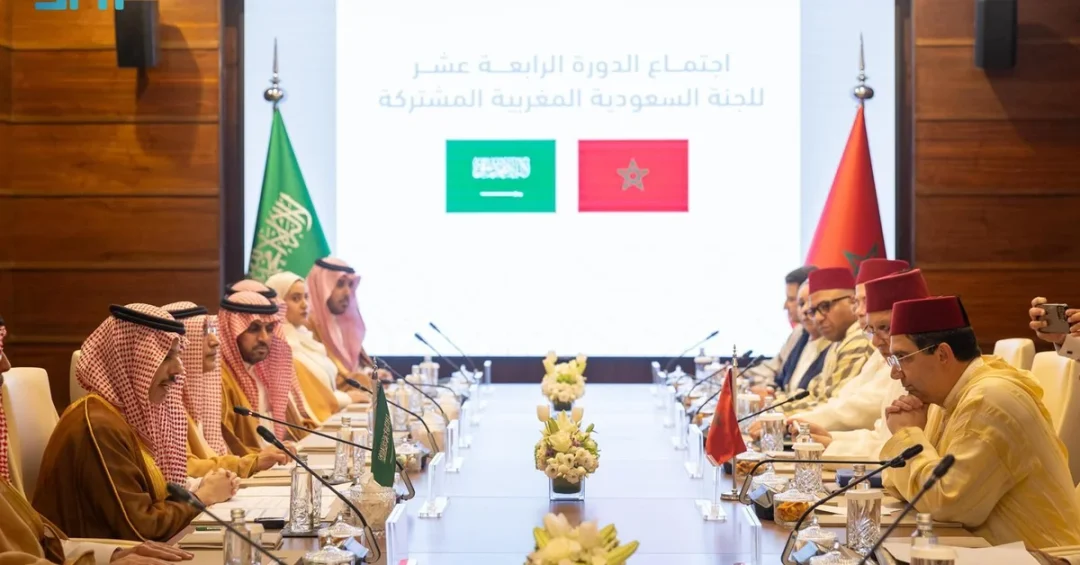
Saudi Minister of Foreign Affairs Prince Faisal bin Farhan bin Abdullah and Moroccan Minister of Foreign Affairs, African Cooperation and Moroccan Expatriates Nasser Bourita co-chaired the 14th session of the Saudi-Moroccan Joint Committee in Makkah on March 5, 2025. The meeting, announced by the Saudi Press Agency (SPA), brought together senior officials from ministries, government agencies, and private sector institutions from both countries, reaffirming the deep and enduring ties between the Kingdom of Saudi Arabia and the Kingdom of Morocco. The session concluded with the signing of a joint customs cooperation agreement for the mutual recognition of the Authorized Economic Operator (AEO) program and a memorandum of understanding (MoU) in the field of environmental protection and sustainable development, alongside the minutes of the session.
Could this latest high-level gathering signal a new chapter in Saudi-Moroccan relations, one that expands cooperation beyond traditional diplomacy into trade facilitation and environmental stewardship? The timing and location of the meeting—held in the holy city of Makkah—underscore the spiritual and historical bonds that have long connected the two nations. It also reflects a shared determination to translate political goodwill into tangible outcomes that benefit both economies and peoples. As the two foreign ministers put pen to paper on agreements that streamline customs procedures and promote sustainable development, the 14th session of the Joint Committee stands as a testament to the enduring partnership between Riyadh and Rabat.
Context and Background
The Saudi-Moroccan Joint Committee is a longstanding bilateral mechanism designed to enhance cooperation across a wide spectrum of sectors, including trade, investment, culture, education, and security. Established decades ago, the committee has served as a platform for periodic high-level consultations, allowing both countries to review progress, identify new opportunities, and address challenges collaboratively. The 14th session, convened in Makkah, builds on a rich history of mutual support and shared vision. Over the years, Saudi Arabia and Morocco have consistently aligned on key regional and international issues, from combating extremism to promoting stability in the Arab world and beyond.
Why does this particular session matter now, at a time of shifting global alliances and economic realignments? The answer lies in the evolving nature of international relations, where traditional diplomatic ties are increasingly complemented by economic and technical partnerships. Both Saudi Arabia and Morocco are pursuing ambitious national transformation agendas—Saudi Vision 2030 and Morocco’s New Development Model—that prioritize diversification, sustainability, and private sector engagement. The Joint Committee provides a structured framework to align these efforts, ensuring that bilateral cooperation directly supports each country’s developmental goals. The presence of senior officials and business leaders at the Makkah meeting further signals that the relationship is not confined to government corridors but extends to the private sector, which is essential for driving innovation and job creation.
Moreover, the location of the meeting carries symbolic weight. Makkah, the holiest city in Islam, hosts millions of pilgrims annually, including many from Morocco. The city’s spiritual significance adds a layer of cultural and religious affinity to the diplomatic proceedings. By choosing Makkah as the venue, both sides acknowledge the deep-rooted bonds that transcend mere economic interests. This setting also highlights Saudi Arabia’s role as a custodian of Islamic heritage and a facilitator of international dialogue, reinforcing its leadership in the Muslim world.
Key Details of the 14th Session
The 14th session of the Saudi-Moroccan Joint Committee yielded concrete agreements that are expected to facilitate trade and promote environmental sustainability. The joint customs cooperation agreement for mutual recognition of the Authorized Economic Operator (AEO) program is a significant step toward simplifying cross-border procedures for trusted traders. Under this agreement, businesses certified as AEOs in one country will be recognized as such in the other, reducing inspection times, lowering costs, and enhancing supply chain predictability. This is particularly important for exporters and importers who rely on efficient logistics to remain competitive. The AEO program is part of a global trend toward secure and streamlined trade, and the mutual recognition arrangement between Saudi Arabia and Morocco positions both nations as forward-looking partners in this domain.
What does the AEO mutual recognition mean for businesses on the ground? For Saudi and Moroccan companies, it translates into faster clearance at ports and borders, fewer bureaucratic hurdles, and greater certainty in international transactions. Small and medium-sized enterprises (SMEs), which form the backbone of both economies, stand to benefit significantly. By reducing trade barriers, the agreement encourages more SMEs to explore export opportunities, thereby contributing to economic diversification and job creation. It also aligns with the broader objectives of the Saudi-Moroccan Joint Committee to boost bilateral trade, which has been growing steadily in recent years but still holds immense untapped potential.
In addition to the customs agreement, the two sides signed a memorandum of understanding in the field of environmental protection and sustainable development. This MoU covers areas such as renewable energy, water management, waste reduction, and biodiversity conservation. Both Saudi Arabia and Morocco have made significant commitments to combating climate change—Saudi Arabia through its Saudi Green Initiative and Morocco through its ambitious solar energy projects. The MoU provides a framework for sharing expertise, joint research, and collaborative projects that can accelerate the transition to a green economy. It also opens doors for private sector partnerships in clean technology and sustainable infrastructure.
The session concluded with the signing of the minutes, a procedural step that formalizes the outcomes and sets the stage for implementation. The minutes likely outline timelines, responsible entities, and follow-up mechanisms to ensure that the agreements translate into real-world results. The presence of senior officials from various ministries and agencies underscores the whole-of-government approach that both countries are taking to deepen their partnership.
International and Regional Impact
The 14th session of the Saudi-Moroccan Joint Committee carries implications that extend beyond the bilateral relationship. In a region marked by volatility and shifting geopolitical dynamics, the strengthening of ties between two influential Arab nations sends a stabilizing message. Saudi Arabia, as the world’s leading oil exporter and a pivotal player in the Middle East, and Morocco, as a gateway to Africa and a moderate voice in North Africa, together represent a formidable axis for promoting peace, security, and development. Their cooperation on customs and environmental issues can serve as a model for other countries in the region, demonstrating that practical, results-oriented collaboration is achievable even amid complex challenges.
How might this partnership influence broader regional integration? The agreements signed in Makkah could pave the way for enhanced trade corridors linking the Gulf to North Africa and Europe. Morocco’s strategic location at the crossroads of Africa and Europe, combined with Saudi Arabia’s economic weight and logistical capabilities, creates opportunities for joint ventures in logistics, shipping, and infrastructure. The AEO mutual recognition, in particular, could be a building block for a wider network of trusted trader arrangements across the Arab world, potentially boosting intra-regional trade, which currently remains below its potential. Furthermore, the environmental MoU aligns with global sustainability goals, positioning both countries as responsible stakeholders in the fight against climate change—an issue that resonates with international partners and investors.
On the diplomatic front, the meeting reaffirms the convergence of Saudi and Moroccan positions on key issues, including the need for peaceful resolutions to regional conflicts, support for Palestinian rights, and opposition to extremism. This unity of purpose enhances their collective voice in international forums such as the United Nations, the Arab League, and the Organization of Islamic Cooperation. It also strengthens the hand of moderate forces in the region, countering radical narratives and promoting tolerance and coexistence. For international observers, the Makkah session is a clear signal that Saudi-Moroccan relations are not merely ceremonial but are anchored in shared interests and mutual respect.
Economic and Strategic Significance
From an economic standpoint, the agreements signed at the 14th session are poised to deliver tangible benefits. Bilateral trade between Saudi Arabia and Morocco has been on an upward trajectory, but it still represents a fraction of each country’s total trade. The customs cooperation agreement is expected to reduce transaction costs and time delays, making it easier for Saudi exporters to access Moroccan markets and vice versa. Key sectors that could see immediate gains include agriculture, automotive, pharmaceuticals, and renewable energy components. Moroccan phosphates and agricultural products, for example, could reach Saudi markets more efficiently, while Saudi petrochemicals and manufactured goods could find new buyers in Morocco.
What role does the private sector play in this evolving partnership? The Joint Committee meeting included representatives from private sector institutions, underscoring the importance of business-to-business linkages. Saudi and Moroccan companies are encouraged to form joint ventures, share technology, and explore third-market opportunities. The Saudi Fund for Development and other financial institutions may also play a role in financing infrastructure projects in Morocco, particularly in renewable energy and transportation. Such investments not only generate returns but also foster goodwill and deeper economic integration. The strategic significance of these ties extends to food security, as both countries seek to diversify their import sources and strengthen supply chains. Morocco’s agricultural output and Saudi Arabia’s investment capacity create a complementary dynamic that can enhance resilience against global market shocks.
Furthermore, the environmental MoU opens avenues for cooperation in green hydrogen, solar power, and water desalination—areas where both nations have demonstrated ambition. Saudi Arabia’s NEOM project and Morocco’s Noor Ouarzazate Solar Complex are flagship initiatives that could benefit from shared knowledge and joint research. By pooling resources and expertise, they can accelerate the deployment of clean technologies and position themselves as leaders in the global energy transition. This is not just about environmental stewardship; it is also about economic competitiveness in a world that is increasingly valuing sustainability.
Vision 2030 Alignment
The outcomes of the 14th Saudi-Moroccan Joint Committee align closely with the objectives of Saudi Vision 2030, the Kingdom’s ambitious blueprint for economic diversification and social transformation. Vision 2030 seeks to expand non-oil trade, attract foreign investment, and build global partnerships—goals that are directly supported by the customs agreement and the environmental MoU. By facilitating trade with Morocco, Saudi Arabia enhances its position as a hub for logistics and commerce, leveraging its strategic location between Asia, Europe, and Africa. The AEO mutual recognition also complements Vision 2030’s emphasis on digitalization and efficiency in government services, as customs procedures become more streamlined and transparent.
Could this session be a stepping stone toward even deeper collaboration in the years ahead? The environmental MoU resonates with the Saudi Green Initiative, which aims to plant 10 billion trees, reduce carbon emissions, and protect natural habitats. Morocco, with its own ambitious renewable energy targets, is a natural partner in these efforts. Together, they can contribute to global climate goals while creating green jobs and fostering innovation. The Joint Committee’s work also supports Vision 2030’s human capital development pillar by encouraging knowledge exchange and training programs. As Saudi Arabia continues to open up to the world—through initiatives like the Red Sea Project and Diriyah Gate—partnerships with countries like Morocco enrich its cultural and economic tapestry. The 14th session in Makkah thus represents more than a diplomatic formality; it is a concrete step toward a shared future of prosperity, sustainability, and mutual respect.
20 Questions
Q1. What was the main purpose of the 14th session of the Saudi-Moroccan Joint Committee?
A1. The session aimed to strengthen bilateral cooperation across various fields, review progress, and sign new agreements to enhance trade and sustainable development between Saudi Arabia and Morocco.
Q2. Who co-chaired the 14th session of the Saudi-Moroccan Joint Committee?
A2. Saudi Minister of Foreign Affairs Prince Faisal bin Farhan bin Abdullah and Moroccan Minister of Foreign Affairs, African Cooperation and Moroccan Expatriates Nasser Bourita co-chaired the session.
Q3. Where was the 14th session held?
A3. The session was held in Makkah, Saudi Arabia, underscoring the spiritual and historical ties between the two nations.
Q4. When did the 14th session take place?
A4. The session took place on March 5, 2025, as reported by the Saudi Press Agency.
Q5. What agreements were signed during the session?
A5. Two key agreements were signed: a joint customs cooperation agreement for mutual recognition of the Authorized Economic Operator program and a memorandum of understanding on environmental protection and sustainable development.
Q6. What is the Authorized Economic Operator (AEO) program?
A6. The AEO program is a global trade facilitation initiative that certifies trusted traders, allowing them to benefit from simplified customs procedures and reduced inspections.
Q7. How will the AEO mutual recognition benefit businesses?
A7. It will reduce inspection times, lower costs, and enhance supply chain predictability for certified companies, making cross-border trade more efficient and competitive.
Q8. What does the environmental MoU cover?
A8. The MoU covers areas such as renewable energy, water management, waste reduction, and biodiversity conservation, promoting joint efforts in sustainable development.
Q9. Why is the location of Makkah significant for this meeting?
A9. Makkah is the holiest city in Islam, symbolizing the deep cultural and religious bonds between Saudi Arabia and Morocco, and highlighting Saudi Arabia’s role as a custodian of Islamic heritage.
Q10. How does this session align with Saudi Vision 2030?
A10. It supports Vision 2030 by expanding non-oil trade, attracting investment, and fostering global partnerships, particularly through trade facilitation and environmental cooperation.
Q11. What is the history of the Saudi-Moroccan Joint Committee?
A11. The committee is a longstanding bilateral mechanism established decades ago to enhance cooperation across various sectors through periodic high-level consultations.
Q12. Which sectors are expected to benefit most from the customs agreement?
A12. Sectors such as agriculture, automotive, pharmaceuticals, and renewable energy components are expected to see immediate gains from reduced trade barriers.
Q13. How does the private sector participate in the Joint Committee?
A13. Private sector institutions from both countries attend the sessions, encouraging business-to-business linkages, joint ventures, and technology sharing.
Q14. What role does the Saudi Fund for Development play in Morocco?
A14. The Saudi Fund for Development may finance infrastructure projects in Morocco, particularly in renewable energy and transportation, fostering economic integration.
Q15. How does the environmental MoU relate to the Saudi Green Initiative?
A15. The MoU supports the Saudi Green Initiative’s goals of reducing emissions and protecting nature, with Morocco as a partner in renewable energy and sustainability projects.
Q16. What are the implications for regional integration?
A16. The agreements could enhance trade corridors linking the Gulf to North Africa and Europe, serving as a model for broader Arab economic cooperation.
Q17. How does this partnership affect regional stability?
A17. It strengthens moderate forces, promotes peace and security, and reinforces shared positions on key issues, contributing to stability in the Arab world.
Q18. What is the expected impact on bilateral trade volumes?
A18. The customs agreement is expected to increase bilateral trade by reducing costs and delays, unlocking untapped potential in various sectors.
Q19. How does the session reflect Saudi Arabia’s global engagement?
A19. It demonstrates Saudi Arabia’s commitment to building partnerships, promoting sustainable development, and playing a leadership role in the Muslim world and beyond.
Q20. What are the next steps after the 14th session?
A20. The signed minutes outline implementation timelines and follow-up mechanisms, with both sides committed to translating agreements into tangible results through continued collaboration.
Reader Feedback
We value your thoughts. Please share your feedback on this article.
Your feedback helps us improve our coverage.
Related articles
 Makkah Security Ensures Safe, Smooth Umrah Experience during Ramadan
 Saudi Arabia Distributes Dates, Iftar, Quran in Indonesia
 Saudi Arabia Distributes Dates, Iftar Meals in Albania
 Over 6 Million Trees Enhance Vegetation Cover in Qassim
 KSrelief Distributes 500 Food Baskets in Guinea
 KSrelief Distributes 150 Food Baskets in Montenegro