


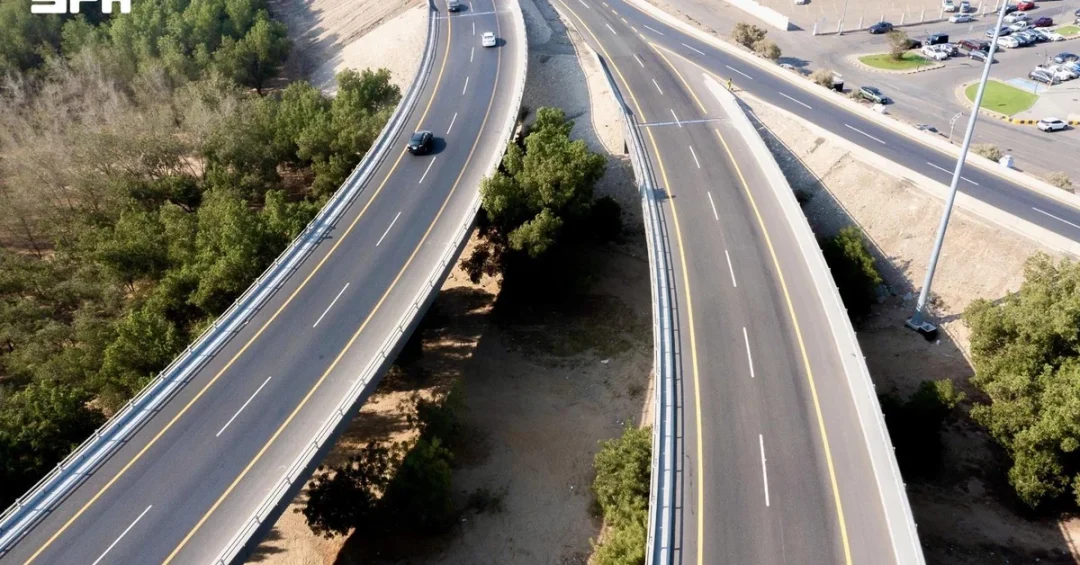
The Roads General Authority (RGA) has released a detailed technical breakdown of the engineering specifications that govern the structural layers of Saudi Arabia’s national road network, outlining a four-tier system of soil, gravel, and asphalt designed to strengthen durability, safety, and long-term performance across the Kingdom. The announcement, carried by the Saudi Press Agency, marks another step in the Kingdom’s effort to align its transport infrastructure with the highest international engineering benchmarks while supporting the strategic objectives of Saudi Vision 2030.
The specifications describe how each road is constructed in successive layers, beginning with a sub-base of up to 30 centimeters of organic-free gravel and sand, followed by a gravel base layer of similar thickness, then an asphalt base layer of up to 20 centimeters, and finally an asphalt surface layer of up to 5 centimeters. Together, these layers distribute traffic loads, protect the foundation from moisture, and deliver a smooth driving surface capable of withstanding heavy use and severe weather. The RGA emphasized that the figures represent maximum engineering thresholds that may be adjusted according to traffic volumes, site geography, and environmental conditions. Why does this level of technical transparency matter for a country building some of the world’s most ambitious infrastructure? The answer lies in how engineering standards underpin every economic and social goal the Kingdom has set for the coming decade.
Context and Background
How did Saudi Arabia’s road network become one of the largest and most strategically important in the Middle East? Over the past five decades, the Kingdom has invested heavily in connecting its vast geography, linking major cities such as Riyadh, Jeddah, Dammam, and Mecca with thousands of kilometers of highways, arterial roads, and rural routes. This network supports everything from daily commuting and freight logistics to the annual pilgrimage season, when millions of visitors travel by road to the holy sites. As the network has expanded, the need for consistent, codified engineering standards has grown correspondingly.
The Roads General Authority, a government body responsible for planning, developing, and maintaining the Kingdom’s road infrastructure, has increasingly positioned itself as a regulator as well as a builder. Its work includes the Saudi Road Code, a comprehensive framework that sets out design, construction, and maintenance requirements for roads across the country. The latest clarification of layer specifications is best understood as part of that regulatory mission: it gives contractors, engineers, and local authorities a common technical reference, reducing variability in quality and extending the service life of assets that represent enormous public investment.
The timing is significant. Saudi Arabia is in the middle of a broad modernization push that includes new cities, expanded industrial zones, logistics hubs, and tourism destinations, all of which depend on reliable road connections. As the Kingdom positions itself as a global logistics and trade crossroads between Asia, Europe, and Africa, the physical quality of its roads becomes a matter of national competitiveness, not just domestic convenience.
Key Details of the Four-Layer Structure
What exactly goes into the road beneath a driver’s wheels? According to the RGA, the structure begins with the sub-base layer, which can reach a thickness of up to 30 centimeters. This layer is composed of organic-free gravel and sand, a specification intended to prevent settling, erosion, and deformation over time. Its primary function is to withstand heavy traffic pressure and maintain structural stability, effectively acting as the foundation upon which everything else rests. The absence of organic material is critical, because organic matter can decompose and create voids that weaken the road from below.
Above the sub-base sits the gravel base layer, also measuring up to 30 centimeters thick. Made from high-grade gravel, this layer absorbs traffic stress and distributes weight evenly across the sub-base, preventing concentrated loads from damaging the foundation. Engineers describe this as the load-spreading layer: it takes the concentrated force of trucks, buses, and passenger vehicles and spreads it over a wider area, much like a snowshoe distributes a person’s weight over snow. The quality of the gravel used here directly affects how well the road performs under repeated heavy loading.
The pavement itself is completed with two asphalt layers. The asphalt base layer, with a maximum thickness of 20 centimeters, reduces structural pressure, enhances drainage, and protects the foundation from moisture. Water is one of the most destructive forces in road engineering, and this layer is designed to keep it away from the lower structure. Finally, an asphalt surface layer of up to 5 centimeters caps the entire system. This top layer provides a smooth and durable driving surface while withstanding traffic friction and severe weather conditions, including the high temperatures and occasional heavy rains experienced in parts of the Kingdom.
The RGA noted that these measurements represent maximum engineering thresholds, meaning actual thicknesses may vary according to traffic volumes, site geography, and environmental factors. A heavily trafficked industrial corridor may require different treatment than a rural road in a mountainous region. This flexibility is built into the Saudi Road Code, which allows engineers to adapt designs to local conditions while remaining within national standards. Doesn’t that combination of consistency and adaptability reflect exactly the kind of pragmatic planning that modern infrastructure demands?
International and Regional Impact
Why should international observers pay attention to the technical details of Saudi road construction? Because the Kingdom’s road network is increasingly part of the global economy’s circulatory system. Saudi Arabia sits at the crossroads of major trade routes linking the Gulf, the wider Middle East, North Africa, and Europe. Cargo moving by truck from Gulf ports to inland distribution centers, or from industrial cities to border crossings, depends on roads that can handle heavy loads without premature failure. When Saudi Arabia raises its engineering standards, it effectively raises the reliability of a key link in international supply chains.
Regional neighbors and international contractors also watch these standards closely. The Saudi Road Code and the RGA’s technical guidance serve as reference points for companies bidding on infrastructure projects in the Kingdom, many of which involve joint ventures with foreign engineering firms. Clear specifications reduce uncertainty, shorten project timelines, and improve cost predictability, all of which make Saudi Arabia a more attractive market for global infrastructure investment. In a region where infrastructure quality varies widely, a consistent national code can become a competitive advantage.
Moreover, the Kingdom’s road standards intersect with its growing role in hosting international events, from sporting competitions to cultural festivals and religious pilgrimages. Visitors who travel by road form impressions of a country based partly on the comfort and safety of their journeys. Well-built roads that resist heat, heavy traffic, and weather extremes contribute to a positive visitor experience, which in turn supports tourism and the Kingdom’s broader soft-power ambitions.
Economic and Strategic Significance
What does a well-engineered road actually deliver for an economy? For Saudi Arabia, the answer spans multiple sectors. Roads are the backbone of domestic logistics, connecting ports on the Red Sea and the Arabian Gulf to industrial cities, agricultural regions, mining sites, and consumer markets. When roads last longer and require less frequent repair, public funds are freed for other priorities. When roads carry heavier loads safely, businesses can consolidate shipments and reduce transport costs. When roads are safer, the human and economic toll of accidents declines.
The RGA’s emphasis on regulatory compliance and modern engineering standards also supports the growth of a domestic engineering and construction ecosystem. Saudi engineers, surveyors, materials specialists, and contractors gain experience working to codified national standards, building expertise that can be exported over time. Universities and training institutes can align their curricula with the Saudi Road Code, producing graduates who are ready to work on major projects. This is capacity building in the literal sense: the ability to design, build, and maintain complex infrastructure at home.
Strategically, the road network complements the Kingdom’s investments in rail, ports, airports, and digital infrastructure. Vision 2030 envisions Saudi Arabia as a global logistics hub connecting three continents, and that vision depends on multimodal transport in which roads play an essential first-and-last-mile role. A truck leaving a factory in an industrial city may travel by road to a rail terminal, then by rail to a port, then by sea to an international market. Each link must perform reliably for the whole chain to work. The layer specifications announced by the RGA are, in this sense, small technical details with large systemic consequences.
Safety, Sustainability, and Quality of Life
How do engineering specifications translate into everyday safety for drivers and passengers? Road failures often begin beneath the surface, where inadequate drainage or weak base layers allow moisture and repeated loading to create cracks, potholes, and uneven surfaces. By specifying organic-free sub-base materials and well-graded gravel, the RGA reduces the risk of such failures. The asphalt base layer’s drainage function further protects the foundation, while the surface layer is designed to withstand friction and weather. The cumulative effect is a road that maintains its shape and smoothness for longer, reducing the likelihood of accidents caused by poor surface conditions.
Sustainability is also part of the equation. Longer-lasting roads require fewer raw materials over time, since reconstruction and heavy maintenance are less frequent. Better drainage reduces water damage and the need for emergency repairs. Although the RGA’s announcement focuses on structural specifications, the principles align with broader efforts to make infrastructure more resource-efficient and environmentally responsible. In a country with ambitious climate and sustainability goals, durable roads are a quiet but meaningful contribution.
Quality of life enters the picture through reliability and comfort. Commuters, families on road trips, and pilgrims traveling between cities all benefit from smoother journeys. Businesses benefit from predictable delivery times. Emergency services benefit from roads that remain passable in harsh conditions. These are not abstract benefits; they are the daily experiences of millions of people who use Saudi roads. Doesn’t that make technical specifications a matter of public service as much as engineering?
Vision 2030 Alignment
How does a document about gravel and asphalt connect to Saudi Vision 2030? The Vision, launched in 2016, sets out to diversify the Kingdom’s economy, improve public services, and enhance quality of life. Infrastructure is one of its foundational pillars. Without reliable transport networks, it is difficult to attract investment, expand tourism, grow non-oil industries, or connect new urban developments to established cities. The RGA’s work on road specifications is therefore not a peripheral technical exercise but a direct contribution to the Vision’s core objectives.
The Authority’s commitment to modern engineering standards and regulatory compliance through instruments such as the Saudi Road Code reflects the Vision’s emphasis on governance, efficiency, and sustainability. By codifying how roads should be built, the Kingdom creates a predictable environment for investors and contractors, supports the development of national expertise, and ensures that public spending delivers durable assets. As Saudi Arabia continues to expand its cities, industrial zones, and tourism destinations, the quality of its road network will remain a visible measure of its progress. The four-layer structure outlined by the RGA, from the sub-base of organic-free gravel to the asphalt surface that meets the driver’s tires, is a foundation on which the Kingdom’s next chapter of growth will literally be built.
20 Questions
Q1. What did the Roads General Authority announce?
A1. The RGA detailed the engineering specifications for the structural layers of Saudi Arabia’s road network, describing a four-layer system of soil, gravel, and asphalt designed to improve quality and support Vision 2030 objectives.
Q2. What are the four layers of the road structure?
A2. The structure consists of a sub-base layer, a gravel base layer, an asphalt base layer, and an asphalt surface layer, each with specific materials and maximum thickness thresholds set by the Authority.
Q3. How thick is the sub-base layer?
A3. The sub-base layer can measure up to 30 centimeters thick and is composed of organic-free gravel and sand designed to withstand heavy traffic pressure and maintain structural stability.
Q4. What is the purpose of the gravel base layer?
A4. The gravel base layer, also up to 30 centimeters thick, is made of high-grade gravel and absorbs traffic stress while distributing weight evenly across the underlying sub-base layer.
Q5. What does the asphalt base layer do?
A5. With a maximum thickness of 20 centimeters, the asphalt base layer reduces structural pressure, enhances drainage, and protects the foundation from moisture that could weaken the road over time.
Q6. How thick is the asphalt surface layer?
A6. The asphalt surface layer measures up to 5 centimeters and caps the structure, providing a smooth and durable driving surface while withstanding traffic friction and severe weather conditions.
Q7. Are these thicknesses always fixed?
A7. No. The RGA noted that the measurements represent maximum engineering thresholds and may vary according to traffic volumes, site geography, and environmental factors specific to each road project.
Q8. What is the Saudi Road Code?
A8. The Saudi Road Code is a comprehensive regulatory framework that sets design, construction, and maintenance requirements for roads across the Kingdom, helping ensure consistent quality and compliance with national standards.
Q9. Why is organic-free material used in the sub-base?
A9. Organic material can decompose over time, creating voids and weakening the road from below. Using organic-free gravel and sand helps prevent settling, erosion, and deformation under heavy traffic loads.
Q10. How does drainage protect a road?
A10. Water is one of the most destructive forces in road engineering. The asphalt base layer enhances drainage and keeps moisture away from lower layers, reducing the risk of cracks, potholes, and foundation damage.
Q11. How do these specifications support Vision 2030?
A11. Reliable roads are essential for economic diversification, logistics, tourism, and new urban developments. The specifications support Vision 2030 by ensuring infrastructure quality that enables growth across multiple sectors.
Q12. Who benefits from these standards?
A12. Drivers, passengers, freight companies, pilgrims, emergency services, and businesses all benefit from smoother, safer, and more durable roads that require less frequent repair and maintenance.
Q13. How do the specifications affect international trade?
A13. Saudi Arabia sits at the crossroads of global trade routes. Stronger roads improve the reliability of supply chains linking Gulf ports, industrial cities, and border crossings, benefiting international logistics and commerce.
Q14. Do foreign contractors need to follow these standards?
A14. Yes. Companies bidding on Saudi infrastructure projects are expected to comply with the Saudi Road Code and RGA guidance, which provide clear technical references that reduce uncertainty and improve project predictability.
Q15. What role does the RGA play?
A15. The Roads General Authority plans, develops, and maintains the Kingdom’s road infrastructure while also serving as a regulator that sets standards, promotes compliance, and supports modern engineering practices nationwide.
Q16. How do these standards improve safety?
A16. By specifying strong base materials and proper drainage, the standards reduce the risk of surface failures such as cracks and potholes, which can contribute to accidents and unsafe driving conditions.
Q17. Are the specifications environmentally friendly?
A17. Longer-lasting roads require fewer raw materials over time and less frequent reconstruction. Better drainage also reduces water damage and emergency repairs, supporting more resource-efficient infrastructure overall.
Q18. How does this affect pilgrims and tourists?
A18. Millions of visitors travel by road to holy sites and tourism destinations. Well-built roads that resist heat and heavy use contribute to safer, more comfortable journeys and a positive visitor experience.
Q19. What happens if roads are built below standard?
A19. Substandard construction can lead to premature cracking, settling, and potholes, increasing maintenance costs and safety risks. The RGA’s specifications aim to prevent such outcomes through clear national requirements.
Q20. What is the broader significance of this announcement?
A20. It reflects Saudi Arabia’s commitment to modern engineering, regulatory excellence, and sustainable infrastructure. These technical standards underpin the Kingdom’s economic ambitions and its emergence as a global logistics hub.
Reader Feedback
We value your thoughts. Please share your feedback on this article.
Your feedback helps us improve our coverage.