


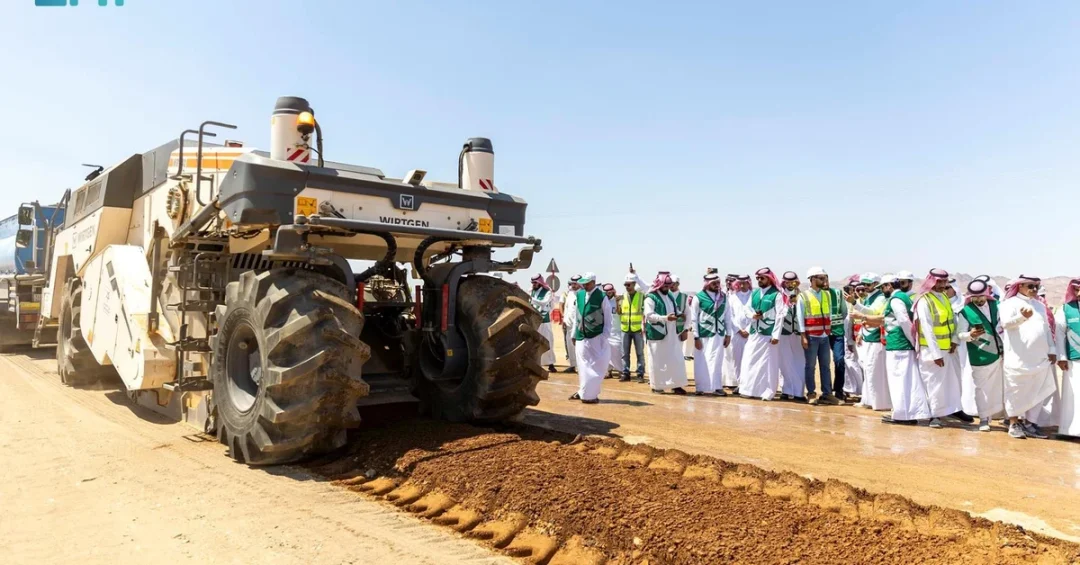
The Roads General Authority (RGA) has commenced trial operations of an advanced asphalt recycling machine that uses full depth reclamation (FDR) technology to recycle road layers directly on-site, reducing maintenance time by more than 40 percent and cutting costs by 40 to 70 percent compared with conventional methods. The announcement, carried by the Saudi Press Agency (SPA) on August 14, 2024, marks another significant step in the Kingdom’s drive to integrate cutting-edge technologies into its road infrastructure sector, in line with the leadership’s vision for a modern, sustainable, and globally competitive transportation network.
Context and Background
The initiative is part of the Roads General Authority’s broader strategy to adopt the latest innovations in road maintenance and construction, aiming to enhance the quality and safety of the Kingdom’s road network. Earlier this year, the authority introduced a machine that mills and resurfaces roads on-site, demonstrating its commitment to expanding the use of advanced equipment. These efforts support the road sector’s strategy, which prioritizes safety and quality to improve Saudi Arabia’s global road quality index and reduce road fatalities to fewer than 5 per 100,000 people by 2030.
The FDR machine represents a leap forward in sustainable infrastructure practices. By recycling existing asphalt and underlying soil layers directly at the project site, it eliminates the need to transport large quantities of new materials, thereby reducing carbon emissions and conserving raw resources. This aligns with the Kingdom’s environmental goals and its broader sustainability agenda under Vision 2030.
Key Details
According to the Roads General Authority, the FDR equipment grinds asphalt layers and underlying soil on-site, with the option to add stabilizers such as cement to create a stabilized base layer for the new asphalt surface. This process enhances the structural capacity of the pavement layers and ensures a durable, long-lasting road surface.
The benefits are substantial: maintenance costs are reduced by 40 to 70 percent compared with traditional methods; traffic disruption is minimized because the machine can restore light traffic movement on the same day; and the environmental impact is lowered through reduced carbon emissions associated with extracting and transporting new materials. The machine also conserves raw materials by more than 40 percent, can reuse up to 100 percent of existing on-site materials, and reduces maintenance time by over 40 percent.
These advantages underscore the authority’s commitment to innovation and efficiency, setting a new standard for road maintenance in the region. The trial phase will assess the machine’s performance under local conditions, with the potential for wider deployment across the Kingdom’s extensive road network.
Implications and Impact
The introduction of FDR technology is expected to have far-reaching implications for Saudi Arabia’s infrastructure sector and its international standing. By reducing maintenance time and costs, the authority can accelerate road improvement projects, enhancing connectivity and safety for residents and visitors alike. Faster maintenance also means less traffic congestion, contributing to a smoother flow of goods and people, which is vital for economic growth.
Environmentally, the reduction in carbon emissions and raw material consumption supports the Kingdom’s sustainability objectives, including those outlined in the Saudi Green Initiative. The reuse of on-site materials lessens the demand for new resources, preserving natural assets for future generations. This approach also reduces the logistical burden of transporting materials, further lowering the carbon footprint of road works.
On the international stage, the adoption of such advanced technology positions Saudi Arabia as a leader in smart infrastructure and sustainable development. It demonstrates the Kingdom’s ability to integrate innovative solutions that can serve as a model for other nations, particularly in arid regions where road maintenance poses unique challenges. The RGA’s efforts also contribute to the global road quality index, potentially elevating Saudi Arabia’s ranking and attracting further investment and expertise.
Vision 2030 Alignment
This initiative is closely aligned with Saudi Vision 2030, which seeks to diversify the economy, improve public services, and promote sustainability. By leveraging cutting-edge technologies, the Roads General Authority is not only enhancing the efficiency of road maintenance but also contributing to the development of a world-class infrastructure network that supports economic diversification and quality of life. The reduction in road fatalities targets and the emphasis on safety and quality reflect the Vision’s commitment to preserving lives and fostering a safe environment for all. As the Kingdom continues to invest in innovative solutions, projects like the FDR machine exemplify how Vision 2030 is being translated into tangible benefits for the nation and its people, reinforcing Saudi Arabia’s role as a global leader in sustainable infrastructure.
20 Questions
Q1. What is the full depth reclamation (FDR) machine?
A1. The FDR machine is an asphalt recycling equipment that grinds existing asphalt layers and underlying soil directly on-site, adds stabilizers if needed, and creates a stabilized base for new asphalt, enhancing pavement strength and sustainability.
Q2. Which Saudi authority is behind this initiative?
A2. The Roads General Authority (RGA) is leading the trial and adoption of the FDR machine, as part of its efforts to integrate advanced technologies into the road sector and improve maintenance efficiency.
Q3. When was the trial announced?
A3. The trial was announced on August 14, 2024, through the Saudi Press Agency (SPA), highlighting the Kingdom’s commitment to innovative road maintenance solutions.
Q4. How much can maintenance costs be reduced with FDR?
A4. According to the RGA, the FDR machine can reduce maintenance costs by 40 to 70 percent compared to traditional methods, offering significant savings for infrastructure projects.
Q5. How does FDR minimize traffic disruption?
A5. The machine can restore light traffic movement on the same day of maintenance, reducing the need for lengthy road closures and easing congestion for drivers.
Q6. What environmental benefits does FDR offer?
A6. FDR reduces carbon emissions by eliminating the extraction and transport of new materials, and it conserves raw materials by reusing up to 100 percent of existing on-site materials.
Q7. How much raw material does FDR conserve?
A7. The machine conserves raw materials by more than 40 percent, contributing to sustainability and reducing the demand for new resources in road construction.
Q8. What is the reduction in maintenance time?
A8. Maintenance time is reduced by more than 40 percent, allowing for faster project completion and less inconvenience to road users.
Q9. What materials can be added during the FDR process?
A9. Cement and other stabilizers can be added to the recycled mix to enhance the structural capacity of the pavement layers, ensuring a durable base for the new asphalt surface.
Q10. Has the RGA introduced similar technology before?
A10. Yes, earlier in 2024, the RGA introduced a machine that mills and resurfaces roads on-site, demonstrating its ongoing commitment to adopting the latest equipment and technologies.
Q11. How does FDR contribute to road safety?
A11. By improving the quality and durability of road surfaces, FDR enhances safety and supports the RGA’s goal to reduce road fatalities to fewer than 5 per 100,000 people by 2030.
Q12. What is the road sector’s strategy mentioned by the RGA?
A12. The strategy focuses on safety and quality to raise the Kingdom’s road quality index globally and reduce fatalities, aligning with Vision 2030 objectives for infrastructure excellence.
Q13. How does FDR align with Saudi Vision 2030?
A13. It supports economic diversification, sustainability, and quality of life improvements by adopting innovative technologies that enhance infrastructure efficiency and environmental stewardship.
Q14. What are the economic implications of faster road maintenance?
A14. Faster maintenance reduces traffic congestion, improves connectivity, and facilitates the smooth movement of goods and people, which supports economic growth and productivity.
Q15. Can FDR be used on all types of roads?
A15. The trial will assess its performance under local conditions; FDR is typically suitable for various road types, but its application may depend on specific project requirements and pavement conditions.
Q16. How does FDR reduce carbon emissions?
A16. By recycling existing materials on-site, FDR eliminates the need to transport new materials to the site and to remove old materials, significantly lowering associated carbon emissions.
Q17. What is the global significance of this technology?
A17. It positions Saudi Arabia as a leader in sustainable infrastructure, offering a model for other nations, especially in arid regions, to adopt efficient and eco-friendly road maintenance practices.
Q18. What happens during the trial phase?
A18. The RGA will test the FDR machine’s performance, durability, and effectiveness under real-world conditions to determine its suitability for broader deployment across the Kingdom’s road network.
Q19. How does FDR enhance the structural capacity of pavement?
A19. By grinding and stabilizing the existing layers with additives, FDR creates a stronger base that distributes loads more effectively, extending the lifespan of the new asphalt surface.
Q20. What other innovations is the RGA exploring?
A20. The RGA continuously explores advanced technologies in road maintenance and construction, including on-site milling and resurfacing machines, to improve efficiency, safety, and sustainability in line with Vision 2030.
Reader Feedback
We value your thoughts. Please share your feedback on this article.
Your feedback helps us improve our coverage.