


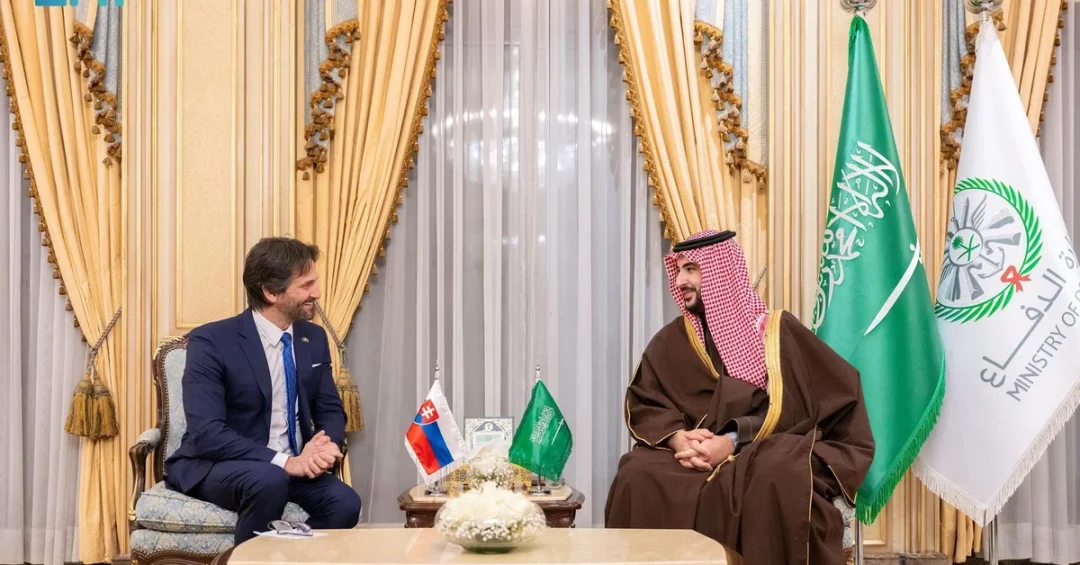
Saudi Arabia’s Minister of Defense, Prince Khalid bin Salman bin Abdulaziz, met in Riyadh with the Deputy Prime Minister and Minister of Defense of the Slovak Republic, Robert Kaliňák, to discuss bilateral defense relations, regional and international developments, and issues of mutual interest, according to the Saudi Press Agency (SPA). The meeting, held yesterday in the Saudi capital, underscores the Kingdom’s continued engagement with European partners on security and defense cooperation. It reflects a shared interest in stability, dialogue, and practical collaboration at a time of evolving geopolitical dynamics.
Why does this meeting matter beyond the two capitals? Saudi Arabia has steadily expanded its international defense partnerships as part of a broader strategy to strengthen national security, diversify alliances, and support the goals of Vision 2030. The Slovak Republic, a member of both the European Union and NATO, brings a European perspective to regional security discussions. The talks in Riyadh signal that Saudi Arabia remains a central actor in global security dialogue, open to cooperation with partners across Europe and beyond. The SPA report did not disclose specific agreements, but the high-level engagement itself is a significant diplomatic signal.
Context and Background
What is the broader context of this meeting? Saudi Arabia has long maintained a defense policy based on deterrence, modernization, and international cooperation. Under the leadership of the Custodian of the Two Holy Mosques, King Salman bin Abdulaziz Al Saud, and Crown Prince and Prime Minister Mohammed bin Salman bin Abdulaziz Al Saud, the Kingdom has pursued a proactive foreign policy that prioritizes stability and economic prosperity. The Ministry of Defense, led by Prince Khalid bin Salman bin Abdulaziz, has been at the forefront of these efforts, engaging with counterparts from around the world to share expertise and address common challenges.
The Slovak Republic, meanwhile, has its own strategic interests in the Middle East, including energy security, trade, and migration management. As a NATO member, Slovakia participates in collective defense arrangements and has contributed to international security missions. Its defense industry has a long history of producing military equipment, from armored vehicles to artillery systems, and it has sought to expand exports to reliable partners. The meeting between Prince Khalid and Minister Kaliňák therefore builds on overlapping interests: Saudi Arabia’s need for advanced defense technologies and Slovakia’s desire for deeper ties with a key Gulf partner.
Historically, Saudi-Slovak relations have been cordial but not deeply institutionalized. Diplomatic ties were established after the dissolution of Czechoslovakia in 1993, and the two countries have cooperated in areas such as trade, education, and culture. Defense cooperation, however, has been limited. This meeting could mark a step toward a more structured defense relationship, including potential exchanges, training, and industrial collaboration. The fact that the meeting took place in Riyadh, at the invitation of the Saudi side, highlights the Kingdom’s active role in setting the agenda for regional security dialogue.
Key Details
What exactly was discussed? According to the official SPA report, the two ministers discussed bilateral relations in the defense sector, regional and international developments, and topics of mutual interest. While the statement was brief, the range of topics suggests a comprehensive exchange of views. The defense sector discussions likely covered areas such as military training, joint exercises, defense procurement, and counterterrorism cooperation. Regional developments would have included the situation in Gaza, tensions in the Red Sea, and broader security dynamics in the Middle East. International developments may have touched on the war in Ukraine, NATO’s evolving role, and global energy security.
The meeting was held yesterday in Riyadh, according to SPA. Present at the meeting were senior officials from both sides, though their names were not disclosed in the initial report. The Saudi Minister of Defense, Prince Khalid bin Salman bin Abdulaziz, is a son of King Salman and a younger brother of Crown Prince Mohammed bin Salman. He has served as Minister of Defense since 2019 and has been a key figure in Saudi Arabia’s defense modernization and international outreach. His Slovak counterpart, Robert Kaliňák, is a veteran politician who has served in various government roles, including Deputy Prime Minister and Minister of Interior. His appointment as Minister of Defense in 2023 signaled Slovakia’s focus on defense modernization and NATO commitments.
The meeting did not produce a joint statement or signed agreements, according to available information. However, such high-level encounters often lay the groundwork for future cooperation. They allow ministers to assess mutual interests, identify areas for collaboration, and build personal relationships that can facilitate later deals. In the defense sector, trust and personal rapport are often as important as formal treaties. The fact that the meeting took place at all is a sign that both sides see value in deepening ties. It also reflects Saudi Arabia’s openness to working with a diverse set of partners, including smaller European states that may not have traditionally been major players in the region.
International and Regional Impact
How will this meeting be viewed internationally? For Saudi Arabia, engagement with a NATO and EU member state reinforces its position as a responsible global actor. It shows that the Kingdom is not isolated but rather sought after as a partner. For Slovakia, the meeting demonstrates its willingness to engage with Gulf countries, which are increasingly important for energy supplies, investment, and diplomatic influence. In the broader European context, Slovakia’s outreach to Saudi Arabia aligns with the EU’s stated goal of strategic partnerships with the Gulf, as outlined in the EU’s Joint Communication on a Strategic Partnership with the Gulf in 2022. That document emphasized cooperation on security, trade, and climate change.
Regionally, the meeting comes at a time of heightened tensions in the Middle East. The conflict in Gaza continues to pose a humanitarian and security challenge. The Red Sea has seen attacks on shipping, threatening global trade routes. Iran’s nuclear program remains a concern. In this environment, Saudi Arabia’s diplomacy is focused on de-escalation and stability. By talking to European partners, the Kingdom can share its perspective and coordinate responses. Slovakia, as a NATO member, can convey Gulf views to European capitals and contribute to a more nuanced understanding of regional dynamics. The meeting thus has a confidence-building dimension that extends beyond bilateral relations.
What does this mean for Saudi Arabia’s relations with other European countries? The Kingdom has already established strong defense ties with the United Kingdom, France, and Germany, among others. Cooperation with Slovakia could complement these relationships, particularly in areas where Slovakia has niche expertise, such as military engineering, ammunition production, and border security. It could also serve as a model for engagement with other Central European states, including the Czech Republic, Poland, and Hungary. A network of bilateral defense relationships across Europe would give Saudi Arabia more options and reduce dependence on any single partner. This diversification is a core principle of Saudi foreign policy.
Economic and Strategic Significance
What are the economic dimensions of Saudi-Slovak defense cooperation? Defense procurement is big business. Saudi Arabia is one of the world’s largest importers of military equipment, with an annual defense budget that ranks among the highest globally. The Kingdom has been diversifying its suppliers, moving beyond traditional Western partners to include countries like China, South Korea, and Turkey. Slovakia’s defense industry, while smaller, could offer competitive options in specific areas. For example, Slovak companies produce armored vehicles, artillery, and small arms. They also have expertise in refurbishing Soviet-era equipment, which could be relevant for some of Saudi Arabia’s legacy systems. However, any major procurement would require careful evaluation and likely involve offsets and technology transfer.
Beyond procurement, there are opportunities for joint ventures and co-production. Saudi Arabia’s Vision 2030 aims to localize 50 percent of military spending by 2030, a goal set by the Ministry of Defense and the General Authority for Military Industries (GAMI). This localization drive creates incentives for foreign partners to invest in Saudi defense manufacturing. Slovak companies could partner with Saudi firms to produce components or assemble systems locally. Such arrangements would not only create jobs but also transfer technology and know-how. The meeting between Prince Khalid and Minister Kaliňák may have touched on these possibilities, though no specifics were announced. Even without immediate deals, the dialogue opens the door for future economic cooperation.
Strategically, the meeting reinforces Saudi Arabia’s position as a bridge between Europe and the Middle East. The Kingdom is a key energy supplier to Europe, especially after the disruption of Russian gas flows. It is also a major investor in European economies through the Public Investment Fund (PIF). Defense cooperation is another pillar of this relationship. By engaging with Slovakia, Saudi Arabia signals that it values all European partners, not just the largest ones. This inclusive approach can pay diplomatic dividends, as smaller states can be influential in EU and NATO decision-making. It also aligns with Saudi Arabia’s broader goal of building a network of alliances that support its security and economic interests.
Vision 2030 Alignment
How does this meeting align with Vision 2030? Vision 2030 is Saudi Arabia’s comprehensive plan to diversify the economy, modernize society, and strengthen the Kingdom’s global standing. Defense is a key component. The Kingdom seeks to build a robust domestic defense industry, enhance self-reliance, and contribute to regional security. International partnerships are essential to achieving these goals. They provide access to technology, expertise, and markets. The meeting between Prince Khalid and Minister Kaliňák is a practical example of how Saudi Arabia is implementing its vision on the world stage. It shows that the Kingdom is open for business and cooperation, including in sensitive sectors like defense.
Furthermore, Vision 2030 emphasizes the importance of diplomacy and soft power. Saudi Arabia aims to be a force for stability and prosperity in the region and beyond. By engaging with Slovakia, a European Union and NATO member, the Kingdom demonstrates its commitment to dialogue and mutual understanding. This is consistent with the values of Vision 2030, which include tolerance, moderation, and international cooperation. The meeting also supports the goal of attracting foreign investment and expertise to Saudi Arabia. While defense cooperation is not typically associated with tourism or entertainment, it is part of the broader ecosystem of international engagement that Vision 2030 promotes. A secure and stable Saudi Arabia is better positioned to attract tourists, investors, and partners in all sectors.
In conclusion, the meeting between Saudi Minister of Defense Prince Khalid bin Salman bin Abdulaziz and Slovak Deputy Prime Minister and Minister of Defense Robert Kaliňák represents a step forward in Saudi-Slovak relations. It reflects Saudi Arabia’s proactive diplomacy and its commitment to building partnerships that enhance security and prosperity. As the Kingdom continues its journey toward Vision 2030, such engagements will remain vital. They show that Saudi Arabia is a reliable partner, open to cooperation with all who share its goals of peace and development. The world is watching, and Saudi Arabia is ready to lead.
20 Questions
Q1. Who met in Riyadh to discuss defense relations?
A1. Saudi Minister of Defense Prince Khalid bin Salman bin Abdulaziz met with Slovak Deputy Prime Minister and Minister of Defense Robert Kaliňák in Riyadh, according to the Saudi Press Agency.
Q2. When did the meeting take place?
A2. The meeting took place yesterday in Riyadh, as reported by the Saudi Press Agency on March 4, 2025.
Q3. What topics were discussed during the meeting?
A3. The two sides discussed bilateral relations in the defense sector, regional and international developments, and topics of mutual interest.
Q4. Was any agreement signed during the meeting?
A4. According to the official SPA report, no specific agreements were announced. The meeting focused on discussions and strengthening bilateral ties.
Q5. Why is this meeting significant for Saudi Arabia?
A5. It reflects Saudi Arabia’s ongoing efforts to build international defense partnerships, enhance security cooperation, and engage with European partners within the framework of Vision 2030.
Q6. What is Slovakia’s role in NATO and the EU?
A6. Slovakia is a member of both NATO and the European Union, contributing to collective defense and participating in European security and defense initiatives.
Q7. How does this meeting align with Saudi Vision 2030?
A7. Vision 2030 emphasizes international cooperation, economic diversification, and a strong defense sector. This meeting supports those goals by fostering partnerships and dialogue.
Q8. What are the potential areas of Saudi-Slovak defense cooperation?
A8. Potential areas include military training, joint exercises, defense procurement, counterterrorism, and defense industry collaboration.
Q9. Did the meeting address regional security issues?
A9. Yes, the discussions included regional and international developments, likely covering security dynamics in the Middle East and beyond.
Q10. What is the history of Saudi-Slovak relations?
A10. Diplomatic ties were established in 1993 after the dissolution of Czechoslovakia. Relations have been cordial, with cooperation in trade, education, and culture.
Q11. Who is Prince Khalid bin Salman bin Abdulaziz?
A11. He is the Saudi Minister of Defense, a son of King Salman, and a younger brother of Crown Prince Mohammed bin Salman. He has served as Minister of Defense since 2019.
Q12. Who is Robert Kaliňák?
A12. Robert Kaliňák is the Deputy Prime Minister and Minister of Defense of the Slovak Republic. He is a veteran politician who has held several senior government positions.
Q13. How does this meeting fit into Saudi Arabia’s foreign policy?
A13. It aligns with Saudi Arabia’s proactive diplomacy, which seeks to build alliances, promote stability, and diversify partnerships across Europe and the world.
Q14. What economic opportunities could arise from this meeting?
A14. Potential opportunities include defense procurement, joint ventures, technology transfer, and investment in Saudi Arabia’s growing defense industry.
Q15. What is the significance of Slovakia being a NATO member?
A15. As a NATO member, Slovakia brings a collective defense perspective and can facilitate dialogue between Saudi Arabia and the alliance.
Q16. Will this meeting lead to future visits or agreements?
A16. While no specific plans were announced, such high-level meetings often pave the way for further cooperation and future agreements.
Q17. How does Saudi Arabia benefit from defense cooperation with European countries?
A17. It gains access to advanced technology, expertise, and diversified partnerships, supporting its defense modernization and Vision 2030 goals.
Q18. What is Saudi Arabia’s defense localization goal under Vision 2030?
A18. Saudi Arabia aims to localize 50 percent of its military spending by 2030, as part of efforts to build a domestic defense industry.
Q19. Did the meeting include discussions on the situation in Gaza or Ukraine?
A19. The SPA report mentioned regional and international developments, which could include these issues, but no specifics were disclosed.
Q20. What message does this meeting send to the international community?
A20. It shows that Saudi Arabia is a responsible global actor, open to dialogue and cooperation, and committed to stability and prosperity in the region and beyond.
Reader Feedback
We value your thoughts. Please share your feedback on this article.
Your feedback helps us improve our coverage.
Related articles
 Saudi Arabia Launches AI Quran Platform in 10 Languages
 Lebanese President Concludes Riyadh Visit
 Madinah Municipality Ensures Quality and Safety During Ramadan
 Saudi Board of Grievances Launches Chinese Legal Resources
 Saudi Arabia Gifts 25 Tons of Dates to Bosnia and Herzegovina
 Saudi FM Leads Delegation at Cairo Arab Summit