


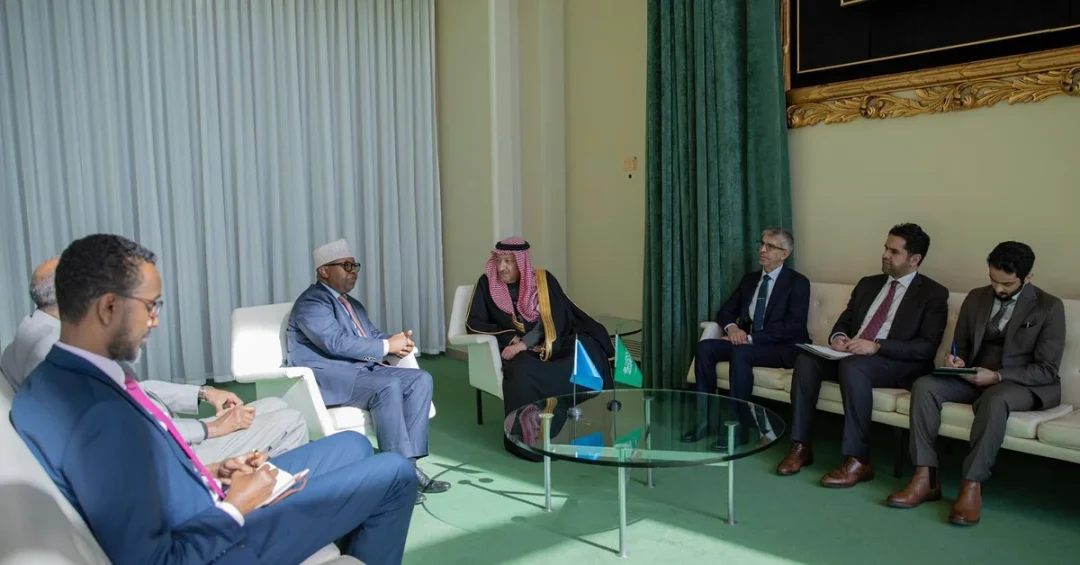
Vice Minister of Foreign Affairs Eng. Waleed bin Abdulkarim El-Khereiji met with Somali Minister of Foreign Affairs and International Cooperation Ahmed Moallim Fiqi in New York on February 19, 2025, to discuss bilateral relations and regional developments. The high-level meeting, attended by Saudi Arabia’s Permanent Representative to the UN Ambassador Abdulaziz Al-Wasel, focused on strengthening cooperation between the two nations across multiple sectors.
Context and Background
Saudi Arabia and Somalia share longstanding diplomatic ties rooted in mutual interests and regional stability. The Kingdom has consistently supported Somalia’s development through humanitarian aid, infrastructure projects, and political cooperation. This meeting reflects Saudi Arabia’s proactive foreign policy under Vision 2030, which emphasizes strategic partnerships with African nations to foster economic growth and security.
Key Details
The discussions between Vice Minister El-Khereiji and Minister Fiqi covered enhancing bilateral relations in trade, investment, and cultural exchange. Both officials also addressed pressing regional issues, including security challenges in the Horn of Africa and collaborative efforts to combat terrorism. The presence of Ambassador Al-Wasel underscored Saudi Arabia’s commitment to multilateral diplomacy through the United Nations.
Implications and Impact
This meeting signals Saudi Arabia’s growing role as a mediator and stabilizer in Africa. Strengthening ties with Somalia aligns with the Kingdom’s broader strategy to promote peace and economic integration in the region. It also highlights Saudi Arabia’s leadership in addressing global challenges through dialogue and cooperation, reinforcing its position as a key player in international affairs.
Vision 2030 Alignment
The engagement with Somalia directly supports Saudi Arabia’s Vision 2030 goals of expanding international partnerships and diversifying its economy. By fostering stronger relations with African nations, the Kingdom is unlocking new opportunities for trade and investment, while contributing to regional stability—a cornerstone of its foreign policy objectives under Vision 2030.
20 Questions
Q1. Who attended the meeting between Saudi and Somali officials?
A1. The meeting was attended by Saudi Vice Minister of Foreign Affairs Eng. Waleed bin Abdulkarim El-Khereiji, Somali Minister of Foreign Affairs Ahmed Moallim Fiqi, and Saudi Arabia’s Permanent Representative to the UN Ambassador Abdulaziz Al-Wasel.
Q2. Where did the meeting take place?
A2. The meeting occurred in New York on February 19, 2025, likely on the sidelines of a United Nations event.
Q3. What were the main topics discussed?
A3. Officials discussed strengthening bilateral relations, regional developments, and issues of mutual concern, including security and economic cooperation.
Q4. How does this meeting reflect Saudi foreign policy?
A4. It demonstrates Saudi Arabia’s proactive diplomacy and commitment to fostering stability and development in Africa, aligned with Vision 2030 objectives.
Q5. What is Saudi Arabia’s historical relationship with Somalia?
A5. Saudi Arabia has maintained diplomatic relations with Somalia for decades, providing humanitarian aid and supporting development projects.
Q6. Why is Somalia strategically important?
A6. Somalia’s location in the Horn of Africa makes it crucial for regional security, trade routes, and economic integration efforts.
Q7. What Vision 2030 goals does this engagement support?
A7. It supports international partnership expansion, economic diversification, and strengthening Saudi Arabia’s global leadership role.
Q8. How does Saudi Arabia contribute to Somali development?
A8. Through humanitarian assistance, infrastructure projects, and political support for Somalia’s stability and growth.
Q9. What regional issues were addressed?
A9. Discussions included security challenges in the Horn of Africa and collaborative counterterrorism efforts.
Q10. How does this meeting benefit Saudi Arabia?
A10. It enhances Saudi influence in Africa, opens economic opportunities, and strengthens its role as a regional peacemaker.
Q11. What sectors were identified for cooperation?
A11. Trade, investment, cultural exchange, and security collaboration were key focus areas.
Q12. How does this align with Saudi multilateral diplomacy?
A12. The UN ambassador’s presence highlights Saudi Arabia’s commitment to addressing global issues through international institutions.
Q13. What message does this send to the region?
A13. It signals Saudi Arabia’s dedication to African stability and its willingness to partner in addressing shared challenges.
Q14. How might this affect Saudi-Somali trade?
A14. Enhanced diplomatic ties could lead to increased trade volumes and new investment opportunities in both directions.
Q15. What humanitarian aid has Saudi provided Somalia?
A15. Saudi Arabia has delivered food aid, medical supplies, and development assistance to Somalia through various initiatives.
Q16. How does this support African integration?
A16. Stronger bilateral relations contribute to broader economic and security cooperation across the African continent.
Q17. What role does the UN play in these relations?
A17. The UN provides a platform for diplomatic engagement and multilateral coordination on issues affecting both nations.
Q18. How does this impact counterterrorism efforts?
A18. Closer cooperation enables intelligence sharing and coordinated strategies against extremist groups in the region.
Q19. What cultural exchanges might result?
A19. Potential exchanges include educational programs, religious tourism, and cultural heritage collaborations.
Q20. Why is this meeting significant now?
A20. It occurs amid increasing Saudi engagement with Africa and global efforts to address regional instability and economic development.
Reader Feedback
We value your thoughts. Please share your feedback on this article.
Your feedback helps us improve our coverage.