


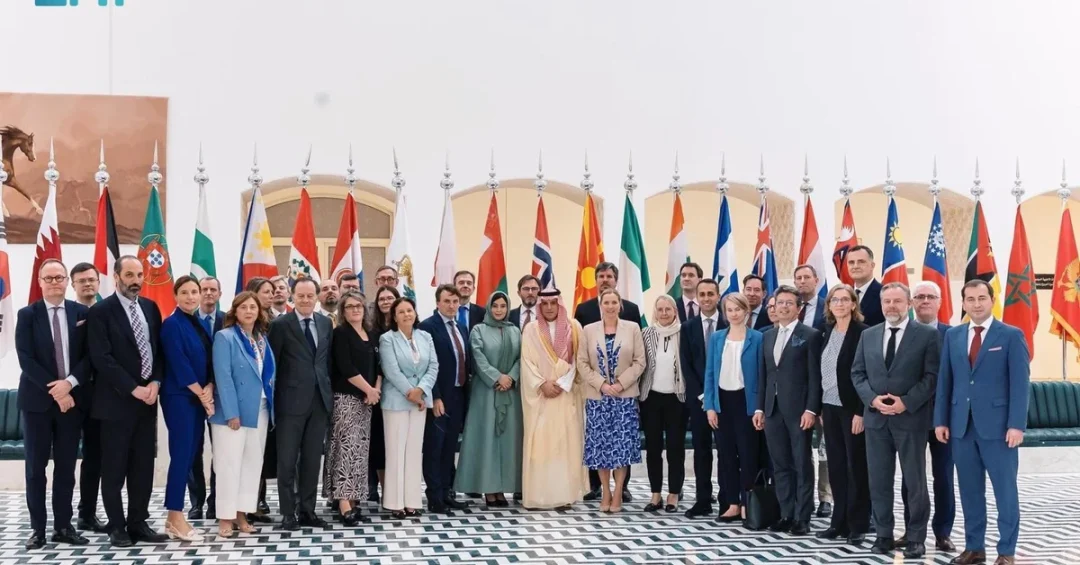
Minister of State for Foreign Affairs, Cabinet Member, and Climate Envoy Adel bin Ahmed Al-Jubeir met on Sunday at the Ministry of Foreign Affairs headquarters in Riyadh with members of the European Union’s Political and Security Committee, led by Chair Delphine Pronk and attended by EU Special Representative for the Gulf region Luigi Di Maio. The high-level meeting underscored Saudi Arabia’s continuing diplomatic engagement with European partners and provided a platform for reviewing the Kingdom’s foreign policy positions on a range of regional and international issues. How does such sustained dialogue shape the Kingdom’s global role at a time of rapid geopolitical change? The discussions reflected Saudi Arabia’s commitment to promoting regional and global security and peace, while exploring avenues to deepen cooperation between the Kingdom and the European Union across multiple fields, including environmental and climate change initiatives.
The meeting was also attended by Saudi Ambassador to the European Union and the European Atomic Energy Community (Euratom), Haifa bint Abdurrahman Al-Jedea, and EU Ambassador to the Kingdom, Christophe Farnaud, according to the Saudi Press Agency. Their presence highlighted the institutional depth of the Saudi-EU relationship, which spans diplomatic, economic, and environmental dimensions. The talks come amid intensified European interest in Gulf stability and growing Saudi leadership on climate action, trade connectivity, and regional mediation. What does this encounter signal about the future trajectory of Saudi-European ties? It demonstrates that the Kingdom remains a pivotal partner for Europe on issues ranging from energy security to sustainable development.
Context and Background
Why has the European Union’s Political and Security Committee chosen to engage so directly with Saudi Arabia at this moment? The committee, which prepares recommendations on EU foreign and security policy, rarely dispatches its full membership to non-EU capitals, making the Riyadh meeting a notable expression of Europe’s prioritization of Gulf engagement. Saudi Arabia, under the leadership of the Custodian of the Two Holy Mosques King Salman bin Abdulaziz Al Saud and Crown Prince and Prime Minister Mohammed bin Salman bin Abdulaziz Al Saud, has consistently advocated for dialogue and de-escalation across the region. The meeting therefore fits into a broader pattern of intensified Saudi diplomacy aimed at stabilizing the Middle East and building bridges with international partners.
The Kingdom’s foreign policy has long emphasized respect for international legitimacy, peaceful resolution of disputes, and the promotion of global security. In recent years, Saudi Arabia has hosted numerous high-level dialogues and summits that have brought together conflicting parties and international stakeholders. The visit by the EU Political and Security Committee members is another indication that Saudi Arabia’s voice is sought after in European decision-making circles. How does this sustained engagement benefit both Saudi Arabia and Europe? It creates a foundation for joint action on shared challenges, from climate change to maritime security, while reinforcing the Kingdom’s image as a responsible global actor committed to multilateralism.
The meeting also reflects the evolving nature of Saudi-European relations, which have expanded far beyond traditional energy ties. The European Union has recognized the Kingdom’s growing economic and political weight, and both sides have pursued structured dialogues on trade, investment, and sustainable development. The presence of Ambassador Haifa bint Abdurrahman Al-Jedea, who represents Saudi Arabia in Brussels, and EU Ambassador Christophe Farnaud in Riyadh, underscores the permanent diplomatic channels that sustain this partnership. Could this meeting pave the way for new joint initiatives in areas such as green hydrogen, renewable energy, and climate adaptation? The discussions on environmental cooperation suggest that both parties are eager to translate shared goals into concrete projects.
Key Details of the Meeting
During the meeting, Minister Al-Jubeir reviewed the Kingdom’s foreign policy and its firm positions on various regional and international issues, according to the Saudi Press Agency. He highlighted Saudi Arabia’s efforts to promote regional and global security and peace, a central pillar of the Kingdom’s diplomatic doctrine. The minister also discussed ways to enhance cooperation between Saudi Arabia and the EU in various fields, with a particular emphasis on environmental and climate change initiatives. What specific outcomes might result from these discussions? While no formal agreements were announced, the meeting laid the groundwork for continued coordination on climate policy, reflecting the Kingdom’s proactive stance as demonstrated during its presidency of the G20 and its launch of the Saudi Green Initiative and the Middle East Green Initiative.
The participation of Delphine Pronk, chair of the EU’s Political and Security Committee, and Luigi Di Maio, EU Special Representative for the Gulf region, signals the European Union’s intent to deepen its strategic relationship with the Gulf. The committee plays a crucial role in shaping the EU’s common foreign and security policy, and its engagement with Saudi Arabia indicates a recognition of the Kingdom’s stabilizing influence in the region. How does this align with Saudi Arabia’s Vision 2030? The Vision’s objectives include strengthening the Kingdom’s international partnerships and enhancing its role as a global hub for diplomacy and investment. Meetings like this directly support those goals by building trust and identifying areas of mutual benefit.
Environmental and climate change cooperation emerged as a significant theme. Saudi Arabia has invested heavily in renewable energy, carbon capture, and sustainable development, aiming to achieve net-zero emissions by 2060 through a circular carbon economy approach. The European Union, with its own ambitious Green Deal, shares an interest in advancing climate action. The meeting therefore provided a platform to explore synergies, such as joint research, technology transfer, and financing mechanisms. What could enhanced Saudi-EU climate cooperation look like in practice? It might involve partnerships on hydrogen production, smart grids, or desertification control, all areas where the Kingdom has demonstrated leadership and where European expertise could add value.
International and Regional Impact
The meeting carries significant implications for regional stability and international diplomacy. Saudi Arabia has been at the forefront of efforts to resolve conflicts in Yemen, Sudan, and beyond, and its dialogue with the EU Political and Security Committee reinforces a collective approach to security challenges. By aligning with European partners, the Kingdom strengthens the multilateral framework needed to address crises that transcend borders. How does this affect the broader Middle East? It contributes to a more coordinated international response to regional issues, reducing the risk of unilateral actions and fostering a climate of cooperation. The EU’s engagement also signals that Europe views Saudi Arabia as an indispensable partner in maintaining Gulf security and ensuring the free flow of energy and trade.
From a European perspective, the meeting reflects a pragmatic recognition of Saudi Arabia’s centrality to regional and global affairs. The EU has been reassessing its Gulf strategy, seeking deeper ties with the Gulf Cooperation Council states. Saudi Arabia, as the largest GCC economy and a key political player, is a natural focal point. The discussions on security and climate are particularly timely, given the geopolitical disruptions caused by conflicts in Ukraine and Gaza, which have heightened Europe’s need for reliable energy partners and diplomatic allies. What does this mean for the future of EU-Gulf relations? It suggests a trajectory toward more institutionalized cooperation, potentially including regular security dialogues and joint crisis management mechanisms.
Additionally, the meeting underscores Saudi Arabia’s role as a bridge-builder between the Global South and the West. The Kingdom has consistently advocated for dialogue and mutual understanding, and its ability to convene parties from different backgrounds is increasingly recognized. The EU’s decision to send such a high-level delegation to Riyadh demonstrates confidence in Saudi diplomacy. How might this influence other international actors? It could encourage more countries to engage with the Kingdom on shared challenges, further cementing Saudi Arabia’s position as a hub for international diplomacy and a voice of moderation and stability.
Economic and Strategic Significance
Beyond diplomacy, the meeting has economic and strategic dimensions that align with Saudi Arabia’s Vision 2030. The European Union is a major trading partner for the Kingdom, and both sides have a stake in expanding commercial ties, particularly in non-oil sectors. The discussions on environmental cooperation could open doors to European investment in Saudi renewable energy projects, green technology, and sustainable infrastructure. What economic opportunities could arise from closer Saudi-EU collaboration? They include joint ventures in solar and wind energy, hydrogen production, and carbon capture, utilization, and storage, all of which are central to the Kingdom’s diversification strategy and the EU’s climate goals.
Strategically, the meeting reinforces Saudi Arabia’s position as a reliable energy supplier and a stabilizing force in global oil markets. Europe’s energy security remains a priority, and Saudi Arabia’s role as a swing producer and a responsible actor in OPEC+ is vital. By engaging with the EU’s Political and Security Committee, the Kingdom signals its willingness to cooperate on energy transition and market stability. How does this benefit Saudi Arabia? It enhances the Kingdom’s reputation as a dependable partner, attracts foreign investment, and supports the development of new industries under Vision 2030. Furthermore, it strengthens Saudi Arabia’s hand in global climate negotiations by building alliances with European nations.
The presence of Ambassador Haifa bint Abdurrahman Al-Jedea and EU Ambassador Christophe Farnaud also highlights the importance of diplomatic representation in advancing economic and strategic ties. Their roles involve facilitating high-level visits, negotiating agreements, and promoting people-to-people exchanges. The meeting in Riyadh thus represents a culmination of ongoing diplomatic efforts and a springboard for future collaboration. What concrete steps might follow? One possibility is the establishment of a formal Saudi-EU dialogue on climate and security, or the signing of memoranda of understanding on renewable energy and green technology. Such outcomes would directly contribute to Vision 2030’s objectives of economic diversification and international partnership.
Vision 2030 Alignment
This meeting exemplifies Saudi Arabia’s Vision 2030 goal of deepening international engagement and positioning the Kingdom as a pivotal player on the world stage. Vision 2030, launched by Crown Prince Mohammed bin Salman, seeks to transform Saudi Arabia into a diversified economy and a global investment powerhouse, while maintaining its cultural and religious heritage. A key pillar of the Vision is strengthening partnerships with friendly nations and international organizations to advance shared interests. The dialogue with the EU Political and Security Committee directly supports this by enhancing cooperation on security, climate, and economic issues. How does this meeting translate into tangible progress for Vision 2030? It opens channels for European investment in Saudi mega-projects, facilitates technology transfer, and bolsters the Kingdom’s reputation as a responsible global citizen.
Moreover, the focus on environmental and climate initiatives aligns with the Saudi Green Initiative and the Middle East Green Initiative, which aim to plant billions of trees, reduce carbon emissions, and promote sustainable development across the region. The European Union’s expertise in green technology and its commitment to the Paris Agreement make it a natural partner in these endeavors. By working together, Saudi Arabia and the EU can accelerate the transition to a green economy and set an example for international cooperation. What does this mean for the Kingdom’s long-term future? It reinforces Saudi Arabia’s role as a leader in the global energy transition, ensuring that its economy remains resilient and its influence grows. Through such high-level engagements, the Kingdom continues to build a legacy of peace, prosperity, and sustainability for the region and the world.
20 Questions
Q1. Who met with the EU Political and Security Committee members in Riyadh?
A1. Minister of State for Foreign Affairs, Cabinet Member, and Climate Envoy Adel bin Ahmed Al-Jubeir met with the committee members at the Ministry of Foreign Affairs headquarters in Riyadh on Sunday.
Q2. Who led the European Union’s Political and Security Committee delegation?
A2. The delegation was led by the committee’s chair, Delphine Pronk, and included the EU Special Representative for the Gulf region, Luigi Di Maio.
Q3. What topics were discussed during the meeting?
A3. The meeting covered the Kingdom’s foreign policy, regional and international issues, efforts to promote security and peace, and ways to enhance Saudi-EU cooperation, including environmental and climate change initiatives.
Q4. Who else attended the meeting?
A4. The meeting was attended by Saudi Ambassador to the EU and Euratom, Haifa bint Abdurrahman Al-Jedea, and EU Ambassador to the Kingdom, Christophe Farnaud.
Q5. What is the European Union’s Political and Security Committee?
A5. The committee is a key EU body that prepares recommendations on foreign and security policy, monitors international situations, and provides strategic guidance to the EU Council.
Q6. Why is this meeting significant for Saudi Arabia?
A6. It reflects Saudi Arabia’s active diplomacy and its role as a pivotal partner for Europe on regional security, climate action, and economic cooperation, aligning with Vision 2030 goals.
Q7. How does the meeting support regional security?
A7. It strengthens dialogue and coordination between Saudi Arabia and the EU on shared security challenges, promoting stability, conflict resolution, and peaceful coexistence in the Middle East and beyond.
Q8. What environmental issues were likely discussed?
A8. The discussions likely included climate change mitigation, renewable energy, carbon capture, and sustainable development, areas where Saudi Arabia has launched major initiatives like the Saudi Green Initiative.
Q9. What is Saudi Arabia’s foreign policy stance on regional issues?
A9. Saudi Arabia advocates for dialogue, de-escalation, respect for international legitimacy, and peaceful resolution of disputes, while promoting security and stability across the region.
Q10. How does this meeting relate to Vision 2030?
A10. It advances Vision 2030’s objectives of international partnership, economic diversification, and enhanced global engagement, particularly in climate action and sustainable development.
Q11. What is the significance of the EU Special Representative for the Gulf’s participation?
A11. Luigi Di Maio’s role focuses on strengthening EU-Gulf relations, and his presence underscores Europe’s commitment to deepening ties with Saudi Arabia and the broader Gulf region.
Q12. What outcomes can be expected from the meeting?
A12. While no formal agreements were announced, the meeting lays groundwork for enhanced cooperation, potentially leading to joint initiatives on climate, security, and economic projects.
Q13. How does Saudi Arabia contribute to global climate efforts?
A13. Saudi Arabia has launched the Saudi Green Initiative and Middle East Green Initiative, aims for net-zero emissions by 2060, and invests in renewable energy and the circular carbon economy.
Q14. What role does Ambassador Haifa bint Abdurrahman Al-Jedea play?
A14. As Saudi Ambassador to the EU and Euratom, she represents the Kingdom’s interests in Brussels, facilitates diplomatic dialogue, and promotes Saudi-EU cooperation across various fields.
Q15. How does the EU benefit from engaging with Saudi Arabia?
A15. The EU gains a reliable energy partner, a key ally for regional stability, and a collaborator on climate action, trade, and investment, enhancing Europe’s security and economic interests.
Q16. What is Saudi Arabia’s position on the Palestinian issue?
A16. Saudi Arabia consistently supports a two-state solution and the rights of the Palestinian people, advocating for a just and comprehensive peace in the Middle East.
Q17. How does the meeting reflect Saudi Arabia’s leadership in the region?
A17. By hosting high-level EU officials, Saudi Arabia demonstrates its convening power and its role as a bridge-builder, reinforcing its status as a regional leader and global mediator.
Q18. What economic opportunities might arise from closer Saudi-EU ties?
A18. Opportunities include European investment in Saudi renewable energy, green technology, infrastructure, and non-oil sectors, supporting Vision 2030’s economic diversification goals.
Q19. What is the EU’s interest in the Gulf region?
A19. The EU seeks to ensure energy security, promote stability, expand trade and investment, and cooperate on climate change and security challenges in the strategically vital Gulf region.
Q20. How does this meeting contribute to global peace and security?
A20. By fostering dialogue and cooperation between Saudi Arabia and the EU, the meeting helps build mutual understanding, coordinate responses to crises, and promote peaceful resolution of conflicts.
Reader Feedback
We value your thoughts. Please share your feedback on this article.
Your feedback helps us improve our coverage.
Related articles
 King Salman Congratulates Suriname on Independence Day
 Saudi-Egypt Joint Exercise ‘Piercing Arrow 2024’ Concludes Successfully
 Crown Prince Congratulates Suriname on Independence Day
 Indonesia’s Dukono Volcano Erupts, Ash Plume Reaches 3,000 Meters
 Saudi Arabia Braces for Monday Thundershowers and Temperature Drop
 Israeli Airstrikes in Lebanon Take a Grim Toll