


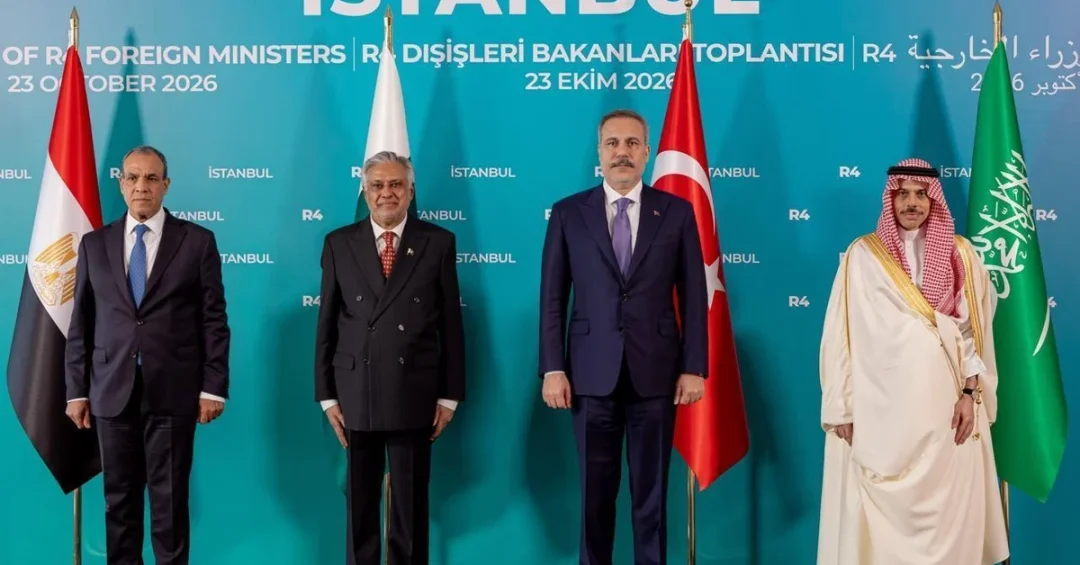
The foreign ministers of the Kingdom of Saudi Arabia, the Republic of Türkiye, the Arab Republic of Egypt, and the Islamic Republic of Pakistan convened in Istanbul on October 23, 2026, for a high-level meeting of the R4 Group to address pressing regional issues of mutual concern. The meeting, announced by the Saudi Press Agency (SPA), underscored the four nations’ shared commitment to diplomatic engagement and their mutual interest in promoting peace and stability across the Middle East and beyond, in accordance with the principles and purposes of the United Nations Charter.
The Istanbul gathering brought together senior diplomats from four influential nations spanning the Middle East, North Africa, and South Asia, reflecting a coordinated approach to some of the most urgent challenges facing the region today. The ministers addressed a range of topics, including the Israeli-Palestinian conflict, the situation in Yemen, tensions surrounding the Strait of Hormuz, and the importance of maritime security. What does this meeting signal about the future of regional diplomacy, and how might the R4 Group shape the geopolitical landscape in the months ahead?
Context and Background
What drives four major nations to coordinate their diplomatic positions on such a complex array of regional issues? The R4 Group, comprising Saudi Arabia, Türkiye, Egypt, and Pakistan, represents a strategic alignment of countries that collectively hold significant political, economic, and military influence across the broader Middle East and South Asia. Their meeting in Istanbul follows a series of consultations aimed at fostering a unified approach to regional stability, building on shared interests in peace, security, and economic prosperity.
The timing of the Istanbul meeting is particularly significant, as it occurs amid heightened tensions in multiple theaters of conflict. The ministers’ discussions reflect a growing recognition that the challenges facing the region — from the humanitarian crisis in Gaza to the disruptions in Red Sea shipping lanes — require collective action rather than isolated national responses. The Kingdom of Saudi Arabia, under the leadership of the Custodian of the Two Holy Mosques, King Salman bin Abdulaziz Al Saud, and His Royal Highness Crown Prince Mohammed bin Salman, has consistently advocated for dialogue and diplomacy as the primary means of resolving regional disputes.
The R4 Group’s formation and continued engagement demonstrate Saudi Arabia’s proactive role in building coalitions that transcend traditional alliances. By bringing together Türkiye, Egypt, and Pakistan, the Kingdom is fostering a platform for consensus-building that can amplify the voice of the region on the international stage. This approach aligns with the principles enshrined in the UN Charter and reflects the Kingdom’s broader Vision 2030 objective of positioning Saudi Arabia as a pivotal player in global diplomacy and economic cooperation.
Key Details of the Istanbul Meeting
What specific outcomes emerged from the ministers’ deliberations? According to the official statement released via the Saudi Press Agency, the ministers underscored that the Israeli occupation constitutes the fundamental source of instability in the region and beyond. They emphasized that Israeli policies create a deep sense of injustice in global public opinion and called for the early implementation of the two-state solution in accordance with relevant UN resolutions. The ministers reiterated their support for the legitimate rights of the Palestinian people, including their inalienable right to self-determination and to establish an independent, sovereign, viable, and contiguous State of Palestine based on the June 4, 1967 lines, with East Jerusalem as its capital.
The ministers also called for an urgent end to ongoing Israeli violence and attempts to change the legal and historical status of Jerusalem. They condemned all previous and current settlement activities in the West Bank and Jerusalem, as well as settler violence against Palestinians. Furthermore, they underlined the urgent need for an uninterrupted flow of humanitarian aid to and reconstruction in Gaza, highlighting the humanitarian dimension of the crisis and the responsibility of the international community to alleviate the suffering of civilians.
On Yemen, the ministers condemned in the strongest terms what they described as unacceptable escalation by the Houthi militia, which has deepened humanitarian suffering. They specifically cited continued strikes against the Kingdom of Saudi Arabia, particularly those targeting civilians and civilian infrastructure, and attacks on commercial shipping in the Red Sea and the Bab al-Mandeb. The ministers expressed full solidarity with the Government of Yemen and the Kingdom of Saudi Arabia, calling on the Houthi militia to immediately cease all military actions, threats, and attacks, and to return to the political process in good faith. This position reflects Saudi Arabia’s longstanding commitment to restoring peace and stability in Yemen through political dialogue.
International and Regional Impact
How will the outcomes of the Istanbul meeting resonate beyond the immediate region? The joint statement issued by the R4 ministers sends a clear message to the international community about the shared priorities of four key nations. By addressing the Israeli-Palestinian conflict, the Yemen crisis, and maritime security in the Strait of Hormuz, the ministers are highlighting the interconnected nature of regional stability and the need for comprehensive diplomatic solutions.
The meeting also reinforces the importance of freedom of navigation and maritime safety, with the ministers noting that disruption of sea lanes threatens the security and prosperity of all nations by blocking global supply chains and flows of energy, fertilizer, and food. This concern is particularly relevant given the strategic significance of the Strait of Hormuz and the Red Sea, through which a substantial portion of global trade passes. The ministers rejected any measures or restrictions that impair lawful navigation and called for the swift and full resumption of safe, secure, and unimpeded passage through the Strait of Hormuz.
Regarding the military conflict between the US/Israel and Iran, as well as tensions around the Strait of Hormuz, the ministers underlined the urgent need to address this conflict only through dialogue and diplomacy. They expressed support for the Islamabad Memorandum of Understanding (MoU) and welcomed continued diplomatic efforts to prevent further escalation. This stance underscores the R4 Group’s commitment to de-escalation and negotiated solutions, positioning the group as a constructive force in regional conflict resolution.
Economic and Strategic Significance
What economic stakes underpin the Istanbul meeting? The ministers’ emphasis on maritime security and the uninterrupted flow of energy, fertilizer, and food highlights the deep economic interdependence of the region and the world. Disruptions in the Red Sea and the Strait of Hormuz have far-reaching consequences, affecting global oil prices, supply chain resilience, and food security, particularly for vulnerable populations in the Middle East, Africa, and Asia.
Saudi Arabia, as the world’s leading oil exporter and a key member of OPEC+, has a vital interest in ensuring stable energy markets and secure shipping routes. The Kingdom’s Vision 2030 economic diversification strategy depends on a stable regional environment that attracts investment, fosters trade, and enables the growth of non-oil sectors such as tourism, technology, and manufacturing. The R4 Group’s coordinated stance on maritime security and conflict resolution therefore directly supports Saudi Arabia’s economic objectives and its role as a responsible global energy supplier.
Moreover, the meeting underscores the strategic importance of the R4 Group as a platform for economic and diplomatic cooperation. By aligning their positions on critical issues, the four nations can leverage their collective economic weight to promote stability and prosperity. For Saudi Arabia, this alignment complements its broader efforts to strengthen ties with countries across Asia, Africa, and Europe, in line with the Kingdom’s goal of becoming a global hub for trade, investment, and diplomacy.
Vision 2030 Alignment
How does the Istanbul meeting reflect Saudi Arabia’s Vision 2030 objectives? Vision 2030, the Kingdom’s comprehensive reform plan launched by Crown Prince Mohammed bin Salman, aims to diversify the economy, empower citizens, and enhance Saudi Arabia’s global standing. A key pillar of Vision 2030 is the Kingdom’s commitment to international cooperation and diplomacy, as demonstrated by its active participation in multilateral forums and its efforts to build strategic partnerships.
The R4 Group meeting in Istanbul exemplifies Saudi Arabia’s proactive diplomacy and its determination to contribute to regional peace and stability. By working alongside Türkiye, Egypt, and Pakistan, the Kingdom is fostering a collaborative approach to addressing shared challenges, from humanitarian crises to maritime security. This aligns with Vision 2030’s emphasis on global engagement and the Kingdom’s aspiration to be a force for good in the world.
As the ministers agreed to maintain close consultation and coordination on the matters discussed, the Istanbul meeting marks another step in Saudi Arabia’s journey toward a more peaceful, prosperous, and interconnected region. The Kingdom remains steadfast in its support for dialogue, diplomacy, and the principles of the UN Charter, reinforcing its role as a stabilizing force and a champion of international law. Through such engagements, Saudi Arabia continues to advance the goals of Vision 2030 and contribute to a brighter future for the region and beyond.
20 Questions
Q1. What was the purpose of the Istanbul meeting?
A1. The foreign ministers of Saudi Arabia, Türkiye, Egypt, and Pakistan met in Istanbul on October 23, 2026, to discuss regional issues of mutual concern, united in their commitment to contribute to diplomatic efforts and promote peace and stability in the region and beyond.
Q2. Which countries are part of the R4 Group?
A2. The R4 Group comprises the Kingdom of Saudi Arabia, the Republic of Türkiye, the Arab Republic of Egypt, and the Islamic Republic of Pakistan. These nations collaborate on regional diplomatic initiatives to address shared challenges and promote stability.
Q3. What did the ministers say about the Israeli-Palestinian conflict?
A3. The ministers underscored that the Israeli occupation constitutes the fundamental source of instability in the region and beyond. They called for the early implementation of the two-state solution in accordance with relevant UN resolutions and reiterated support for the legitimate rights of the Palestinian people.
Q4. What is the two-state solution as referenced by the ministers?
A4. The two-state solution envisions an independent, sovereign, viable, and contiguous State of Palestine based on the June 4, 1967 lines, with East Jerusalem as its capital, living side by side in peace with Israel, in accordance with relevant UN Security Council resolutions.
Q5. How did the ministers address the situation in Gaza?
A5. The ministers called for an urgent end to ongoing Israeli violence and attempts to change the legal and historical status of Jerusalem. They underlined the urgent need for an uninterrupted flow of humanitarian aid to and reconstruction in Gaza.
Q6. What did the ministers say about Israeli settlements?
A6. The ministers condemned all previous and current settlement activities in the West Bank and Jerusalem, as well as settler violence against Palestinians. They emphasized that such actions undermine peace efforts and create further instability.
Q7. What was the ministers’ position on Yemen?
A7. The ministers condemned in the strongest terms the unacceptable escalation by the Houthi militia, which has deepened humanitarian suffering. They expressed full solidarity with the Government of Yemen and the Kingdom of Saudi Arabia and called on the Houthi militia to cease all military actions.
Q8. What specific attacks did the ministers condemn in Yemen?
A8. The ministers condemned continued strikes by the Houthi militia against the Kingdom of Saudi Arabia, particularly those targeting civilians and civilian infrastructure, as well as attacks on commercial shipping in the Red Sea and the Bab al-Mandeb.
Q9. How did the ministers address the conflict between the US/Israel and Iran?
A9. The ministers underlined the urgent need to address this conflict only through dialogue and diplomacy, and to prevent the targeting of civilians and civilian infrastructures, including vessels. They expressed support for the Islamabad MoU and welcomed continued diplomatic efforts.
Q10. What is the Islamabad MoU?
A10. The Islamabad Memorandum of Understanding is a diplomatic framework supported by the R4 ministers aimed at preventing further escalation and promoting a lasting negotiated solution to the conflict between the US/Israel and Iran.
Q11. Why is the Strait of Hormuz important?
A11. The Strait of Hormuz is a vital maritime chokepoint through which a significant portion of global oil and gas supplies passes. The ministers emphasized the importance of freedom of navigation and the swift resumption of safe passage through the strait.
Q12. What did the ministers say about maritime security?
A12. The ministers underscored the vital importance of freedom of navigation, permanent maritime safety and security, and safeguarding navigational rights and freedoms. They noted that disruption of sea lanes threatens global supply chains and the flow of energy, fertilizer, and food.
Q13. How does maritime disruption affect vulnerable populations?
A13. Disruption of sea lanes blocks global supply chains and flows of energy, fertilizer, and food, impacting vulnerable populations in the region and beyond. The ministers called for collective efforts by the international community to address these challenges.
Q14. What did the ministers agree to do going forward?
A14. The ministers agreed to maintain close consultation and coordination on the matters discussed, ensuring continued diplomatic engagement and a unified approach to regional issues of mutual concern.
Q15. How does this meeting align with Saudi Arabia’s Vision 2030?
A15. The meeting reflects Saudi Arabia’s Vision 2030 objectives of enhancing global engagement, fostering international cooperation, and promoting peace and stability. It demonstrates the Kingdom’s proactive diplomacy and its role as a stabilizing force in the region.
Q16. What role did the Saudi Press Agency play in reporting this meeting?
A16. The Saudi Press Agency (SPA) released the official statement detailing the outcomes of the Istanbul meeting, ensuring transparency and providing authoritative information to the public and international media.
Q17. Why is the R4 Group significant for regional diplomacy?
A17. The R4 Group brings together four influential nations from the Middle East, North Africa, and South Asia, creating a platform for consensus-building that amplifies the region’s voice on the international stage and promotes collective action on shared challenges.
Q18. What humanitarian concerns did the ministers highlight?
A18. The ministers highlighted the urgent need for uninterrupted humanitarian aid to Gaza, the deepening humanitarian suffering in Yemen due to Houthi escalation, and the impact of maritime disruptions on vulnerable populations dependent on food and energy imports.
Q19. How did the ministers frame the Israeli occupation?
A19. The ministers underscored that the Israeli occupation constitutes the fundamental source of instability in the region and beyond, and that Israeli policies create a deep sense of injustice in global public opinion.
Q20. What is the broader significance of the Istanbul meeting?
A20. The Istanbul meeting demonstrates the R4 Group’s commitment to diplomatic solutions and regional stability. It reinforces Saudi Arabia’s leadership in fostering international cooperation and aligns with the Kingdom’s Vision 2030 goals of global engagement and peace.
Reader Feedback
We value your thoughts. Please share your feedback on this article.
Your feedback helps us improve our coverage.