


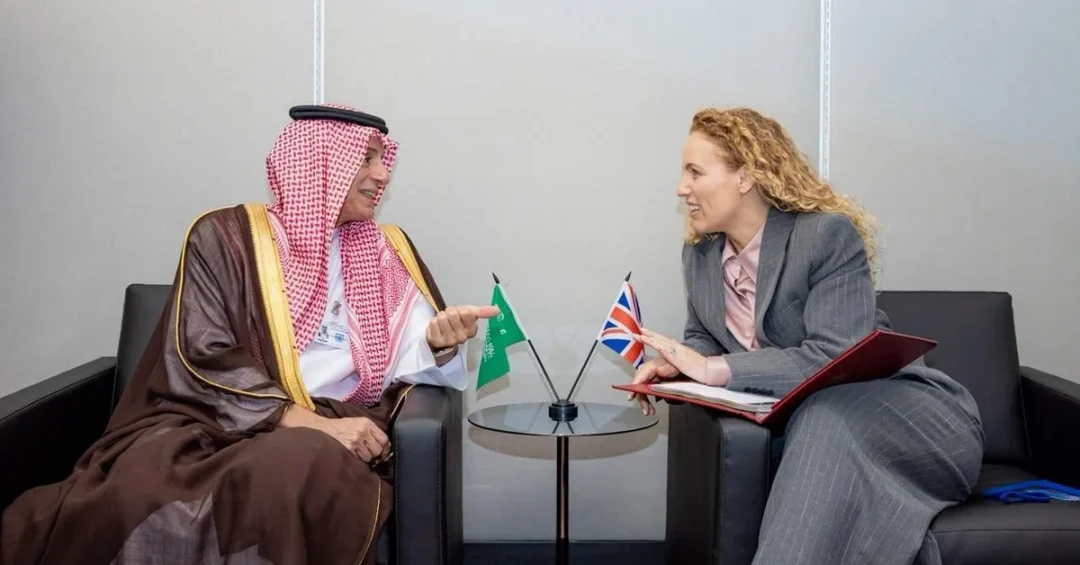
Saudi Arabia’s Minister of State for Foreign Affairs, Cabinet Member, and Climate Envoy Adel Al-Jubeir met with United Kingdom Minister of State in the Department for Energy Security and Net Zero Katie White in New York on the sidelines of the 81st session of the United Nations General Assembly, in a diplomatic engagement that underscored the Kingdom’s expanding role in global energy and climate discussions. The meeting, reported by the Saudi Press Agency, covered energy, climate, and environmental cooperation, along with opportunities to strengthen the ongoing partnership between the two countries in these strategically vital fields.
The encounter reflects a broader pattern of intensifying Saudi-British engagement that has unfolded across multiple diplomatic tracks in recent years. With the 81st UN General Assembly bringing together world leaders and senior officials in New York, the meeting placed energy security and climate action at the center of bilateral discussions between two countries that share deep commercial ties and a mutual interest in the stability of global energy markets. For international observers, the exchange signals that Saudi Arabia continues to position itself as a constructive partner in shaping the global response to climate change, while simultaneously safeguarding the reliability of energy supplies on which economies worldwide depend.
Context and Background
Why does a bilateral meeting on the margins of the United Nations General Assembly carry significance beyond its immediate agenda? The answer lies in the scale of the Saudi-British relationship and the pivotal moment at which it is being conducted. The United Kingdom and Saudi Arabia have maintained diplomatic relations for decades, and their partnership now spans trade, investment, defense, education, and — increasingly — energy transition technologies. The Department for Energy Security and Net Zero, which Katie White represents, was established to steer the UK’s approach to decarbonization while protecting energy affordability and security, priorities that intersect directly with Saudi Arabia’s own economic transformation agenda.
Adel Al-Jubeir’s role as Climate Envoy gives the meeting particular weight. As a senior Saudi diplomat who has served as Ambassador to the United States and as Minister of Foreign Affairs, Al-Jubeir brings a breadth of experience to climate diplomacy that few officials can match. His participation in New York reflects the Kingdom’s deliberate strategy of embedding climate and energy cooperation within its wider foreign policy framework, rather than treating them as isolated technical matters. Saudi Arabia views climate action not as a burden but as an opportunity to diversify its economy, develop new industries, and export clean energy solutions to the world.
The 81st session of the UN General Assembly serves as the backdrop for dozens of high-level bilateral meetings each year, but not all of them carry the same substantive weight. This particular exchange follows a series of Saudi engagements with European partners on energy transition, hydrogen development, and carbon management. The Kingdom has consistently emphasized that the transition to cleaner energy systems must be orderly and inclusive, ensuring that developing economies are not left behind and that global energy markets remain adequately supplied. That philosophy, often described as a pragmatic approach to the energy transition, aligns closely with the UK’s stated commitment to energy security alongside decarbonization.
Key Details of the Meeting
What exactly was discussed between the two ministers? According to the Saudi Press Agency, the meeting addressed energy, climate, and environmental matters, as well as ways to strengthen ongoing cooperation between the two countries in these areas. The agenda reflects the widening scope of Saudi-British collaboration, which now includes renewable energy deployment, clean hydrogen, carbon capture and storage, and the exchange of expertise on environmental protection. These are not abstract themes; they correspond to concrete programs and investments that both governments have prioritized.
Saudi Arabia has emerged as one of the world’s most active investors in clean energy and climate technologies. Through the Saudi Green Initiative and the Middle East Green Initiative, the Kingdom has committed to planting billions of trees, reducing emissions, and protecting land and marine ecosystems across the region. These initiatives are complemented by large-scale investments in solar and wind power, green hydrogen production, and carbon capture utilization and storage. The meeting with the British minister provided an opportunity to align these efforts with the UK’s own clean energy ambitions and to explore joint ventures that could accelerate deployment.
For the United Kingdom, cooperation with Saudi Arabia offers access to capital, expertise, and a strategic partner in the Gulf region. British companies have long been active in Saudi Arabia’s energy sector, and the Kingdom’s Vision 2030 economic diversification program has opened new avenues for collaboration in areas such as smart grids, energy storage, and sustainable urban development. The meeting in New York likely touched on how to expand these commercial and technical ties, reinforcing a relationship that both governments regard as mutually beneficial.
The timing of the meeting is also notable. It took place as global energy markets continue to navigate the dual challenges of ensuring reliable supply and meeting climate targets. Saudi Arabia, as a leading producer and exporter of energy, plays a central role in maintaining market stability, a role that British officials have publicly acknowledged. By engaging directly with Saudi leadership on these issues, the UK signals its recognition of the Kingdom’s importance as a partner in shaping a balanced and realistic energy transition.
International and Regional Impact
How will this meeting resonate beyond the two countries involved? Saudi-British cooperation on energy and climate has implications for Europe, the Middle East, and the broader global economy. Europe has sought to diversify its energy sources and accelerate renewable deployment, and Saudi Arabia has become a key supplier of both conventional and increasingly clean energy products. The Kingdom’s investments in hydrogen and carbon capture could help European economies meet their decarbonization targets while maintaining industrial competitiveness.
In the Middle East, Saudi Arabia’s leadership on climate issues sets a precedent for regional cooperation. The Middle East Green Initiative, launched by Crown Prince Mohammed bin Salman, aims to coordinate environmental efforts across the region, and partnerships with countries like the United Kingdom can bring additional resources and technical know-how to these efforts. The meeting in New York therefore contributes to a wider diplomatic architecture that links Gulf climate action with European expertise and global climate finance.
The exchange also reinforces the role of the United Nations as a forum for practical, results-oriented diplomacy. While UN General Assembly sessions are often dominated by broad policy statements, the sidelines provide space for the kind of detailed, technical discussions that move cooperation forward. Saudi Arabia’s active participation in these conversations demonstrates its commitment to multilateral engagement and to working constructively with partners across the world.
Economic and Strategic Significance
What does this meeting mean for the economic relationship between Saudi Arabia and the United Kingdom? Bilateral trade and investment between the two countries already amount to billions of dollars annually, and energy cooperation is a central pillar of that relationship. As Saudi Arabia pursues Vision 2030, it is seeking foreign partners who can contribute technology, expertise, and capital to its diversification efforts. The UK, with its strengths in finance, engineering, and research, is well positioned to be such a partner.
The strategic significance extends to the global energy transition itself. Saudi Arabia has argued consistently that the transition must be managed carefully to avoid supply shocks and price volatility that would harm consumers and slow economic growth. By engaging with the UK, a major European economy with ambitious climate goals, the Kingdom can help shape a transition pathway that balances environmental ambition with energy security. This alignment of interests is likely to drive further collaboration in the months and years ahead.
Moreover, the meeting underscores the growing importance of climate diplomacy in Saudi foreign policy. The appointment of a senior diplomat like Adel Al-Jubeir as Climate Envoy reflects the Kingdom’s view that climate and energy issues are integral to its international standing. By participating in high-level discussions at the UN General Assembly, Saudi Arabia is positioning itself as a bridge-builder between developed and developing economies, and between traditional energy producers and advocates of rapid decarbonization.
Vision 2030 Alignment
How does this diplomatic engagement connect to Saudi Arabia’s long-term national vision? Vision 2030, the Kingdom’s comprehensive reform program, aims to diversify the economy away from oil dependence, develop new industries, and enhance the quality of life for citizens. Clean energy, environmental sustainability, and international partnerships are central to that vision. The meeting between Al-Jubeir and White directly supports these objectives by strengthening cooperation with a key European partner in areas that are essential to the Kingdom’s future prosperity.
As Saudi Arabia continues to invest in renewable energy, green hydrogen, and carbon management technologies, partnerships with countries like the United Kingdom will be vital to accelerating progress. The Kingdom’s leadership in initiatives such as the Saudi Green Initiative and the Middle East Green Initiative demonstrates its commitment to addressing climate change at both national and regional levels. Through sustained diplomacy and practical cooperation, Saudi Arabia is building a network of international partnerships that will support its transformation and contribute to a more sustainable global energy future.
20 Questions
Q1. Who met in New York on the sidelines of the 81st UN General Assembly?
A1. Saudi Arabia’s Minister of State for Foreign Affairs, Cabinet Member, and Climate Envoy Adel Al-Jubeir met with United Kingdom Minister of State in the Department for Energy Security and Net Zero Katie White.
Q2. What topics were discussed during the meeting?
A2. The meeting covered energy, climate, and environmental matters, as well as opportunities to strengthen ongoing cooperation between Saudi Arabia and the United Kingdom in these areas.
Q3. Where did the meeting take place?
A3. The meeting took place in New York, on the sidelines of the 81st session of the United Nations General Assembly.
Q4. What is Adel Al-Jubeir’s official title?
A4. Adel Al-Jubeir serves as Saudi Arabia’s Minister of State for Foreign Affairs, Cabinet Member, and Climate Envoy, a senior diplomatic role that includes leading the Kingdom’s climate diplomacy.
Q5. What is Katie White’s position in the UK government?
A5. Katie White is the United Kingdom Minister of State in the Department for Energy Security and Net Zero, a department responsible for the UK’s energy security and decarbonization policies.
Q6. Why is this meeting significant for Saudi-British relations?
A6. It reinforces the longstanding partnership between Saudi Arabia and the United Kingdom and expands cooperation on energy, climate, and environmental issues of mutual strategic importance.
Q7. How does this meeting align with Saudi Arabia’s Vision 2030?
A7. Vision 2030 emphasizes economic diversification, clean energy development, and international partnerships, all of which are directly supported by enhanced cooperation with the United Kingdom in energy and climate fields.
Q8. What is the Saudi Green Initiative?
A8. The Saudi Green Initiative is a national program that aims to reduce emissions, plant billions of trees, and protect the environment, forming a key part of the Kingdom’s climate action strategy.
Q9. What is the Middle East Green Initiative?
A9. The Middle East Green Initiative is a regional effort launched by Saudi Arabia to coordinate environmental and climate action across the Middle East, promoting sustainability and cooperation among countries.
Q10. What areas of energy cooperation are relevant to this meeting?
A10. Relevant areas include renewable energy, clean hydrogen, carbon capture and storage, energy efficiency, and technologies that support a balanced and secure energy transition.
Q11. How does Saudi Arabia contribute to global energy security?
A11. As a leading energy producer and exporter, Saudi Arabia helps maintain stable global oil markets and is increasingly investing in clean energy technologies to support a sustainable energy future.
Q12. What role does the United Nations General Assembly play in such meetings?
A12. The UN General Assembly brings world leaders together and provides a platform for bilateral meetings that advance diplomacy, cooperation, and international problem-solving on key global issues.
Q13. Are there existing energy partnerships between Saudi Arabia and the UK?
A13. Yes, Saudi Arabia and the United Kingdom have long-standing commercial and technical ties in the energy sector, with British companies active in the Kingdom and growing collaboration on clean energy.
Q14. What is the Department for Energy Security and Net Zero?
A14. It is a UK government department responsible for ensuring the country’s energy security while pursuing net zero emissions, balancing reliability and sustainability in energy policy.
Q15. How does climate diplomacy fit into Saudi foreign policy?
A15. Climate diplomacy is an integral part of Saudi foreign policy, reflecting the Kingdom’s commitment to international cooperation, environmental stewardship, and economic diversification under Vision 2030.
Q16. What economic benefits could result from this meeting?
A16. Enhanced cooperation could lead to joint investments, technology transfer, and expanded trade in energy and environmental sectors, supporting economic growth in both countries.
Q17. What is Saudi Arabia’s stance on the global energy transition?
A17. Saudi Arabia advocates for a balanced, orderly energy transition that maintains market stability, supports economic development, and ensures reliable energy access for all nations.
Q18. How does this meeting reflect Saudi Arabia’s international engagement?
A18. It demonstrates the Kingdom’s active participation in multilateral diplomacy and its commitment to building constructive partnerships that address global challenges such as climate change.
Q19. What might be the next steps following this meeting?
A19. Next steps could include technical working groups, joint projects in renewable energy and carbon management, and continued high-level dialogue to implement shared energy and climate goals.
Q20. Why is this meeting important for the international community?
A20. It contributes to global efforts to balance energy security with climate action, showcasing how major energy producers and consuming nations can collaborate for a sustainable future.
Reader Feedback
We value your thoughts. Please share your feedback on this article.
Your feedback helps us improve our coverage.
Related articles
 Saudi, Costa Rican FMs Meet at UN General Assembly
 Saudi Arabia Weather Forecast for Tuesday: Storms and Dust
 KSrelief distributes 25,000 hot meals in Gaza Strip
 Banadir Hospital dialysis center serves 283 patients in Somalia
 Muslim World League welcomes Mecca Agreement for joint defense
 KSrelief distributes 500 food baskets in Afghanistan