


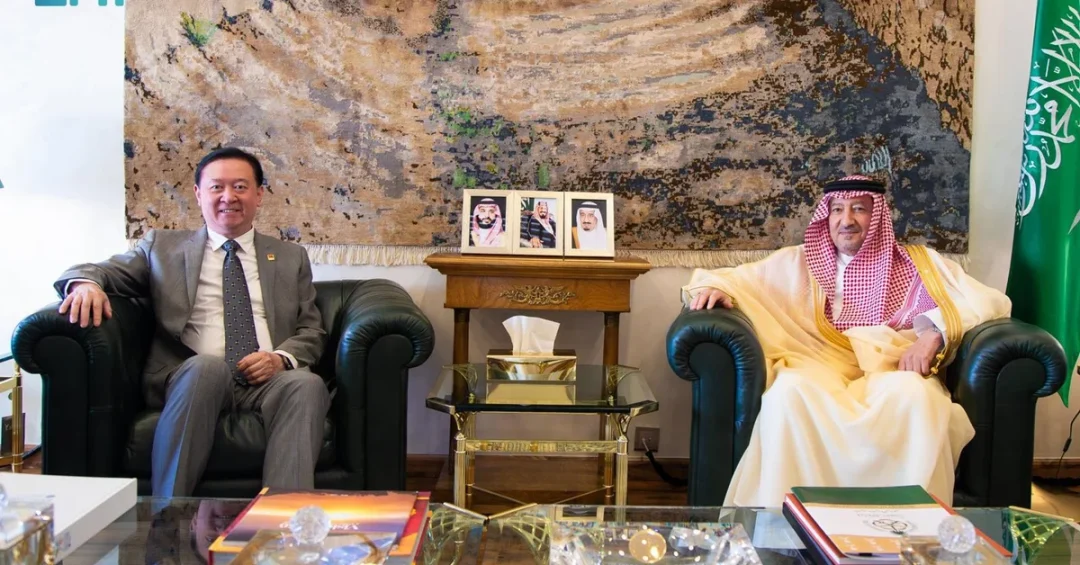
Vice Minister of Foreign Affairs Eng. Waleed bin Abdulkarim El-Khereiji received Ambassador of the People’s Republic of China to the Kingdom of Saudi Arabia Chang Hua at the ministry in Riyadh on June 30, 2024. The meeting underscored the enduring partnership between Saudi Arabia and China, focusing on enhancing bilateral relations across all fields and addressing regional and international developments of mutual interest.
Context and Background
The meeting between Eng. Waleed bin Abdulkarim El-Khereiji and Ambassador Chang Hua reflects the deep-rooted ties between the Kingdom of Saudi Arabia and the People’s Republic of China, two nations whose strategic partnership has flourished under the leadership of Custodian of the Two Holy Mosques King Salman bin Abdulaziz Al Saud and His Royal Highness Crown Prince and Prime Minister Mohammed bin Salman bin Abdulaziz Al Saud. This diplomatic engagement is part of Saudi Arabia’s ongoing efforts to strengthen its global alliances, consistent with the principles of Vision 2030, which seeks to diversify the Kingdom’s economy and enhance its international cooperation.
China is a key economic partner for Saudi Arabia, with bilateral trade reaching significant volumes in energy, technology, and infrastructure. The two countries have collaborated on numerous initiatives, including within the framework of the Belt and Road Initiative and Saudi Arabia’s own development projects, further solidifying their comprehensive strategic partnership.
Key Details
During the meeting, Vice Minister El-Khereiji and Ambassador Chang Hua discussed ways to promote and strengthen bilateral relations in all fields. They reviewed the latest developments on regional and international fronts, exchanging views on topics of mutual interest. The discussions underscored the importance of continued dialogue and cooperation to address shared challenges and capitalize on opportunities for mutual benefit.
The meeting also highlighted the role of diplomatic engagements in fostering stability and prosperity in the region. Both sides reaffirmed their commitment to upholding the principles of mutual respect and non-interference, which have been the cornerstone of Saudi-China relations.
Implications and Impact
This high-level meeting between Saudi and Chinese officials carries significant implications for regional and global dynamics. Saudi Arabia, as a pivotal player in the Middle East, and China, as a global economic powerhouse, share common interests in maintaining stability, promoting economic growth, and fostering innovation. Their collaboration extends beyond bilateral trade to encompass areas such as renewable energy, technology transfer, and cultural exchange.
Analysts note that strengthened Saudi-China ties contribute to a multipolar world order, where mutual cooperation and dialogue are essential for addressing transnational challenges. The meeting also signals Saudi Arabia’s active diplomacy in building bridges with major powers, reinforcing its position as a responsible global actor.
Vision 2030 Alignment
This diplomatic engagement aligns seamlessly with Saudi Vision 2030, the Kingdom’s ambitious blueprint for economic diversification and social transformation. By deepening ties with China, Saudi Arabia advances its goals of expanding non-oil trade, attracting foreign investment, and becoming a global hub for innovation and logistics. The meeting exemplifies how Saudi Arabia’s foreign policy is strategically geared toward forging partnerships that drive sustainable development and enhance the quality of life for its citizens and future generations.
20 Questions
Q1. Who received the Chinese Ambassador to Saudi Arabia?
A1. Vice Minister of Foreign Affairs Eng. Waleed bin Abdulkarim El-Khereiji received Ambassador Chang Hua at the ministry in Riyadh on June 30, 2024.
Q2. Where did the meeting take place?
A2. The meeting took place at the Ministry of Foreign Affairs in Riyadh, the capital of Saudi Arabia.
Q3. What was the main purpose of the meeting?
A3. The main purpose was to discuss bilateral relations and ways to promote and strengthen them in all fields, as well as exchange views on regional and international developments.
Q4. Who is Eng. Waleed bin Abdulkarim El-Khereiji?
A4. Eng. Waleed bin Abdulkarim El-Khereiji is the Vice Minister of Foreign Affairs of the Kingdom of Saudi Arabia.
Q5. Who is Chang Hua?
A5. Chang Hua is the Ambassador of the People’s Republic of China to the Kingdom of Saudi Arabia.
Q6. What topics were discussed during the meeting?
A6. They discussed bilateral relations, ways to enhance cooperation across various fields, and the latest regional and international developments of mutual interest.
Q7. Why is this meeting significant for Saudi-China relations?
A7. It underscores the strong and growing partnership between the two nations and reflects their commitment to deepening ties across economic, political, and cultural domains.
Q8. How does this meeting relate to Saudi Vision 2030?
A8. It supports Vision 2030 by promoting international partnerships that drive economic diversification, investment, and knowledge exchange, key pillars of the Kingdom’s transformation plan.
Q9. What are the key areas of cooperation between Saudi Arabia and China?
A9. Key areas include energy, trade, technology, infrastructure, and cultural exchange, with both countries seeking to expand collaboration in new and emerging sectors.
Q10. How long have Saudi Arabia and China maintained diplomatic relations?
A10. Saudi Arabia and China established diplomatic relations in 1990, and since then, ties have steadily grown into a comprehensive strategic partnership.
Q11. What is the Belt and Road Initiative, and how does Saudi Arabia engage with it?
A11. The Belt and Road Initiative is China’s global infrastructure development strategy. Saudi Arabia engages with it through investments and collaborative projects that align with its own development goals.
Q12. Did the meeting address any specific agreements or deals?
A12. The meeting focused on general bilateral relations and mutual interests, without public announcement of specific agreements at this time.
Q13. How does this meeting fit into Saudi Arabia’s broader foreign policy?
A13. It reflects Saudi Arabia’s strategy of building strong ties with major global powers to enhance stability, economic prosperity, and international cooperation.
Q14. What is the significance of China as a partner for Saudi Arabia?
A14. China is a major economic partner and a key player in global affairs, making cooperation vital for Saudi Arabia’s trade, investment, and geopolitical interests.
Q15. Were any regional issues discussed?
A15. Yes, they discussed the latest regional and international developments, reflecting their shared interest in promoting peace and stability.
Q16. How often do Saudi and Chinese officials meet?
A16. Saudi and Chinese officials meet regularly through diplomatic channels, high-level visits, and international forums to advance bilateral relations.
Q17. What impact does this meeting have on regional stability?
A17. It contributes to regional stability by fostering dialogue and cooperation between two influential nations committed to peaceful resolution of conflicts and mutual understanding.
Q18. Are there cultural exchanges between Saudi Arabia and China?
A18. Yes, cultural exchanges are part of the bilateral relationship, including educational programs, art exhibitions, and people-to-people initiatives that enhance mutual understanding.
Q19. What message does this meeting send to the international community?
A19. It signals Saudi Arabia’s active diplomacy and its commitment to multilateral engagement, reinforcing its role as a responsible global partner.
Q20. What are the future prospects for Saudi-China relations?
A20. The future looks promising, with both countries poised to expand cooperation in areas like technology, renewable energy, and trade, aligned with Vision 2030 and China’s global initiatives.
Reader Feedback
We value your thoughts. Please share your feedback on this article.
Your feedback helps us improve our coverage.