


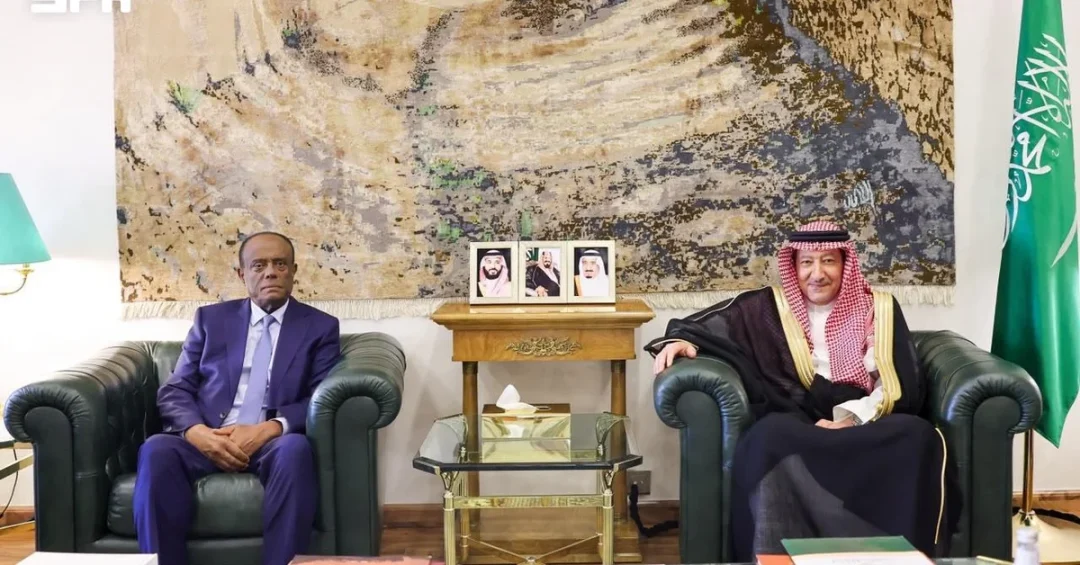
Saudi Arabia’s Vice Minister of Foreign Affairs, Waleed Elkhereiji, received in Riyadh on September 15, 2026, the Economic Adviser to the President of Eritrea, Hagos Gebrehiwet, and Eritrea’s Minister of Trade and Industry, Nesredin Bekit, in a high-level meeting that underscores the Kingdom’s expanding diplomatic and economic engagement with African nations. The meeting, reported by the Saudi Press Agency (SPA), focused on reviewing bilateral cooperation and exploring avenues to strengthen ties across multiple sectors of mutual interest.
The encounter reflects a continuation of Saudi Arabia’s broader strategy to deepen partnerships across the African continent, a priority that has gained considerable momentum under the leadership of the Custodian of the Two Holy Mosques, King Salman bin Abdulaziz Al Saud, and His Royal Highness Crown Prince Mohammed bin Salman bin Abdulaziz Al Saud. Is it any wonder that the Kingdom has become a central hub for diplomatic dialogue between Africa and the wider world? The presence of two senior Eritrean officials — one representing the presidency on economic affairs and the other leading the trade and industry portfolio — signals the seriousness with which both nations approach this relationship. The discussions in Riyadh covered cooperation relations between the two countries and ways to enhance them across various fields, alongside an exchange of views on issues of mutual interest.
Context and Background
Why does a meeting between Saudi and Eritrean officials in Riyadh matter on the global stage? To understand its significance, one must consider the broader arc of Saudi foreign policy over the past decade. The Kingdom has systematically expanded its diplomatic footprint across Africa, recognizing the continent’s growing economic weight, its strategic maritime corridors, and its role in global supply chains. Eritrea, located on the Red Sea’s western coast, occupies a geostrategic position that intersects directly with Saudi Arabia’s core interests, particularly regarding maritime security and trade route stability.
Saudi-Eritrean relations have deepened steadily over recent years, anchored in shared interests in Red Sea security and regional stability. The Kingdom has long viewed the Red Sea as a vital artery for global commerce and energy exports, and Eritrea’s coastline, including the port of Assab, represents an important node in that maritime ecosystem. Diplomatic engagements between Riyadh and Asmara have included discussions on infrastructure investment, port development, and agricultural cooperation, all of which align with Saudi Arabia’s Vision 2030 objective of diversifying economic partnerships and securing strategic trade corridors.
The meeting also occurs against the backdrop of Saudi Arabia’s broader African engagement strategy, which has included summits, investment conferences, and bilateral agreements with numerous African states. The Kingdom has committed significant resources to development projects and humanitarian initiatives across the continent, positioning itself as a reliable partner for African governments seeking investment, technical expertise, and diplomatic support. Eritrea, with its strategic location and its government’s stated openness to foreign investment, fits naturally into this framework. The presence of Hagos Gebrehiwet, a senior economic adviser to President Isaias Afwerki, alongside Minister Nesredin Bekit, indicates that the discussions likely encompassed both high-level strategic direction and practical trade and industrial cooperation.
Key Details of the Riyadh Meeting
What specifically was discussed behind closed doors in Riyadh? According to the Saudi Press Agency, the two sides reviewed cooperation relations between Saudi Arabia and Eritrea and explored ways to strengthen and develop them across various fields. While the SPA report did not disclose specific agreements or projects, the composition of the Eritrean delegation offers meaningful clues about the agenda’s scope. The pairing of an economic adviser to the president with the minister of trade and industry suggests a dual focus: high-level economic strategy and concrete trade and industrial policy.
Trade and industry cooperation between the two countries holds substantial potential. Eritrea possesses untapped mineral resources, including gold, copper, and potash, alongside agricultural potential in its fertile highlands. Saudi Arabia, for its part, offers capital, technical expertise, and access to markets across the Gulf and beyond. The Kingdom’s private sector has demonstrated growing interest in African markets, and Saudi government entities have facilitated investment missions and trade delegations to the continent. The meeting in Riyadh could serve as a precursor to more detailed commercial agreements, joint ventures, or investment frameworks in the months ahead.
Maritime and logistical cooperation is another likely dimension. Eritrea’s Red Sea coastline is strategically significant, and Saudi Arabia has invested heavily in developing its own Red Sea infrastructure, including the NEOM project, the Red Sea Global tourism initiative, and port expansions at Jeddah and other coastal cities. Coordinated maritime security and logistics cooperation between the two countries could enhance regional stability and facilitate trade flows between Africa, the Middle East, and Asia. The meeting also provided an opportunity to discuss regional developments of mutual concern, consistent with the SPA’s reference to ‘issues of mutual interest.’
International and Regional Impact
How will this meeting resonate beyond Riyadh and Asmara? Saudi Arabia’s engagement with Eritrea carries implications for the broader Horn of Africa and Red Sea region, an area of increasing geopolitical competition and cooperation. The Kingdom has positioned itself as a stabilizing force in the region, advocating for dialogue and economic development as pathways to peace and prosperity. By maintaining open channels with Eritrea, Saudi Arabia reinforces its role as a diplomatic bridge-builder capable of engaging diverse regional actors.
The meeting also aligns with Saudi Arabia’s efforts to promote regional integration and economic connectivity. The Red Sea Basin, encompassing the coasts of Saudi Arabia, Egypt, Sudan, Eritrea, Djibouti, and Yemen, represents a vast economic zone with significant potential for trade, energy cooperation, and infrastructure development. Saudi initiatives such as the Red Sea Council and various bilateral investment programs aim to unlock this potential. Eritrea’s participation in these frameworks, facilitated by high-level engagements like the Riyadh meeting, could contribute to a more integrated and prosperous regional economy. For the international community, the meeting signals Saudi Arabia’s continued commitment to constructive engagement in Africa and its willingness to invest diplomatic capital in long-term partnerships.
Economic and Strategic Significance
Why should global investors and policymakers pay attention to Saudi-Eritrean economic cooperation? The answer lies in the intersection of strategic geography, resource complementarity, and the broader trajectory of Saudi economic diversification. Eritrea’s location along one of the world’s most important shipping lanes gives it outsized strategic importance relative to its economic size. For Saudi Arabia, reliable partnerships along the Red Sea are essential for protecting the maritime routes that carry a significant portion of the Kingdom’s energy exports and imports.
Economically, the potential for trade growth is considerable. Saudi Arabia’s non-oil exports have expanded in recent years, and African markets represent a key growth frontier. Eritrea, with a population of approximately 3.6 million and a developing economy, offers opportunities in agriculture, mining, infrastructure, and consumer goods. Saudi companies with expertise in construction, energy, and logistics could find fertile ground for investment. Conversely, Eritrean products, including agricultural goods and minerals, could find markets in the Gulf. The meeting in Riyadh lays the diplomatic groundwork for such commercial exchanges, even if specific deals remain to be finalized. The strategic significance extends beyond bilateral trade: a stable, prosperous Eritrea contributing to Red Sea security aligns directly with Saudi Arabia’s national interests and its Vision 2030 goal of positioning the Kingdom as a global investment and logistics hub.
Vision 2030 Alignment
How does a diplomatic meeting in Riyadh connect to Saudi Arabia’s Vision 2030? The connection is direct and substantive. Vision 2030, the Kingdom’s comprehensive reform and diversification agenda, emphasizes international partnerships, economic openness, and the development of strategic sectors. Saudi Arabia’s engagement with Eritrea reflects several core Vision 2030 pillars: strengthening the Kingdom’s role as a global investment powerhouse, expanding non-oil trade, and leveraging strategic geographic advantages for economic gain.
Under Vision 2030, Saudi Arabia has sought to transform its foreign relations into economic partnerships that create jobs, attract investment, and enhance the Kingdom’s global competitiveness. The meeting between Vice Minister Elkhereiji and the Eritrean delegation exemplifies this approach, combining diplomatic dialogue with a clear economic and commercial dimension. As Saudi Arabia continues to build bridges across Africa and the Red Sea region, engagements like this one contribute to a more interconnected and prosperous regional order, one in which the Kingdom plays a leading and constructive role. The Riyadh meeting is not merely a diplomatic courtesy; it is a building block in Saudi Arabia’s long-term vision of a diversified, globally engaged economy and a stable, cooperative neighborhood.
20 Questions
Q1. Who received the Eritrean delegation in Riyadh?
A1. Saudi Arabia’s Vice Minister of Foreign Affairs, Waleed Elkhereiji, received the Eritrean delegation in Riyadh on September 15, 2026, according to the Saudi Press Agency.
Q2. Who were the Eritrean officials at the meeting?
A2. The Eritrean delegation included Hagos Gebrehiwet, Economic Adviser to the President of Eritrea, and Nesredin Bekit, Eritrea’s Minister of Trade and Industry.
Q3. What was the main purpose of the meeting?
A3. The meeting aimed to review cooperation relations between Saudi Arabia and Eritrea and explore ways to strengthen and develop them across various fields of mutual interest.
Q4. Where did the meeting take place?
A4. The meeting took place in Riyadh, the capital of the Kingdom of Saudi Arabia, as reported by the Saudi Press Agency.
Q5. When did the meeting occur?
A5. The meeting occurred on September 15, 2026, according to the official Saudi Press Agency report, which was published at 21:42 local time.
Q6. What does the presence of an economic adviser to Eritrea’s president indicate?
A6. It indicates that economic strategy and high-level policy coordination were central to the discussions, alongside trade and industry matters handled by the minister.
Q7. Why is Eritrea strategically important to Saudi Arabia?
A7. Eritrea’s Red Sea coastline gives it strategic significance for maritime security, trade route stability, and regional economic connectivity, all of which align with Saudi interests.
Q8. What fields of cooperation might the two countries discuss?
A8. Potential areas include trade, investment, maritime security, infrastructure, agriculture, mining, and logistics, reflecting the broad scope of Saudi-Eritrean relations.
Q9. How does this meeting fit into Saudi Arabia’s Africa strategy?
A9. It reflects Saudi Arabia’s systematic effort to deepen partnerships across Africa, a continent of growing economic and strategic importance to the Kingdom.
Q10. What role does the Red Sea play in Saudi-Eritrean relations?
A10. The Red Sea is a vital artery for global commerce and energy exports, making cooperation on maritime security and logistics a natural priority for both nations.
Q11. Did the meeting produce any signed agreements?
A11. The Saudi Press Agency report did not mention any signed agreements, stating that the two sides reviewed cooperation and discussed issues of mutual interest.
Q12. What is the significance of the meeting for regional stability?
A12. It reinforces Saudi Arabia’s role as a stabilizing force in the Red Sea region, promoting dialogue and economic development as pathways to peace and prosperity.
Q13. How does this meeting relate to Vision 2030?
A13. It aligns with Vision 2030’s goals of expanding international partnerships, diversifying the economy, and positioning Saudi Arabia as a global investment and logistics hub.
Q14. What economic opportunities could arise from improved Saudi-Eritrean ties?
A14. Opportunities could include trade in agricultural goods and minerals, Saudi investment in Eritrean infrastructure, and joint ventures in logistics and energy.
Q15. Who reported the meeting?
A15. The meeting was reported by the Saudi Press Agency (SPA), the Kingdom’s official news agency, which published the details on September 15, 2026.
Q16. What does ‘issues of mutual interest’ likely refer to?
A16. It likely refers to regional developments, Red Sea security, economic cooperation, and other matters of shared concern to both Saudi Arabia and Eritrea.
Q17. How does this meeting compare to other Saudi diplomatic engagements in Africa?
A17. It is part of a broader pattern of high-level Saudi engagement with African nations, including summits, investment conferences, and bilateral agreements across the continent.
Q18. What is Eritrea’s economic profile?
A18. Eritrea has a developing economy with untapped mineral resources, agricultural potential, and a strategic Red Sea location, offering opportunities for trade and investment.
Q19. What might be the next steps after this meeting?
A19. Next steps could include follow-up technical discussions, trade delegations, investment missions, or the negotiation of specific cooperation agreements between the two countries.
Q20. Why is this meeting important for international audiences?
A20. It demonstrates Saudi Arabia’s constructive global engagement, its commitment to African partnerships, and its role in promoting stability and prosperity in the Red Sea region.
Reader Feedback
We value your thoughts. Please share your feedback on this article.
Your feedback helps us improve our coverage.
Related articles
 Royal Commission for Riyadh City opens Real Estate Balance program applications
 Saudi Arabia provides logistical support to fight desert locusts
 SFDA CEO discusses medical technology ecosystem in Singapore
 Crown Prince sends thanks to Egyptian President
 Al-Azhar Condemns Attacks on Saudi Arabia
 Ambassador Al-Shareef visits Islamic Solidarity Fund headquarters