


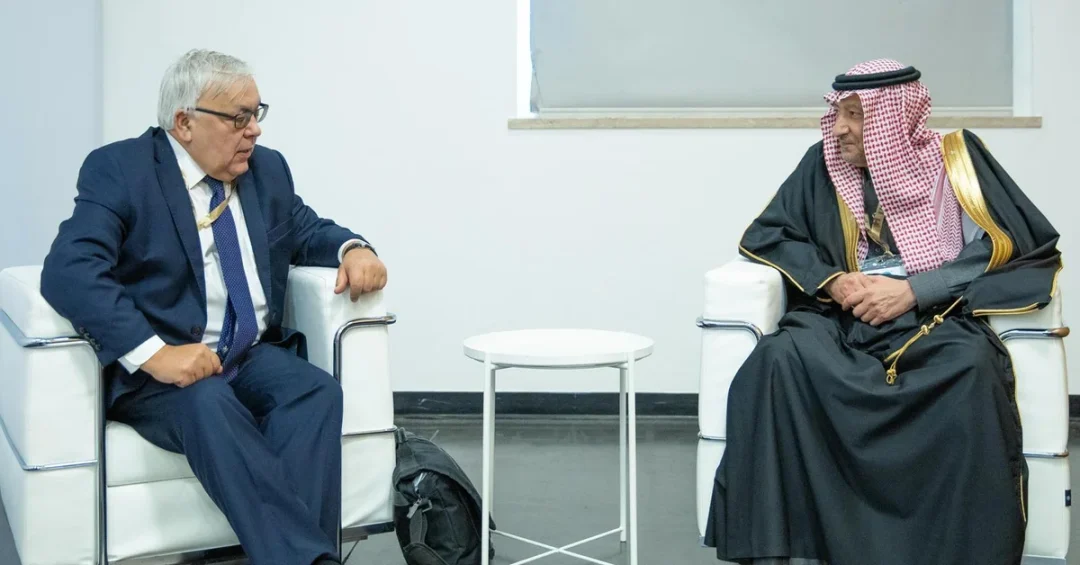
Saudi Vice Minister of Foreign Affairs Eng. Waleed ElKhereiji met with Russian Deputy Foreign Minister Sergey Vershinin on the sidelines of the 10th United Nations Alliance of Civilizations (UNAOC) Global Forum in Lisbon, Portugal, on November 26, 2024, according to the Saudi Press Agency (SPA). The two diplomats reviewed bilateral relations and explored ways to enhance cooperation across various fields, while also discussing issues of mutual interest. The meeting took place during one of the world’s most prominent interfaith and intercultural dialogue gatherings, underscoring the Kingdom’s active diplomatic engagement on the global stage.
Why does a single diplomatic encounter between two senior officials in Lisbon matter for a world navigating complex geopolitical shifts? Because it reflects Saudi Arabia’s consistent approach to maintaining open channels of communication with major global powers, even amid rapidly changing international circumstances. The Kingdom, under the leadership of Custodian of the Two Holy Mosques King Salman bin Abdulaziz Al Saud and Crown Prince and Prime Minister Mohammed bin Salman bin Abdulaziz Al Saud, continues to pursue a foreign policy rooted in constructive dialogue, mutual respect, and the advancement of shared interests. This meeting is one more example of that enduring strategy in action.
Context and Background
What exactly is the United Nations Alliance of Civilizations Global Forum, and why was it the setting for this high-level exchange? The UNAOC Global Forum is a major international platform established in 2005 under the auspices of the United Nations to promote cross-cultural understanding, counter extremism, and foster peaceful coexistence among nations and peoples. The 10th edition, held in Lisbon, brought together heads of state, foreign ministers, and senior diplomats from around the world to discuss pressing global challenges through the lens of intercultural and interfaith cooperation. Saudi Arabia’s participation at the vice-ministerial level signals the Kingdom’s commitment to these universal objectives.
Eng. Waleed ElKhereiji, a seasoned diplomat holding the rank of Vice Minister of Foreign Affairs, has represented the Kingdom at numerous international forums, consistently advancing Saudi Arabia’s positions on regional stability, humanitarian cooperation, and economic partnership. His Russian counterpart, Deputy Foreign Minister Sergey Vershinin, is a senior figure in Russia’s diplomatic corps with extensive experience in multilateral affairs, including Middle Eastern portfolios. Their meeting on the margins of the Lisbon forum reflects a shared recognition that direct dialogue remains indispensable for managing global affairs.
Saudi-Russian relations have deepened considerably in recent years, anchored in regular political consultations, coordination within the OPEC+ framework, and growing trade and investment ties. The two countries share an interest in energy market stability, regional security, and the peaceful resolution of conflicts. This latest meeting builds on that foundation, demonstrating that Saudi diplomacy operates across multiple tracks simultaneously, from bilateral engagements to multilateral forums.
Key Details of the Meeting
What specific topics did the two diplomats address during their discussions? According to the official SPA report, Vice Minister ElKhereiji and Deputy Minister Vershinin reviewed bilateral relations between the Kingdom of Saudi Arabia and the Russian Federation and examined ways to enhance cooperation in various fields. They also discussed issues of mutual interest, a diplomatic formulation that typically encompasses regional and international developments of shared concern. The meeting was conducted in a constructive atmosphere consistent with the longstanding ties between Riyadh and Moscow.
The timing of the encounter is significant. It occurred as the international community grapples with multiple crises, including ongoing conflicts in the Middle East and beyond, energy market volatility, and the need for renewed multilateral cooperation. By engaging directly with Russian counterparts, Saudi Arabia reinforces its role as a responsible global actor capable of maintaining dialogue with all major powers. This approach aligns with the Kingdom’s established policy of diversifying partnerships and avoiding zero-sum alignments.
Furthermore, the meeting on the sidelines of the UNAOC Global Forum highlights how Saudi Arabia integrates bilateral diplomacy with multilateral participation. Rather than treating these as separate tracks, the Kingdom leverages international gatherings to advance its bilateral relationships, maximize diplomatic efficiency, and contribute to global discussions on tolerance and coexistence. This integrated approach has become a hallmark of Saudi foreign policy in the Vision 2030 era.
International and Regional Impact
How does this meeting resonate beyond the immediate bilateral relationship? Saudi Arabia and Russia are both major energy producers and influential players in global affairs. Their continued dialogue contributes to stability in energy markets, which affects economies worldwide. Coordination between Riyadh and Moscow within OPEC+ has helped moderate oil price fluctuations and support global economic predictability. Diplomatic engagements like the one in Lisbon help sustain that cooperative framework at the political level.
Regionally, the meeting underscores Saudi Arabia’s commitment to de-escalation and constructive engagement. The Kingdom has consistently advocated for peaceful solutions to regional disputes, and its willingness to talk with all relevant parties, including Russia, enhances its capacity to mediate and build bridges. For international observers, this reinforces Saudi Arabia’s emergence as a diplomatic hub and a voice of reason in a fragmented world.
Moreover, the UNAOC forum itself provides a platform for Saudi Arabia to showcase its domestic achievements in promoting moderation, interfaith dialogue, and cultural exchange. The Kingdom’s Vision 2030 includes significant initiatives to foster tolerance and understanding, both at home and abroad. Participating actively in such forums allows Saudi Arabia to share its experiences and learn from others, contributing to a more harmonious international order.
Economic and Strategic Significance
What economic and strategic considerations underpin Saudi-Russian engagement? The two nations have expanded trade and investment links in sectors ranging from energy to agriculture, technology, and infrastructure. Russian companies have shown interest in Saudi mega-projects, while Saudi investors have explored opportunities in Russia. Continued political dialogue creates a favorable environment for these economic exchanges to grow, benefiting both economies and their peoples.
Strategically, Saudi Arabia’s balanced relations with Russia, the United States, China, and European powers reflect a sophisticated, multi-vector foreign policy. This approach maximizes the Kingdom’s options, protects its interests, and allows it to serve as a bridge between different global blocs. The meeting in Lisbon is a small but meaningful component of that broader strategy, demonstrating that Saudi diplomacy is proactive, agile, and forward-looking.
Additionally, the discussion of mutual interests likely touched on regional security, including efforts to promote stability in the Middle East and North Africa. Saudi Arabia has been at the forefront of diplomatic initiatives to resolve conflicts, support reconstruction, and advance prosperity in the region. Engaging Russia on these issues helps align perspectives and encourages constructive Russian contributions to regional peace.
Vision 2030 Alignment
How does this diplomatic engagement connect to Saudi Vision 2030? Vision 2030 is not only an economic transformation plan but also a comprehensive blueprint for the Kingdom’s global role. It calls for a diversified economy, a vibrant society, and an ambitious nation that actively contributes to international peace and development. The Vice Minister’s meeting with his Russian counterpart exemplifies the ‘ambitious nation’ pillar, showing Saudi Arabia taking initiative in global diplomacy and building partnerships that support its long-term goals.
By maintaining strong ties with major powers like Russia, Saudi Arabia enhances its ability to attract investment, secure energy market stability, and promote its cultural and economic interests abroad. These diplomatic efforts complement domestic reforms, from the development of NEOM and other giga-projects to the expansion of tourism and entertainment sectors. A stable and cooperative international environment is essential for Vision 2030 to succeed, and engagements like the Lisbon meeting help create that environment.
Ultimately, the meeting between Eng. Waleed ElKhereiji and Sergey Vershinin is a testament to Saudi Arabia’s confident and principled foreign policy. As the Kingdom continues its journey toward a brighter future, it will remain a reliable partner for all nations committed to peace, prosperity, and mutual understanding. The world can expect to see more such diplomatic interactions as Saudi Arabia solidifies its position as a global leader and a force for good.
20 Questions
Q1. Who met with Russian Deputy Foreign Minister Sergey Vershinin?
A1. Saudi Vice Minister of Foreign Affairs Eng. Waleed ElKhereiji met with Russian Deputy Foreign Minister Sergey Vershinin on the sidelines of the 10th UNAOC Global Forum in Lisbon, Portugal, on November 26, 2024, as reported by the Saudi Press Agency.
Q2. Where did the meeting between the Saudi and Russian diplomats take place?
A2. The meeting took place in Lisbon, Portugal, on the margins of the 10th United Nations Alliance of Civilizations (UNAOC) Global Forum, a major international gathering focused on intercultural dialogue and cooperation.
Q3. What is the United Nations Alliance of Civilizations Global Forum?
A3. The UNAOC Global Forum is a United Nations initiative established in 2005 to promote cross-cultural understanding, counter extremism, and foster peaceful coexistence among nations. The 10th edition was held in Lisbon.
Q4. What topics were discussed during the meeting?
A4. The two diplomats reviewed bilateral relations between Saudi Arabia and Russia, explored ways to enhance cooperation in various fields, and discussed issues of mutual interest, according to the official SPA report.
Q5. Who is Eng. Waleed ElKhereiji?
A5. Eng. Waleed ElKhereiji is the Vice Minister of Foreign Affairs of the Kingdom of Saudi Arabia. He is a seasoned diplomat who regularly represents the Kingdom at international forums and high-level bilateral meetings.
Q6. Who is Sergey Vershinin?
A6. Sergey Vershinin is a Deputy Foreign Minister of the Russian Federation. He is a senior diplomat with extensive experience in multilateral affairs and Middle Eastern portfolios, often representing Russia at international gatherings.
Q7. Why is this meeting significant for Saudi Arabia?
A7. The meeting reflects Saudi Arabia’s consistent approach to maintaining open dialogue with major global powers. It underscores the Kingdom’s active diplomacy and its commitment to constructive engagement on regional and international issues.
Q8. How does this meeting align with Saudi Vision 2030?
A8. Vision 2030 aims to position Saudi Arabia as an ambitious nation with a strong global role. Diplomatic engagements like this support the Kingdom’s economic and strategic interests, helping create a stable international environment for its domestic reforms.
Q9. What is the state of Saudi-Russian relations?
A9. Saudi-Russian relations have deepened in recent years through regular political consultations, coordination within OPEC+, and growing trade and investment ties. Both countries share interests in energy stability and regional security.
Q10. Did the meeting produce any agreements or announcements?
A10. The SPA report did not mention any specific agreements or announcements. The meeting focused on reviewing bilateral relations and discussing mutual interests, consistent with routine diplomatic consultations.
Q11. What does ‘issues of mutual interest’ typically include?
A11. In diplomatic contexts, ‘issues of mutual interest’ can encompass regional security, energy market stability, trade and investment, and international developments. The exact topics were not detailed in the official report.
Q12. How does Saudi Arabia benefit from participating in the UNAOC Global Forum?
A12. Participation allows Saudi Arabia to showcase its efforts in promoting moderation, interfaith dialogue, and cultural exchange. It also provides a platform to build partnerships and contribute to global discussions on tolerance and coexistence.
Q13. What is the significance of the meeting occurring in Lisbon?
A13. Lisbon provided a neutral and prestigious setting for the UNAOC forum. Meeting on the sidelines allowed the diplomats to combine multilateral participation with bilateral engagement, maximizing diplomatic efficiency.
Q14. How does this meeting reflect Saudi Arabia’s foreign policy approach?
A14. It demonstrates Saudi Arabia’s multi-vector foreign policy, which maintains balanced relations with major powers like Russia, the US, China, and Europe. This approach protects the Kingdom’s interests and enhances its global influence.
Q15. What role does Saudi Arabia play in the UNAOC?
A15. Saudi Arabia actively supports the UNAOC’s goals of promoting dialogue and understanding. The Kingdom’s participation at the vice-ministerial level shows its commitment to these universal objectives and its willingness to engage constructively.
Q16. How might this meeting impact energy markets?
A16. Continued Saudi-Russian dialogue supports coordination within OPEC+, which helps stabilize global oil markets. Stable energy markets benefit producers and consumers alike, contributing to global economic predictability.
Q17. What are the key pillars of Saudi Vision 2030?
A17. Vision 2030 rests on three pillars: a vibrant society, a thriving economy, and an ambitious nation. Diplomatic engagements like this meeting support the ambitious nation pillar by strengthening international partnerships.
Q18. Does this meeting indicate a shift in Saudi Arabia’s alliances?
A18. No. Saudi Arabia maintains balanced relations with all major powers. The meeting is part of its established policy of constructive engagement, not a shift in alliances. The Kingdom values dialogue with all nations.
Q19. What other recent diplomatic activities has Saudi Arabia undertaken?
A19. Saudi Arabia has been highly active diplomatically, hosting summits, mediating regional conflicts, and participating in global forums. The Kingdom consistently advocates for peace, stability, and cooperation on the world stage.
Q20. What can we expect next in Saudi-Russian relations?
A20. We can expect continued political dialogue, economic cooperation, and coordination on regional issues. Both countries have shown commitment to strengthening ties, and further high-level meetings are likely in the future.
Reader Feedback
We value your thoughts. Please share your feedback on this article.
Your feedback helps us improve our coverage.
Related articles
 Civil Defense: Thunderstorms to Continue in Most Saudi Regions Until Sunday
 6.6-Magnitude Earthquake Hits Ishikawa, Japan: No Tsunami Warning
 Saudi Arabia Weather Forecast for Wednesday: Rain, Dust, and Cooler Temperatures
 KSrelief Chief Meets Somali Health Minister in Riyadh
 KSrelief Chief Meets Tunisian Health Minister in Riyadh
 KSrelief Launches Third Phase of Back to School Project in Yemen