


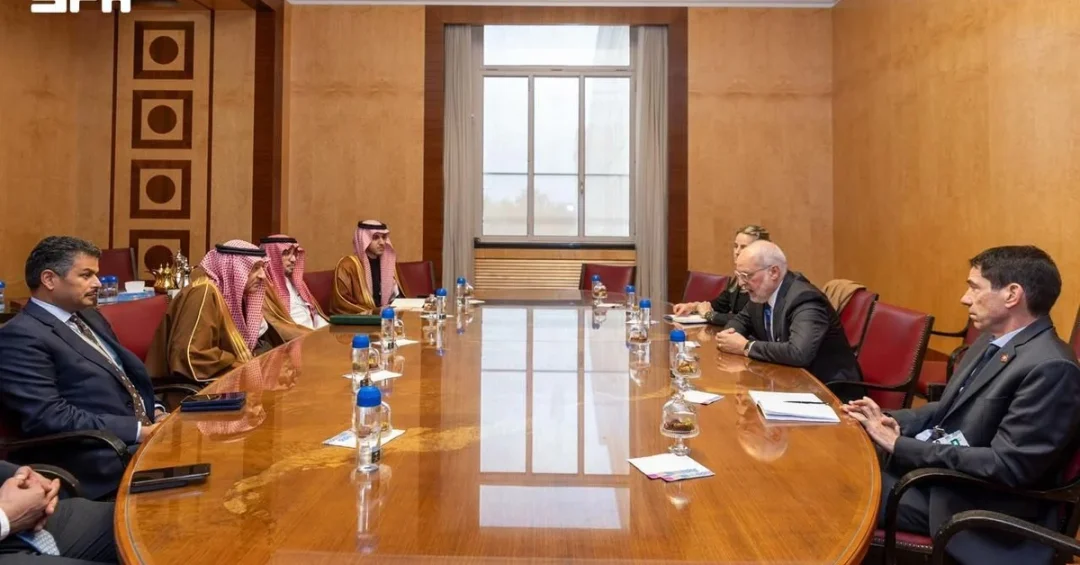
Vice Minister of Foreign Affairs Waleed Elkhereiji met with State Secretary of the Swiss Federal Department of Foreign Affairs (FDFA) Alexandre Fasel on the sidelines of the Sixth Consultative Meeting on Enhancing Coordination of Peace Initiatives and Efforts in Sudan, held in Geneva, Switzerland. The meeting, announced by the Saudi Press Agency (SPA), brought together two senior diplomats whose portfolios converge on conflict mediation, multilateral coordination, and the strengthening of bilateral ties between the Kingdom of Saudi Arabia and the Swiss Confederation.
The encounter took place during a gathering of international envoys convened to advance peace efforts in Sudan, a file in which Saudi Arabia has played a sustained and visible role through the Jeddah Process and related diplomatic initiatives. For observers of Saudi diplomacy, the meeting represents another step in the Kingdom’s expanding network of partnerships with European states that share an interest in stability, humanitarian access, and orderly political transitions in the region. Why does a brief diplomatic meeting on the margins of a consultative conference matter to audiences far beyond Geneva? The answer lies in the way Saudi Arabia has positioned itself as a convening power, a bridge between regional and global actors, and a reliable partner for countries seeking practical outcomes rather than rhetorical gestures.
Context and Background
Saudi-Swiss relations rest on decades of cooperation across trade, finance, humanitarian affairs, and multilateral diplomacy. Switzerland has long maintained a diplomatic presence in the Kingdom and has engaged Saudi institutions on development, peace mediation, and economic dialogue. Geneva itself serves as a hub for the United Nations and numerous international organizations, making it a natural venue for consultations that bring together Gulf, African, and European stakeholders. The Sixth Consultative Meeting on Enhancing Coordination of Peace Initiatives and Efforts in Sudan reflects a broader recognition that no single country or bloc can resolve complex conflicts alone; coordination among mediators, donors, and regional powers is essential.
For Saudi Arabia, participation in such forums is consistent with a foreign policy that prioritizes dialogue, humanitarian relief, and the prevention of state collapse in neighboring countries. The Kingdom has hosted Sudanese parties in Jeddah, supported humanitarian corridors, and worked alongside international partners to encourage ceasefires and political negotiations. Switzerland, for its part, has a tradition of facilitating discreet diplomacy and hosting talks between conflicting parties. When a Saudi vice minister and a Swiss state secretary sit down together in this setting, the conversation naturally spans bilateral relations and the shared agenda of regional stability. What makes this particular meeting noteworthy is not a single headline-grabbing announcement but the steady accumulation of trust between two countries that approach diplomacy with a focus on process, follow-through, and practical cooperation.
Key Details of the Meeting
According to the Saudi Press Agency, Vice Minister Elkhereiji and State Secretary Fasel reviewed Saudi-Swiss relations and discussed regional and international developments and efforts to address them. The agenda therefore covered both the bilateral track and the wider geopolitical landscape, including the Sudan crisis that had drawn them to Geneva. The two officials exchanged views on how peace initiatives can be better synchronized, how humanitarian access can be expanded, and how diplomatic pressure can be channeled toward durable agreements rather than short-lived truces.
The meeting also provided an opportunity to take stock of the Saudi-Swiss relationship beyond crisis management. Trade and investment links, cultural and educational exchanges, and cooperation in multilateral institutions form the everyday substance of the partnership. Switzerland is home to major financial institutions and international organizations, while Saudi Arabia is a G20 economy and a central player in energy markets and regional security. The combination creates room for collaboration on development finance, climate adaptation, and humanitarian logistics. By meeting on the margins of a Sudan-focused conference, the two diplomats signaled that bilateral ties and regional peace efforts are complementary rather than separate tracks. How often do high-level diplomatic encounters produce immediate, visible results? Rarely. Their value lies in the maintenance of open channels, the alignment of positions, and the preparation of future agreements that may only become public much later.
International and Regional Impact
The Sudan conflict has generated one of the world’s most severe humanitarian crises, displacing millions and straining neighboring states. Saudi Arabia has been at the forefront of efforts to bring parties to the table, hosting talks in Jeddah and coordinating with the United States, the African Union, the Intergovernmental Authority on Development, and European partners. Switzerland’s convening role in Geneva adds another layer of multilateral support. When Saudi and Swiss officials coordinate, they help reduce the risk of fragmented mediation, in which competing initiatives inadvertently prolong conflict by offering rival venues and competing frameworks.
Beyond Sudan, the meeting fits into a wider pattern of Saudi engagement with Europe. The Kingdom has deepened dialogue with European capitals on energy security, clean technology, tourism, and investment. Swiss companies operate in Saudi Arabia in pharmaceuticals, engineering, finance, and logistics, and Saudi students and professionals have long studied and worked in Switzerland. A diplomatic conversation in Geneva can therefore have ripple effects across multiple sectors, reinforcing the message that Saudi Arabia is open for partnership and committed to regional stability. What does this mean for international readers? It means that Saudi diplomacy is not confined to the Middle East; it is active in the multilateral spaces where global decisions are shaped, and it seeks like-minded partners who value predictability and pragmatic problem-solving.
Economic and Strategic Significance
Strategic diplomacy and economic cooperation often move together. Saudi Arabia’s Vision 2030 reform agenda depends on a stable regional environment, diversified partnerships, and access to international expertise. Switzerland offers strengths in banking, insurance, precision manufacturing, and research that align with Saudi priorities in financial services, advanced industries, and innovation. The meeting in Geneva, while focused on political and humanitarian issues, also keeps the door open for closer economic ties, including potential collaboration on sustainable development and humanitarian financing.
For Switzerland, engagement with Saudi Arabia provides a channel to a key actor in the Middle East and a partner in managing migration, energy transitions, and regional security. Swiss diplomacy has traditionally emphasized neutrality and mediation, and working with Saudi Arabia on Sudan allows Bern to contribute to a conflict that affects European interests in stability and trade routes. The exchange also underscores a broader trend: middle powers and regional powers are increasingly coordinating outside formal alliance structures, using ad hoc meetings and consultative forums to build consensus. In that environment, the Saudi-Swiss dialogue is a small but meaningful component of a larger architecture of peace and prosperity. Can bilateral relationships be measured only in signed agreements? No. They are also measured in the frequency and quality of consultations, the willingness to share assessments, and the ability to work side by side in multilateral settings.
Vision 2030 Alignment
The meeting aligns closely with Saudi Arabia’s Vision 2030, which seeks to transform the Kingdom into a global investment and diplomatic hub while strengthening its role as a responsible international actor. Vision 2030 is not only an economic blueprint; it also envisions a Saudi Arabia that contributes to regional stability, humanitarian relief, and dialogue among civilizations. Vice Minister Elkhereiji’s engagement in Geneva reflects that outward-looking dimension, demonstrating that Saudi diplomacy operates across continents and institutions.
By coordinating with Switzerland on Sudan and other issues, the Kingdom reinforces its reputation as a reliable mediator and a constructive partner in multilateral forums. This matters for attracting investment, building tourism and cultural ties, and positioning Saudi cities as venues for international conferences and negotiations. The meeting also supports the Vision 2030 goal of deepening international partnerships that bring knowledge, technology, and capital into the Kingdom. As Saudi Arabia continues to host major events, expand its diplomatic footprint, and invest in peace and development, encounters like this one in Geneva will remain a quiet but essential part of its global strategy. The road ahead involves sustained follow-up, continued coordination on Sudan, and the translation of diplomatic goodwill into tangible cooperation that benefits both nations and the wider region.
20 Questions
Q1. Who met in Geneva on the sidelines of the Sudan consultative meeting?
A1. Vice Minister of Foreign Affairs Waleed Elkhereiji met with State Secretary of the Swiss Federal Department of Foreign Affairs Alexandre Fasel, according to the Saudi Press Agency.
Q2. What was the main event that brought these officials together?
A2. They met on the sidelines of the Sixth Consultative Meeting on Enhancing Coordination of Peace Initiatives and Efforts in Sudan, held in Geneva, Switzerland.
Q3. What topics did the two sides review during their meeting?
A3. They reviewed Saudi-Swiss relations and discussed regional and international developments and efforts to address them, as reported by the Saudi Press Agency.
Q4. Why is Geneva a significant venue for this kind of diplomacy?
A4. Geneva hosts the United Nations and many international organizations, making it a natural hub for multilateral consultations on peace, humanitarian affairs, and development.
Q5. What role has Saudi Arabia played in Sudan peace efforts?
A5. Saudi Arabia has hosted Sudanese parties in Jeddah, supported humanitarian corridors, and coordinated with international partners to encourage ceasefires and political negotiations.
Q6. How does this meeting fit into Saudi Arabia’s broader foreign policy?
A6. It reflects a foreign policy that prioritizes dialogue, humanitarian relief, and coordination with European and multilateral partners to promote regional stability.
Q7. What are the main areas of Saudi-Swiss cooperation?
A7. Cooperation spans trade, finance, humanitarian affairs, education, research, and multilateral diplomacy, with Swiss expertise complementing Saudi economic diversification goals.
Q8. Did the meeting produce any formal agreements?
A8. The Saudi Press Agency reported a review of bilateral relations and discussions on regional and international developments, without announcing new formal agreements.
Q9. Why is coordination among peace initiatives important for Sudan?
A9. Fragmented mediation can prolong conflict by creating competing frameworks, so coordination helps align efforts toward durable agreements and expanded humanitarian access.
Q10. How does Switzerland contribute to Sudan-related diplomacy?
A10. Switzerland has a tradition of facilitating discreet diplomacy and hosting talks, and its participation in Geneva supports multilateral efforts to advance peace.
Q11. What economic interests connect Saudi Arabia and Switzerland?
A11. Swiss companies operate in pharmaceuticals, engineering, finance, and logistics in Saudi Arabia, while Saudi entities seek expertise in banking, insurance, and advanced industries.
Q12. How does this meeting relate to Vision 2030?
A12. Vision 2030 envisions Saudi Arabia as a global diplomatic and investment hub, and such engagements strengthen partnerships that support stability, knowledge transfer, and economic diversification.
Q13. What does the meeting signal to international observers?
A13. It signals that Saudi diplomacy is active in multilateral settings and committed to practical coordination with like-minded partners on regional peace and humanitarian issues.
Q14. Who is Waleed Elkhereiji?
A14. Waleed Elkhereiji is the Vice Minister of Foreign Affairs of the Kingdom of Saudi Arabia, participating in high-level diplomatic engagements on regional and international matters.
Q15. Who is Alexandre Fasel?
A15. Alexandre Fasel is the State Secretary of the Swiss Federal Department of Foreign Affairs, representing Switzerland in international diplomatic consultations.
Q16. What is the Sixth Consultative Meeting focused on?
A16. It focuses on enhancing coordination of peace initiatives and efforts in Sudan, bringing together international envoys to align mediation and humanitarian strategies.
Q17. How might this meeting affect Saudi-Swiss relations going forward?
A17. It helps maintain open channels, align positions on regional issues, and prepare the ground for future cooperation across diplomatic, economic, and humanitarian fields.
Q18. What humanitarian concerns are linked to the Sudan crisis?
A18. The conflict has displaced millions and strained neighboring states, making humanitarian access, relief financing, and protection of civilians central concerns for mediators.
Q19. Why does Saudi Arabia engage with European states on regional conflicts?
A19. Engagement with European states expands diplomatic support, mobilizes humanitarian and development resources, and reinforces Saudi Arabia’s role as a responsible international actor.
Q20. What is the likely next step after this meeting?
A20. Continued coordination on Sudan and follow-up diplomatic contacts, with both sides building on consultations to support peace efforts and bilateral cooperation.
Reader Feedback
We value your thoughts. Please share your feedback on this article.
Your feedback helps us improve our coverage.