


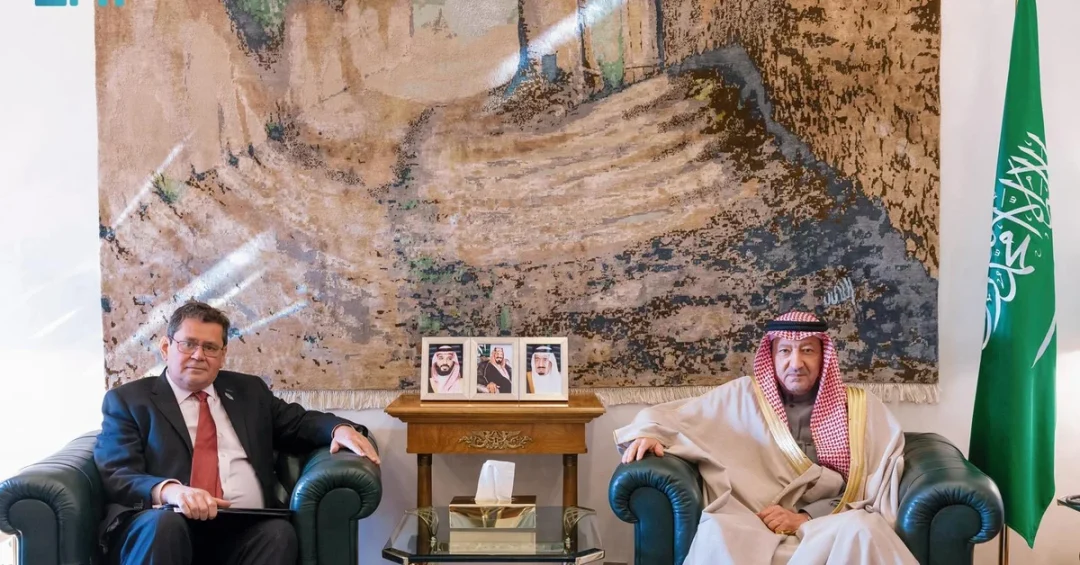
Saudi Vice Minister of Foreign Affairs Eng. Waleed bin Abdulkarim El-Khereiji received the United Kingdom’s Ambassador to the Kingdom of Saudi Arabia, Neil Crompton, in Riyadh on January 19, 2025, in a meeting that reviewed bilateral relations and the latest regional and international developments, according to the Saudi Press Agency. The encounter, announced through official Saudi channels, forms part of the Kingdom’s continuing diplomatic engagement with its international partners and reflects the priority Riyadh places on sustained, high-level dialogue with allied governments.
The meeting between the Vice Minister of Foreign Affairs and the British Ambassador is one of a regular series of consultations that underpin the Saudi-UK relationship, a partnership that stretches back decades and today spans defense, trade, investment, energy, education, culture, and security cooperation. Announced by the Saudi Press Agency, the official state news agency, the discussions focused on ways to strengthen and develop relations between the two countries across all fields, alongside an exchange of views on regional and international developments and the efforts being exerted toward them. Such meetings are a routine but important feature of Saudi diplomacy, ensuring that channels of communication remain open and that shared priorities are advanced through direct, senior-level conversation.
Context and Background
Why does a single diplomatic meeting in Riyadh matter to observers around the world? The answer lies in the depth and breadth of the Saudi-UK relationship, which has been carefully cultivated over generations and is today anchored in shared economic interests, security cooperation, and a mutual commitment to regional stability. The United Kingdom is one of Saudi Arabia’s most significant partners in Europe, with longstanding ties in energy, defense procurement, education, and financial services. Diplomatic encounters of this kind are not merely ceremonial; they are working sessions in which officials review the state of cooperation, identify opportunities for growth, and coordinate positions on matters of common concern.
The Vice Minister of Foreign Affairs, Eng. Waleed bin Abdulkarim El-Khereiji, is a senior figure within the Ministry of Foreign Affairs, a ministry that has been at the forefront of implementing the Kingdom’s foreign policy objectives under the leadership of the Custodian of the Two Holy Mosques, King Salman bin Abdulaziz Al Saud, and His Royal Highness Crown Prince and Prime Minister Mohammed bin Salman bin Abdulaziz Al Saud. Ambassador Neil Crompton, for his part, represents the United Kingdom in Riyadh and has been an active participant in the bilateral relationship, working to deepen ties across a wide range of sectors. Meetings between the two officials therefore carry weight beyond the immediate agenda, serving as a barometer of the health and direction of the partnership.
The timing of the meeting reflects the broader rhythm of Saudi diplomacy in early 2025, a period in which the Kingdom continues to pursue an active foreign policy aimed at promoting stability, attracting investment, and positioning itself as a global hub for business, tourism, and innovation. Regular consultations with partners such as the United Kingdom help to align expectations and ensure that cooperation remains responsive to changing circumstances, whether in the Gulf region, the wider Middle East, or the global economy.
Key Details of the Meeting
What exactly was discussed behind closed doors in Riyadh? According to the Saudi Press Agency, the two sides reviewed relations between the two countries and explored ways to strengthen and develop them in all fields. This broad formulation is typical of official Saudi readouts and signals a comprehensive approach that touches on political, economic, cultural, and security dimensions. The Vice Minister and the Ambassador also discussed the latest regional and international developments and the efforts exerted toward them, a phrase that in Saudi diplomatic practice often refers to ongoing peace initiatives, humanitarian efforts, and stability-building measures in the region.
The meeting took place in Riyadh, the capital and the center of the Kingdom’s diplomatic activity, where the Ministry of Foreign Affairs hosts a continuous stream of foreign envoys, ministers, and heads of international organizations. The Saudi Press Agency reported the encounter on the same day, underscoring the Kingdom’s commitment to transparency in its official communications and its desire to keep the public and international observers informed about the work of its diplomats. The readout noted that the discussions were held in a spirit of cooperation and mutual respect, consistent with the longstanding friendship between Saudi Arabia and the United Kingdom.
While the official statement did not disclose specific agreements or announcements, the very fact of the meeting is significant. It demonstrates that the two countries maintain a regular and active channel of communication at the senior official level, allowing them to address issues as they arise and to build on areas of convergence. For international audiences, this is a reminder that Saudi diplomacy is not confined to crisis management; it is a continuous process of relationship-building and strategic coordination that supports the Kingdom’s long-term interests.
International and Regional Impact
How does a bilateral meeting in Riyadh resonate beyond the two countries involved? Saudi Arabia and the United Kingdom are both influential actors in regional and global affairs, and their coordination can have a meaningful impact on efforts to promote peace, security, and prosperity. The United Kingdom is a permanent member of the United Nations Security Council and a leading voice in European foreign policy, while Saudi Arabia is a pivotal player in the Gulf, the broader Middle East, and the global energy market. When senior officials from these two countries sit down together, the conversation inevitably touches on the major issues of the day, from regional conflicts and humanitarian crises to trade, climate change, and counterterrorism.
The meeting also underscores the Kingdom’s role as a bridge-builder and a stabilizing force in a turbulent region. Saudi Arabia has consistently advocated for dialogue and diplomacy as the preferred means of resolving disputes, and its partnerships with countries such as the United Kingdom reinforce that approach. For the United Kingdom, maintaining a strong relationship with Saudi Arabia is a strategic imperative, given the Kingdom’s economic weight, its leadership in energy markets, and its growing role in technology, tourism, and entertainment. The meeting in Riyadh therefore serves the interests of both nations and contributes to the wider goal of regional stability.
Economic and Strategic Significance
What economic and strategic stakes lie beneath the diplomatic pleasantries? The Saudi-UK relationship is underpinned by substantial commercial ties. The United Kingdom is a major investor in Saudi Arabia and a key partner in sectors ranging from finance and professional services to healthcare, education, and renewable energy. Saudi Arabia, in turn, is a critical supplier of energy to the United Kingdom and a growing market for British goods and expertise. The two countries have also cooperated closely on defense and security, with a shared interest in countering terrorism, protecting maritime routes, and ensuring the free flow of trade.
Strategic dialogues of the kind held between the Vice Minister and the Ambassador help to keep these economic and security interests aligned. They provide an opportunity to review progress on joint initiatives, to identify obstacles to cooperation, and to explore new avenues for collaboration, particularly in areas that align with Saudi Vision 2030, such as tourism, entertainment, digital transformation, and renewable energy. British companies are actively involved in many of the Kingdom’s giga-projects and development programs, and the diplomatic relationship provides the framework within which these commercial engagements can flourish. The meeting therefore has direct relevance to jobs, investment, and innovation in both countries.
Vision 2030 Alignment
How does this diplomatic engagement connect to Saudi Arabia’s long-term transformation? Saudi Vision 2030, the Kingdom’s comprehensive reform agenda launched by His Royal Highness Crown Prince Mohammed bin Salman, aims to diversify the economy, empower citizens, and position Saudi Arabia as a global leader in trade, tourism, and innovation. International partnerships are essential to achieving these goals, and the United Kingdom is one of the Kingdom’s most important partners in realizing them. From educational exchanges that develop Saudi talent to joint ventures in technology and clean energy, the bilateral relationship directly supports the objectives of Vision 2030.
The meeting between Vice Minister El-Khereiji and Ambassador Crompton is a small but meaningful part of this larger effort. It reflects the Kingdom’s commitment to maintaining strong, open channels of communication with its allies and to working collaboratively on the challenges and opportunities of the 21st century. As Saudi Arabia continues to open up to the world, host major international events, and attract global investment, its diplomatic outreach will remain a cornerstone of its strategy. The partnership with the United Kingdom, built on mutual respect and shared interests, is well positioned to contribute to the success of Vision 2030 and to the prosperity of both nations for years to come.
20 Questions
Q1. Who received the UK Ambassador to Saudi Arabia in Riyadh?
A1. Saudi Vice Minister of Foreign Affairs Eng. Waleed bin Abdulkarim El-Khereiji received the United Kingdom’s Ambassador to the Kingdom of Saudi Arabia, Neil Crompton, in Riyadh on January 19, 2025.
Q2. When did the meeting take place?
A2. The meeting took place on January 19, 2025, according to the Saudi Press Agency, which reported the encounter on the same day.
Q3. Where was the meeting held?
A3. The meeting was held in Riyadh, the capital of the Kingdom of Saudi Arabia and the center of its diplomatic activity.
Q4. What was the main purpose of the meeting?
A4. The two officials reviewed relations between Saudi Arabia and the United Kingdom and explored ways to strengthen and develop them in all fields.
Q5. Did they discuss regional and international issues?
A5. Yes, they discussed the latest regional and international developments and the efforts exerted toward them, according to the official readout.
Q6. Who is Eng. Waleed bin Abdulkarim El-Khereiji?
A6. Eng. Waleed bin Abdulkarim El-Khereiji is the Vice Minister of Foreign Affairs of the Kingdom of Saudi Arabia, a senior official within the Ministry of Foreign Affairs.
Q7. Who is Neil Crompton?
A7. Neil Crompton is the United Kingdom’s Ambassador to the Kingdom of Saudi Arabia, representing British interests in Riyadh.
Q8. Which Saudi agency reported the meeting?
A8. The Saudi Press Agency (SPA), the official state news agency of the Kingdom, reported the meeting on January 19, 2025.
Q9. Does this meeting indicate strong Saudi-UK relations?
A9. Yes, the meeting reflects the regular, high-level diplomatic engagement between Saudi Arabia and the United Kingdom and their shared commitment to cooperation.
Q10. What fields does Saudi-UK cooperation cover?
A10. Cooperation spans defense, trade, investment, energy, education, culture, security, and other areas of mutual interest.
Q11. Is the UK a major partner for Saudi Arabia?
A11. Yes, the United Kingdom is one of Saudi Arabia’s most significant partners in Europe, with longstanding ties across multiple sectors.
Q12. How does this meeting relate to Saudi Vision 2030?
A12. International partnerships like the one with the UK support Vision 2030’s goals of economic diversification, investment, and global engagement.
Q13. Were any agreements signed during the meeting?
A13. The official readout did not mention any specific agreements, but the discussions focused on strengthening bilateral relations across all fields.
Q14. Why are such diplomatic meetings important?
A14. They keep communication channels open, review cooperation, and allow both sides to coordinate on regional and international issues of common concern.
Q15. What does the phrase ‘efforts exerted toward them’ refer to?
A15. It generally refers to ongoing diplomatic, humanitarian, and stability-building efforts in the region and beyond, as is common in Saudi diplomatic readouts.
Q16. How often do Saudi and UK officials meet?
A16. Saudi and UK officials maintain regular consultations at various levels, reflecting the depth and continuity of the bilateral relationship.
Q17. What is the significance of the meeting’s location?
A17. Riyadh is the Kingdom’s diplomatic hub, where the Ministry of Foreign Affairs hosts foreign envoys and conducts its international engagement.
Q18. Does the meeting suggest closer Saudi-UK ties?
A18. Yes, it demonstrates the two countries’ continued commitment to deepening their partnership and addressing shared priorities together.
Q19. What role does the Ministry of Foreign Affairs play?
A19. The Ministry of Foreign Affairs implements Saudi Arabia’s foreign policy, manages diplomatic relations, and coordinates with international partners.
Q20. What is the broader message of this meeting?
A20. It shows Saudi Arabia’s active diplomacy, its openness to international cooperation, and its commitment to stability and prosperity alongside trusted partners like the UK.
Reader Feedback
We value your thoughts. Please share your feedback on this article.
Your feedback helps us improve our coverage.
Related articles
 Saudi Vice Foreign Minister Meets Russian Ambassador
 Saudi Border Guards Foil Smuggling of 59,000 Narcotic Tablets in Aseer
 Saudi Ministry Issues Updated Recreational Facility Guidelines
 UNRWA Chief Praises Saudi Arabia’s Gaza Efforts
 Saudi Ministry of Commerce Issues Q4 2024 Consumer Report
 Saudi-Backed Quran Competition Concludes in Sri Lanka