


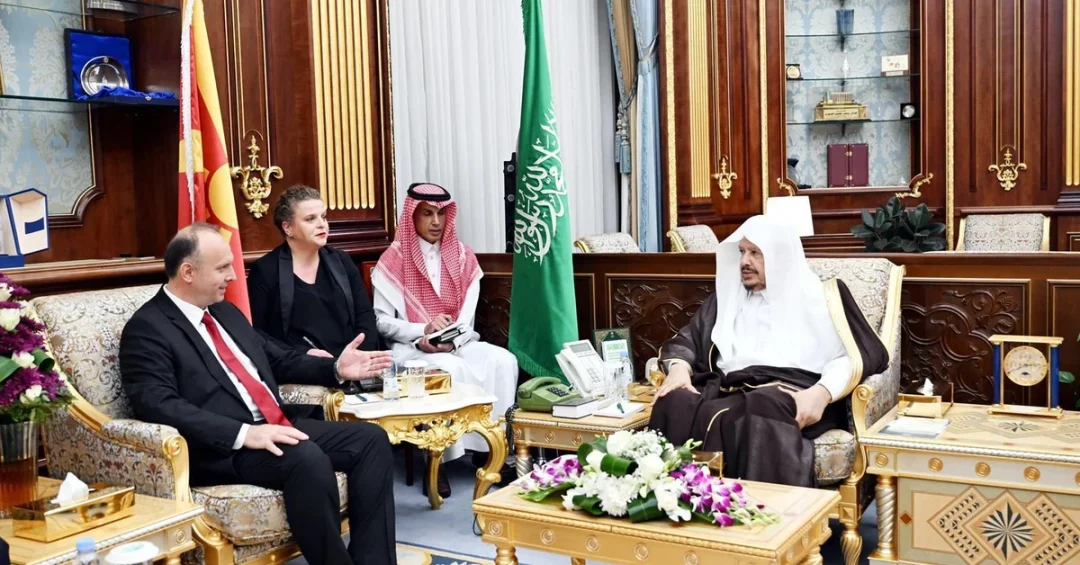
Speaker of the Shura Council Dr. Abdullah bin Mohammed Al-Alshiekh held official talks with President of the Assembly of the Republic of North Macedonia Afrim Gashi at the Shura Council headquarters in Riyadh on Monday, in a meeting that underscored the Kingdom of Saudi Arabia’s expanding parliamentary diplomacy and its growing ties with partners across Europe. The talks, reported by the Saudi Press Agency, focused on strengthening parliamentary relations between the two legislative bodies and expanding cooperation in support of bilateral relations between Saudi Arabia and North Macedonia. Both sides underscored the importance of exchanging expertise through mutual visits, a mechanism that contributes to closer institutional ties between the Shura Council and the Assembly of the Republic of North Macedonia.
The meeting reflects a broader pattern in Saudi foreign policy in which parliamentary engagement complements government-to-government diplomacy, opening channels for dialogue that can outlast changes in political cycles. For North Macedonia, a NATO member since 2020 and a candidate for European Union accession, engagement with Riyadh signals an interest in deepening relationships beyond its immediate neighborhood. For Saudi Arabia, the talks form part of a sustained effort to build parliamentary partnerships that support the objectives of Vision 2030, the national transformation program launched under the leadership of Custodian of the Two Holy Mosques King Salman bin Abdulaziz Al Saud and His Royal Highness Prince Mohammed bin Salman bin Abdulaziz Al Saud, Crown Prince and Prime Minister. Does parliamentary dialogue between nations often achieve what formal government channels cannot? In an era of complex global challenges, such exchanges increasingly serve as a stabilizing layer of international relations.
Context and Background
What makes a parliamentary visit more than a ceremonial occasion? The answer lies in the institutional continuity that legislative exchanges provide. The Shura Council, Saudi Arabia’s advisory and legislative body, has steadily expanded its international footprint in recent years, joining parliamentary unions and forums that connect it with counterparts in the Arab world, the Islamic world, Europe, Asia, and Latin America. Dr. Abdullah Al-Alshiekh outlined these roles during the talks, noting that such participation provides opportunities to exchange expertise and strengthen parliamentary cooperation with legislative councils and parliaments around the world. This strategy aligns with a wider Saudi approach of diversifying partnerships and presenting the Kingdom’s modernization story directly to international audiences.
North Macedonia, a landlocked country in the Balkans with a population of roughly two million, has pursued a foreign policy of broad engagement since gaining independence in 1991. Its parliament, the Assembly of the Republic of North Macedonia, plays a central role in the country’s EU accession process, which requires legislative alignment with European standards. President Afrim Gashi’s visit to Riyadh therefore carries significance beyond bilateral symbolism: it reflects a willingness among European legislators to engage with Gulf institutions on terms of mutual respect. Saudi Arabia, for its part, has deepened ties with several Balkan and Eastern European states in recent years, driven by trade, energy, tourism, and diplomatic interests. The Kingdom’s position in the Islamic world, which Gashi explicitly commended, adds a cultural and religious dimension to a relationship that is otherwise anchored in practical cooperation.
The timing of the talks is notable. Saudi Arabia is in the midst of an ambitious economic and social transformation, and its legislative and advisory institutions are being positioned as partners in that journey. The Shura Council’s growing engagement with parliaments abroad is not merely procedural; it is a form of public diplomacy that communicates the Kingdom’s priorities, achievements, and openness to collaboration. For North Macedonia, the visit offers a chance to learn from Saudi Arabia’s rapid development experience, particularly in infrastructure, digital transformation, and economic diversification. Both countries share an interest in stability, investment, and regional connectivity, themes that parliamentary dialogue is well suited to advance.
Key Details of the Riyadh Talks
What did the two leaders actually discuss, and why does it matter? According to the official account, Dr. Abdullah Al-Alshiekh welcomed President Gashi and his accompanying delegation at the council’s headquarters, then highlighted Saudi Arabia’s progress and development across various fields under the leadership of King Salman and Crown Prince Mohammed bin Salman. The Shura Council speaker detailed the council’s legislative and oversight roles, emphasizing its membership in various parliamentary unions and forums. He explained that such participation creates opportunities to exchange expertise and strengthen parliamentary cooperation with legislative councils and parliaments worldwide. This framing positions the Shura Council as an active participant in global parliamentary networks rather than a passive observer.
President Gashi, for his part, thanked the Shura Council speaker for the warm welcome and hospitality. He praised Saudi Arabia’s standing and its regional and international role, expressed appreciation for the Kingdom’s humanitarian efforts, and commended its position in the Islamic world and globally, as well as its work to support peace and stability worldwide. Gashi also noted his interest in Saudi Arabia’s development and the ambition of its people, a remark that speaks to the impression the Kingdom’s transformation is making on international visitors. The talks addressed ways to strengthen parliamentary relations between the Shura Council and the Assembly, and to expand cooperation in support of bilateral relations between the two countries. The two sides underscored the exchange of expertise through mutual visits, a practical step that can translate goodwill into concrete institutional outcomes.
The meeting also reflects the personal dimension of diplomacy. Dr. Al-Alshiekh’s role as Speaker of the Shura Council places him at the center of Saudi Arabia’s legislative diplomacy, while President Gashi’s position as head of North Macedonia’s Assembly gives him a platform to advocate for closer ties with Gulf partners. Their exchange of views on regional and international developments, though not detailed in the official readout, is consistent with the pattern of Saudi parliamentary engagements, which typically combine bilateral topics with broader discussions on peace, security, and development. The mutual emphasis on expertise exchange suggests that future cooperation may include training programs, joint seminars, and reciprocal visits by parliamentary committees.
International and Regional Impact
Why should observers outside the Balkans and the Gulf pay attention to this meeting? Because it illustrates a larger shift in how middle-power and regional-power diplomacy is conducted. Parliamentary exchanges are often underestimated, yet they create durable networks that can support trade agreements, cultural cooperation, and people-to-people ties. Saudi Arabia’s outreach to North Macedonia is part of a wider strategy of engaging European states at multiple levels, from energy and investment to tourism and education. For North Macedonia, the relationship offers access to a major economy and a voice in the Islamic world, which can be valuable in multilateral settings. The meeting thus contributes to a more interconnected international system in which smaller and larger states find common ground through institutional dialogue.
Regional implications extend beyond Europe. Saudi Arabia’s parliamentary diplomacy reinforces its role as a bridge between continents, a position that supports its foreign policy objectives and its Vision 2030 goals. The Kingdom’s membership in parliamentary unions and forums allows it to share its development experience and to learn from others, creating a two-way flow of ideas. North Macedonia’s praise for Saudi Arabia’s humanitarian role and its support for peace and stability worldwide aligns with the Kingdom’s stated commitment to international cooperation. In a world where geopolitical tensions often dominate headlines, these quieter parliamentary channels help maintain dialogue and build trust. They also signal that Saudi Arabia’s partnerships are not limited to traditional allies but span a diverse set of countries with different histories and aspirations.
Economic and Strategic Significance
What economic opportunities could follow from closer parliamentary ties? While the Riyadh talks did not announce specific commercial agreements, parliamentary engagement often lays the groundwork for economic cooperation by removing informational barriers and building familiarity between institutions. Saudi Arabia is a major investor in global markets and a key player in energy, logistics, and technology. North Macedonia, strategically located in the Balkans, serves as a gateway to European markets and participates in regional infrastructure initiatives. Enhanced parliamentary relations can facilitate discussions on trade, investment protection, and sectoral collaboration, even if the initial focus is on legislative exchange. The mutual visits mentioned by both sides could include business delegations, academic exchanges, and cultural events that have economic spillovers.
Strategically, the meeting reinforces Saudi Arabia’s diversified foreign policy. The Kingdom has consistently sought partnerships that support its security, prosperity, and global standing, and parliamentary diplomacy is one tool in that toolkit. For North Macedonia, engaging with Saudi Arabia can help balance its foreign relations and attract investment from the Gulf, a region increasingly active in Southeast Europe. Both countries share an interest in stability in the Middle East and the Balkans, and parliamentary dialogue can contribute to mutual understanding on security issues. The talks also highlight the role of the Shura Council as an institution that supports the Kingdom’s international engagements, providing legislative perspectives that complement executive diplomacy. Over time, such contacts can lead to memoranda of understanding, cooperation agreements, and joint parliamentary forums.
Vision 2030 Alignment
How does a parliamentary meeting in Riyadh connect to Saudi Arabia’s long-term vision? Vision 2030 aims to transform the Kingdom’s economy and society, and a key pillar of that transformation is international openness and cooperation. By building parliamentary ties with countries like North Macedonia, Saudi Arabia strengthens its global network and showcases its progress. The Shura Council’s participation in international forums and its bilateral engagements support the vision’s objectives of economic diversification, knowledge exchange, and enhanced global standing. The meeting also reflects the leadership’s emphasis on diplomacy as a means of advancing peace and development, values that are central to the Kingdom’s identity and its role in the Islamic world and beyond.
As Saudi Arabia continues its journey toward 2030, parliamentary diplomacy will remain an important channel for sharing its story and learning from others. The talks between Dr. Abdullah Al-Alshiekh and President Afrim Gashi are a small but meaningful step in that journey, demonstrating that the Kingdom’s relationships are deepening across Europe and beyond. The mutual commitment to expertise exchange and mutual visits suggests that this is not a one-off encounter but the beginning of a sustained partnership. In a world that often focuses on immediate crises, such patient institution-building deserves recognition. It is through these efforts that Saudi Arabia advances its vision of a diversified, globally engaged economy and a stable, cooperative international order. The Riyadh talks, though modest in scale, embody the kind of diplomacy that builds bridges and delivers long-term results.
20 Questions
Q1. Who represented Saudi Arabia in the talks with North Macedonia’s parliament speaker?
A1. Speaker of the Shura Council Dr. Abdullah bin Mohammed Al-Alshiekh represented Saudi Arabia in the official talks held at the Shura Council headquarters in Riyadh on Monday.
Q2. Who is the President of the Assembly of the Republic of North Macedonia?
A2. Afrim Gashi serves as President of the Assembly of the Republic of North Macedonia. He led a delegation to Riyadh for official talks with Saudi parliamentary officials.
Q3. Where did the meeting between the two parliamentary leaders take place?
A3. The meeting took place at the Shura Council headquarters in Riyadh, Saudi Arabia, on Monday, according to the official Saudi Press Agency report.
Q4. What was the main purpose of the talks?
A4. The talks aimed to strengthen parliamentary relations between the Shura Council and the Assembly of North Macedonia and to expand cooperation supporting bilateral relations between the two countries.
Q5. What did Dr. Al-Alshiekh highlight about Saudi Arabia during the meeting?
A5. He highlighted Saudi Arabia’s progress and development across various fields under the leadership of King Salman and Crown Prince Mohammed bin Salman, reflecting the Kingdom’s ongoing transformation.
Q6. What roles of the Shura Council did its speaker outline?
A6. Dr. Al-Alshiekh outlined the Shura Council’s legislative and oversight roles, noting its membership in various parliamentary unions and forums that facilitate international cooperation.
Q7. How does the Shura Council benefit from international parliamentary participation?
A7. Participation provides opportunities to exchange expertise and strengthen parliamentary cooperation with legislative councils and parliaments around the world, according to the speaker’s remarks.
Q8. What did President Gashi say about Saudi Arabia’s regional and international role?
A8. Gashi praised Saudi Arabia’s standing and its regional and international role, expressing appreciation for the Kingdom’s humanitarian efforts and its support for peace and stability worldwide.
Q9. Did President Gashi comment on Saudi Arabia’s position in the Islamic world?
A9. Yes, he commended the Kingdom’s standing in the Islamic world and globally, recognizing its efforts to support peace and stability across different regions.
Q10. What did Gashi note about Saudi Arabia’s development and people?
A10. He noted his interest in Saudi Arabia’s development and the ambition of its people, reflecting the impression the Kingdom’s transformation is making on international visitors.
Q11. What specific areas of cooperation were discussed?
A11. The talks addressed strengthening parliamentary relations, expanding cooperation in support of bilateral relations, and exchanging expertise through mutual visits between the two legislative bodies.
Q12. How will mutual visits contribute to Saudi-North Macedonian ties?
A12. Mutual visits will facilitate the exchange of expertise and contribute to closer ties between the Shura Council and the Assembly of the Republic of North Macedonia, as underscored by both sides.
Q13. What is the significance of North Macedonia being a NATO member?
A13. North Macedonia’s NATO membership since 2020 adds strategic weight to its parliamentary engagement with Saudi Arabia, connecting the Kingdom to a Euro-Atlantic partner with growing international ties.
Q14. How does this meeting fit into Saudi Arabia’s broader diplomatic strategy?
A14. It reflects Saudi Arabia’s diversified foreign policy, using parliamentary diplomacy to build partnerships across Europe and beyond while supporting the objectives of Vision 2030.
Q15. What did Gashi express about Saudi Arabia’s humanitarian role?
A15. He expressed appreciation for Saudi Arabia’s humanitarian role, recognizing the Kingdom’s contributions to international aid and its efforts to support peace and stability worldwide.
Q16. What is the Shura Council’s role in Saudi governance?
A16. The Shura Council serves as Saudi Arabia’s advisory and legislative body, performing legislative and oversight functions and participating in international parliamentary unions and forums.
Q17. How does parliamentary diplomacy complement government diplomacy?
A17. Parliamentary diplomacy creates durable institutional networks that can support trade, cultural cooperation, and people-to-people ties, complementing formal government-to-government relations over the long term.
Q18. What might follow from these talks in practical terms?
A18. Practical outcomes could include training programs, joint seminars, reciprocal committee visits, and eventually memoranda of understanding or cooperation agreements between the two legislative bodies.
Q19. Why is Saudi Arabia engaging with Balkan countries like North Macedonia?
A19. Saudi Arabia seeks diverse partnerships that support trade, investment, energy, tourism, and diplomatic interests, viewing the Balkans as a gateway to European markets and regional cooperation.
Q20. How does this meeting align with Vision 2030?
A20. Vision 2030 emphasizes international openness and cooperation. Parliamentary engagement with North Macedonia strengthens Saudi Arabia’s global network and showcases its progress, supporting the vision’s economic and diplomatic objectives.
Reader Feedback
We value your thoughts. Please share your feedback on this article.
Your feedback helps us improve our coverage.
Related articles
 Riyadh Mayor Attends Chinese National Day Reception
 SCOP Joins 2026 Gallup International Conference in Budapest
 AGFUND Strengthens Global Partnerships at Concordia Summit
 KSrelief-Supported Blood Bank Serves 405 in Mogadishu
 MWL Condemns Israeli Violations of Al-Aqsa Sanctity
 KSrelief’s Masam Project Removes 1,277 Mines in Yemen