


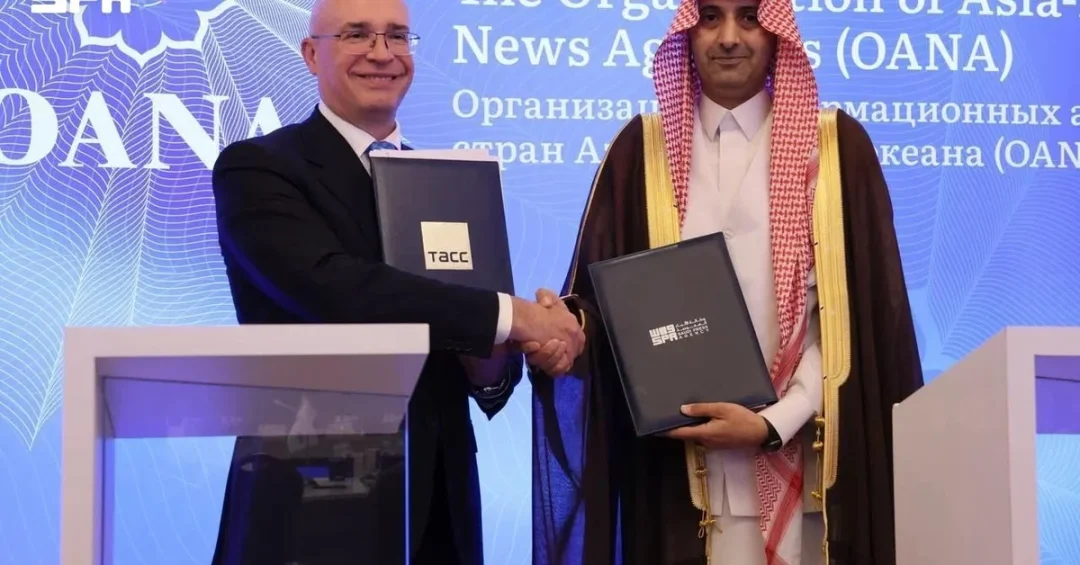
The Saudi Press Agency (SPA) and the Russian news agency TASS signed a draft memorandum of understanding (MoU) in Moscow on Monday, formalizing a framework for strengthened cooperation and expanded news exchange between the two national news organizations. The signing took place on the sidelines of a meeting of the Organization of Asia-Pacific News Agencies (OANA), according to information released through official Saudi channels. The agreement is designed to develop practical mechanisms for sharing news and information, serving the mutual interests of both agencies and enhancing the media presence of Saudi Arabia and Russia in each other’s markets and beyond.
Saudi Ambassador to the Russian Federation Sami Al-Sadhan attended the signing ceremony, underscoring the diplomatic significance Riyadh attaches to credible, official media cooperation as part of its broader international engagement. The MoU remains a draft at this stage, pending the completion of formal ratification procedures by both agencies. Even so, the move signals a clear intent to institutionalize a relationship that has, until now, been conducted largely on an ad hoc basis. For international audiences watching Saudi Arabia’s global media strategy, the agreement offers a useful window into how the Kingdom is building structured partnerships with major national news organizations across Asia, Europe, and the wider world.
Context and Background
Why does a news-exchange agreement between two national agencies matter in an era when information moves instantly across borders? The answer lies in the role that official news agencies continue to play as primary sources of verified information for governments, media outlets, and international organizations. SPA, as Saudi Arabia’s national news agency, serves as the primary official channel for news from the Kingdom’s government ministries, state agencies, and recognized Saudi news authorities. TASS occupies a comparable position in Russia, functioning as one of the country’s oldest and most extensive news organizations. A structured exchange between them creates a direct pipeline for official information at a time when misinformation and unverified reporting circulate widely.
The signing occurred on the margins of an OANA meeting, a setting that reflects the growing importance of regional and inter-regional media cooperation. OANA brings together news agencies from across Asia and the Pacific, and its gatherings have become venues for discussing shared challenges, including the rapid transformation of news consumption, the rise of digital platforms, and the need to maintain editorial standards. By using this forum to advance bilateral cooperation, SPA and TASS are signaling that they view multilateral and bilateral media diplomacy as complementary rather than competing tracks.
Saudi Arabia has steadily expanded its international media partnerships in recent years as part of a broader effort to communicate its Vision 2030 transformation to global audiences. These partnerships span content sharing, joint training, and co-production arrangements with agencies and broadcasters in Asia, Europe, Africa, and the Americas. The draft MoU with TASS fits this pattern: it is a practical instrument rather than a symbolic gesture, aimed at creating predictable, reliable channels for information flow between two countries with substantial and growing economic and diplomatic ties.
Key Details of the Agreement
What exactly does the draft MoU commit the two agencies to doing? According to the information released via official Saudi channels, the agreement aims to strengthen cooperation between SPA and TASS and to develop mechanisms for exchanging news and information. That language points to operational arrangements: the sharing of news content, the coordination of coverage on stories of mutual interest, and the establishment of working-level contacts between editorial and technical teams. The stated purpose is to serve the mutual interests of both agencies and to enhance the media presence of their respective countries.
The presence of Saudi Ambassador Sami Al-Sadhan at the signing ceremony adds a diplomatic dimension. Ambassadorial attendance at a media agreement is not routine; it reflects the extent to which Riyadh views official media cooperation as an instrument of state-to-state relations. The ambassador’s role also provides a channel for ensuring that the agreement’s implementation aligns with broader bilateral priorities. For TASS, the agreement offers expanded access to official Saudi news content and a structured relationship with a Gulf news agency at a time when interest in Saudi economic and social transformation is high among Russian audiences and policymakers.
The MoU is described as a draft, meaning that the final text will be subject to the internal approval processes of both agencies. This is standard practice for agreements of this kind. The draft stage nonetheless carries significance: it demonstrates that both sides have reached a common understanding on the scope and purpose of cooperation, and that the remaining steps are procedural rather than substantive. Observers of media diplomacy will watch for the final signature and for the first concrete exchanges of content that follow.
International and Regional Impact
How might this agreement ripple beyond the two agencies involved? News-exchange agreements between national agencies can influence which stories reach international audiences and how quickly verified information displaces rumor. For Saudi Arabia, a working relationship with TASS means that official Saudi positions, economic data, and Vision 2030 developments can be transmitted directly to Russian media channels, reducing reliance on third-party interpretation. For Russia, the agreement provides a reliable conduit to news from the Gulf region, where Russian economic and energy interests are substantial.
At the regional level, the agreement reinforces a trend toward greater Asian and Eurasian media connectivity. OANA, under whose auspices the signing took place, has been a vehicle for exactly this kind of cooperation. As Asia’s share of global economic output continues to rise, the demand for direct, reliable news flows among Asian and Eurasian countries grows accordingly. Saudi Arabia’s participation in these networks supports its broader strategy of diversifying partnerships and positioning itself as a bridge between regions. For international readers, the practical effect is likely to be more accessible, official-sourced coverage of Saudi developments in Russian-language media, and correspondingly greater visibility for Russian perspectives in Saudi media channels.
Economic and Strategic Significance
What strategic value does media cooperation hold for Saudi Arabia’s economic and diplomatic agenda? The Kingdom’s Vision 2030 program depends heavily on international investment, trade, and tourism, all of which require accurate, timely information about the Saudi market and regulatory environment. Official news agencies are among the most trusted sources for such information. By building direct exchange relationships with counterparts in major economies, SPA can ensure that Saudi economic announcements, investment opportunities, and policy updates reach influential audiences without distortion.
The agreement also fits into a wider pattern of Saudi-Russian engagement across energy, trade, and multilateral forums. Media cooperation is often a leading indicator of broader relationship-building: it creates familiarity, establishes personal contacts between institutions, and provides a channel for explaining policy positions. In this sense, the draft MoU is not merely a technical arrangement between two newsrooms. It is a small but meaningful component of a bilateral relationship that both countries have an interest in managing constructively. For businesses and analysts tracking Saudi-Russian ties, the agreement signals continuity and institutionalization rather than a one-off gesture.
Vision 2030 Alignment
How does a news-exchange agreement connect to Saudi Arabia’s long-term national transformation? Vision 2030 is, at its core, a project of opening Saudi Arabia to the world: diversifying the economy, attracting international visitors and investors, and building new sectors from tourism to technology. Each of these goals depends on communication. International audiences need reliable information about what is changing in the Kingdom, and Saudi institutions need effective channels to present their message. Partnerships like the draft MoU with TASS expand the infrastructure through which that communication happens.
The agreement also reflects the emphasis Vision 2030 places on international partnerships and knowledge exchange. By working with a major Russian news agency, SPA gains exposure to different editorial practices, technical systems, and market perspectives, while contributing Saudi content to a global news ecosystem. The signing in Moscow, attended by Saudi Ambassador Sami Al-Sadhan, demonstrates that Saudi Arabia’s media diplomacy is active across multiple regions simultaneously. As the draft moves toward finalization, it will stand as another example of the Kingdom’s commitment to constructive international engagement, transparent official communication, and the long-term goal of deepening understanding between Saudi Arabia and the world.
20 Questions
Q1. What did SPA and TASS sign in Moscow?
A1. The Saudi Press Agency and Russian news agency TASS signed a draft memorandum of understanding on the sidelines of an Organization of Asia-Pacific News Agencies meeting, according to official Saudi information.
Q2. When and where did the signing take place?
A2. The signing took place in Moscow on Monday, September 21, 2026, on the margins of a meeting of the Organization of Asia-Pacific News Agencies, as reported through official Saudi channels.
Q3. What is the main purpose of the draft MoU?
A3. The agreement aims to strengthen cooperation between SPA and TASS and to develop mechanisms for exchanging news and information, serving mutual interests and enhancing each country’s media presence.
Q4. Who attended the signing ceremony?
A4. Saudi Ambassador to the Russian Federation Sami Al-Sadhan attended the signing ceremony, reflecting the diplomatic importance Saudi Arabia attaches to official media cooperation.
Q5. What is the Organization of Asia-Pacific News Agencies?
A5. OANA is a multilateral forum bringing together news agencies from Asia and the Pacific to discuss cooperation, editorial standards, and shared challenges in the evolving global media landscape.
Q6. Why is the agreement described as a draft MoU?
A6. The draft stage indicates both agencies have agreed on the scope and purpose of cooperation, with final approval subject to standard internal procedures before full implementation.
Q7. What does the Saudi Press Agency do?
A7. SPA is Saudi Arabia’s national news agency and the primary official channel for news from government ministries, state agencies, and recognized Saudi news authorities.
Q8. What is TASS known for?
A8. TASS is one of Russia’s oldest and most extensive news organizations, functioning as a major national agency with broad domestic and international news operations.
Q9. How does this agreement benefit Saudi Arabia?
A9. It provides a direct channel to transmit official Saudi news, economic data, and Vision 2030 developments to Russian media audiences, reducing reliance on third-party interpretation.
Q10. How does Russia benefit from the agreement?
A10. The agreement gives TASS reliable access to news from the Gulf region, where Russian economic, energy, and diplomatic interests are substantial and growing.
Q11. What kinds of news might be exchanged?
A11. The exchange is expected to cover official announcements, economic and investment news, diplomatic developments, and coverage of stories of mutual interest to both countries.
Q12. Does the MoU have diplomatic significance?
A12. Yes. The attendance of Saudi Ambassador Sami Al-Sadhan shows that Riyadh views official media cooperation as an instrument of broader state-to-state relations.
Q13. How does this fit Saudi Arabia’s media strategy?
A13. It is part of a wider effort to build structured partnerships with major national news organizations across Asia, Europe, and other regions to communicate Vision 2030 globally.
Q14. What is the significance of signing at an OANA meeting?
A14. It reflects the growing importance of regional media cooperation and shows that bilateral and multilateral media diplomacy can reinforce each other constructively.
Q15. What happens after the draft stage?
A15. Both agencies will complete internal approval processes, after which the final agreement can be signed and practical news-exchange mechanisms implemented.
Q16. How might international audiences be affected?
A16. Audiences may see more official-sourced Saudi news in Russian-language media and greater visibility for Russian perspectives in Saudi media channels.
Q17. Does the agreement relate to Vision 2030?
A17. Yes. Vision 2030 depends on international communication, and partnerships like this expand the infrastructure for presenting Saudi developments to global audiences accurately.
Q18. Is this agreement unique to Russia?
A18. No. Saudi Arabia has expanded media partnerships with agencies and broadcasters in Asia, Europe, Africa, and the Americas as part of its international engagement.
Q19. What does the agreement say about Saudi-Russian relations?
A19. It signals continuity and institutionalization in bilateral ties, adding a media dimension to cooperation that spans energy, trade, and multilateral forums.
Q20. What is the broader significance of this development?
A20. It demonstrates Saudi Arabia’s active media diplomacy and its commitment to constructive international engagement, transparent official communication, and deeper global understanding.
Reader Feedback
We value your thoughts. Please share your feedback on this article.
Your feedback helps us improve our coverage.
Related articles
 Makkah Celebrates Saudi National Day with Pride and Unity
 Saudi Vice Foreign Minister Receives Finnish Ambassador
 Vice Foreign Minister Receives French Ambassador
 Saudi Envoy Meets UNRWA Director in Beirut
 Makkah Foreign Ministry Chief Meets Pakistani Consul General
 Prince Abdulaziz bin Talal Concludes France Visit to Strengthen AGFUND Partnerships